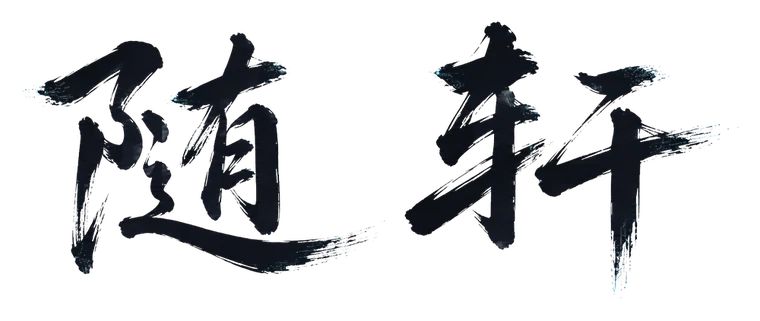
The rain in the name I came across the name Suixuan (随轩) in a dictionary of idioms in my last year of high school.
Read literally, 随 suits my temper: easygoing, going along with things. A 轩 is a corridor or small room with windows, a common name for teahouses and studies; it was also a kind of covered carriage. I did not want to shut myself in a windowless study; I liked the sense of something open and on the move.
The allusion comes from a commentary on the Book of the Later Han: when Zheng Hong toured the farms in a drought, “rain followed his carriage”. So the two characters hide the word for rain, which suits the 霖, a timely rain, in my given name. My pen name 古雴 is my own coinage too: 雴 is the heavy rain that ends a drought.
The two names sum up my temper fairly well. Half of me is 随, following: I do not plan my life or chase what is hot, and one question leads to the next. The other half is 古, the old: the more everyone hurries forward, the more I want to look back.
“Zheng Hong eased the corvée and kept his government simple. Touring the farms in spring during a drought, rain followed his carriage.”
Xie Cheng’s Book of the Later Han, quoted in Li Xian’s commentary Read these first 2005 A Complex of Rain The second post: my name was bound to carry rain. 2005 Let Me Explain Why This Place Is Called “Suixuan” The allusion, with three Tang poems that use the word. ↗ About me ↗ Essay The long guide
The starry sky beneath everything If I had to name one starting point for my thinking, it would be the starry sky.
This is not sentimentality but a stance: reverence first, analysis second. When I later read Paul Woodruff calling this forgotten virtue “reverence”, I realised I had long since made it the foundation; later still it merged with Kant’s “starry heavens above me and the moral law within me”. Love rather than hate; see what is good before finding fault. That sky has always hung over Suixuan.
“The starry sky is engraved in my heart; I could not rub it out if I tried.”
“The Moral Law Above My Head and the Starry Sky in My Heart”, 2009 Read these first 2005 Philosophy of the Starry Sky The first post on Suixuan. 2007 Reverence: A Forgotten Virtue Reading Woodruff: a name for awe. 2009 The Moral Law Above My Head and the Starry Sky in My Heart The sky meets Kant. ↗ Tag philosophy↗ Essay The long guide
Plural, not anything goes I have called myself a pluralist since my undergraduate years, but my pluralism opposes dogmatism and has no patience for relativism.
Relativists still believe, deep down, that a standard must be absolute and universal; when they cannot find one, they give up. So I say relativism and absolutism are birds of a feather. Real plurality is not “anything goes” but “keep the common ground and seek the differences”: differences are worth cherishing, and they only come into view in serious dialogue. This stance runs through nearly all my later arguments about science, religion, Chinese medicine and politics.
“They are always pursuing the absolute; when they wake up to the fact that it can never be reached, they give up the pursuit itself.”
“Relativism and Absolutism Are Birds of a Feather”, 2008 Read these first 2006 Preserving Common Ground, Seeking Difference Keep what is shared, then go looking for the differences. 2008 Relativism and Absolutism Are Birds of a Feather What relativists throw away is the pursuit itself. ↗ Topic Philosophy & Thought
From Kant to Heidegger My training in the philosophy department at Peking University began with Kant; after graduate school the weight shifted to phenomenology.
In my second year I wrote on Kant’s space and time and Hawking’s universe; later, in “Negative Ontology”, I argued that critical philosophy was meant to set limits, not to extend knowledge. Kant was my starting point, and he is still the highest opponent I have never put down.
Reading Being and Time, I became convinced that truth is first of all disclosure and clearing, not the agreement of a proposition with a fact. Reading Aristotle on touch, I began to suspect that one root of modernity’s troubles is that sight has overpowered touch and flattened the world into pictures.
In Singapore I lead a reading group at the Unfinished Bookstore: over fifty sessions and a year and a half we read Being and Time from the introduction to death and conscience. Claude later distilled the talks into a plain-language reading, now in the Books section.
Read these first 2005 Kant’s Space-Time and Hawking’s Universe A second-year paper on Kant. 2007 Negative Ontology Critique means setting limits. 2008 The Path to “Authenticity” On the intent of Being and Time. 2009 Aristotle’s Tactile World When sight overpowers touch. ↗ Books Being and Time in Plain Words↗ Series Phenomenology & Heidegger↗ Topic Philosophy & Thought
History of science as a nature reserve I call my view of science “the history of science as a nature reserve”, subtitled “a Darwinian view of science”.
What the history of science studies and tells is precisely what science has left behind. Modern history of science does not only keep obsolete science as “specimens”; it also wants a “nature reserve” for it, which keeps it from fighting the frontier head-on and shields it from being hunted to death by the frontier. Being obsolete does not mean being foolish or wrong, only out of season.
Read these first 2006 Science—Seen from a Religious Perspective Science and religion are more tangled than the textbooks say. 2016 Obsolete Wisdom Preface to my lectures: studying the obsolete, unapologetically. 2017 Watt’s Kettle: Myth and Reality History wrapped in myth. 2018 History of Science as a Nature Reserve A Darwinian view of science. ↗ Books Obsolete Wisdom↗ Books A Brief History of Scientific Culture↗ Topic History of Science & Scholarship
Whig and anti-Whig The history of science has an old quarrel: if historians cannot escape their own point of view, what is left of “anti-Whig” history?
My answer: anti-Whig history asks us to suspend conclusions, not to rise above perspective. Historians of science have their own historiography and an independent point of view; they no longer measure the past by the yardstick of today’s scientists. When Steven Shapin declared that there was no such thing as the Scientific Revolution, I defended Kuhn’s concept.
“What anti-Whig history requires is only suspending ‘conclusions’, not transcending ‘perspective’.”
“The Rationality of Whig History and the Possibility of an Anti-Whig Approach”, 2013 Read these first 2009 What, Exactly, Is the Scientific Revolution? On Shapin’s claim that there was none. 2013 The Rationality of Whig History and the Possibility of an Anti-Whig Approach Suspend conclusions, not perspective. ↗ Series History of Science & Technology
Museums: unfolding knowledge again Lately I have written two pieces on museums and science communication for China Science Daily.
“From Inscription on the Page to Spatial Exhibition” starts from Latour’s “inscription”: science compresses the world, layer by layer, into charts and formulas, and visualization can perform a “reverse inscription”, unfolding that compressed knowledge again so that it reaches the senses. “Please Touch, Please Do Not Touch” moves from a damaged specimen to the hand and the glass case in the museum.
Read these first 2026 From Inscription on the Page to Spatial Exhibition Reverse inscription. 2026 Please Touch, Please Do Not Touch Hands and glass cases in the museum. ↗ Series Museums & Science Communication
The ontology of media The idea of my doctoral thesis was simple and presumptuous: join Heidegger’s ontology to McLuhan’s media studies.
Media precede objects; all technology is media; the history of media can be practised as a transcendental philosophy. That is why the “double-edged sword” is the laziest metaphor for technology: technology is not just something people use well or badly; it first changes the people who use it.
Read these first 2010 Heidegger’s Media Ontology: A First Exploration Media precede objects. 2010 Theses on Media Ontology All technology is media. 2012 Media History as Transcendental Philosophy In Chinese only. ↗ Books The Strong Programme of Media History↗ Books An Introduction to the Philosophy of Technology↗ Tag media
Technology: “what can be learned” Later I offered a plainer definition: technology is “something that can be learned”.
The traditional definition calls technology “a means to an end”, as if the end came first and then the tool. But when my father bought a computer and handed it to me to play with, the computer in his mind was less a means to an end than simply something that could be learned. The definition frees technology from the frame of means and ends.
“Here I try to give a new definition of what technology is: ‘something that can be learned’.”
“The Definition of ‘Technology’”, 2015 Read these first 2015 The Definition of “Technology” A means to an end, or something that can be learned? ↗ Books The Extension of Man↗ Books What Is Technology↗ Tag technology
Ten years on, still on the line The two pieces I wrote that year, “Bitcoin: The Nature of Money” and “Bitcoin: The Disappearance of the State”, were less investment analysis than a live experiment in the philosophy of media, with money as the subject.
Ten years later I am still on this line: “On Fair Launch” asks where legitimacy in the crypto world comes from; “From BTC to NFT” argues that what goes on chain is power, not wealth; “The Great Blockchain of Being” tries to gather it all into a philosophy of decentralization. This year, in an AI interview, I pressed the question again: do we still need central banks in the age of AI?
“As opposed to ‘real’, Bitcoin is simply one of the least virtual currencies in history.”
“Bitcoin: The Nature of Money”, 2013 Read these first 2013 Bitcoin: The Nature of Money Money as a ledger tradition. 2013 Bitcoin: The Disappearance of the State Bookkeeping with no state behind it. 2022 From BTC to NFT: From Wealth to Power What goes on chain is power. 2024 On “Fair Launch” Where crypto’s legitimacy comes from. 2025 The Great Blockchain of Being A philosophy of decentralization. 2026 Do We Still Need Central Banks in the Age of AI? Why should a small clique still decide the global market? ↗ Series Web3 & Bitcoin↗ Topic Web3 & Cypherpunks
Huawendao: Chinese characters on chain From Bitcoin grew a more “Chinese” branch: Huawendao.
I believe the core of Chinese cultural cohesion is not a monotheism but the tradition of Chinese characters and of keeping history; the culture of the court historian is where the Chinese placed their faith. Hence the Huawendao white paper and the idea of a “triple greatness of the crypto renaissance”: put Chinese characters on chain, and let history-keeping and decentralized technology complete each other.
Read these first 2010 Reviving the Culture of the Court Historian The court historian as a religious institution. 2022 Huawendao White Paper Chinese characters on chain. 2023 The Triple Greatness of the Crypto Renaissance History-keeping meets decentralization. ↗ Series Chinese Civilization & the Way of Chinese
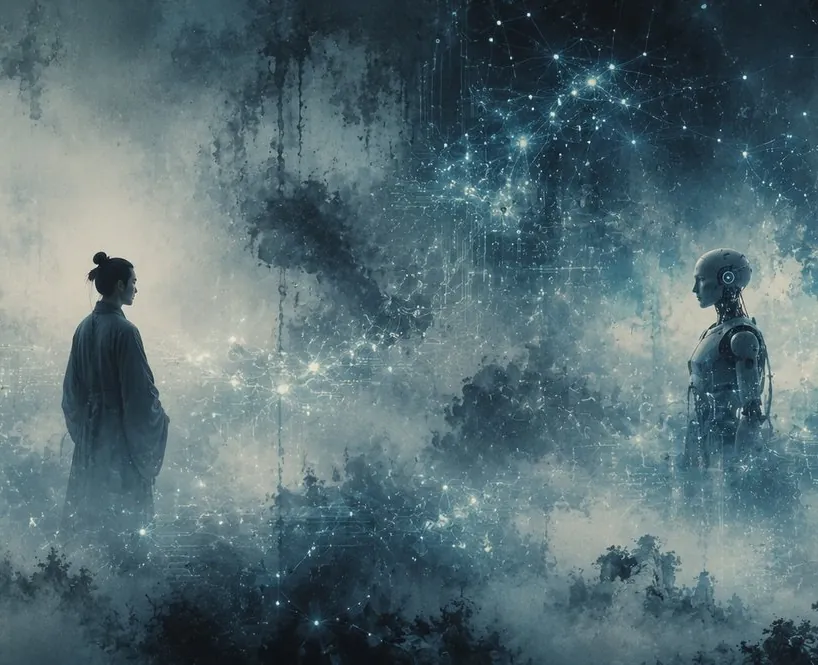
Setting a mind for AI I too used to dwell on whether AI could have a mind; looking back, that discussion stayed at a lower level.
Whether we call AI minded or mindless, it has already become a real force that needs to be understood, guided and restrained. The question worth pursuing is how to set a mind for AI, and how to temper it.
I also criticize OpenAI-style “alignmentism”: “aligning with human intentions” is a pseudo-proposition, because no one is entitled to speak in the name of humanity. This year I have also let ChatGPT ask the questions: several rounds back and forth, then it writes the discussion up. That is how I talked through reality and happiness, and why moral philosophy should question the heart rather than calculate.
“The question really worth pursuing is not only whether AI has a mind, but how to set a mind for AI, and how to temper it.”
“From ‘Whether There Is a Mind’ to ‘How to Establish the Mind’”, 2026 Read these first 2024 Accelerationism Is Not Liberatory Enough “Aligning with human intentions” is a pseudo-proposition. 2026 From “Whether There Is a Mind” to “How to Establish the Mind” Heart-mind studies in the age of AI. 2026 A Philosophical Discussion of Reality and Happiness ChatGPT asks the questions. 2026 Question the Heart, Not Calculation Moral philosophy, the self and the public. 2026 AI, Freedom, and the Formation of the Self Another round of dialogue. ↗ Series Setting a Mind for AI
A leash, not pulled teeth This year I started a column of AI interviews: a news story as the occasion, questions put to me by an AI, the conversation written up.
On agent safety, I said AI can be seen as a well-trained wolfdog that may still slip its control: leash it rather than pull its teeth; capabilities can be open, actions must be bounded. On the safety politics of frontier labs, I hope to let despotism stop at the factory gate. On the copyright suits against AI companies, I say AI should be born bearing sin, and the way to atone is not a copyright tax but opening up its own fruits of wisdom.
Read these first 2023 Unemployment or Liberation? AI’s Dual Revolution A technological revolution needs a social one. 2026 AI Should Be Born Bearing Sin Atonement by opening up. 2026 Put a Leash on AI, Not Pull Its Teeth Open capabilities, bounded actions. 2026 Let Despotism Stop at the Factory Gate The safety politics of a frontier lab. ↗ Series AI & the Free Society↗ Tag AI interviews
Everyone can be a scientist The real crisis in academia is not that AI can write papers, but that many academic institutions judge by outward labels instead: titles, institutions, journals.
That is why I said universities that forbid students to write papers with AI should be dissolved on the spot: a scholar who refuses the best assistant available is closer to academic corruption.
Recently my student Shen Cong and I started a company: an AI application that makes scientific exploration fun, using AI to visualize science and knowledge so that interdisciplinary researchers and ordinary people alike can take part in research. Seeking knowledge can turn from a dull, profit-driven job back into a pleasure.
“With the help of AI, everyone can be a scientist.”
“Reviving the Original Aspiration to Seek Knowledge”, 2026 Read these first 2026 Universities That Forbid Students to Write Papers with AI Should Be Dissolved Checking “AI-generated rates” is a joke. 2026 The Real Crisis in Academia Is Not That AI Can Write Papers It is that we only recognize titles. 2026 Reviving the Original Aspiration to Seek Knowledge In the age of AI, everyone is a scientist. ↗ Series AI & Scholarship↗ Post The Blog Has Been Refreshed: this site was redesigned with AI
Taking up freedom More important than any label are a few judgments I have held all along.
Freedom is not a privilege but a burden, worth taking up of one’s own accord: that was my parting message to Peking University. Leisure is a responsibility, and the bottom line of modern civilization is to deny the “freedom to be a slave”. Freedom of speech needs public space as its condition, and algorithmic cocoons are taking that space apart. “Discontent” is precisely the responsibility of intellectuals.
In Singapore I have not changed my tune: freedom is the root, plurality the branches. Writing on current events this year, I have put that bottom line to work again and again: DEI must start from equality for all; criticizing Meta does not mean letting the government become the product manager; machines can ban accounts, and regulators must also explain.
“University students, as intellectuals and as the conscience of society, should first of all be people who think for themselves and dare to take up freedom.”
“Choosing Peking University, Taking on Freedom”, 2008 Read these first 2008 Choosing Peking University, Taking on Freedom A parting message to Peking University. 2012 Freedom vs. Equality I am a right-wing socialist. 2019 The Responsibility of Intellectuals Discontent as a duty. 2021 “Leisure” as “Responsibility” Why must we critique capitalism? 2021 Freedom of Speech and Social Media Free speech needs a public space. 2026 Freedom Is the Root, Plurality the Branches Plurality cannot be bought with freedom. ↗ Series Enlightenment & the Spirit of Freedom↗ Topic Culture & Public Commentary
Freedom at the lectern I taught at Tsinghua for years, and my stance comes down to two things: zero tolerance for plagiarism, unlimited tolerance for free minds.
My old notice to prospective students said it plainly: I was looking for people who love freedom and can bear its weight. Writing this year on Wang Hong, math olympiads and the freedom to run schools, I made the same point: education abroad is not necessarily looser, but it is freer.
“To sum up, my attitude to plagiarism comes down to one line: a zero without appeal, and unsparing mockery.”
“On Plagiarism”, 2018 Read these first 2017 Hu Yilin’s Recruitment Notice Love freedom, and bear it. 2018 On Plagiarism A zero without appeal. 2026 On Wang Hong, Math Olympiads and the Freedom to Run Schools Not looser, but freer. ↗ Topic Teaching & Courses
People and places along the way All of the above grew out of a particular life.
The people and things along the way, my grandfather, the birth of my daughter Tianyu, walks along Singapore’s streets, are in the Life & Notes topic. I never show off my child in public, but I have started a column on the philosophy of raising children, using what I learn as a parent to talk about general questions; the first piece is on how to reason with children.
“A ‘tourist attraction’ and a ‘street’ are entirely different things.”
“The Street Is Not a Tourist Attraction”, 2025 Read these first 2006 Grandfather 2022 Tianyu My daughter is born. 2025 The Street Is Not a Tourist Attraction Walking Singapore’s streets. 2026 The Philosophy of Raising Children (I) The opposite of reasoning is force and deceit. ↗ Series Singapore & Everyday Life↗ Topic Life & Notes
The resolve of a pirate “I am the man who will become the Pirate King” is not a joke but a manifesto for scholarship.
A philosopher is like a sailor, drifting and searching on a boundless ocean, and must be a pirate, because a philosopher is always a heretic who has to break out of rules and conventions. I listen to Bach and to anime theme songs, and I play games. Scholarship and life cannot be split apart: scholarship needs panache, and life needs depth.
Read these first 2007 I Am the Man Who Will Become the Pirate King! Freedom and dreams. 2009 This Issue’s Music: “We Are!” An anime theme song. ↗ Topic Life & Notes
A few small devices Suixuan hides a few small devices.
The cup One on the home page, one at the end of this page: shake it and let chance pick a post.
Tag atlas At the foot of the Topics page: three hundred-odd tags clustered into galaxies by how often they meet. Drag, zoom, combine.
Margin notes Select any passage in a post to leave a note right there.
Plain reading On a post, the button at the top right switches to a plain layout.
Search Press / anywhere.
Subscribe Leave your email in the footer for a note when there is a new post.
中 Most posts have a Chinese original; switch at the top right. ↗ Tag atlas