
In recent years I haven’t really kept up with the new things in the crypto world, because researching them takes a lot of time and energy, and it also affects one’s state of mind quite a bit—because if you’re not careful, you start feeling like you’ve “lost a hundred million yuan.” So it’s better, really, to let what you can’t see be “quiet” to the eyes. But the NFT craze and the so-called “metaverse” are major developments that spilled beyond the crypto bubble; even if I’m no longer paying attention to the crypto world, I can’t help but pay attention to them, so here I am writing again. (A few months ago I already wrote “NFT and Tulip Mania”, arguing that the NFT craze deserves attention, though at that time I still hadn’t really dug into it myself.)
I had actually been following the Colored coin technology from a few years ago. Later on, although I no longer paid much attention to the crypto world, I still knew about the launch of ERC721. Unfortunately, I missed the first train of the NFT boom. Looking back now, on the one hand it was indeed because I didn’t think it through carefully enough; on the other hand, my line of sight was somewhat off.
The application scenarios I imagined for NFT technology were, from the very beginning, biased toward textual objects—for example, contracts, agreements, certificates, patents, and later I thought of papers and books. I had long been looking forward to NFT systems in these areas, and so I didn’t give enough weight at first to this wave of NFT enthusiasm that was dominated by “images.” It was only recently, through further learning, thinking, and opportunities to prepare lectures, that I finally understood one thing: in fact, what really matters is not the image itself, but “power.” CryptoPunks, Bored Ape Yacht Club, metaverse real estate—at bottom, all of these are “power.”
“Wealth” is often mentioned alongside “power,” as something people rush headlong toward. The two can often be converted into one another, but they are by no means entirely the same. “Wealth” is homogeneous, or at least under modern market economies and monetary systems, wealth can be measured in a homogeneous way. Zhang San’s 100 yuan and Li Si’s 100 yuan are completely equivalent and interchangeable (fungible). But “power” is not interchangeable; even where there is a comparable notion of “size,” “power” is still non-fungible. For example, the director of the traffic bureau and the director of the drug administration are both directors; in some sense one can say they are “the same size,” but the power of this director and the power of that director are not interchangeable. A bureau chief is above a division chief, but several division chiefs added together still do not equal one bureau chief. Even in places where everything has a clear price tag and power can be traded for money, each position may have a price, but as a “position” it is in fact something unique.
Bitcoin achieved the decentralization of wealth in the digital world, laying a solid foundation for the so-called “metaverse” (I will write another article on the metaverse issue later). Bitcoin broke away from any anchor points of the old world, disrupted the old world’s financial system, and established a wealth-measurement system that can run spontaneously within the metaverse.
And what NFT achieves is no longer merely putting wealth on-chain, but putting power on-chain. It can allow a non-interchangeable, graded system of power to also break away from any anchor points of the old world and run spontaneously in the new universe.
Like wealth, power is also decentralized in origin. Each person exercises their own power by virtue of their own strength. But in civilized society, power quickly becomes a centralized system of credit certification, with the center of power setting the rules and bestowing status. The centralization and creditification of power is earlier and more stubborn than the centralization and creditification of money.
This is the natural trend of power. Even in the so-called metaverse, power cannot escape the trend toward concentration. But we still have to go through a process of decentralization, or rather, “de- old-centering”: that is, to some extent at least, to get rid of the old world’s system of power certification, detach from the old anchor points, and carve out new territory in the new world.
So-called power is nothing more than something built on “identity” or “status.” For instance, I am a teacher at a certain university; that is my “identity,” and this identity contains a certain amount of power (and of course the corresponding obligations as well). To identify a person’s “identity,” we need to design a label. This label may take the form of a stamp, a badge, a business card, a certificate on paper, and so on, but these surface-level “images” as “symbols” are not the essence of identity. For these images to be ensured as “real” rather than “forged,” they must in essence conform to some kind of “record,” such as an employment record in the school personnel roster, a service record in the list of officials of a certain department, and so forth. And the validity of these records ultimately still depends on the recognition of a certain authority center.
But in essence, according to democratic principles, the legitimacy of this authority center itself ultimately comes from the recognition of the masses, so this authority center can in theory be bypassed, or pluralized. As long as a group of people recognizes a certain identity, then the owner of that identity can possess a specific status or exercise a specific power. For example, as long as everyone recognizes that the person wearing a police badge has law-enforcement power, then the person wearing the police badge can have law-enforcement power within the community that recognizes this point.
But to realize such decentralized recognition of power, there are many difficulties, one of which, neither too small nor too large, is—just like the problem Bitcoin faces—the problem of anti-counterfeiting. If anyone can wear a police badge, then in the digital world a trillion badge-wearers could pop up at any moment. Power symbols need to be backed by “records” that cannot be arbitrarily tampered with. If these records are not stored in a central institution, then who should hold them?
What blockchain technology solves is precisely this problem. Just as Bitcoin solved the problem of the uncontrolled issuance of monetary symbols, NFT solves the problem of the uncontrolled issuance of power symbols. As for how people might come to recognize certain symbols as specific markers of power, that is not a problem blockchain technology can solve—just as getting people to recognize Bitcoin as valuable is also a question of community. What blockchain technology can solve is this: once people recognize the symbol Bitcoin as valuable, blockchain can ensure that this symbol is not overissued or counterfeited; likewise, once people recognize that the various symbols of NFT can correspond to specific power, blockchain can ensure that these symbols are not overissued or counterfeited.
Once I understood this, I very quickly came to see why the hottest NFT projects were by no means the contracts, certificates, and such that I had imagined, because I was still imagining the function of NFT with the old world as the anchor point of power, without realizing that such an anchor point simply isn’t needed at all—or rather, it is not the key point of the revolution.
Why can CryptoPunks sell for so much money? Before mocking the bubble, we must first understand: what exactly are people buying? Even madness has to have some reason beyond speculation. Even hype has to have a reason why it can get going. What people are buying is of course not that pixel image of a bit over 200 bytes that anyone can download; what they are buying is an “identity.” This identity is still relatively empty at present—it has not yet been filled with a certain kind of power. But as long as people continue to respect “history” (as I mentioned in an earlier article, “Give value to history, and truth or falsehood to mathematics”), these 10,000 historically milestone-making “identities” will always be respected by later generations, and then they will spontaneously attract certain privileges—even if it is only the “right to show off,” that too is almost eternal.
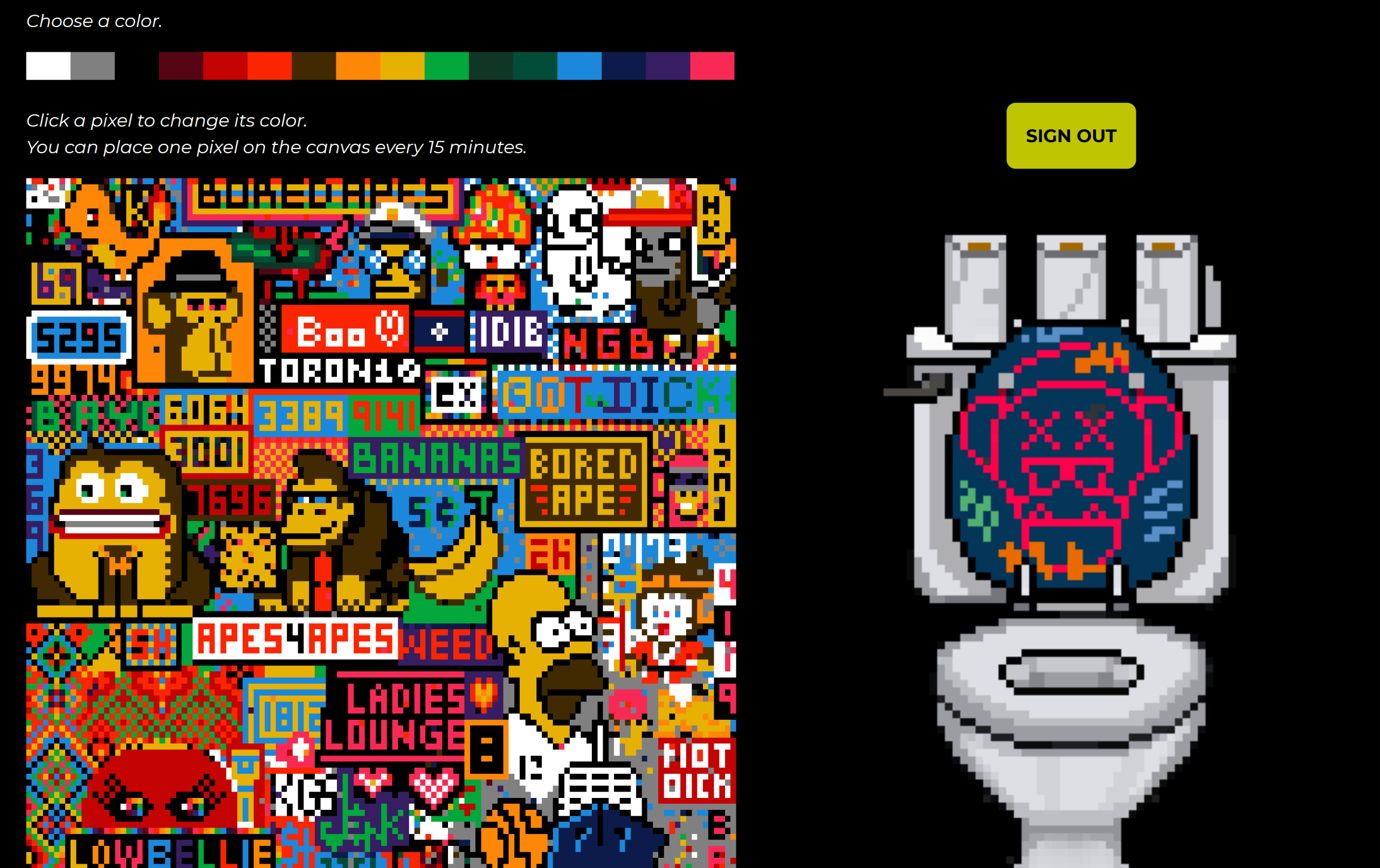
And the reason the Bored Ape Yacht Club was able to catch up later on is not because it is beautifully drawn, but because it straightforwardly displayed “power” up front—buying one ape means joining this “privilege club” of 10,000 members, and possessing the identity that can exercise specific powers. Although the initial privilege is merely the right to slowly doodle on a graffiti board at the rate of one pixel every 15 minutes. How insignificant this power is! But perhaps the power held by the ancestors of the first human beings to gain privilege was nothing more than doodling on cave walls? This insignificant power constitutes a starting point.
Even the reason game NFTs like axie and thesandbox became so wildly popular is that the corresponding NFTs grant players “admission rights.”
It is like the navigators of the Age of Discovery who opened up new continents: in the first round they brought back wealth, and then they began to rebuild power and order in the new continents. Those who earned their first pot of gold from the new continents understand better than the old money that has always enjoyed a comfortable life on the old continents the value of staking out territory in the new ones.
Translated from the Chinese original with AI assistance. The original text is authoritative.