
Introductory note
Recently, the operator of the wastewater treatment plant in Gongping Town, Haifeng County, Guangdong, took the Gongping Town government and the Haifeng County Finance Bureau to court, demanding payment of more than 70 million yuan in wastewater treatment fees and late charges accrued through the end of 2025. Caixin reported that this wastewater plant has been in continuous operation for nearly seven years and has treated a cumulative total of more than 38 million tons of wastewater, yet the operator has never received the service fees paid by the local government; because it had long been advancing the costs on its own, the company once applied to suspend operations, only to be refused by the environmental authorities.
This is by no means an isolated case. At the beginning of June, the central ecological and environmental inspection team reported on rural living-environment problems in Siping, Jilin: in 2024, Shuangliao City completed six rural wastewater treatment stations, but failed to build, as required, the accompanying 57.5 kilometers of wastewater collection pipe network, leaving the treatment stations idle; among them, a wastewater station in Bolishan Town with a daily treatment capacity of 400 tons has lacked a 5.5-kilometer branch line, so domestic sewage from the surrounding area has long been discharged directly. Earlier, a “smart city” project in a county in Guizhou that had invested more than 80 million yuan actually developed seven subprojects, of which six were shut down or left idle; and Zhuhai’s Tram Line 1, after three years out of service, was finally decided to be dismantled. During its operation, its average annual cost exceeded 91 million yuan, while fare revenue averaged just over 1 million yuan a year, making the transport cost about 67 yuan per passenger.
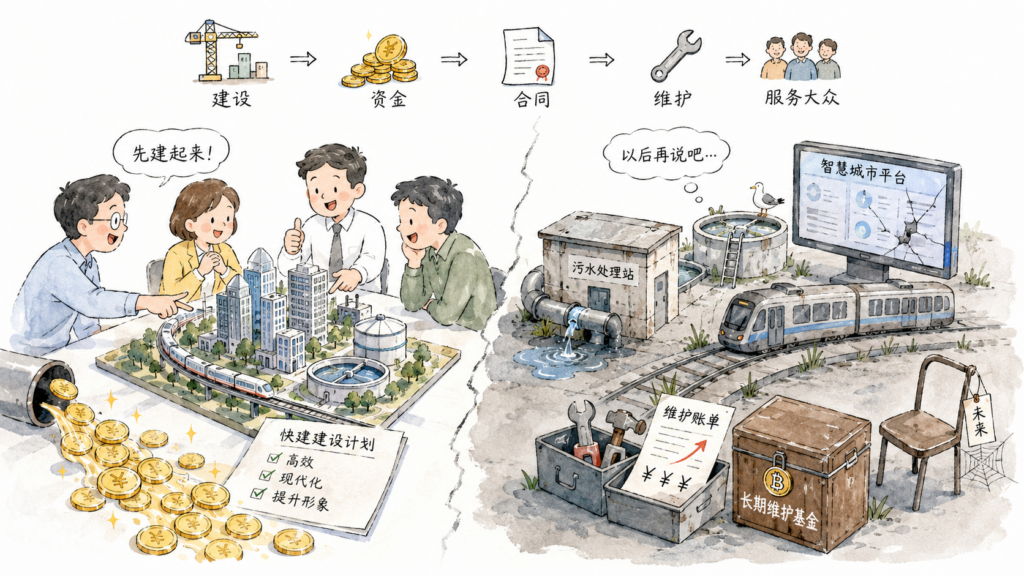
Wastewater plants, rural wastewater stations, smart cities, and trams may seem to belong to the separate fields of environmental protection, digital governance, and transportation, yet they all expose the same dilemma of public governance: when a project is completed, it counts as a political achievement, an investment, and a vision of modernization; once it enters the operational phase, however, it turns into a long-term fiscal responsibility for payment, maintenance, depreciation, renewal, and exit.
Around this phenomenon, Hu Yilin, in an interview with this column, offered a deeper explanation: the so-called “can build it, can’t maintain it” is not just the short-sightedness of local governments, nor is it merely inadequate project appraisal; rather, it is that the modern financial system has long shaped a temporal preference that “values the present and overdraws the future.”
The arrears behind the wastewater plant: the rupture in the life cycle of public services
The Gongping Town wastewater plant case is typical because it pushes the contradiction in public services to a rather acute point: the plant cannot easily be shut down, because suspension would bring environmental and livelihood risks; yet the service fees can be withheld for a long time, with the result that the operating company becomes a shadow financier for the local fiscal authority.
In Hu Yilin’s view, what such projects truly need to assess is not whether a plant building or piece of equipment has been completed, but whether there are reliable funds and responsibility arrangements for the ability to provide services continuously over the next few decades. In other words, public services cannot be understood merely as engineering projects; they must be examined within the framework of long-term operational responsibility.
The idleness of the Siping rural wastewater stations shows another isomorphic problem: the facilities were built, but the pipe network was not matched to them, and the service system never came into being. Wastewater treatment is not a task that can be completed simply by “having a treatment station”; it must simultaneously rely on the pipe network, household connections, sludge disposal, operation and maintenance, and monitoring mechanisms. Building only the treatment station and not the pipe network may superficially complete the construction task, but in reality no service capacity has been formed.
Similar problems also appear in digital governance and transportation projects. A smart city project can build big screens, platforms, and mini-programs, but if the data are not updated, departments do not coordinate, and grassroots cadres do not use them, the system quickly becomes a digital ruin. Trams are the same: during construction they symbolize modernization, but once they are in operation, it becomes clear that passenger flow, maintenance, safety, and fiscal subsidies are all mismatched.
These cases jointly suggest: the difficulty of public services often does not lie at the moment of “completion,” but in the long, inconspicuous daily maintenance that follows.
How “short-sightedness on the part of builders” is reinforced by the financial system
Hu Yilin does not simply attribute “can build it, can’t maintain it” to a lack of foresight on the part of individual local governments or builders. He argues that, in a certain sense, it has been influenced by the bias of the financial system.
“From monetary policy to financing methods, the builder’s ‘short-sightedness’ has been reinforced,” Hu Yilin said.
According to his analysis, the faster and larger an engineering project is, the easier it is to obtain investment, loans, and policy resources. The construction phase can generate investment totals, GDP, project progress, engineering acceptance, and a picture of political achievement; but the operational phase confronts labor, electricity, chemicals, maintenance, depreciation, renewal, and complaints. The modern fiscal and financial system prefers capital expenditure and does not favor long-term operating expenditure.
He further pointed out: “The faster and bigger the project is built, the more investment I can get. Then, once the project is finished—even before it is finished—I can, through pre-sale, quickly cash out and hand it over to the users or operators, and deal with the follow-up problems later.”
This judgment places public works and real-estate pre-sales within the same structure: the gains of the construction phase are made immediate, while the costs of the operational phase are pushed into the future. The builder takes today’s cash flow, while the users, operators, or future fiscal authorities inherit the subsequent responsibilities.
From presold housing to supertall towers: real estate is also the same problem
In Hu Yilin’s view, China’s real-estate pre-sale system is a typical manifestation of this temporal preference in the private sphere. Developers raise funds rapidly through pre-sales, turning the housing needs of the next few decades into today’s sales revenue. Once the homes are delivered, those who are truly faced with elevator maintenance, facade aging, fire-safety upgrades, property governance, and insufficient maintenance funds are the owners.
“Real-estate developers need capital to circulate quickly, and they don’t consider the long term,” Hu Yilin said.
He especially mentioned supertall buildings. From a long-term use perspective, supertall structures are not necessarily economical. Elevators, fire protection, electromechanical systems, facade maintenance, refuge floors, underground space, and property management all bring higher complexity, and long-term upkeep costs and depreciation pressure are greater as well. But within the logic of development finance, supertall buildings can more quickly and more fully capitalize land value.
Hu Yilin does not think that consumers or users are completely blind to future maintenance costs. His judgment is that even if people are somewhat aware of them, the financial system still systematically encourages them to underestimate the future: when narratives of asset appreciation, credit expansion, and rapid cash recovery become the dominant logic, long-term maintenance costs are compressed into a remote and vague issue.
In his words: “Do consumers or users really fail to think about future maintenance costs? Not necessarily—they may have thought about them—but the entire financial system encourages people to value the present and overdraw the future.”
The temporal ethics of Keynesianism: future money is cheaper
Hu Yilin traces this tendency back to the modern monetary view influenced by Keynesianism. He does not deny that this line of thinking was effective in certain historical phases. In the early and peak stages of industrialization, global markets expanded at an accelerating pace, populations grew rapidly, and technological progress and resource development kept advancing; in such an environment, overdrawing the future today could often be absorbed by a larger market, a stronger tax base, and more people tomorrow.
“This model really was able to seize the lead in the early and peak stages of industrialization, under conditions of rapid global market expansion and rapid population growth,” Hu Yilin said.
But he believes the basic premises have changed today. Once industrialization enters a mature stage, the marginal utility of market expansion diminishes, resource and environmental problems become increasingly prominent, and population growth slows or even turns to decline. Costs that could once be concealed by future growth are now increasingly difficult to absorb.
He especially emphasizes that population decline changes the moral and economic meaning of “leaving problems to the future.” The future no longer means more consumers, more taxpayers, and more people to take over the burden; on the contrary, it may mean fewer people shouldering more old debts.
Hu Yilin summed it up this way: “Under this new situation, Keynesian values have become outdated.”
Here, “outdated” does not mean a simple denial of Keynesianism’s significance as a tool for crisis response, but rather that the temporal ethics behind it no longer fit the new historical conditions. When future money is always assumed to be cheaper than today’s money, governments, businesses, and consumers are all encouraged to discount the future into the present and to postpone dealing with maintenance, depreciation, debt, and environmental costs.
Bitcoin cannot replace institutions, but it can make long-term commitments harder and firmer
Speaking of Bitcoin, Hu Yilin especially stresses that it cannot automatically provide a public-service system. Wastewater plants, roads, schools, hospitals, pipe networks, and elevators still require budgets, organization, regulation, assignment of responsibility, and exit mechanisms.
But he argues that Bitcoin may be more conducive to the implementation of certain institutions.
For example, if a public project, at the time of approval, is required to lock in 20 years of operating funds, a real problem arises under a fiat-currency system: inflation over 20 years may greatly erode the purchasing power of those locked funds. A sum of money has been locked in nominal terms, but by the future it may be insufficient to pay for actual labor, materials, energy, and maintenance costs. If more funds are locked in to resist inflation, the project will appear far too expensive in the present.
Hu Yilin pointed out: “If it is fiat currency, inflation 20 years later may greatly dilute the purchasing power of this locked fund, which makes the method of locking funds both disadvantageous and unable to solve the problem. But if the currency itself does not depreciate, or even appreciates, then the method of locking funds becomes more effective.”
In this sense, Bitcoin is not the public-service system itself, but it may change the monetary environment in which institutions operate. If a currency is not easily diluted by expansion, and even carries expectations of appreciation over the long term, then long-term lock-in arrangements such as operating reserves for public projects, building maintenance funds, and infrastructure renewal funds are more likely to preserve real purchasing power.
Hu Yilin’s view can be summarized as follows: Bitcoin’s significance is not only monetary innovation, but also a new philosophy of time. Through supply constraints and anti-depreciation mechanisms, it forces people to重新value future costs, rather than simply assuming that future money will become cheaper and future people will pay for today.
The real problem is this: the future has no representation
Looking back at these cases, the evaluation of public projects should not ask only “Was it built?” It should also answer a set of longer-term questions at the very outset of the project: who will use it, who will pay, who will maintain it, who will renew it, and how will it exit when it is no longer needed.
Some localities have already begun to confront this issue. For example, Tongchuan’s Yaozhou District in Shaanxi has recently explored the standardized exit of rural domestic wastewater treatment facilities, classifying idle facilities according to causes such as population outflow, toilet renovation substitution, and pipe-network coverage, and establishing mechanisms such as preliminary review by towns and subdistricts, public participation, joint departmental review, and third-party assessment. The significance of such practices lies in recognizing that public assets also have a life cycle: maintain what should be maintained, connect what should be connected to the network, and exit what should exit.
As this reporter observes, the fundamental contradiction in “can build it, can’t maintain it” is that the future is absent from today’s decisions. Builders, financiers, approvers, developers, and local governments can all speak at today’s meeting table; but future owners, taxpayers, maintainers, and the next generation of residents cannot attend today’s project-approval meeting.
Hu Yilin’s critique thus points toward a larger institutional ethics: the growth-driven finance of the 20th century packaged overdrawing the future as development; but in the 21st century, population contraction, resource constraints, and environmental pressure are forcing modern society to rethink the relationship among money, construction, and responsibility.
Conclusion
From the unpaid bills at the Fair Town sewage plant to the idle Siping sewage station; from the shutdown of the smart-city platform to the dismantling of the light rail, “can build it, can’t afford to maintain it” is no longer merely a grassroots fiscal issue, but a public question about time, money, and responsibility.
Hu Yilin’s judgment is that if the monetary system continues to reward present-day expansion and dilute future commitments, then public services will keep turning into “today’s projects” and “tomorrow’s liabilities.” And the real lesson Bitcoin offers is not that all public projects should switch to cryptocurrency, but that it reminds modern society: future money should not be casually diluted, and future costs should not be arbitrarily passed on.
Translated from the Chinese original with AI assistance. The original text is authoritative.