
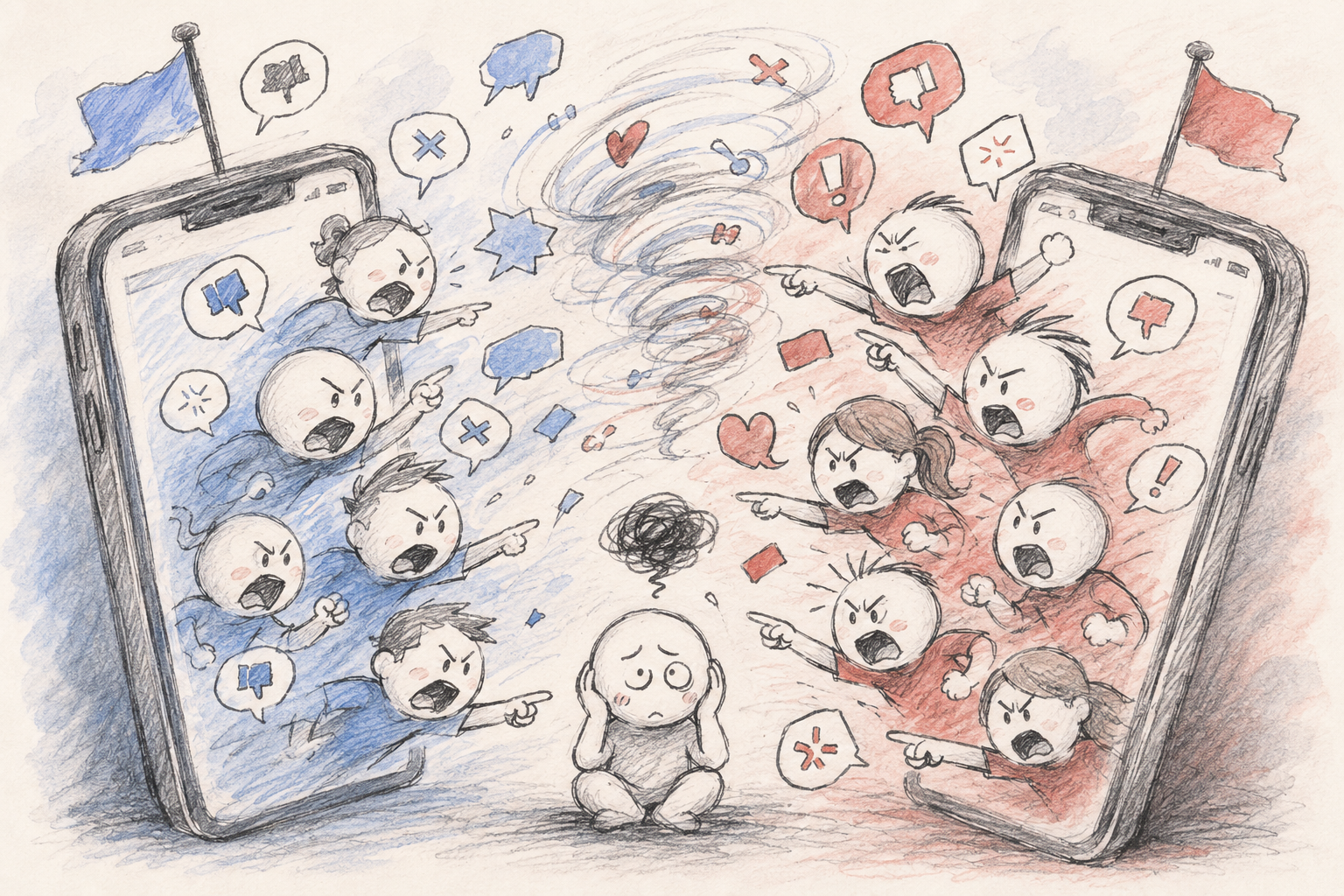
Published in Science Times (2026-05-15, p. 4, Culture); here is the original draft. You may be scrolling on your phone at this very moment, have seen this astonishing title, and clicked in to have a look. If you saw this article in the printed newspaper, that is quite rare, but even then you must have first noticed these eye-catching headlines.
In this age of mass media, this age of information explosion, this age of the attention economy, the foremost question for information providers is not whether the content can withstand scrutiny from every angle, or whether it can withstand the test of time, or whether the author has deep accumulations, or whether the viewpoint is unique or distinctive… What they first consider is how to grab your attention and entice you to click in and read; second, how to attract traffic, to keep people reading related articles, or to draw in more people to read as well.
If an article is profound and solid, and written with steady balance so that no fault can be picked in it, then it will probably earn very little traffic. First of all, its professional depth will already have scared away ninety percent of readers. Even if a few readers patiently grind through the article to the end, that will probably be the end of it. These rational, research-oriented readers will not call up their friends and relatives, nor will they stir up controversy, and so they will not attract even more traffic.
So in the context of the attention economy, substantive accumulation and a calm, well-grounded standpoint become, paradoxically, negative attributes. The attention economy prefers to arouse your emotional response and to incite all kinds of opposition and controversy, to get you “worked up”; ideally, it will drag you into a shouting match and “explode public opinion,” and then the traffic will keep flowing in an endless stream.
So we are increasingly accustomed to slicing complex matters into two sides and creating a tense atmosphere of opposition: East and West, left and right, men and women, rich and poor, tradition and modernity, elites and the masses. Across all dimensions, issues that are extreme, emotional, and antagonistic are always more popular.
Of course, these oppositions and divisions are not newly emerged things; they have always existed in this world. But precisely because of that, they usually have complex lines of development and multiple facets, and it is hard to give a simple either-or answer. Yet under the attention economy, public opinion often tends to “pick a side” quickly and then fight to the bitter end. Media, too, often no longer tries to mediate and soften differences; instead, it would gladly fan the flames and add fuel to the fire, detonating the conflict in order to enjoy the benefits of traffic.
In this sense, the theme of International Museum Day in 2026, “Museums Uniting a Divided World,” is not merely a pretty slogan, but a declaration of some sort of historical mission. The Chinese version of the theme was changed to “Museums: Bridges Connecting the World,” which weakens the crisis feeling of the English version and fails to express the grave situation that “the world is already divided.”
But “bridge” has a fine resonance: a bridge does not aim to “eliminate division”; a bridge does not abolish the two banks. A bridge is a bridge precisely because there is distance between the two shores, because there is a river, because there is a barrier that is hard to cross. If a museum is to become a bridge, it is not to erase differences and pretend that the whole world is one big happy family. On the contrary, a bridge instead “presents” division and opposition, giving those who live on the east bank a chance to go deep into the west bank and more clearly experience difference and disagreement,
The mission of the museum is not to conceal differences either, but to place difference within longer stretches of time, more specific contexts, and more complex narratives, so that people can see clearly and roam freely across diverse domains.
Of course, museums also like to exhibit “eye-catching” objects, but unlike the attention economy, these objects all have “roots”; they condense the weight of history and are not fabricated in bulk out of thin air.
These artifacts themselves have complex experiences and stories. With their own substantiality, they resist the trend toward labeling. A single collection item may embody both the diligence and wisdom of working people and the cruelty and extravagance of rulers, but it does not stand on either side itself. We can attach all kinds of narratives to it, but we can never exhaust its meaning; it stands quietly there, forever open to the next interpreter.
The history of the museum itself, like that of all collections, is also far-reaching and complex. Museums once were places where the powerful and the aristocratic displayed their status; they also once signified the plunder and exaction of colonialism. But they also promoted the popularization of knowledge and equality in education, and brought out the charm of all kinds of niche cultures. It is neither an absolute good nor a pure evil.
Through exhibition design and interpretation, we can make the objects in museums “take sides”: this one represents female strength, that one represents elite culture… But fundamentally, what keeps an object in a museum is not its position or camp, but the fact that it has withstood the test of time and carries the history of civilization—including the various narratives imposed on it by different eras and different groups. It does not stand above controversy; rather, it has sedimented conflict and opposition as part of its historical depth.
I do not want to list some specific examples, because if I do so here, I can only first turn them into simple signs and discuss them using fixed terms. The key point is that space is limited, so our discussion will still easily label them and subsume them under some narrow standpoint. In the real space of the museum, however, we more spontaneously respect the substantiality of these objects; even with only a brief glance, we can more easily grasp the complex meanings they contain.
It is like two people who curse each other to death and back in cyberspace, but if they meet in a real library, they are more likely to become polite and civil. That is because the real world is not as flimsy and rootless as the swiftly refreshing stream of online information; materiality itself exerts a pressure, forcing you not to pass through it or swipe past it too easily.
Of course, not every domain can bring out the complexity and multiplicity of the real. Museums in the colonial era may have adopted some kind of Western-centric linear narrative, in which heterogeneous cultural creations were arranged as trophies, outdated objects were regarded as merely stepping-stones to modernity, and all difference existed only to set off the superiority of a single modern Western culture. Such an exhibition space is likewise a suppression of materiality.
Over the past few decades, the concept of the contemporary museum has undergone a series of transformations. Today we usually think that the task of the museum is not to display dogmas on behalf of some authoritative ideology, nor to indoctrinate the public with some fixed, black-and-white knowledge, but to open up a space that is open and inclusive, inviting the public to actively participate, to appreciate or examine all kinds of differences and their historical roots.
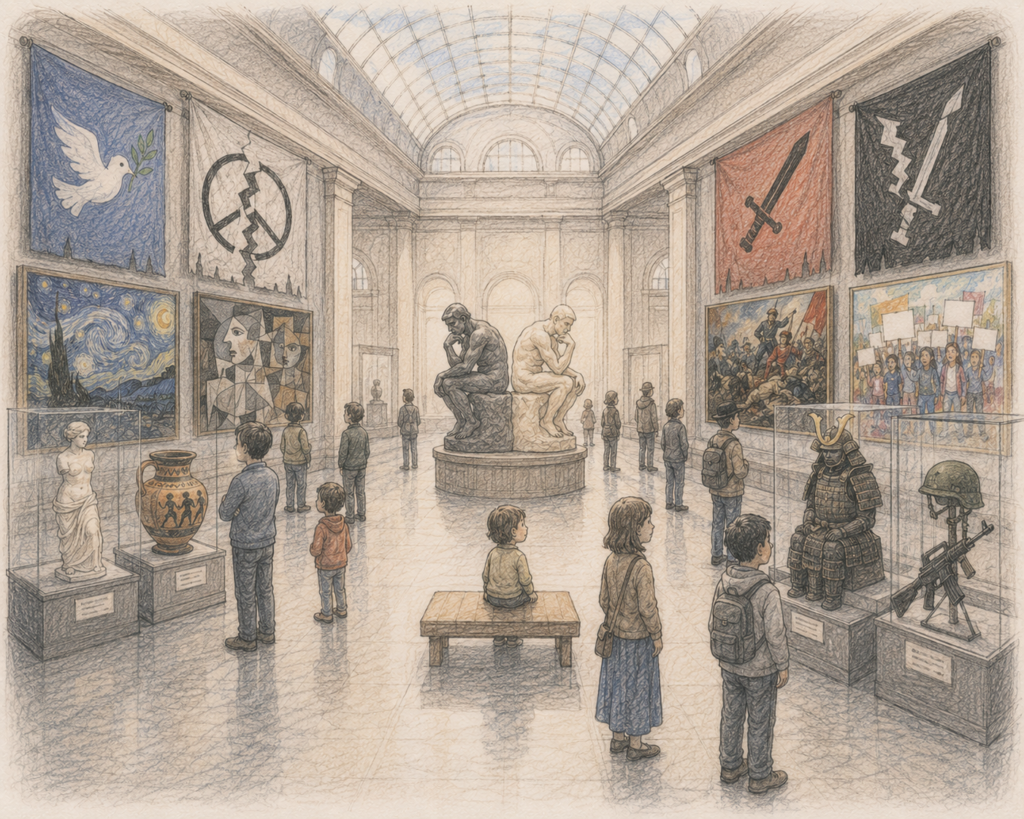
In museums, we do not avoid difference; on the contrary, we gaze at difference. We can understand that the various differences and disputes among human beings do not arise out of nowhere, as if they could be summoned at will or waved away at will—many present-day oppositions are like this, with people taking their own positions for granted while denouncing opposing views as stupid and absurd, wishing they could expel their opponents from the human race. The facts are not so. Most differences and disputes have heavy historical origins and complex cultural backgrounds. When we become aware of the complexity of the problem, we do not necessarily need to give up our own position lightly; however, we may gain greater understanding and tolerance toward hostile positions—we realize that their attitudes are not mad or wild, but also have historical and cultural roots. If I still want to refute him, I can trace things back to their source and make a criticism in a more rational and profound way; if I can accommodate him, then we can also understand each other, recognizing that the disagreement may come from the historical or cultural foundations each side holds fast to.
The division of the world is not only because people disagree. A society having different opinions is in fact healthy, and even more the source of innovation. What is more dangerous is that people have lost the space in which they can understand the world together. Everyone, each within their own screen, is swept along by different emotions, algorithms, and narratives, and it is becoming harder and harder to acknowledge that the other side also lives in the same world. Of course, museums cannot directly repair this fragmented world. They cannot enact fair and just laws, cannot eliminate the gap between rich and poor, and cannot make all historical wounds reconcile automatically. But museums can at least do one thing that is becoming increasingly scarce today: they bring people back to “actuality,” and thereby respect evidence, history, and complexity.
Translated from the Chinese original with AI assistance. The original text is authoritative.