
This article was published in China Science Daily (2026-04-23, p. 3, General), with the title changed to AI Can Now Read “All the Books in the World”; Do Humans Still Need to Read Books?. It was edited down and divided into sections at publication; the original draft is posted here:
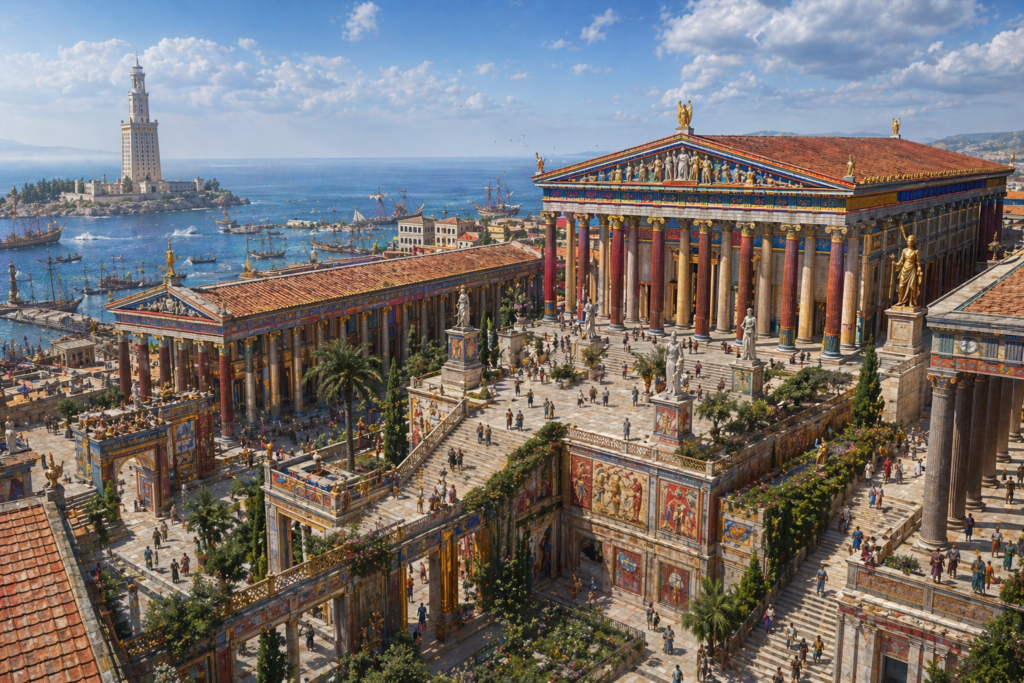
Around 295 BCE, Ptolemy I commissioned the Greek scholar Demetrius to build a magnificent library and Mouseion (an academic institution) in the city of Alexandria. Demetrius proposed the grand vision of “collecting all the books in the world,” and it received the continuing support of the Ptolemaic royal house. The first three Ptolemies carried the project forward one after another, continually expanding it, and it lasted for 150 years, until it was finally brought to an end only under Ptolemy VIII. To gather books, they used every means at their disposal: on the one hand, they spent huge sums to send special agents to “scour the world for books”; on the other hand, they compelled every ship docking in the harbor to hand over all the books it carried, had scribes copy them, returned the copies, and kept the originals in the collection.
These books gave rise to the great synthesis of Greek science, and, through contact and fusion with knowledge from Egypt and Babylon, enabled countless brilliant achievements of ancient science. These included the first generation of scholars recruited and supported by Ptolemy I, represented by Euclid; visiting scholars represented by Archimedes; outstanding scholars such as Aristarchus, who proposed heliocentrism, Eratosthenes, the father of geography, and Apollonius, known for his work on conic sections; and continuing into the Roman era, scholars still influenced by that academic tradition, such as Hero, the mechanician and inventor of the steam engine, and the astronomer Ptolemy (active in the second century CE), all the way to Hypatia, the female scientist who marked the end of Greek scholarship. They all benefited from the Library of Alexandria. Alas, as with the golden age of any ancient civilization, endless books were eventually lost amid war, regime change, and religious conflict. Only a few top-tier achievements survived to pass down to later generations. Yet the very height of the syntheses also accelerated the loss of many books—because copying books was inconvenient, and once there were more complete and more systematic versions, older books were more easily lost. For example, Euclid’s work led to the loss of a large number of earlier Greek geometrical writings, and Ptolemy’s astronomical system caused many earlier works in astronomy to disappear.
This is a chronic ailment of ancient scholarship: in some miraculous golden age, scholars vied with one another in a hundred schools of thought, and all kinds of ideas and knowledge sprang up in abundance; then, at the end of that golden age, they were gathered together and systematized, creating magnificent masterpieces that marked the summit of human intellect. After that, the lively, diverse, but not quite adequate or too eccentric doctrines gradually fell out of circulation, while those once-great masterpieces slowly hardened into rigid dogma, losing the vitality of evolution and renewal. All that could be done was to wait for the next miraculous age to revive them.
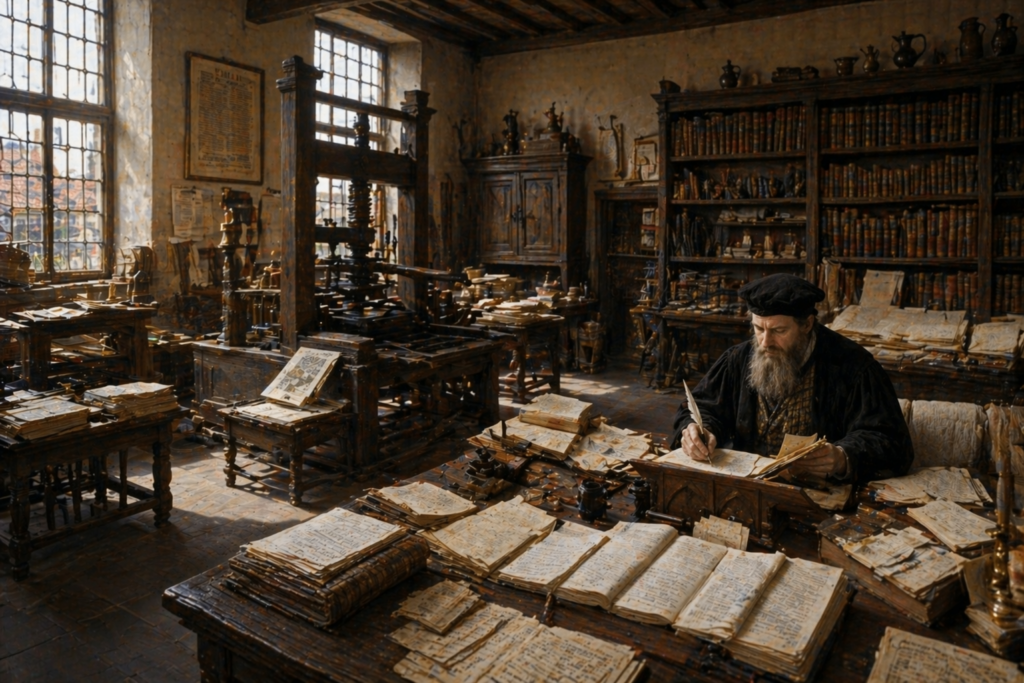
Ancient Western scholarship, which reached its peak under Ptolemy III, underwent wave after wave of decline and revival—in the hands of the Romans, the Arabs, and Europe in the twelfth century, there were longer or shorter revivals. What modern people call the “Renaissance” was not the first scholarly revival; rather, it was the last one, after which scholarship never again declined. That is because this revival was no longer due to the accidental support of some king or some kingdom, but to a new social environment (the rise of civil society and the emergence of capitalism) and new media equipment (the movable-type printing press).
By the sixteenth century, the Swiss scholar Conrad Gessner devoted himself to compiling the first comprehensive Bibliotheca Universalis, attempting to list every Latin, Greek, and Hebrew work published within a hundred years of Gutenberg’s printing press. He included about 10,000 entries by some 1,800 authors and compiled more than 30,000 indexes by discipline and theme, and he kept adding to them. Of course, many publishers of the same era were also striving to collect all handwritten books, collate and edit them, and then print them in bound volumes. The entire Renaissance, and the Scientific Revolution that followed, benefited from the gathering of knowledge made possible by printing.
Bibliotheca Universalis summed up the knowledge humanity had accumulated before the age of print, and as the number of books published after the age of print exploded exponentially, posterity could no longer compile a bibliotheca universalis that indexed every book. After the great synthesis of ancient knowledge, the Renaissance ushered in yet another round of a hundred schools contending for supremacy.
The transnational scholarly network made up of printed books and postal routes replaced the academic holy sites that had originally been limited to one place and one time, and precious texts no longer depended on fixed sites such as the Temple of Serapis for preservation. Books no longer had to fear being lost or corrupted because copying them was difficult; even heterodox doctrines could circulate in the world.
After that, human scholarship never again suffered loss or decline, yet to some extent it still retained the stage-like pattern of “long divided, it must unite; long united, it must divide.” The profusion of the early modern period was synthesized once by Newton; after Newton’s death, Europe entered the Age of Enlightenment, and the Encyclopedists became the representatives of that age. They continued to integrate existing works, gathering and organizing all the knowledge humanity had accumulated since the age of print.
After the Enlightenment, scholarship entered the age of specialization. Together with the gradual maturation of the modern education system, science became a “branching discipline,” with scholars exploring ever more narrowly defined specialties, at most gathering and organizing knowledge within a single discipline, and never again managing to unify all human knowledge.
Is that really so? Has the grand ambition of “collecting all books” become obsolete? In the age of handwritten books, Ptolemy’s kings brought it to the extreme; in the age of printed books, Gessner was unparalleled before and after. So what about after yet another media revolution? In the information age, this ambition has taken on a new form.
E-books no longer require magnificent bookshelves; today, an ordinary smartphone can store five Alexandrian libraries. Even a contemporary library is at most just a few hard drives. This has made “collecting all the books in the world” possible once again.
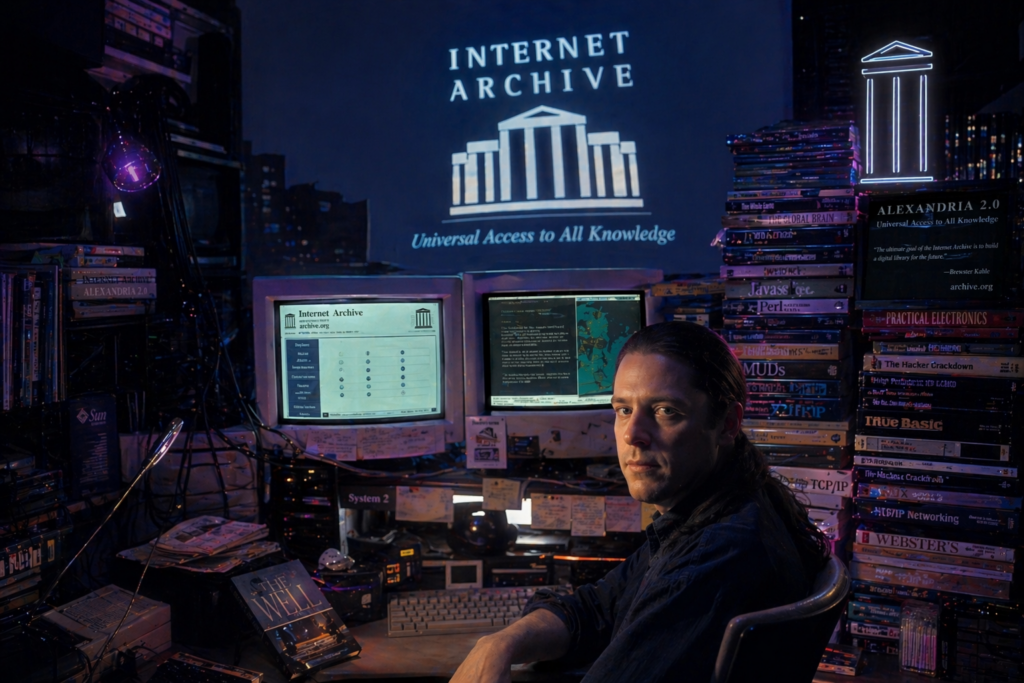
Brewster Kahle, who founded the Internet Archive in 1996, directly paid homage to the Library of Alexandria, even calling what he was doing “the library of Alexandria version 2” (the library of Alexandria version 2). He carried forward and transformed the ambition of the Ptolemaic kings, with the slogan “Universal Access to All Knowledge,” because the Library of Alexandria had geographical limits and access barriers, allowing only a very small number of scholars to obtain knowledge from it, whereas the Internet Archive aims not only to collect all knowledge, but also to make it open and accessible to everyone.
A few years later, Google Books launched a project to “collect all the books in the world,” and in 2010 estimated that the total number of published books in all languages amounted to about 130 million, declaring that it would scan them all into digital form.
But their ambitions both ran into setbacks, especially the long copyright lawsuits. The Internet Archive lost its case and was forced to delete hundreds of thousands of copyrighted books, but it still continued its collecting mission. Google, though it won the lawsuit, gradually cooled toward the project, scaled it back, and only provided search functionality for book snippets rather than reading access.
In order to break through copyright restrictions, some people turned to pirate platforms; Sci-Hub and Z-Library are examples. After Z-Library was shut down, Anna’s Archive became the great synthesis of pirate platforms: it collected tens of millions of books and hundreds of millions of papers from Library Genesis, Sci-Hub, Z-Library, and the Internet Archive, making them freely downloadable for everyone. It also launched the ambition to “collect all the books in the world,” planning to gather 700 million books.
Whether it is the cooperative model of the Internet Archive or the pirate model of Anna’s Archive, humanity has indeed built a new Library of Alexandria in the digital world, and with some initial success. The next question is: how are these books to be read? The internet has helped people gather vast quantities of books, but on the other hand, it is also the internet that is reducing humanity’s reading ability. In particular, young people who grew up in the internet age spend far more time on short videos than on reading; even when they do read text, they increasingly prefer short pieces of news rather than whole books. And scholars, for their part, are reading more and more papers rather than books.
The Library of Alexandria’s collection of books, together with the scholars attracted by the Mouseion, fostered a flourishing of knowledge; the post-Renaissance printed book market benefited emerging artists, scientists, and inventors. But what sort of readers can Alexandria 2.0 on the internet attract?
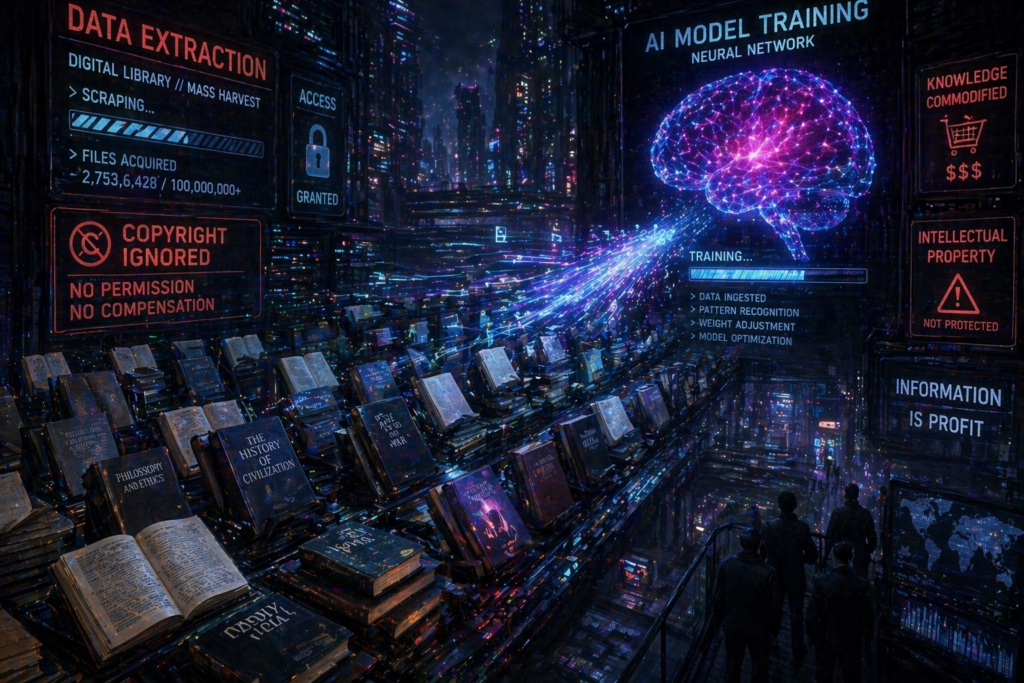
In February 2025, internal emails in Meta’s litigation were unsealed, revealing that Zuckerberg had authorized his company to download more than 81 TB of data through Anna’s Archive for training AI models. In the end, the court sided with Meta, holding that AI training constituted fair use and that there was no evidence it would harm the interests of copyright holders.
Meta is merely the most conspicuous example; in fact, other AI companies are probably no exception. In December 2025, a group of authors filed a copyright lawsuit against the six major AI giants, accusing Anthropic, Google, OpenAI, Meta, xAI, and Perplexity of using pirated books to train large language models. The mainstream Western large models are all on the list.
This can be called AI’s “original sin” — the raw data used to train large models is often taken from the essence of human civilization either without permission or through coercive appropriation, much as Ptolemy’s kings seized books by every crafty means.
As the saying goes, “Those who steal a hook are executed; those who steal a state become nobles.” Kong Yiji stole books and was mocked by others, but when King Ptolemy stole books it became a tale of renown. After all, they did indeed create a golden age of human knowledge and leave behind a more far-reaching treasure for human civilization. Human beings have long since become unable to survey every book in the world, but AI can really do it. Digitized books can not only be gathered into one place, but also be surveyed and summarized. We find that in many respects AI is already performing better than the most elite human scholars, especially in its ability to marshal a vast range of sources and to handle enormous amounts of literature, as well as its ability to carry out cross-disciplinary and interdisciplinary synthesis. However, on the one hand AI allows the countless books sedimented by human civilization to play their part; on the other hand, it seems to be further weakening human beings’ need to read, so much so that even traditional schooling has become irrelevant. Just as once we have calculators, mental arithmetic becomes useless; once we have map apps, the ability to find our way becomes useless; and once we have AI that can give exquisite answers to any question at any time, the usefulness of the human brain as a whole will also be greatly discounted.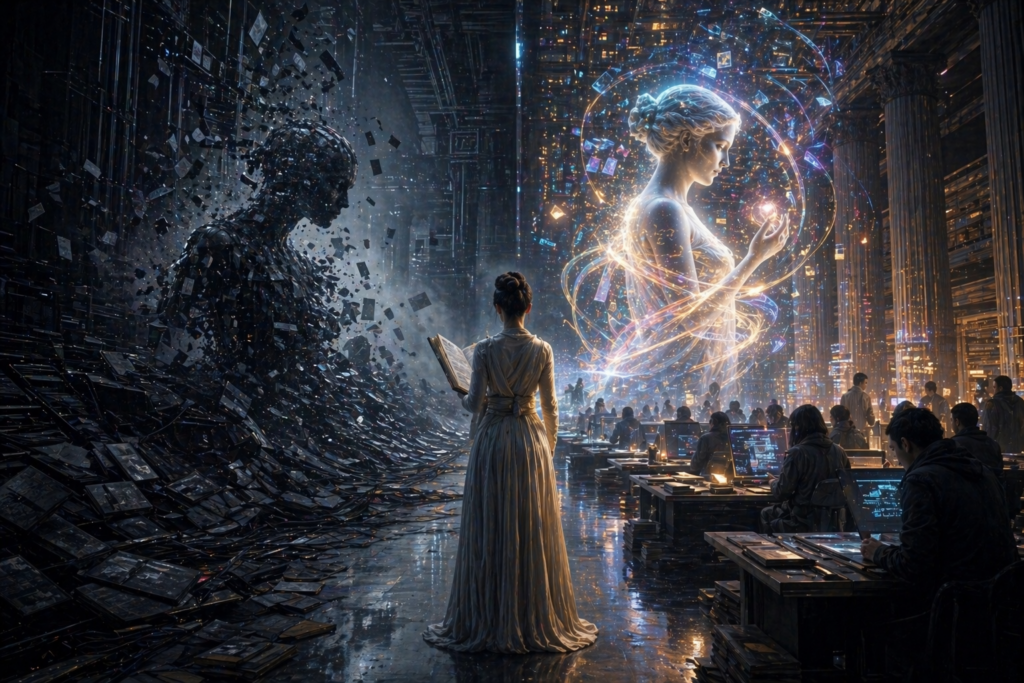
Translated from the Chinese original with AI assistance. The original text is authoritative.