
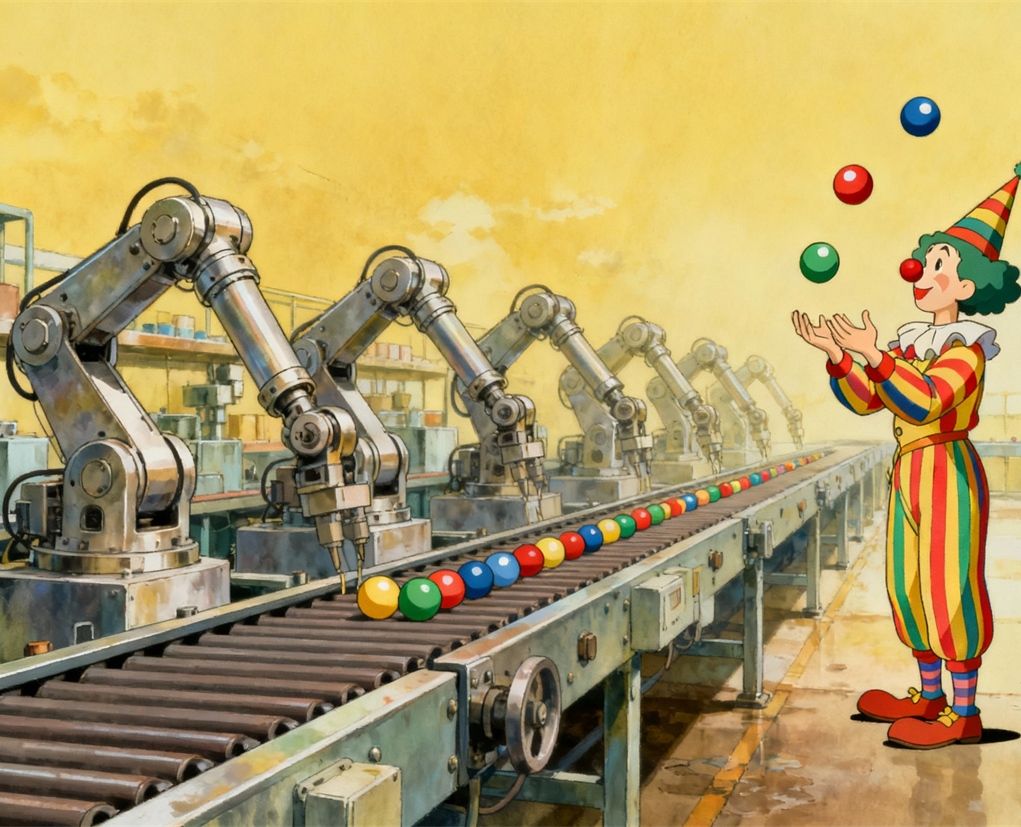
The Cycle of Involution and Unemployment
Could We Really Work Only Two Days a Week?
As artificial intelligence keeps iterating, a new wave of “raising lobsters” (OpenClaw) has recently swept in: we can give AI permissions, let it act on its own, operate computers like a human, scrape data, write papers, build websites, make trades—there is nothing it cannot do. Although at present it still does not seem easy to train a truly labor-replacing “lobster,” the sense of crisis among wage workers is already hitting us head-on.
One lovely fantasy might be this: wage workers go on working as usual and collecting their salaries, but hand all the actual labor over to artificial agents, and themselves, apart from occasionally playing the boss to train the little lobsters under their command, can simply collect their pay and slack off all day! But I think many wage workers know in their hearts that this is only a lovely fantasy. The truth is that once artificial agents can really replace wage workers’ jobs, if the boss can get lobsters to do the work either way, why not just use lobsters directly? Why on earth pay to hire a bunch of employees who are only there to slack off?
At the same time, some experts and some bosses have stepped out to steady morale, and the pie they paint is very tempting. Some say that under AI replacement, “humans in the future will only need to work two days a week, and wages will not decrease and may even rise.” Others say that “in the future we may work three days a week, only two hours a day.”
People in the comments had already voiced their doubts: capitalists will not let every employee work two days a week; instead, they will let one-third of employees work six days a week, and then fire the other two-thirds who are not grinding hard enough. This trend applies both to a single company and to society as a whole: if everyone in the whole society worked only two days a week, that state would most likely be unsustainable, and very soon it would head toward a situation in which some people’s work intensity rises while others become unemployed.
Involution Is the Result of Rational Choice
In fact, we are already experiencing such a trend: from the once widespread nine-to-five plus weekends, to the increasingly common 996, while unemployment is also rising and wages have not increased significantly.
We sometimes blame “capitalists” for exploitation and squeezing, and sometimes blame wage workers for being too caught up in involution, but in fact this problem is not caused by the bad character of certain people; it is the result of rational calculation by all parties.
For ordinary employees, being diligent, striving, and pursuing self-improvement are all good qualities, aren’t they? Under the rule of distribution according to work, of course the more you work, the more you get. If everyone else works only two days while I work three days a week, I can earn 50% more than others and also complete more performance targets, avoiding elimination at the bottom of the ranking—so why wouldn’t I work one extra day?
For the boss, say his work requires 6 labor-hours per week, meaning he needs to hire 3 employees, each working 2 hours a week, to get the job done. Now 2 of the employees are willing to work 3 hours a week, which is already enough to finish the work, while the remaining one honestly insists on working only two days. Then why would a rational boss not fire the surplus third person? Or perhaps he should have hired only 2 people from the start.
It should be noted that even if the boss does not lower the hourly wage, he still has reason to use fewer people. Because every time he hires one more person, what he pays is not only the salary that ends up in the employee’s hands; the boss must also be responsible for the employee’s welfare benefits, and he also bears the cost of training and education; there are also extra friction costs in teamwork—2 employees working together are obviously easier to coordinate than 3; and of course there are the costs of providing office space and office tools, and so on.
Moreover, assuming the boss cannot conjure up more work out of thin air, and the company’s overall profitability does not change, then even if he does not fire the third person, he still cannot keep wages unchanged. If all three people keep their wages, then that would be a negation of the principle of distribution according to work and of more work, more pay. If one insists on distribution according to work, then the result is inevitably that the third person’s wage must be cut, and in fact the hourly wages of the first two people also go down.
In short, the most reasonable solution seems to be to affirm the enthusiasm of strivers, insist on distribution according to work, let the two employees who work one extra day each receive one extra day’s pay, and implement bottom-out elimination for the surplus employee.
So now, for that already eliminated employee—now turned unemployed—he sits down in pain and reflection and begins to weigh things rationally. Distribution according to work, after all: if you do not labor, you get nothing, and can only rely on minimum subsistence benefits or your parents. But if he regains his rationality and ambition and wants to find work again, he must perform better than the employees already on the job in order to be rehired. Then his most direct method is to increase working time, or lower his wage demands. For example, he may discover that working three days a week while receiving only two days’ pay is acceptable after all; it is still better than being unemployed.
With this resolve, he returns to his original company or finds a new one. At this point, a rational boss, faced with this job applicant willing to work longer hours for less pay, will surely be willing to hire him as long as his concession offsets the extra costs of training and getting adjusted to each other. Meanwhile, the employees already on the job, seeing the idle job-seeker coveting their positions and understanding the fact that “if you won’t do it, there are plenty of others who will,” will very likely have to accept higher work intensity and lower pay in order to keep their jobs.
As this cycle keeps going, everyone raises work intensity, which in turn gives birth to more unemployed people; as unemployment increases, pressure rises further, forcing work intensity to rise again and wages to fall further. This is “involution”: every link in the chain seems to be the result of rational weighing of options.
Learning from History: Engels’s Stagnation
This trend is not something I have made up in a vacuum. In fact, Britain, which launched the First Industrial Revolution, had already experienced a round of it long ago. In the 1770s, Watt’s steam engine entered the market and soon combined with new types of textile machines, marking the Industrial Revolution’s entry into its peak. But from the 1770s onward, British workers’ labor hours increased year by year, hourly wages fell instead of rising, child labor became rampant while large numbers of adult workers were unemployed, and average life expectancy and living standards (reflected in per capita grain and meat consumption) declined significantly. This trend did not bottom out until the 1840s, and then gradually improved. Because Engels recorded the miserable condition of British workers in the early 1840s in The Condition of the Working Class in England, contemporary economists call this phenomenon “Engels’s stagnation,” used to describe the stagnation or even regression of the living standards of lower-class workers in the early Industrial Revolution.
Without question, we hope that as technology advances, human beings can become increasingly less burdened and enjoy more freely disposable leisure time, rather than turning into ever more exhausted “oxen and horses.” Of course, in the main, the Industrial Revolution did indeed bring benefits to humanity. Setting aside the first few decades of the Industrial Revolution, and then setting aside the two world wars, overall, from the latter half of the nineteenth century to the latter half of the twentieth century, the wealth gap in developed countries narrowed, working hours shrank, and income increased.
Three Clues for Reversing Involution
But the question is: how exactly was that early trend of unemployment and involution reversed? In the new technological revolution (such as the current intelligence revolution), can we avoid falling again into severe involution?
A popular view is that although new technology caused unemployment in some jobs, it also created many new ones. To borrow the example above, if the boss who originally needed 6 labor-hours per week opens up new business and now needs 8 labor-hours per week, then he can still accommodate all employees without having to lay anyone off. But the reality is not that simple. First, new business takes time to emerge, and it cannot guarantee that just as employees are facing layoffs, there will happen to be enough new business to absorb them. Second, competition for new business can still trigger involution—if there is not enough new work, then the logic above still applies; if there is too much new work to handle, then unemployment may be lower, but at least labor intensity will still generally rise.
Historically, what on earth really reversed the trend?
1. First of all, unquestionably, it was the bargaining power won through workers’ movements stretching over a hundred years, with wave after wave of struggle, as well as various legal and institutional protections (such as the ban on child labor and the eight-hour workday);
2. Second was the education system that gradually became widespread in the nineteenth century—including basic education and vocational education. On the one hand, schools locked up large numbers of young people, delaying their entry into the labor market; on the other hand, the long process of specialized education made many advanced positions harder to replace, so that people could no longer be swapped out at will, increasing the bargaining power of the employed;
3. Finally, there was the national welfare system, which only gradually became完善 after the Second World War, easing the pressure on the unemployed, and thereby weakening their urgency to lower their demands and come back to “grind” in the workplace. Of course, high welfare without work has in fact already partially broken the principle of distribution according to work.
A Fragile Balance
And none of the above solved the problem once and for all; at most, they promoted a certain fragile balance for a certain period of time. We can see that even without considering the shock of AI technology, by the twenty-first century the above “balance” was already teetering on the brink of collapse.
1. First, the impact of many hard-won laws and institutions is local rather than universal. For example, overtime culture is rampant in Silicon Valley, because the emerging tech industries represented by Silicon Valley lack the counterweight of traditional union power. In addition, late-developing countries like China ignore the various institutions of the old developed countries and accelerate involution—I am not saying that Chinese involution is sinful; on the contrary, this is also the result of rational calculation. After the international market has already been divided up by the old developed countries, a late-developing country that wants to squeeze out a place for itself has to be a bit more “grinding,” just as the unemployed person (the one left behind) in the earlier example must be more grinding if he wants to return to the company’s front line.
2. Second, the expansion of the education system is already nearing its limit. Once upon a time, having a bachelor’s degree already made you a top-tier talent, and doctorates were exceedingly rare. But now universities have expanded enrollment to the limit, and almost everyone has a high level of education. Even for a high-end professional, the situation is still: “if you won’t do it, there are plenty of others who will.” Higher education can no longer increase the bargaining power of the employed.
3. As for the welfare state, it too is on the verge of collapse. For in many cases, national welfare systems either run by means of monetary inflation and rolling over old debts with new ones, or rely on this generation of young people paying to support this generation of old people in retirement, while when this generation of young people grows old, they in turn need a newer generation of young people to support them. But on the one hand, the cycle of borrowing new to repay old has already become excessively bloated—for example, U.S. national debt is already an astronomical figure; on the other hand, because the population has begun to shrink, the “pay-as-you-go” pension system is becoming increasingly difficult to sustain.
The AI Revolution Is Set to Break the Balance
The onrushing AI revolution, on the one hand, has all the characteristics of the Industrial Revolution, and on the other hand, it has even more new features that further threaten employment.
1. First, laws and institutions can force a worker to work at most 8 hours a day in order to prevent involution, but they cannot impose such a limit on machines. A machine can of course run 24 hours a day, and it can also be duplicated infinitely. As long as a machine can replace one wage worker, it can immediately replace all wage workers of the same type. Traditional regulations can forbid human involution, but surely they cannot forbid data copying on a computer, can they?
II. Second, the education system once eased the unemployment pressure brought by the Industrial Revolution by creating highly trained specialists to match high-tech positions and brain-work jobs. But the first thing this wave of AI is challenging is precisely brain workers. What AI itself learns is not a particular skill, but “learning” as such. Once AI’s learning ability matches or surpasses that of human beings, the professional thresholds set by human education and learning will be meaningless.
III. Finally, it is not so much AI as the entire internet technology stack that is challenging traditional state institutions; in particular, Bitcoin is challenging the traditional system of monetary regulation, which in turn places many welfare systems that traditionally rely on monetary policy under even greater pressure.
In short, in the age of the AI revolution, the fragile balance is bound to be broken. If we do not want once again to fall into the vicious circle of “the more advanced technology becomes, the heavier life grows,” we must find a new way out.
Distribution According to Labor and Its Limits
Distribution According to Labor: The Logical Presupposition of the Involution Cycle
Let us return to the original line of reasoning and take another look at what other logical presuppositions make the rational boss choose 2 people who work 3 days a week rather than 3 people who work 2 days a week.
As we have already hinted, the principle of “distribution according to labor” plays a key role. “Distribution according to labor” means that labor power is measurable, additive and subtractive, a linear scale for measuring the value of work. Only when “labor” is regarded as something homogeneous, neutral, and calculable do the above 2×3 and 3×2 become comparable.
But in fact, most of what human beings “create” is not such a homogeneous thing. For example, suppose I want to make an exquisite porcelain vase, and I hire one person to paint it, another to write a poem on it, and a third to fire the porcelain. Would I then fire the third person simply because the first two are willing to put in more effort? Impossible, because although their work is homogeneous in terms of labor time, it is utterly non-homogeneous in terms of creative content and cannot be substituted for one another.
The hallmark of the First Industrial Revolution was assembly-line production, and the secret of assembly-line production is “substitutability” — every part is substitutable, every worker is substitutable, every product is mutually substitutable. One strives to make every link in production as homogeneous, standardized, and impersonal as possible. So the kind of vase-making mode described above, in which several non-substitutable people cooperate to complete a unique work, is a feature of premodern craft. Today it has been marginalized into a kind of “art” activity, no longer a mode of production. In the modernized factory, there is no place left for a painter’s or a poet’s “workstation”; at most, their copyright is bought out and then transformed into a process that even fools who know nothing about art can operate for mass printing.
The entire modern education system, even while raising professional thresholds, is ultimately still aimed at cultivating people who can replace one another and supplying society with “labor power.”
So, in the industrial era, from ways of thinking to factory models, everything was homogenizing and quantifying labor power/productive power. Therefore, taking labor productivity as the basis of a distribution system was naturally the most reasonable thing of all.
But this situation was determined by the production mode of the industrial age, and under the innovation of artificial intelligence, the mode of the production line may finally be broken. Therefore, the AI revolution, on the one hand, may be intensifying the worsening of the “involution logic”; on the other hand, it may be bringing the possibility of fundamentally leaping out of the “involution logic.”
The Effectiveness and Limitations of Distribution According to Labor
In any case, “distribution according to labor” is a good paradigm, one that is reasonable both at the level of value theory and at the level of economics. Any new paradigm that replaces “distribution according to labor” should likewise possess similar fairness and effectiveness.
So-called fairness means, first of all, following the general principle of “everyone is equal.” Of course, there is no absolute equality in the strict sense: people are born with different talents, and some are born disabled, so their labor capacity is destined to fall short of others’. Moreover, in actual practice, different forms of labor (such as manual labor and mental labor) differ enormously in real distribution, so it is hard to speak of absolute fairness. But relatively speaking, measuring differences among people by labor is still more fair than deciding by bloodline or privilege, and usually more fair than distributing according to capital.
Effectiveness, meanwhile, includes two levels. First, it can be measured and evaluated relatively objectively. Second, it can form positive feedback, so that each person’s reward and pursuit are aligned, and each person’s pursuit is in turn aligned with the harmony and progress of society as a whole. For example, labor intensity can be measured by working hours, and wages can be settled according to working hours. In pursuit of higher wages, people will devote more labor time and, on the whole, create more productive power for society. Of course, one should note that this effectiveness is relative. In the heyday of the industrial era, speaking broadly, it was a good thing for everyone to work more actively and produce more productive power, contributing to social progress. But in other circumstances, this is not necessarily a good thing. For example, in many cases laziness instead promotes technological innovation, while excessively extending labor hours instead causes involution, social instability, and weak consumer demand, and so on.
Not Everything Is Necessarily Better in Greater Quantity
A linear increase in productive power is not necessarily a good thing either. The value system of the industrial era pursued “higher, faster, stronger”; many people even measured the height of human civilization by the scale of energy humans can harness (the Kardashev scale). The more energy one can harness, and thus the more productive power one can provide, the more “advanced” the civilization is.
In any case, 10 is always better than 1, and 100 is always better than 10. More is better, isn’t that right? But the key is that when we speak abstractly of a homogeneous, neutral “labor power” or “productive power,” it is like the amount in my bank account: of course, more is better. But when we speak concretely about any actual product, it is usually not the case that more is better, because the meaning of these products is ultimately to enrich our lives, while our lives are limited by the finitude of the body and the senses, and in fact cannot bear the infinite proliferation of any real thing.
For example, eating meat ten times a year is always better than eating meat once a year; eating meat once a week is better than eating meat ten times a year; and eating meat three times a day is better than eating meat once a week… but would eating meat ten times a day be even better than three times a day? What about thirty times a day? That person might well burst in half a day.
All material products, so long as they are enjoyed through the actual fleshly senses of human beings, have their limits, and are not necessarily better in greater quantity. Yet in the nearly 200 years since the Industrial Revolution, thanks to the increase in productive power, ordinary people have gone from being unable to eat meat more than a few times a year to having meat at every meal. During this period, the increase in productive power and the improvement in living standards were aligned. But in modern developed countries, basic material needs such as food and clothing have long been satisfied, and in fact are generally in excess—obesity is now more of a problem than hunger. At this point, an increase in productive power no longer necessarily goes hand in hand with an increase in living standards. Once basic needs for food and warmth are met, simply increasing the quantity of goods has little meaning; the more important question becomes how technology can be made to serve human beings’ pursuit of a higher level of enjoyment in life.
But in fact, because the value system and economic structure of society as a whole still retain the inertia of productivism since the Industrial Revolution, in many cases producers consciously or unconsciously continue to promote one-way linear accelerationism—since basic material needs have already been met, capitalists then use the cultural industries to create vanity-driven and addictive demands. The luxury goods industry, the cosmetics industry, the entertainment industry, the virtual economy, and so on are all opening up new fields of demand that are difficult to fill. No wonder philosophers say that the main product of the “post-industrial age” is “demand”; advertising is the new growth engine. Only by constantly opening up new demands can productive power continue to expand without limit.
But human beings’ capacity to accept new things is also limited. Generally speaking, we welcome the constant emergence of new things, with new news, new literary and artistic works, new technological products, new games and toys refreshing themselves around us; this makes life richer and more enjoyable. But the “refresh” speed of human attention also has its limits, whereas the acceleration of industrial production has no limit. By today, in many fields, the “refreshing” of all kinds of things has changed from making people feel “dazzled by abundance” to making them feel “unable to take it all in,” and even to leaving them at a loss. Elderly people have already felt this in advance: the continuous iteration of new technologies is no longer experienced by them as liberation, but as pressure to keep adapting. Now this pressure has already been transmitted to people under the age of 35. Faced with constantly iterating new technologies, if one is even a beat slow to adapt, one risks being eliminated by the times.
The same is true in the fields of culture and leisure: from taking 15 days to finish a book, to 1.5 hours to watch a movie, to now 15 seconds to swipe through a short video. New products “refresh” faster and faster, seemingly accelerating the satisfaction of human cultural needs. But too rapid a refresh speed excludes immersion, chewing over, savoring, and aftertaste; it may not truly enhance the richness and enjoyment of human life, and instead makes people more likely to fall into a state of addiction or emptiness.
Distribution According to Pleasure
Liberating the Mind: Beyond Distribution According to Labor
In short, the synchronized rise of production and life since the Industrial Revolution has reached its limit in many respects. Production and life have begun to split apart. While productive power increases, life does not necessarily become richer and more colorful in step; instead, it may become more exhausting, monotonous, alienated, mediocre, and reduced to “bread and circuses,” and so on. One of the root causes is the productivist value system behind “distribution according to labor,” which pursues linear growth in productive power. So if we want to break through the logic of involution, and also break through productivism, we must first liberate our minds, leap beyond the old formula of “distribution according to labor,” stop pursuing the calculation of “workload” with linear scales, and stop always building production modes out of substitutable parts. Instead, we should bring out each individual’s irreducible personality.
Of course, it is easy to say “bring out individuality,” but many problems remain unresolved. First, how do we cultivate and stimulate individuality? The current education system and entertainment system both seem to need transformation. Second, under the premise of guaranteeing each person’s individuality, what kinds of works can actually be created? Do we want these works to remain toys of small artistic circles, or to be able to enter the commodity market? Finally, if we still have not yet reached the stage of “distribution according to need,” then what exactly should we distribute according to? Based on what quantifiable indicators should we measure different people’s contributions?
“Distribution according to need” is of course ideal, but at least for now it is not really suitable. Of course, its problem is no longer material scarcity—given the productive power of the modern world, in fact there is enough to maintain the basic food and clothing needs of everyone. The key issue still lies in the feedback mechanism: the value system fostered by distribution according to labor is more work, more reward, encouraging people to labor actively; while distribution according to need means more desire, more reward, which does not seem to be a positive incentive for social stability and development.
Expressing Desires: The Human Mission in the AI Era
In the AI era, which human capacity is more worth encouraging? Do we really rejoice at seeing human beings continue to strengthen their labor power, increasing labor time and labor intensity, and becoming cattle and horses driven by AI? The more ideal situation should be that human beings are liberated from heavy, repetitive labor, and that AI serves human purposes.
Human beings liberated from low-level labor have at least one task they should not abandon: the capacity to express desire. I hope that AI will serve me, but what exactly I want and what I like are still things that require my own personal oversight. If I cannot even figure out what I like, and simply wait for AI to feed me everything, then human dignity is truly cast to the ground, human autonomy as such is lost, and the diversity and richness of human civilization are also in grave danger.
So in any case, human beings still need to have aspirations; they need to learn and improve themselves in order to better formulate wishes to AI. For example, a person in antiquity, impoverished in both material and spiritual life, simply could not imagine what an affluent life looked like; at most he could imagine “a land flowing with milk and honey” — unlimited milk to drink and unlimited honey to eat, and that would have been the finest life imaginable. Asking the omnipotent God for their wishes would amount to no more than that. But the freedom of milk and sugar has already been realized in modern society; human beings have long been living in the “promised land” that ancient people imagined as the best possible world. What, then, should we pray for next? If AI is also omnipotent, what kind of beautiful world do we want it to promise us? Is it really just more milk and more honey?
Of course, for someone lacking in imagination, today’s AI can also help expand it; so long as he puts forward ambiguous hopes, AI will offer him a rich array of options. But in any case, these options all remain within the existing fashionable categories of human society as a whole. AI has no body and no senses; it can only combine and arrange various options within the imagined world already available to human beings, and it is hard for it to carve out new spaces on its own. AI can help us imagine, and it can also help us realize our own imagination, but fundamentally all of this depends on each person’s discernment and aesthetic taste.
Taste and enjoyment are everyone’s mission; these should not be replaced by AI, or rather, they should not be replaced by any Other.
So, in the AI era, the positive incentive mechanism society needs does not necessarily have to encourage hard work, but it must certainly encourage everyone to improve their taste, sensitivity, and imagination.
Distribution by Enjoyment: A New Slogan
Whether it is for the grand goal of making human civilization ever more diverse and colorful, or for the sake of being able to better enjoy one’s personal leisure, we all need to actively develop our own taste, sensitivity, and imagination. For this goal, the mere increase of productivity is no longer the key; what matters is what is produced — fundamentally, we need to produce more “趣味” or “fun.”
Science and technology, or productive forces, whatever the case may be, their value is ultimately reflected in the enhancement of human happiness; happiness (happiness/乐) has always been the ultimate measure of value.
So here I would like to tentatively propose a new principle to replace “distribution according to labor”: “distribution according to enjoyment.”
Each person has different tastes, and “fun” is naturally personalized and plural; but on the other hand, it can also be measured to some extent. Happiness is measurable, yet not additive. Statistics and psychological scales can quantify happiness, but these numerical values cannot simply be added or subtracted — just as a cup of 30-degree water plus a cup of 80-degree water does not become two cups of 110-degree water; and doing one thing that gives 3 points of happiness together with another thing that gives 8 points of happiness does not become 11 points of happiness, and may instead reduce the 8-point happiness a bit.
So it may be possible for us to evaluate the value of something by taking someone’s own happiness and the happiness it brings to others as the basis, without needing to fully homogenize that thing.
“Distribution according to labor” requires the commodification of labor power, turning it into a resource that can be added, subtracted, and statistically totaled; but “distribution according to enjoyment” only requires the mathematization of happiness, not its commodification. Or to put it another way, a market environment formed on the basis of “distribution according to enjoyment” calls for an entirely new paradigm of commodity economy.
The Internet Economy: An Economic Paradigm without Conservation
I am not imagining this new economy out of thin air; in fact, this new paradigm is inherently better suited to the information age. When the value center of society is no longer monopolized by industrial products, but is gradually shifting toward the “digital objects” of the information world, then the entire value paradigm ought to change accordingly.
As early as the mid-20th century, Norbert Wiener, one of the founders of the information age, had already warned that the spread of “cybernetic machines” might cause a serious unemployment crisis, and he proposed his own response: “The answer is, of course, to demand a society based on human values rather than buying and selling.” What he called “a society based on buying and selling” is most typically exemplified by the United States. That kind of society was suited to the industrial age and helped America become the world’s hegemon; yet Americans carried on with that same inertia into the information age, and Wiener thought this was foolish. Wiener said: “In the life milieu of the American, all problems of information are judged according to a standard American point of view: a thing is valuable only as it enters into the market as a commodity.” But “information and entropy are not conserved, and are equally unsuited to be commodities.”
The “temperature” mentioned above is an expression of “entropy” in the thermodynamic sense — we can measure it, but we cannot simply add and subtract it. And in the “information theory” pioneered by Wiener and Shannon, they extended thermodynamic concepts and used “entropy” to understand information.
Traditionally, any commodity is conserved. For example, if I produce 1 liter of milk every minute, then in one hour I will produce 60 liters of milk. And if I take 10 liters out of those 60 liters and drink them, then 50 liters remain. If everyone needs to drink one liter of milk, then at most only 60 people can drink. Unless there really is a miracle that can conjure bread and wine out of thin air, any manufactured thing is conserved.
But “information” is different. For example, “the second law of thermodynamics” is a piece of information; just as the value of milk lies in being drunk by people, the value of information lies in being known by people. But when I come to know “the second law of thermodynamics,” nothing has decreased. The “second law of thermodynamics,” known by one more person, is still the original “second law of thermodynamics.” Once information has been “produced,” it is inexhaustible and unending.
A work of art is something somewhere between a commodity and information. Its value as a collectible is conserved: if I collect this painting, you cannot collect it; but its aesthetic value is not conserved: once I have appreciated this painting, you can still appreciate it as well, and after being appreciated by countless people, the painting itself has not diminished at all.
The “digital objects” on the internet — documents, images, or programs, etc. — can sometimes acquire the features of commodities through additional copyright restrictions, but fundamentally they are information rather than commodities, and can be copied and forwarded with ease.
To make milk benefit more people, what is needed is expanded production; but to make a work of art benefit more people, what is needed is sharing and dissemination.
The market model suited to industrial products can continue to develop through the incentive cycle of “labor power — commodity — capital — labor power,” but it is not necessarily the best fit for the internet economy. And historically, we can also see that the internet economy has a more natural tendency toward a “sharing economy.” Whether it is mass entertainment information spread through open social platforms such as Twitter and Facebook, or code production centered on the open-source community of GitHub, or knowledge repositories exemplified by Wikipedia, all have grown through openness and sharing. In fact, AI large models have precisely become so intelligent by absorbing and aggregating these openly shared corpora. The economic model of open-source sharing is itself the source of momentum for the information age — or the AI age.
Fun: The Inner Motivation of the Sharer
In the commodity economy of the industrial age, the main motivation of producers who contributed commodities to society was of course “making money”; ordinary employees sold labor power in order to earn wages, while capitalists of course did so for capital appreciation. This incentive mechanism was effective. But in the sharing economy of the information age, when many people contribute free and open-source works to society, what exactly is their motivation?
There has already been much research on this, for example a paper published in 2021 at ICSE, a top conference in software engineering, which listed the most widely recognized motivations (multiple-choice). The top one was “fun,” endorsed by 91% of individual developers; next came altruism (85%) and kinship/community belonging (kinship, 80%); reputation (reputation, 68%) was also a mainstream pursuit, while fewer than 30% of respondents chose monetary reward (payment) as one of their motivations.
If fun refers to the most superficial and direct sense of “乐” — “joy/pleasure” — then in fact altruism, community belonging, and reputation can all be counted as part of “乐” in the broader sense — just as joy (joy) emphasizes the release of inner emotion; pleasure (pleasure) emphasizes enjoyment and sensory experience; and happiness (happiness) emphasizes durability and a sense of fullness. The release of inner feeling, the family-like sense of belonging, and the self-affirming quality of reputation are all different forms of “乐.”
The creations of the industrial age were driven by a feedback mechanism like “labor for money,” whereas the creations of the information age are instead primarily motivated by “sharing for fun.”
And “happiness” is naturally suited to the sharing economy, because happiness itself can multiply through sharing.
Beyond open-source software, similar patterns can also be seen in other areas of the internet economy. For example, on social media platforms, users are even willing to pay to become content producers simply “for fun”; in the live-stream tipping economy, the ones who receive higher incentives are not the hardest-working streamers, but the streamers who are best at mobilizing audience emotions, the streamers who can bring everyone the most fun.
And in the field of AI, fun is precisely the driving force behind the explosive progress of this latest wave of AI. Before the AI boom, Nvidia made gaming graphics cards, and OpenAI got its start by making AI e-sports players; both got their start through play. OpenAI’s core programmers even summarized a new “fun-oriented” value system — no longer presupposing a specific goal and then measuring gains and losses by distance from that goal — “Do not presuppose specific goals, but let there be values as guidance, and those values are novelty and interest. So long as each time you choose the direction that is newer and more interesting, you will not be ordinary.” (“Why Greatness Cannot Be Planned”)
In short, we have already seen that fun has become one of the main sources of motivation in the internet economy, and in some fields we have already seen a certain form of “distribution according to enjoyment.”
Vindicating Pleasure
Therefore, my advocacy of “distribution according to enjoyment” is not a fantasy, but rather an effort to “vindicate” the new trend already taking shape in the information age, and to extend it to more realms of real society beyond the digital world. At present, fun has certainly already played a key driving role in many respects, but it still seems to be regarded as some kind of marginal or even negative force, and has not been fully acknowledged or encouraged.
Distribution according to labor contains the notion that labor is honorable, but if I were to say “pleasure is honorable,” I seem as though I should be scolded. Yet this is precisely because we have not taken “fun” seriously, and have not sufficiently liberated human beings’ capacity for pleasure and freedom of pleasure.
In aristocratic society, laborers were generally despised, and there was some reason for that, because laborers at the time generally lacked cultivation, lacked knowledge, and were coarse in speech — but in fact these two aspects are cause and effect of one another: precisely because laborers were despised, they lacked opportunities to receive elite education and aesthetic refinement, so they naturally appeared coarser than the aristocrats who lived in ease and luxury; and because they were coarser, they received even more contempt, and thus prejudice was reinforced in a cycle. The Industrial Revolution and the successive social revolutions that followed completely restructured society, and only then were laborers no longer discriminated against, and the value of labor came to be recognized.
And today, especially in Chinese society, our contempt for “pleasure-seekers” also has some basis, because those addicted to pleasure always seem to lack ambition, lack creativity, and make no contribution. But this condition itself is also caused by this society’s systematic neglect of “pleasure.”
In fact, “labor is glorious” does not mean that any kind of labor is worthy of pride. A slave who serves as a tyrant’s henchman, no matter how hard he works, can hardly be called glorious. Pleasure is similar. When I am giving pleasure its due, this by no means implies that any form of pleasure deserves encouragement. On the contrary, when we take pleasure seriously, the first thing we must do is free ourselves from vulgar tastes and pursue pleasures that are freer and more “advanced.”
Two people may both like drinking. One is a worthless drunk who says he likes drinking because he gets himself drunk on hard liquor every day; the other is an elegant and sensitive wine taster who also says he likes drinking. But these two tastes are not equal. A person who truly knows how to enjoy pleasure should not become addicted to crude stimulation, but should be able to control his desires freely, continuously improve his sensibility and discernment, and learn to appreciate complex and subtle flavors.
In the AI era, what we need most is the capacity to feel and to appreciate. This is not something one can acquire by lying on the sofa with food brought to one’s mouth; it requires systematic cultivation, training, and practice to develop. Yet traditional values, public opinion, social atmosphere, and the education system all aim at producing “workers,” producing interchangeable screws in a machine, and rarely at cultivating the ability to enjoy—imagination, sensibility, and aesthetic judgment… Cai Yuanpei’s ideal of “replacing religion with aesthetic education” has never been realized. Even aesthetic capacity, which is among the more respected capacities within the broader ability to enjoy, has never received systematic attention and cultivation from the social system as a whole. So aside from the few individuals who, thanks to talent and opportunity, develop refined taste, most pleasure-seekers lack the conditions for refinement and elevation, and naturally end up seeming vulgar and coarse.
So, if we are to move toward “distribution according to pleasure,” we must first give pleasure its due. Then, centering on “pleasure,” we need to build an entire set of values, an economics, a market system, and an educational system, so that those who are better at creating happiness and enjoying happiness receive more incentives, and so that we can ultimately break out of the spiral of involution and unemployment, in order to adapt to the new trends of the AI era.
Translated from the Chinese original with AI assistance. The original text is authoritative.