
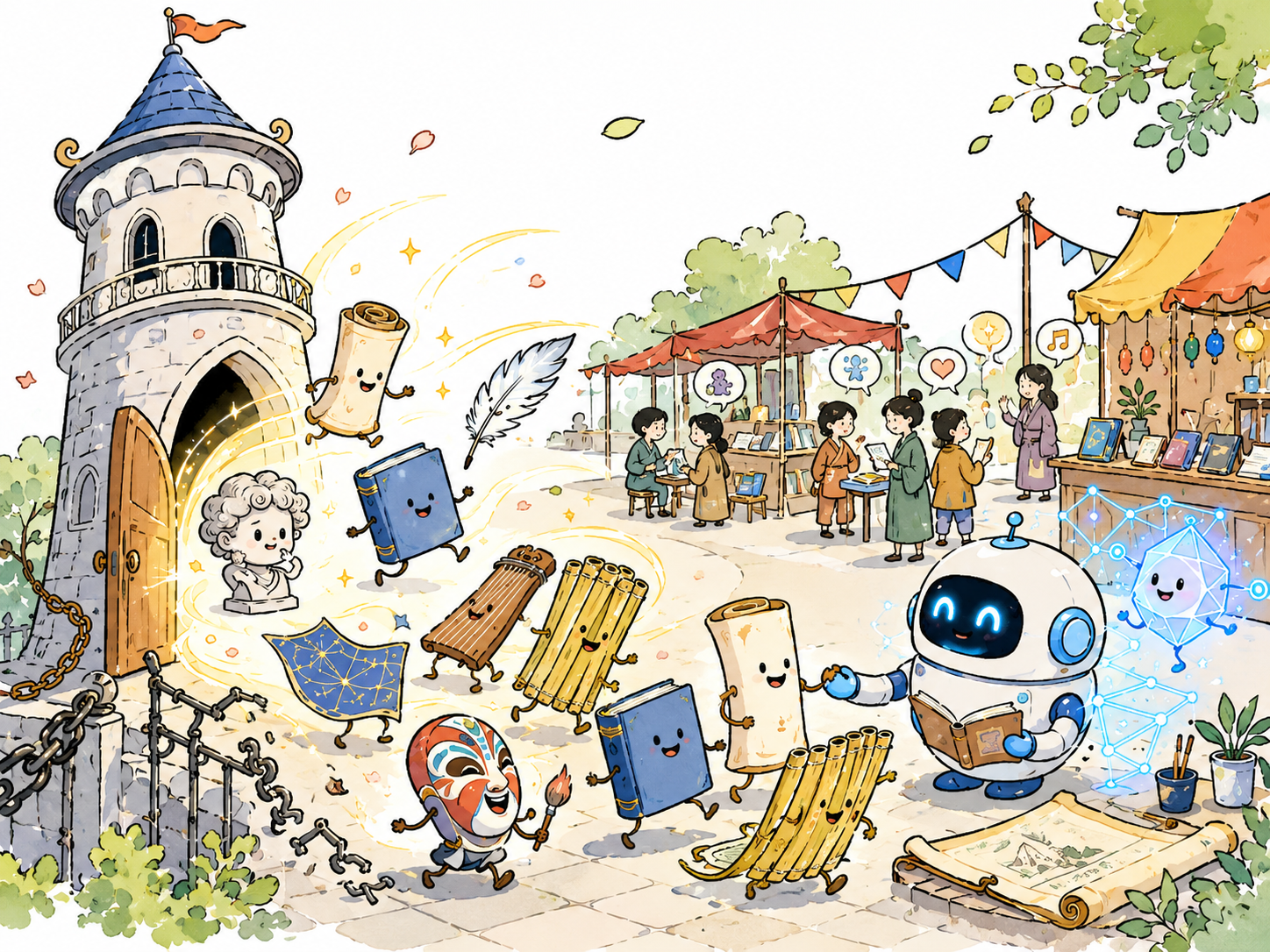
It’s graduation season again, and recently many universities in China have acquired a new task: checking AI-generation rates. Rules like “if AI-generated content (AIGC rate) exceeds 40%, you cannot graduate” are simply hilarious; they show how helpless some universities are in the age of AI. I believe that any university that stipulates that using AI means you cannot graduate can be dissolved on the spot; that is the best thing it can do for this era. Stop misleading the young.
Checking the AIGC rate is a joke
Checking the AIGC rate is in the same vein as the earlier thesis plagiarism check. I criticized the absurdity of plagiarism checks in an article a long time ago: plagiarism should be zero tolerance; there are only two possibilities, plagiarized or not plagiarized. Rules about things like a 4% repetition rate are completely ridiculous. At most, plagiarism-detection tools are auxiliary tools for exposing plagiarism; they can never be used as a hard standard for deciding whether someone passes. If a school does not have enough teachers to carefully judge whether the detected repetition rate actually amounts to plagiarism, then the school simply should not enroll so many students in the first place.
The current “AIGC rate check” is a hundred times more absurd than thesis plagiarism checking. Because the AIGC rate is basically impossible to check. At most, maybe someone directly chats with an outdated AI model to generate a passage of text, then copies it over without even looking at it; that kind of thing is probably easy to detect. But as long as one does what I introduced earlier—using cowork or codex, seriously working with AI to establish lots of skill, and then letting AI do the writing—what comes out is basically in a style not much different from your own writing. And unlike image information, textual information has no equivalent of the pixel-level invisible watermarks that mainstream AIs hide in generated images; it is almost impossible to detect.
I searched through a few online tools that claim to check AIGC, and experimentally used them; indeed, none of them are reliable. Many times they even identified text I wrote myself as 100% AIGC. Even more ironically, when I searched for tools to check the AIGC rate, I could also see many ads claiming to use AI to help you intelligently reduce repetition, and there were even some automatic AI-rate-checking tools that could in turn help you lower your AI rate. Their slogan was “one-click boost your paper’s originality.” In other words, the way to reduce the AIGC rate is to use a little more AI—how absurd is that?
What universities are currently able to do when they check for AI generation is probably only to scare off some of the laziest uses, such as directly tossing the topic to AI and letting it handle the whole paper. Even in that case, if one can use the latest versions of ChatGPT or Claude, I doubt it can necessarily be detected. I’ve seen university teachers say: the worst thing in students’ papers right now is not using AI; whether one can bypass the firewall and use foreign large models is another dividing line.
The purpose of university education
Absurd things like checking the AIGC rate not only show that universities are utterly incapable of determining whether students are qualified, they also mark a loss of direction about what kind of students universities are actually supposed to cultivate.
What kind of student is the purpose of university education supposed to cultivate? In the final analysis, there are only two levels: one is the cultivation of an inner civic character, the other is training in external professional competence.
At the level of inner cultivation, I once said at the graduation ceremony for the history of science minor program: taking the history of science department as representative, the undergraduate education of many disciplines, especially the humanities, aims to cultivate students to “be citizens who can argue,” providing each person with the knowledge reserve and broadened horizons needed to join in rational debate over various public issues. In this respect, AI is indeed hard to replace, and I have repeatedly called for “the revival of liberal education and general education in the AI era.” But in a nutshell, this aim is actually just “cultivating public intellectuals.” With or without AI, most Chinese universities cannot really achieve this. So in fact most Chinese universities should already have been dissolved long ago: as “undergraduate” institutions, they are all unqualified; at most they still have the meaning of “junior college,” that is, the external purpose of professional training.
Training professionals also has two directions, and in the end both are about promoting employment and helping students find occupations with better pay and higher social value. The first direction is to train academic talent, so that they may remain in the field as teachers in the future, or become researchers in scientific institutions, inheriting and advancing human knowledge in the relevant field; the second direction is to train talent for society and for the market, so that they may become excellent employees or entrepreneurs in the future, allowing students to make money while also supplying society with high-quality labor.
Refusing AI writing goes against the purpose of education
Whether we are climbing toward the academic frontier or adapting to society, we should notice that the frontier is continuously advancing, and society is continuously changing. Dinosaurs, however powerful, still go extinct when the environment changes; teaching schemes that once produced countless masters should also be eliminated if they no longer suit the new environment.
What kind of people are more in demand in today’s job market? Isn’t it true that AI is being used in every industry now? In such an environment, what is the point of insisting on conclusions like “ability declines after removing AI”? AI has already been embedded in the working environment of every industry. In some fields AI still cannot do the job well; that is another matter. But as long as the work can be done, and the same result is produced, would you really be discounted just because you use AI more? Employers are practical people: if you are “obedient and productive,” you are a good employee. Indeed, many bosses, in order to further reduce costs and improve efficiency, actually prefer people who use AI more, and many large companies even count token consumption rate as part of performance evaluation.
Most work is about producing results, not proving yourself, or preparing for survival in the apocalypse. Many anti-AI arguments are built on some absurd “apocalyptic imagination”—what will you do when the day comes that there is no AI to use? Of course we cannot rule out that possibility, but guarding against the ultimate catastrophe of civilizational collapse is not the mission of an ordinary university.
When training a cook, should one first teach them how to drill wood to make fire? Because what if there are no stoves to use—then how could one cook?
When training a driver, should one first teach them how to handle horses? Because what if there are no cars to drive—then how could one drive?
When training a doctor, should one first teach them how to gather herbs? Because what if modern medicines and medical tools are all gone—then how could one treat illness?
…The above training schemes are absurd, because humanity has long possessed these technological devices, and the entire employment environment is built upon them. We should, on the contrary, require professionals to be familiar with the latest equipment, rather than insist that they must adapt to obsolete tools.
But why is it that so many undergraduate universities fail to understand something that any vocational school can readily grasp? If the new equipment is already widespread in the market, why must we still train students to work without it? Can this still count as an educational purpose of cultivating talent?
If the purpose of education is to promote scholarship and contribute to human knowledge, then one should proceed from reality and judge according to whether the work itself contributes to human knowledge. If I discovered a room-temperature superconductor with the help of AI, would humanity reject it merely because it depended on AI? If I used AI to discover vulnerabilities in commonly used software, would the developers refuse to patch them just because you depended on AI? Of course, if you say that in many fields AI-made things still cannot match human work and the quality is still relatively poor, so you do not want to accept them into the human knowledge base, that is reasonable—but then you need to judge the outcome itself, not focus on whether AI was used. If a university can no longer judge, on the basis of the thesis itself, whether it is capable of contributing value to humanity’s common knowledge, then that shows it simply has no ability to grant the relevant degree at all, and it should have been dissolved on the spot long ago.
Several reasons for a limited quarantine of new technology
I have also tried, as far as possible, to provide some defense for the conservative practices of schools: indeed there are some exceptional cases in which we still need to cultivate relatively primitive abilities under conditions of isolation from new equipment.
1. The cultivation of academic taste
In the AI era, humanity still needs to safeguard aesthetics and taste; I have repeatedly emphasized this in many earlier articles. AI can write all kinds of papers, but it itself does not know which topic is “interesting,” or rather, it can only judge in the statistical-average sense which topic is “interesting” for most people, but it cannot stand from the standpoint of the academic elite, from the standpoint of pioneers and adventurers moving into unknown regions, to broaden humanity’s range of interests. So human beings still need to cultivate and train their own taste, so that they can cooperate with AI better.
But what the above logic can support is this: universities should still have classes, and there should still be experienced teachers guiding students in many respects, rather than relying entirely on students to learn by themselves through AI. The above logic cannot support universities in forbidding the use of AI to assist in thesis writing. On the contrary, using AI in a degree thesis does not hinder the display of academic taste. Universities should strengthen the examination of students’ sense of problems, academic taste, and judgment when evaluating theses.
Moreover, even if universities were all shut down, we could still encourage the cultivation of academic taste in other spaces, such as primary and secondary education, extracurricular education, apprenticeship systems in technical schools or enterprises, and social associations, rather than leaving it necessarily to universities to do.
In addition to academic taste, there are also some more basic skills that need training. For example, if you want to use AI, at the very least you need to be able to read, right? To use AI to write a paper, one also needs to have the ability to verify information, so as to avoid AI mis-citations, fabricated data, or writing that misses the point. Of course, since every student should possess basic verification ability, school teachers should of course also possess these abilities, so schools should have both the ability and the responsibility to review papers co-written by students and AI.
2. International competition, confidentiality, funding, and other factors
At present, the two major American commercial models on the market—ChatGPT and claude—basically occupy a cliff-like lead position. By comparison, Chinese or open-source AI models lag behind by one or two major versions, and there is no trend of the gap narrowing.
This creates a problem I mentioned before: whether one can bypass the firewall to use the latest AI will significantly affect students’ thesis quality.
There is another layer to the problem, which is that using AI well costs money. Recently I asked some students on campus, and first of all, not many of them use overseas large models; and even when they do, they mostly use them for free, at most purchasing a basic plan. But in fact, to use AI well right now, a basic plan is not enough; sometimes one needs to pay extra to buy token quotas in order to use it well.
Is this a kind of unfairness? In a sense, yes—but similar problems have long existed. For example, if one student only knows how to use CNKI or domestic databases, while another is adept at Google Scholar and foreign databases, the papers they write will obviously differ greatly. To write a good paper, one already has to bypass the firewall to search English-language literature.
Many universities provide students with free access to many domestic and foreign databases, and in recent years some have even begun to provide official firewall-bypassing services. If that is the case, mainstream AI services should be provided by the school in the same way mainstream databases are. If the school cannot provide advanced research tools, then it deserves to fall behind; it might as well be dissolved on the spot.
Even if the school itself does not provide it, the AI fee can also be covered by the project group. For a project team or an academic lineage collective, a dozen or so people spending ten thousand yuan or more a month on AI fees is really not much; hiring a research assistant would cost several thousand yuan too, wouldn’t it? Much less now, when most people are still at the stage of thinking even a hundred yuan is too expensive—if a teacher can subsidize each person 100 yuan a month, that is actually enough for basic use. Compared with the traditional costs of buying materials, going abroad for field investigations, and so on, this is just a drop in the bucket.
Of course, since mainstream large models are all in the hands of overseas commercial companies, we have reason to worry about improper privacy leaks. But most papers actually do not involve such problems, because most papers are about collecting and organizing materials from existing public databases, and the original viewpoints or data one adds are ultimately meant to be published in public databases as well. So long as you are not beaten to publication by peers, you need not fear issues like privacy leakage. In this respect, the risk of using large models is probably even lower than attending an academic conference.
For the small number of scenarios involving sensitive information, or where one simply wants to resist foreign commercial models, one should not give up AI either. We can use domestic models, especially open-source large models, to build our own AI agents. Although their performance is somewhat worse than the two major foreign models, with careful setup they can still play a pretty good role. And through practice, we can provide useful feedback to the open-source community and promote the iteration of open-source models. We often see news like this: philosophers, historians, mathematicians, scientists, and scholars in other fields collaborate with AI large-model companies, becoming the first to use unreleased new versions of models, making certain academic discoveries and feeding them back to the AI companies, in such close cooperation. But in China such channels are still relatively few, or rather there are many state-level cooperative projects but a lack of transparency. I have, however, seen many scholars in the field of communication studies actively exploring this, while humanistic scholars are the most laggard in their response.
3. Insufficient ability to verify
In actual fact, the biggest difficulty that student papers written with AI cause for schools and teachers is that they increase the difficulty of verification.
First of all, AI has indeed raised the average level of student papers. I taught general-education courses at Tsinghua for seven years, and I know all too well how bad student papers can be. Some are so badly plagiarized that they are not even coherent, the wording is awkward, and some students even directly copied a block of advertising copy for me. Basically, as long as what students hand in does not obviously plagiarize, does not go off topic, and has a certain logic with smooth wording, then it is basically enough to give a mark above the middle range. Basically, being able to reach the level of an outstanding high school student’s argumentative essay is already good or above. And my grading at Tsinghua counts as strict, because I usually assign grades according to a normal distribution and then lift them upward; the total of A-, A, and A+ usually does not exceed half, or only slightly exceeds half. But in fact many teachers give at least A- as the lowest grade, and a B is already considered very bad; there was once a student who got a B and came to me to negotiate, hoping I would change this very bad grade. (In my view, B is good, C is pass, and D is poor.) In short, my grading standard is—if it can be read through and stays basically on topic, that’s C; if the logic is smooth and the structure clear, that’s B; if it is well founded and cited, that’s A-; if it has highlights and distinctive ideas, that’s A or A+
But now, if they all use AI-assisted writing, then I am in a difficult position. Because the bottom line is that AI writing has already reached, at least on the level of fluent and readable prose, the level of the best human beings, and whether or not it hallucinates, at first glance it can at least seem well-founded and convincing without any problem. That is to say, AI-written assignments—even if you simply ask a domestic model a question—are at the very least at the level of an A-. If I do not want to just hand out A’s across the board and brush things off, then I need to scrutinize them further on top of that, which will inevitably greatly increase my workload.
Of course, I can also use AI to grade papers, but if students use AI to write and teachers use AI to grade, then what do universities still exist for? The university might as well be dissolved on the spot; everyone could just learn directly from AI and be done with it. And if university education still has any meaning, then teachers cannot completely shirk the task of evaluating students. Teachers still need to give students guidance and judgment based on their own experience and taste.
But that is extremely difficult. A general-education class can have as many as several hundred students; even before AI writing became common, I already needed to rely on teaching assistants to help with grading. Only papers that were controversial or distinctive would I read personally, and of course I would also do spot checks, but grading everything was still too exhausting. And once AI writing becomes widespread, giving the work to teaching assistants is not as good as giving it to AI—but in the end, to make the judgment of “who collaborated better with AI” requires a very high level of time and ability from the teacher.
But one cannot forbid AI writing simply because “using AI to write raises the overall level of assignments,” can one? If teachers feel hard pressed when grading homework, that means either the entire university education system has a problem (might as well dissolve it on the spot!), or at the very least the teacher’s course design has a problem.
The same applies to course papers and degree theses. If teachers cannot effectively evaluate them, then the education and assessment system should be changed. Ordinary courses should reduce paper assignments and switch to other forms of assessment, such as in-class discussion, Skill.md generation, team competition, error-checking AI texts, and all sorts of other formats. Of course, many humanities majors still absolutely need writing training, so a more elite form of cultivation is needed—for example, having supervisors take responsibility for small-group meetings to guide students in writing papers with AI assistance.
I have always believed that the humanities still have meaning in the AI era, or rather, even greater meaning, but that does not mean that many current humanities courses of the spoon-feeding, water-adding sort still have meaning. Existing methods of cultivation must be thoroughly reformed, so that education returns to the main line of forming free personality, rather than contenting itself with knowledge indoctrination and skills training.
How, after all, should universities be reformed?
I have said a great many principles and ideals, and I have also talked about what a university teacher can do. But from the standpoint of the entire university education system, and standing in the position of a university president or college administrator, how exactly should universities be reformed today?
I can only say: I don’t know either. Anyway, all I know is that the current system does not work, and I can also say some broad directions about “collaborating with AI,” but how to implement them specifically, I really cannot say.
Of course, I do not have high hopes either. The resistance to university reform is too great. Let alone the AI era, in fact in many respects universities have not even adapted to the information age. I remember that when I was a student 20 years ago, I heard a philosophy of technology teacher say that he thought paper journals should be obsolete, and that open and free online publishing should replace them; I felt deeply in agreement. When I had just started my undergraduate studies, the introductory philosophy course set up an online forum; when I was in graduate school, the philosophy of technology teaching and research office also set up an online forum. What has it become today? Clearly everyone’s searching and reading are basically done online, yet why is the public platform for scholars’ communication still paper journals? Even online forums and similar communication platforms have instead disappeared. The sciences and engineering are a little better; preprint sites have considerable influence, and in programming-related areas people even directly value platforms like GitHub. But the humanities’ adaptation to the internet age is simply not progress but regression.
From the perspective of evolution theory, degeneration is also a kind of adaptation, because as the overall environment becomes harsher and harsher, some species will hide in those harsh environments that many species cannot tolerate—for example, in the deep darkness of caves, avoiding competitors and carving out their own little territory. In the face of the wave of technology, the humanities seem to have chosen precisely such a retreat strategy—not only can they not accept new technologies, they must instead insist on the old order and form a system of their own, so that the old authority can remain unchallenged.
But this wave of AI revolution, I think, is such a drastic change in the environment that there is nowhere left to hide.
Even without the AI revolution, the Ponzi-like structure of humanities education is already on the verge of collapse. Because if the best future you can offer the students you train is to become teachers, then you need an ever-increasing number of faculty positions to absorb your disciples and their disciples. In the past, population growth and university expansion provided ample teaching posts. But now, with population decline and university enrollment having reached its peak, future teaching posts will only become fewer and fewer. If the humanities academic world still insists on reproduction standards internal to the ivory tower, it is destined to become unsustainable. Of course, we can further turn toward general education, so that even if existing universities do not need so many research positions, they can still accommodate quite a number of teaching positions. But on the one hand this path is also nearing its limit; on the other hand, this path should not use writing papers and publishing papers as the standard of evaluation.
So the university system, especially the humanities system, is already at the end of the road and on the verge of extinction; without reform, it is destined to decay and perish. And as for reform? We cannot find a definite direction—that is normal. Every time the times undergo a great upheaval, it is a good opportunity for innovation and entrepreneurship, but at the same time these entrepreneurs and explorers will face an extremely high failure rate. Everyone could foresee the internet era, but most of the first wave of internet companies collapsed. The “venture capital” system supported innovative entrepreneurial activity with a high failure rate. From the investor’s point of view, even if 99% of the investments go down the drain, as long as one succeeds in revolutionizing things and leading a new era, then it is still a profit. Before the final winner emerges, except for the extremely rare people with vision and foresight who can reduce the failure rate a little, most people have no foresight whatsoever. That is to say, the whole society cannot reach a consensus on how revolution happens; only under such conditions can what is called revolution truly be revolution. If we could reach a consensus in advance on how the new order would operate, then that would not be “revolution” at all.
There are too many universities on the market now. The only value of so many universities existing is to provide room for trial and error. If all universities boldly reform, and 99% fail, then perhaps we will have found the best path of reform. — But this is obviously impossible; no university president can bear such a gamble. In order to avoid wrecking the university, they would rather let it slowly decay than let it get swept up in a tragic revolution.
The future of the humanities does not lie in the university
So, the future of the humanities does not lie in the university. I believe in the eternal value of philosophy and the immortal significance of history, but these disciplines will flourish outside the ivory tower. I would rather hope that a market environment composed of commercial companies and civic associations can bring the light of the humanities into full bloom again in the new era. For this, all traditional universities can do is not block the road: do not tie students’ hands and feet; let them face the frontiers of the era directly, rather than letting them immerse themselves in the painstaking study of drilling wood to make fire; do not bind the wings of knowledge; let knowledge be as open and shared as possible, so that ordinary people outside the ivory tower and AI can freely read all knowledge.
Translated from the Chinese original with AI assistance. The original text is authoritative.