
Recently, the U.S. government, citing national security, asked Anthropic to suspend foreign nationals’ access to its frontier large models Fable 5 and Mythos 5. Anthropic then announced that, in order to ensure compliance, it would take both models offline for all users. This incident quickly sent shockwaves through the AI industry: if one country can, on security grounds, suddenly cut off global users’ access to frontier AI, then what exactly is AI—a commercial service, a piece of public infrastructure, or a new kind of strategic weapon?
In the public discussion surrounding this incident, opinion quickly split into two camps. One side believes that frontier large models may be used for cyberattacks, biosecurity risks, and other high-risk purposes, so government intervention is not without reason; the other side worries that export controls will usher AI into an era of technological nationalism, in which global users, enterprises, and researchers will all be forced to confront one question: might their production tools be shut down at any moment by a single order from the U.S. government?
In Hu Yilin’s view, this latest round of export controls on large models is a “bad move.”
He does not deny AI’s dangers. On the contrary, he believes that the AI age is destined to be a “chaotic epoch.” Hacker attacks, biosecurity risks, the restructuring of the international order, and shocks to social life may all be amplified by the spread of AI capabilities. But he rejects the simple interpretation of danger as “foreign danger,” and the attempt to isolate large models behind national borders.
“Using a large model is not like using nuclear weapons, and it is not even like using guns and ammunition,” Hu Yilin says. Nuclear materials, guns, and ammunition at least have physical form; there are border checkpoints, warehouses, transportation, and manufacturing facilities—linkages that can be regulated. Large models are different. They are, in essence, informational capability. So long as information can flow, shared accounts, proxy access, remote collaboration, and resale of services can all become channels for evading control.
He believes that the so-called solution of “opening only to U.S. nationals” is logically very fragile. If one worries that terrorists may use large models for bad purposes, then do U.S. nationals not commit crimes? The United States sees a great many shootings every year, which shows that danger does not come only from beyond the border. If a terrorist truly wants to use a large model, they may not even need direct access credentials; they could very well find among hundreds of millions of Americans an account whose owner is willing to lend it out, sell it, or be exploited.
The fundamental problem with this kind of export control, in Hu Yilin’s view, is that it mistakes a problem of the information age for a border-management problem of the industrial age. It assumes that danger comes from outside, assumes that domestic users are inherently trustworthy, and assumes that a cloud model can be cut off by national borders just like a physical weapon. But the diffusion logic of AI is precisely the opposite: once capability exists in the form of information and software, it is very difficult to keep it permanently enclosed within some sovereign container.
More extreme solutions are equally ineffective. If the United States, for the sake of security, were to ban domestic users as well and thoroughly suppress frontier large models, the result might not be a reduction in global risk, but rather helping China and other countries narrow the gap. Hu Yilin poses a counterquestion: if, one year later, China’s open-source large models also reached the same dangerous level of capability, what would the United States do then? Continue the ban, or lift it again? If a ban cannot stop others from developing and can only make oneself stagnate, then it is not a security policy, but strategic self-harm.
This is also why he thinks the significance of this incident is far-reaching. Even if the models in question quickly regain access, it has already made many people who value freedom and technological autonomy realize that whether AI will be available in the future may depend on a whim of the U.S. government. Today there is the “tariff cudgel”; tomorrow there may be the “AI cudgel.” For other countries, enterprises, developers, and even ordinary users, this uncertainty itself will become a powerful impetus toward autonomous paths and open-source paths.
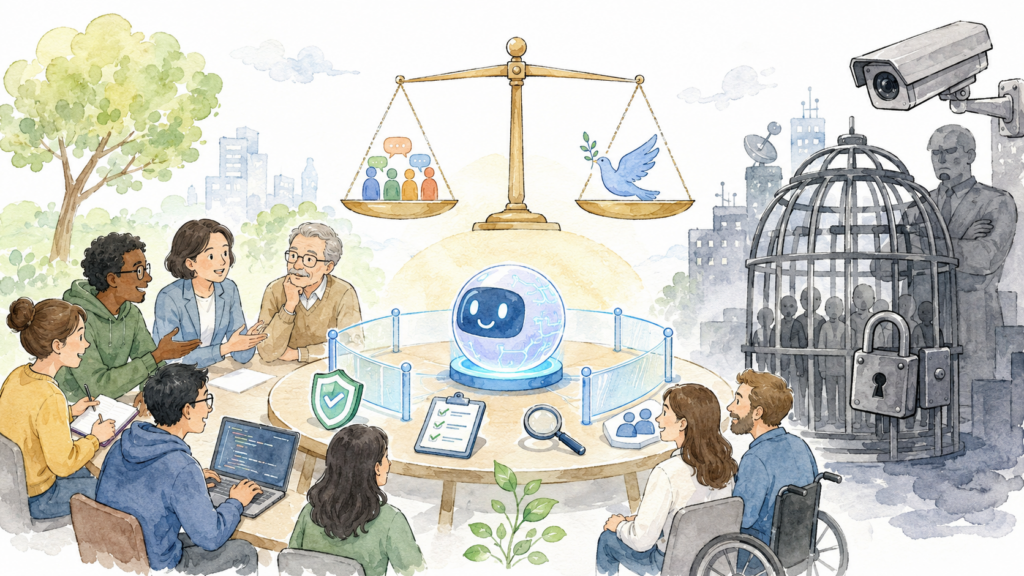
But Hu Yilin is not simply advocating “no regulation.” He emphasizes that, in order to pass through the turbulence of AI more peacefully, regulation is still necessary. The problem is that regulation should be more bottom-up than top-down; it should rely more on industry self-discipline, civic organizations, open-source communities, and decentralized institutional experimentation, rather than a government decree.
For example, when it comes to restricting the use of high-risk models, if AI companies were to spontaneously form an industry association to coordinate red-team testing, access thresholds, risk disclosure, and abuse tracing, that would be preferable to the government suddenly ordering a ban. Open-source communities can also explore their own governance methods, such as tiered model releases, dangerous capability assessments, codes of use, community review, and accountability mechanisms. Hu Yilin acknowledges that there are no ready-made answers for how these institutions should be designed; in many cases, one can only “cross the river by feeling for the stones.” But he believes that when exploring new institutions, one must adhere to some basic principles: openness, freedom, decentralization, spontaneous order, and vigilance against the concentration of power.
In his view, AI’s dangers are real, but one cannot allow human civilization to regress politically and culturally just because danger exists. Throughout history, all authoritarian governments have loved to use “security,” “order,” and “stability maintenance” to strengthen the concentration of power. A society may perhaps achieve outward calm through high levels of control, even to the point where “a road is not picked clean of lost property,” but if the price is the sacrifice of freedom, creativity, and human dignity, then it is nothing to admire.
Hu Yilin understands the AI revolution within a longer history of technology. Printing advanced the Reformation and also changed political communication and public opinion; American independence was inseparable from newspapers, pamphlets, and public debate; the Industrial Revolution shattered feudal institutions and also brought severe social conflict. Technological revolutions have never been gentle or painless; they are often accompanied by chaos, bloodshed, and the collapse of old orders.
“The AI revolution is not a dinner party either,” Hu Yilin says. It will inevitably plunge the international order and social life into upheaval. The wise course is not to reject the AI revolution, but, on the premise of acknowledging that new technologies are irreversible, to build a new order in a more peaceful and less bloody way as far as possible.
Therefore, what he truly opposes is not regulation, but the restoration of a closed order in the name of regulation; not security itself, but the elevation of security into the supreme value that overwhelms freedom. The AI age needs new institutions, but this new institutional order should not be a new despotism of the technological age. It should be a capacity for self-restraint that grows within an open society, rather than a future that can be switched off at a single stroke by state power.
Translated from the Chinese original with AI assistance. The original text is authoritative.