
The deadline for submitting assignments for the History of Technology survey course has now passed. Although I had already previously talked about plagiarism, it still wasn’t enough, so I’m posting a special article here to explain the matter and to lay down rules for how I will deal with plagiarism in the future.
This time there were 29 students in the course altogether. One student withdrew from the class (not taking the exam and not submitting the assignment), so the actual number was 28. Looking at their midterm assignments now, I found a total of 5 plagiarized pieces! That’s almost one-fifth!
Of course, among them were 2 international students (though they are international students, they are clearly Chinese; the non-native Chinese speakers, in fact, work much harder), and 2 art students. If we exclude students admitted by non-standard routes, doesn’t that restore a little confidence in Tsinghua? But when I grade, I treat everyone the same; I won’t give you any special consideration just because your “background is not good.”
This extremely high plagiarism rate still comes on the premise that I have repeatedly emphasized, “You may copy books, but do not plagiarize.” The assignment I set was called “paper or reading notes.” Students who are not good at writing papers could substitute reading notes, and reading notes were not restricted in format. One could be very lazy about it: copy long passages from the original book, and after each copied passage add one or two lines of complaint if desired. When I discovered that there were 2 plagiarized submissions among the early assignments, I even angrily issued an announcement, emphasizing that as long as you copied out 6,000 words, you would definitely pass, and emphasizing that plagiarism would definitely get 0. That announcement has already received 50 clicks, but afterward three more plagiarized assignments were submitted.
This phenomenon left me stunned, and at the same time forced me to reconsider my own attitude toward plagiarism. I’m afraid I still wasn’t clear enough in stating my position; in particular, I should have explained it clearly at the very beginning of the course and emphasized it more strongly when assigning the work. I thought my expression this semester was clear enough, but reality slapped me in the face.
Why do students plagiarize?
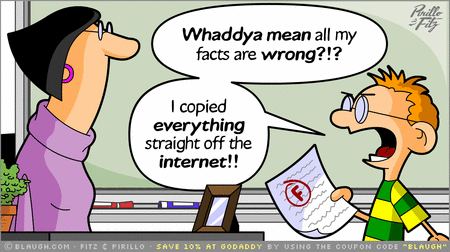
What has most overturned my understanding from this course is the question of why students plagiarize. My original understanding was rather naive: I thought plagiarism was nothing more than those students not wanting to work hard, not reading, not putting in the effort to study, and having to cobble together a paper to bluff their way through, so naturally the only option was to plagiarize.
But this reason of “bluffing your way through” utterly fails to explain the behavior of these students in my class. Because according to my assignment requirements, if you wanted to bluff your way through, all you had to do was take an e-book, randomly copy a few passages from it as quotations, and you could get by. And I had also promised that the grade would not be ugly. (In fact, as long as plagiarism is not discovered, the assignment is basically never below 80, the vast majority are above 90, and half the class is above 96.)
So if copying from books is enough to get by, why plagiarize at all? I still haven’t figured this out, so I can only make some tentative guesses.
Guess 1: Did they feel that a copied assignment was too perfunctory and would definitely not get a high grade, so they wanted to hand in something that looked more presentable? It’s possible that one student had such a mindset, but it certainly wasn’t the case for the others, because the assignments they turned in were disgusting at a glance: one submission had punctuation and fonts all over the place and even contained “?????”; another didn’t even remove the Baidu Baike link; one turned in a reading note on Cao Yu’s Thunderstorm (hey sister, this is a History of Technology survey course)…… These were obviously trash, assignments that clearly would not get a high grade even if I didn’t catch the plagiarism. Obviously, they weren’t turning in such things merely to get by.
Guess 2: Were they really just too stupid—so stupid that even though simply copying from books would get them through, they somehow failed to think of this convenient and reliable method? I feel this guess is a little more plausible, because judging from the actual results, they really are stupid. But even if they may have entered Tsinghua through non-standard channels, Tsinghua’s back door isn’t something you can just stroll through; however you look at it, they can’t be idiots, can they? So their brains probably aren’t dumb, and yet why did they still do something stupid? I’m afraid it’s still because their thinking is blocked; they simply never thought in the direction of a proper method at all.
Guess 3: So rather than saying they are stupid, it would be better to say they are “stubborn,” single-mindedly going all the way, knowing only plagiarism as a way to bluff, forming a stubborn mental set that can’t be dragged back. The teacher says you can just muddle through and pass; they say: no way, I insist on muddling through in my own way, I can’t do it any other way. But why would that be? One explanation is that they’ve become habitual old hands at it, always bluffing by plagiarizing; when I told them they could bluff without plagiarizing, they were unprepared for such unexpected happiness, so they simply maintained their usual style. This explanation may apply to one senior student, but the problem is that there are also 3 freshmen. For freshmen, this is only the second semester of college classes—how could they have developed such a deeply rooted habit already? That still doesn’t explain it.
Guess 4: So their “habit” of plagiarism probably wasn’t formed merely within half a year or a year after entering university, but has deeper roots. It had already eaten into their body and mind during middle school, or even in childhood, and only then could it produce this kind of state deep to the marrow, leading to this stubborn, headlong persistence in plagiarism.
And so I arrived at a sensational conclusion: plagiarism has already seeped into the blood of this nation, becoming not just an infectious disease but even a hereditary disease.
A cultural environment where cheating has become the norm
Of course, talking about national character is definitely over the top, but from the perspective of the cultural environment, it is indeed true that Chinese people as a whole are tolerant of fraud. Starting from elementary school, schools and teachers, by their own example, repeatedly show us how to fake things: how to rehearse before an open class, how to speak when being interviewed, how to cooperate when competing for titles like model school or civilized city, how one should deal with inspections, and so on…… Not to mention how students, when they need to learn to write essays, use fabricated stories to embellish fabricated emotions. One could say that every student grows up in an environment saturated with fakery. As for those returned international students who are “exported and then sold domestically,” the fact that they got into Tsinghua by such a method is itself the result of exploiting loopholes, so naturally one can imagine the environment in which they grew up.
Besides the matter-of-course atmosphere of cheating, disrespect for creators of knowledge is also a common tendency. A few days ago there was an uproar over the fact that a Shanghai Chinese-language textbook changed “grandmother” to “maternal grandmother” in a reading passage. Shanghai residents were furious, feeling that this was the oppression of southern dialect by northern dialect, that local culture was being invaded, and so on. But the issue is actually very simple: this article has an author. Whether to change it or not, and what to change it into, should always be up to the author, even if the author has already sold the copyright of the revisions outright to the textbook publisher. Out of respect for the original work, this should still be asked of the author first. But of course the textbook compilers will not consider the original author’s opinion.
Now that self-media is popular, interviewing and investigation are long no longer basic skills for journalists; “shui gao” is. A lot of online literature, apps, and the like copy one another, and they do so as if it were perfectly natural. The actual original authors get up early and work late, conduct in-depth research, and write an article, only to receive a pitifully small fee and sink into obscurity; when others repost it, they merely write “from the internet,” and that is considered very respectful.
How universities can resist plagiarism
I grew up in this kind of environment too. I also once racked my brains fabricating stories in order to write essays; this kind of behavior has been treated as perfectly natural since childhood. The whole atmosphere makes you used to hypocrisy and blind to originality; when students like this enter university, it is a miracle if they can consciously resist plagiarism.
And universities themselves are part of the whole cultural environment, so naturally they do not escape it either. Overall, universities continue to indulge, and even cultivate, students’ habits of plagiarism and fraud.
A few years ago I heard about a stage in the thesis process called “plagiarism checking.” Fortunately, it doesn’t seem to have become popular yet at Peking University or Tsinghua, but it seems to be very common at institutions everywhere else. For example, the official Weibo account of People’s Daily has openly promoted methods for “plagiarism self-checking.” The widespread application of this technical measure only further encourages plagiarism. For why I say this, see what I previously called “result eclipsing process” — when an auxiliary means of detection and assessment itself turns into the goal, it may instead encourage the appearance of those “melamine” cases. If you are going to add melamine in order to pass a protein test, then it would be better to allow you to simply water it down directly.
The technology of “plagiarism checking” was originally only an auxiliary means of identifying plagiarism. If plagiarism is detected, that does not necessarily mean plagiarism actually exists; it may just be that the citation format could not be read by the machine (I myself have had such an experience), and if no plagiarism is detected, there still may in fact be plagiarism. Plagiarism checking itself does not mean plagiarism; it is only a technical means to help detect plagiarism. But the crucial question is: can the person who writes the article not know whether they plagiarized or not? Then why would the author themselves need to do “plagiarism self-checking”? What exactly is “plagiarism self-checking” checking? Obviously, what it is checking is no longer whether there is plagiarism, but whether plagiarism can be discovered by the school under the premise that one already knows it is plagiarized. The fact that the concept of “plagiarism self-checking” can even make sense shows that dealing with inspections has become the goal, and whether there is plagiarism is no longer important—or rather, plagiarism has become the default option.
In such an environment of universal plagiarism, it already seems quite rare that fewer than one-fifth of my class plagiarized.
In response to the trend of plagiarism, there are even people saying that graduation theses should be abolished, because original papers are hard to write, so one has to plagiarize; since plagiarism is not allowed, one might as well not write them at all. This kind of statement is also absurd to the extreme. Writing a paper is itself the most basic competence required by many majors. If someone has studied a field like literature, history, philosophy, law, sociology, or economics for four years and still cannot write a paper, then they simply should not graduate.
As for the fact that statements like “original papers are very hard” can be made, brazenly spoken by university professors and even reposted by the official CSSCI Weibo account, this also proves the widespread lack of understanding in China of academic research. What does originality mean? It does not mean building an airy castle out of nothing; on the contrary, it means standing on the shoulders of predecessors and peers. The most fully integrated and most effectively utilized work of others is precisely the most original achievement. To emphasize originality is to emphasize citation; it means not plagiarizing and writing for oneself. That is not hard to do.
Universities’ resistance to plagiarism should not rely on barriers like plagiarism checks, and even less on foolish ideas like abolishing degree theses. Rather, they should return to fundamentals and convey the right scholarly outlook and standards of writing to students. Of course, many Chinese universities are filthy and chaotic, and even professors don’t know how to write papers, so naturally it is impossible to talk about teaching students well.
Not plagiarizing makes writing papers easier
The reason people say original papers are very hard is because they lack the most basic understanding of academic writing. In fact, even a freshman can easily write an original paper. The only issue is that the significance and level of the original achievement may vary, but an original paper really is very easy to write. That is to say, as long as you do not plagiarize or steal, think for yourself, write for yourself, and honestly mark citations for anything taken from elsewhere, then it will certainly be an original paper—one of a kind, no branch office elsewhere; if there is any resemblance, it is purely because it was copied.
A paper written carefully by a freshman may be superficial and immature, but everyone has their own immaturity. My own immature style is also my personal characteristic; it cannot be exactly the same as anyone else’s. My paper is the result of my own searching, reading, thinking, and writing, and of course that makes it my original paper.
If you say your level is limited, that you don’t understand how to cite, and don’t know whether a certain sentence should be cited or not, then the method is simple: for anything you are not sure about, cite it all. What is so hard about that?
Of course, citation sources differ in quality. More professional scholars have a deeper understanding of the relevant literature resources, so they are better at citing the most primary or most authoritative sources. Freshmen may be entirely unfamiliar with the state of the academic field and may only be able to cite some online materials and popular articles. Then articles that draw on thicker and stronger sources are of course more professional, and articles that cite shallower and less reliable sources are of course more amateur. But this is still only a matter of level, not a matter of plagiarism versus non-plagiarism.
In short, writing a non-plagiarized paper is really very simple. As long as you understand a little about the business of “citation,” and write honestly, that’s enough.
By contrast, writing a plagiarized paper is relatively difficult. Of course, taking someone else’s entire paper, changing the author’s name, and handing it in is indeed very simple (though making sure the teacher doesn’t notice is also quite difficult). But if you want to copy a little here and pirate a little there, cutting and pasting together a paper, that is not easy.
Why not? Because every normal paper is original, the result of the author’s independent searching, reading, thinking, and writing, and every sentence in it, even every citation, has its own unique context. Different authors have very different accumulations from reading, different ways of thinking, different questions they face, and different styles of argument. So if you want to extract their various statements and fuse them into your own language to make a smoothly reasoned article, that is extremely difficult.
When I was a teaching assistant and when I was a teacher, how did I catch plagiarism? I did not copy every article down paragraph by paragraph to search for it, nor did I use plagiarism-checking websites, and I certainly did not take especially well-written passages and run searches on them. On the contrary, I always checked for plagiarism when I saw articles that were especially, especially bad. More specifically, I always suspected plagiarism when I saw particularly awkward, twisted, bizarre, or abrupt sentences in an article.
Because if the student is not writing according to their own line of thought—if they are not writing what they themselves think, or what they themselves read—then, because it was copied, all sorts of discordant signs appear. For example, the logic suddenly jumps, the views in the preceding and following text conflict, the style suddenly changes, and so on.
To avoid outright copying an entire paper and instead stitch together something that still looks decent from bits and pieces, is extremely difficult. I have never seen it done, and I cannot imagine how one would write it. Of course, if you really can painstakingly piece together such a paper, then adding quotation marks to all the plagiarized parts and turning them into citations will certainly make the paper much better.
There is no “anonymous knowledge”
So many people think writing papers is hard entirely because of a misunderstanding, and a major part of this misunderstanding is the belief that there is such a thing as “anonymous knowledge.” That is to say, they think some knowledge has no source.
Even in the natural sciences, there are indeed many very common consensuses, but they still are not completely anonymous. For example, the most glorious thing for scientists is to have laws, units, or constants named after them: Newton, Watt, Ampere, Ohm, Euler’s formula, Planck’s constant…… These names proclaim that even the most basic scientific concepts still have a “source”; it’s just that because they are so important and used so widely, later generations no longer need to cite the original paper when using them, but instead show respect in another way. As for other experimental data, observational reports, and so on, they are even more clearly sourced: whose data were they, who discovered the facts—none of this knowledge appears out of thin air.
In the humanities it is even more so. Even things that are “well known to all” have a source: namely, the general public of a certain time and region. As for other viewpoints, assertions, and evaluations, of course they are all made by certain people and naturally have their origins. Of course, sometimes your skill is limited and your level is limited, and you cannot trace the most original source, but you can always trace some line of transmission and annotate it.
If that is the case, doesn’t a paper have to be nothing but citations from beginning to end? Of course, having citations from beginning to end is also fine; there is nothing wrong with it. But under normal circumstances there are of course many non-cited sentences of your own, and these sentences are not anonymous either; they do not lack a source. The source of these sentences is you yourself. Otherwise, why would it be called originality?
Of course, original statements can also happen to coincide with others’ statements. For example, if I say, “Marx put it well,” or “As Engels said,” others may also make that evaluation; Zhang San and Li Si may both think Marx put it well. So do I need to put quotation marks around even these two sentences and say them through Zhang San’s mouth? Not necessarily, because even if Zhang San and Li Si say the same sentence, the meaning of the sentence is still somewhat different. The context in which they say it cannot be exactly the same, the basis for their judgment and the resources they stand on are not the same, and the questions they address or the objects they compare are not the same.
So the same sentence can be spoken by you yourself without citation, or cited as said by Zhang San, or cited as said by Li Si, and the different methods express different meanings.
Then in what circumstances can you personally state your judgment without citation? If and only if that really is your judgment. How simple is that.
For example, one plagiarized passage I caught this time was prompted by the following paragraph: “Whewell ultimately established his status in the history of science, becoming the most outstanding figure in the field of history of science at that time… By the mid-nineteenth century (this date is problematic; this student wasn’t copying rigidly, but made some slight changes, and here he obviously got it wrong), research in the history of science had already accumulated many works, such as Dampier’s *History of Science*, and so on.”
As soon as I saw this whole big paragraph and found no footnote, I was immediately 100% certain it had been copied. The student may have thought these were all objective facts—something anyone would say the same way—so he could just copy them directly and use them without citation. In fact, it was nothing of the sort. Was Whewell (also translated as Sewell) really the most outstanding? Of course he had emblematic significance, but to say he was that outstanding would be far from true. As for Dampier’s *History of Science*, it is utterly insignificant in academic circles; the only reason this book became well known is that its Chinese translation came out earliest. In reality, it is merely a popularizing work written by an outsider journalist (not a scholar of the history of science) with old-fashioned ideas. Truly influential masters like Koyré, by contrast, weren’t even mentioned. Why mention a journalist and not a master? Because what was copied was merely some text written by an extremely amateur person from who-knows-where on Baidu Baike.
Of course, even if this student had written Koyré instead of Dampier, he would still have been exposed, because whether it is Dampier or Koyré, the first-year student would be unable to independently make a judgment about their place in the history of science; therefore such a judgment must have a source.
In fact, to judge who was most influential and who more outstanding across an entire era and an entire scholarly world—how difficult is that? How many texts would one have to read? Only by being very familiar with the field would one be qualified to make that judgment. A first-year student certainly does not have that qualification, so he can only be quoting a more authoritative source.
For instance, as a PhD in the history of science, I do have a little qualification to make judgments, because I can synthesize the general academic consensus and have personally read the works of Sarton, Koyré, and others, so to some extent I do have the ability to offer a personal appraisal and overview of the historiography of the history of science. Of course, the overview I produce comes from my own judgment. And since a student does not have the ability to produce such an overview himself, the judgments he gives must always come from somewhere else; if he fails to indicate the source, then it is definitely plagiarism, isn’t it.
But even if I am qualified to make my own judgments, I can still cite more authoritative sources, because there are many people even more qualified than I am to make such judgments. The same sentence: if I quote a more authoritative person to express it rather than saying it in my own name, that unquestionably increases rather than weakens the weight of that judgment. For the same sentence, whether I cite Zhang San or Li Si is not the same either; it reflects my scholarly accumulation and taste.
All knowledge, views, judgments, comments… are named. Anything without a name attached is one’s own. How simple.
Stealing books is stealing
Many people greatly overestimate the difficulty of writing a serious paper, while grossly underestimating the consequences of plagiarism. They think plagiarism is at most just a minor mistake, causing no harm to others and little effect on themselves—at worst, rewrite it, and that’s that. What else could happen?
The image of Kong Yiji in Lu Xun’s writing has deeply entered people’s hearts:
“You must have stolen someone else’s things again!”
Kong Yiji widened his eyes and said, “How can you slander people out of the blue like this…”
“What innocence? I saw you steal He’s book the day before yesterday, and they hung you up and beat you.”
Kong Yiji then flushed red, the veins on his forehead standing out in ridges, and argued, “Stealing books can’t be counted as stealing… Stealing books!… A scholar’s affairs, can that be counted as stealing?” Then came a string of hard-to-understand words, things like “a gentleman remains poor,” and “zhehu,” which drew everyone into loud laughter. Inside and outside the shop, the air was filled with cheerfulness.
“Can a scholar’s affairs be counted as stealing?” Those are Kong Yiji’s words, obviously a joke meant to be funny and ironic. But many people really do defend plagiarism and piracy in just this Kong Yiji manner. A scholar’s affairs don’t count as stealing.
If stealing books doesn’t count as stealing, then what does plagiarism count as? It doesn’t make the original author lose anything, so what’s the big deal? But this logic is obviously nothing more than sophistry. A work, for its author, is unquestionably sweat and blood, flesh and bone, property. When an author makes a work public, just as a collector makes a collection public or a painter hangs a painting out for display, the author merely hopes that more people will see it; he is not relinquishing ownership of it.
To take something without asking is called stealing. If someone lets you look at it, or even lets you play with it or borrow it, and you sneakily carry it home, that is naturally theft.
The problem is that after ordinary theft, your home has one more thing, and the original owner’s home has one thing less. But after article plagiarism, on the surface it seems that the original author hasn’t lost anything. How, then, can this be called stealing?
However, although the original author does not suffer physical damage from the plagiarizer, he is by no means unharmed. Because the reason an author makes his work public is not some selfless, pure act of giving; rather, he hopes to gain something from the act of publication. What does he hope to gain? Very simply, first and foremost fame and profit. Earning benefits through copyright or patent rights is protected by the intellectual property regime, and this system is itself one of the foundations that have enabled modern science and technology to develop at high speed. At the same time, especially for humanists, reputation is often an even more important pursuit. Authors all hope readers will read their works, understand their thoughts, spread their reputation, gain recognition and exchange in life, and achieve an immortal continuation after death.
And acts of plagiarism, to a greater or lesser degree, will always damage the author’s fame and profit. From the logic of taking without asking, and from the result of harming the original owner, plagiarism is no different from theft.
Of course, the degree of harm varies. Some plagiarism causes enormous damage, perhaps directly causing the original author to vanish without a trace or suffer profound misunderstanding; some causes relatively little harm, and in very rare cases may even do no harm but instead help the original author become more famous. But these differences in degree cannot eliminate the fact that plagiarism is theft. It’s like going to a museum: some people steal the Mona Lisa, others only steal a few pebbles. Of course the difference in degree is enormous, but a great thief is still a thief, and a petty thief is still a thief. Theft is theft, plagiarism is plagiarism; there is nothing to discuss. Sentencing may differ in severity, but there is no difference in establishing guilt.
Plagiarism not only harms the original author, it also harms readers, harms society, and even more so harms oneself. China’s current situation is precisely like this: in an environment where you plagiarize me and I plagiarize you, young readers learn neither proper attitudes nor serious scholarship, and will only continue copying back and forth. Every plagiarizer is both a perpetrator and a victim.
The harm plagiarism does to oneself is even greater. Life is an irreversible journey; spilled water cannot be gathered back, and things done cannot be taken back. Not all mistakes can be easily remedied, and plagiarism is one kind of mistake that becomes difficult to erase once committed. I won’t make public plagiarism in course work, but if a student has plagiarized in a thesis or any public text, then even if he becomes famous decades later, others can dig up his old offenses at any time and strike at his reputation, and he will have no way to refute them at all; he will never shake off the label of plagiarism in his entire life.
Because China’s cultural environment is now so indulgent toward plagiarism, many people fail to feel how awful this lifelong stigma is. But students will not be students forever, and China cannot possibly remain in this disgraceful state forever either. Students will grow up, and China will eventually change as well, but once plagiarism has been committed, by the time one regrets it then, it will already be too late.
My measures
I cannot change the environment, but at least I can control myself. When I am a teacher, I cannot change the broader Chinese environment, but at least I can control the basic requirements of my course. Since I believe excessive indulgence toward plagiarism is wrong, then I cannot indulge it.
When I used to serve as a teaching assistant, when facing plagiarizing students, I would often give them a chance to rewrite and then let them pass with a barely passing grade. But now that I am a teacher, with nothing much left to worry about, I should carry out my own position.
First, plagiarists should not be given a chance to rewrite. If I give them a chance to rewrite, then the impression people get is: plagiarism? At worst, if you’re caught, just rewrite it and that’s fine; if you’re not caught, you just get through; if you are caught, you don’t really lose anything. That is not leniency toward students, only indulgence toward plagiarism.
Although I cannot change the broader environment, what I can at least do is make plagiarists feel this sense of irreversible loss within my course. Only then can they truly learn a lesson.
Second, I do not speak kindly to plagiarists. If I were not, in the end, still somewhat unable to let go, I would gladly strive to mock and humiliate plagiarists. I believe this is the more responsible kind of education, because the cultural environment is so poor that people cannot feel the atmosphere of “plagiarism is shameful,” and that is precisely what encourages plagiarism. Since I cannot change the larger cultural environment, I can control the environment of my course. At the very least, within my course, students should be made to feel the atmosphere of “plagiarism is shameful” and to develop the basic taste of looking down on plagiarism. But I would not go so far as to publicize the plagiarist’s work and rally everyone to despise it together, so I can only try my best to express the appropriate contempt in my own words. University students are already adults; their minds are not that fragile, and there is no need to hold them in the palm of one’s hand and treat them like little emperors. Letting them face an appropriate judgment is the more responsible attitude.
To sum up, my attitude toward plagiarism is just one sentence: zero points with no room for compromise and merciless mockery.
From now on I will remember, at the start of the semester and when assigning work, to state my attitude repeatedly.
Translated from the Chinese original with AI assistance. The original text is authoritative.