
Prelude
0.1. The Triple Transformation of Faith, Thought, and Power
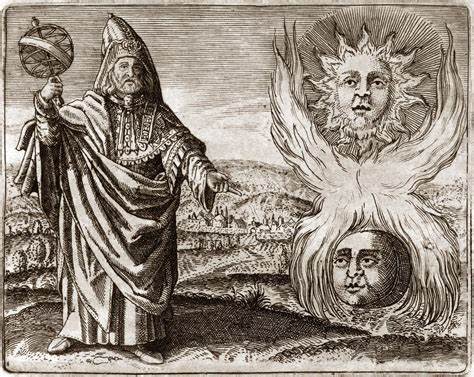
During the Renaissance, a new current of thought arose in Europe. Many thinkers and activists who opposed the decayed and rigid dogmas of the Middle Ages gathered together, seeking to revive ancient, Eastern wisdom. The new idol they invoked was called “Hermes Trismegistus” (“the thrice-great Hermes”).
Copernicus said that the sun should sit at the center of the universe, just as “the thrice-great Hermes called the sun the ‘visible god’”; Bruno was burned at the stake for spreading Hermetic heresy; Boyle and Newton followed Hermes’s Emerald Tablet and devoted themselves to alchemy; the legendary Rosicrucians advocated the selfless sharing of Hermes’s wisdom and promoted a reform to be undertaken for all humanity…
We do not know whether Hermes was ever a real historical figure, but in any case, the role he played as an anonymous symbol was far more influential than he was as an actual writer.
The reason he is called “thrice-great” is that, according to legend, Hermes was at once the greatest priest, philosopher, and king of ancient Egypt (priest, philosopher, and king). These three identities correspond precisely to the three dimensions of human culture: faith, thought, and power. And from the Renaissance and the Reformation to the Scientific Revolution, and then on to the Enlightenment and the Industrial Revolution, this whole series of ancient-to-modern transformations that ultimately enabled the rise of the West also began simultaneously in these three domains. Seen from another angle, if a revolution does not penetrate all three of these domains at once, then it does not count as a truly great revolution. In essence, what is truly “thrice-great” is not Hermes, this largely fictional figure himself, but the Renaissance movement propelled by the Hermeticists.
Today, the crypto movement initiated by Satoshi Nakamoto, or more broadly speaking, the networked social revolution of the information age, is also another new wave of “triple greatness.” Many people cannot see the whole picture and only care about the money-making opportunities or criminal risks offered by blockchain, much as most people in the past could not foresee that the spread of the printing press might shake the authority of the Catholic Church. But I, after all, work in the history of science and technology; after studying those great transformations in history, I believe that the movement before our eyes is likewise a great transformation occurring simultaneously across multiple dimensions.
In this movement, the three domains undergoing transformation are still faith, thought, and power; and much like the Renaissance, these transformations did not arise out of thin air, but rather as a revival of many traditional yet obscured values in human civilization. At the level of thought, the focus of the transformation is to elevate “individual freedom.” This is not a brand-new concept, but a reexamination of the classical liberal and Austrian School ideas of freedom; even the mutually opposed traditions of Hayek, Marx, Arendt, and others may perhaps be brought together under one roof. At the level of power, the focus of the transformation is to implement “decentralization,” to elevate communities and bottom-up forces, and to resist traditional power structures. At the level of faith, perhaps the controversy is greater: much of what people casually call “Bit-ism” is actually still at the level of thought and has not yet reached the level of faith. I think that the revival at the level of faith ought to be a revival of long-termism and historicism (in contrast to short-sighted capitalism), as well as a revival of the city-state spirit that pursues excellence (in contrast to a mass-media society that pursues traffic and attention).
Of course, any great social transformation is difficult and tortuous. As the crypto movement has developed to this day, it itself now faces the danger of degeneration or co-optation. So what we need now is a “revival of the revival,” first of all to revive the early spirit of innovation in the crypto movement.
The recent inscription movement is an opportunity. Through this movement, we have the chance to revive Bitcoin maximalism, and thereby further revive the independent and free thought inherent in Bitcoin; we have the chance to revive the power of the retail community, and thereby further revive the decentralizing movement for the transformation of power structures; we have the chance to revive Chinese culture, and thereby further draw on the more conspicuous long-termism and historicism within Chinese culture to advance the revival of the city-state spirit.
I. Reviving Bitcoin Maximalism
1.1. The inscription movement is rebellious performance art, but it also has a money-making future
Regarding this wave of inscription fever, my initial view was that Bitcoin inscriptions were akin to a wave of “performance art,” whose significance lay in exposing the absurd present condition of the crypto-currency circle, especially the ERC20 speculation culture on Ethereum. The early phase of the inscription craze roughly coincided with the MEME coin craze, which also confirms the spiritual aim of this wave: popularization; anti-VB (Vitalik Buterin); anti-VC (venture capital); fair launch; anonymous initiation…
By “performance art,” I mainly mean the rebellious character of the inscription movement; I am not denying the profit-seeking nature of this movement. In the crypto-currency circle there has never been any action that is purely art for art’s sake. Perhaps the initiation of Dogecoin in those days could count as a piece of pure performance art: the initiator’s original intention was to satirize the atmosphere of speculation and hype in the crypto-currency circle, so he made a joking MEME dog head into the currency’s image, and after it launched he quickly sold off all the coins he had mined. Yet unexpectedly, Dogecoin continued to be enthusiastically embraced by the community, and in the end even got hyped up by Musk. After Dogecoin, for the initiator to say he did not want to make money and only wanted to play with memes and jokes became somewhat hypocritical. We have already seen that the crypto-currency circle always mixes memes and speculation into one thing, intertwining punk spirit with capitalism.
So I am also willing to believe that in this wave of inscription fever, there will ultimately emerge a new hero surpassing Dogecoin and even overturning Ethereum. Although, on the whole, the frenzy of short-term speculation is the dominant force (this is the norm in the coin world), once the inscription movement contains some genuinely targeted spiritual aims that may have long-term influence, then it may firmly occupy an ecological niche.
1.2. The ecological niche inscriptions may occupy is that of Bitcoin’s parasite
“Ecological niche” refers to a certain way of taking root within an ecosystem. As the saying goes, one mountain cannot contain two tigers; two forces with converging “positions” will always fight to the death. But if differentiated positioning can be found and sufficient consensus achieved, then two blockchains can coexist in the world and prosper together. For example, Bitcoin occupies the position of “digital gold,” requiring maximum reliability as a store-of-value currency while also remaining firmly established as the originator of cryptocurrencies; Ethereum got its start by providing a “smart contract” platform, and it won by relying on the cohesion of its spiritual leader, V God; Dogecoin occupies the position of grassroots culture and MEME culture. (Of course, the latter two positions may not be stable.)
So what about inscriptions? Many people say that the inscription craze is a return to the “Bitcoin ecosystem,” and I partly agree with that. But a more apt analogy may be that inscriptions and Bitcoin have a “parasitic” relationship: that is to say, the development of inscriptions depends on Bitcoin, but conversely, Bitcoin’s survival does not depend on inscriptions; on the contrary, it may see inscriptions as bloodsuckers or destroyers.
But a parasitic relationship does not mean that long-term coexistence is impossible. The parasite does not hope for the host’s demise; on the contrary, the parasite also hopes that the host grows ever stronger and more prosperous. On the other hand, although Bitcoin inscriptions need to draw on the resources of the Bitcoin network, they are also contending with Bitcoin’s other competitors. In the long run, whether the relationship is parasitic or mutualistic remains to be seen.
Whether parasitic or symbiotic, in any case, we can say that the Bitcoin inscriptions opened up by BRC20 count as part of the “Bitcoin ecosystem.” Just as the altcoins of the past could also be counted as part of the Bitcoin ecosystem. This is because both altcoins and Bitcoin inscriptions are a kind of “Bitcoin-standard economic system.” What I mean is that when I invest in or speculate on a certain altcoin, just as when I buy Bitcoin inscriptions, I am more inclined to denominate them in Bitcoin and to calculate gains and losses in terms of Bitcoin. Those who trade short-term will, at least for a period of time, measure profit and loss in Bitcoin. What makes inscriptions even more closely tied to Bitcoin than the altcoins of the past is that the fees for minting and sending inscriptions are also denominated in Bitcoin.
1.3. The first dimension of the great revival — returning to the Bitcoin standard
This is the first kind of “revival” I want to speak of, namely a return to the Bitcoin standard — the Bitcoin Standard (this is a bible for spreading the Bitcoin idea; the Chinese translation is called Future of Money, but the literal translation should be Bitcoin Standard).
The Bitcoin standard is directly opposed to the dollar standard, and at the same time the Bitcoin standard is a “revived” gold standard in an entirely new way. This idea is a total rebellion against the world monetary order and financial system since the collapse of the Bretton Woods system. It is a return to the spiritual aims of the gold standard (rather than a return to the gold standard itself). The core of the gold standard is that centralized, top-down monetary manipulation must be restrained, and the power to mint or issue money must be decentralized.
So Bitcoin was revolutionary from the very beginning. It opposed what seemed like an impregnable world order, overturned the rules and practices of Wall Street, that place of wealth enough to rival nations, as well as the entire financial and banking system, and mocked the consensus and tacit understanding of the ruling class, the giant capital sharks, and all the other vested interests…
To participate in so great and exhilarating a cause, the first step we take is extremely simple, but in a sense also extremely difficult: namely, to make the following paradigm shift in thought, from a fiat-currency standard to a Bitcoin standard. After the switch, many things look different in nature. For example, buying Bitcoin is no longer an “investment” but a form of “saving”; for example, an investment with an annualized 1% return becomes a high-risk thing; for example, I no longer need a bank to hold my money; for example, I no longer flinch at the very mention of deflation…
Of course, as to how far the revolutionary nature of Bitcoin can actually be pushed, early Bitcoin users also had many disagreements. I remember that back then many Bitcoin users were anarchists. They not only wanted to strip the government of its power to mint money, but also wanted to strip the government of all authority, making everything from judicial to administrative affairs completely marketized and decentralized. I myself am of course not that radical. But whether radical or conservative, left or right, the early Bitcoin users should at least have been able to reach a very basic consensus: namely, that Bitcoin is revolutionary, that it is a “social experiment.”
And this notion, as the coin world developed, especially after ERC20 replaced altcoins as the preferred channel for issuing coins, after stablecoins became popular, after the rise of DeFi, and of course after the U.S. government increasingly intervened in the coin world as well… the coin world has become ever more feverishly popular, but its revolutionary ideal seems to have been castrated. Coin speculators have increasingly turned to U-standard, that is, investing denominated in U.S. dollars. Coin issuers and speculators, facing regulators, tremble with fear and self-castrate themselves (especially by castrating the securities ecosystem that had long been popular in the coin world), no longer daring to cross even a single line. The very spirit of “decentralization,” which makes blockchain technology viable in the first place, has been thrown to the winds—I have repeatedly emphasized the ideal of decentralization at events in the blockchain circle, only to be mocked by many people who only want to talk about “wealth codes.”
Let me emphasize again: I am not opposed to “wealth codes” in themselves. From the beginning I said that trying to make money in the coin world without wanting to make money is hypocritical. But making money should have the spirit with which to make money. The pioneers of Bitcoin should be like those adventurers and gold prospectors who in their day ventured to the New World: a bit wild and unrestrained, with a free and easy spirit, and the heroic ambition to clear land and proclaim themselves kings—not like base serfs, kneeling and begging the lords to grant them a bowl of soup after they have had their fill of meat.
1.4. The posture for participating in the crypto movement should not be “licking”
Yes, we bitcoiner can participate in the coin world in all kinds of postures, but the one posture we absolutely should not take is “licking.”
In the beginning, most people’s posture was to “play,” so we very naturally called ourselves “Bitcoin players.” Many of the earliest players tried it out of curiosity, mined some bitcoin just for fun, and exchanged pizzas with others in the community just for fun as well.
Early Bitcoin players often said that we were carrying out a “social experiment”; if the experiment failed, then so be it—we had still staged such a spectacular, grand affair, and that alone was worthwhile.
Later, when my wave of Bitcoin players entered the scene, Bitcoin had already begun to take shape, so it could no longer be said to be a game that might stop at any time. Our main posture was “hodl” — the word hodl came from a misspelled post on a Bitcoin forum, but it quickly became jargon in the crypto world. This kind of somewhat cynical “persistence” was the basic attitude of a large group of Bitcoin players. Of course, this attitude was also based on the above-mentioned idea of “Bitcoin as the standard,” namely that holding bitcoin is saving rather than investing.
There were also some people, especially developers and entrepreneurs, who were dissatisfied with the overly passive mentality of the hodlers, so they shouted the slogan buidl. Rather than “build,” the Chinese word 搞, “to mess with,” “to work on,” or “to get things done,” is actually more apt. They believed that just hodling coins was not enough; one also had to stir things up, make projects, make communities…
A little later still, the mainstream posture became “speculating,” and several rounds of Bitcoin’s explosive rises attracted more and more speculators. But the original speculators were by no means some sort of capital titans. Back then, Zhao Dong sold a house and dove into the crypto world to speculate in coins, and that was already enough to make him a big brother-like leader in the crypto scene; he counted as major capital. Erbao and Yangyang got their start selling beef, while people like Sun-ge and Wu Jihan were just fresh graduates. At the time, each of them had his own moment in the sun, but nobody could really be said to be some towering magnate.
And yet, in recent years? What sort of posture do the young people newly entering the crypto world have? Allow me to borrow Zhang Xuefeng’s style and say something unpleasant: the main posture of newcomers is “licking.”
Within the crypto world, everyone is licking “V God” (VB), and then some people lick Sun-ge, while others lick various kol figures. Coin speculators desperately lick project teams to get allocations; NFT players also lick issuers to get on whitelists; project teams and issuers in turn desperately lick the capital side (VC), while small projects also have to lick kol figures to help create momentum. And then all the various leaders in the crypto world, including the capital side, together have to lick the government—emphasizing compliance in every possible way, being subservient and obedient, dutifully abiding by laws and regulations…
Forgive my frankness, but the crypto world from top to bottom is steeped in a culture of “licking.” The revolutionary spirit of opening up new frontiers and turning the world upside down has long since faded, and even the punk spirit of laughing, cursing, and resisting authority has become increasingly scarce.
This is not what the crypto world looks like in my memory or in my imagination. So I am hoping that the first great revival will not merely be a simple return to the Bitcoin-standard mode of pricing, but will also use this return to revive once again the spirit and energy of Bitcoin’s early community—we do not need to lick anyone, nor do we need to chase after others begging for crumbs. We ourselves are the pathfinders; we ourselves are the kings.
1.5. Anti-VB
Of course, objectively speaking, most of the people promoting the inscription ecosystem do not have the ideals or sentiments I have just described. More often than not, they are simply tired of the Ethereum ecosystem and want to speculate on something new, so they have switched over to inscriptions. However, even if they do not consciously see themselves as reviving anything, in practice they may indeed help rekindle the fire of revolution. It is like how, following the early adventurers, a new batch of people who journeyed to the New World may not have had particularly lofty ambitions or much daring; many of them were oppressed by the Old World, or were even outright prisoners, and in utter desperation chose to put down roots in the New World. Yet in the long run, their pioneering work was still revolutionary.
The players in the inscription ecosystem are mainly Chinese, and most of them are profit-seeking speculators, but at the very least they are tired of the way things work under the Ethereum ecosystem, tired of licking VB, licking VC, and exhausting themselves only to end up with at most a few scraps and leftovers.
Anti-VB should ideally be a wave that rises simultaneously both at home and abroad, but abroad capital has more often chosen Ethereum competitors such as the Solana chain, which in my view is merely the same soup in a different bowl, whereas domestic players have more often chosen meme coins and inscriptions, which look lower-end, but objectively, while getting rid of VB, they have also suppressed the position of VC.
Let us talk about VB first. It cannot be denied that VB is extraordinarily outstanding both technically and intellectually, and he himself can certainly be said to have ideals, sentiments, and revolutionary ambition. And as a community leader, VB was indeed a key factor in Ethereum’s victory over its early fork, ETC, and in its breakout from among the many smart-contract chains. But the problem is also that he cannot let go of his own ambition; after the Ethereum community gradually matured and grew, he did not consciously fade into the background as Satoshi Nakamoto did. On the contrary, he has continued to consolidate and strengthen his influence.
He has always been steering the direction of Ethereum’s development. This includes even targeted topics such as longevity, which were promoted around VB’s interests; on the other hand, major upgrades such as the shift from PoW to PoS were also pushed through thanks to VB’s forceful insistence in the face of widespread opposition. Some people may say: even without V God forcing it through, the Ethereum community would have chosen the PoS route anyway. Perhaps that is true. But the question is, since the community could spontaneously form such a tendency, why did VB still need to keep using his influence to promote PoS?
Bitcoin was born in 2009, and Satoshi Nakamoto voluntarily faded out by the end of 2010, withdrawing completely in 2011. Even though at that point Bitcoin was still a game for only a handful of geeks and still far from the ideal monetary system, Satoshi had already come to believe that the community was large enough to continue operating on its own. Ethereum published its white paper in 2013 and was sold in 2014, but it was not until 2018 that VB hesitantly said he was considering leaving the community, only to quickly abandon that thought because of “a sense of responsibility” and “a sense of mission.” To this day, he has been the community leader for nearly 10 years.
Regarding the shift to PoS, I discussed this before: Why Can’t PoS Ethereum Become the Standard Currency? In simple terms, PoS is a mechanism that is more conducive to incumbents permanently maintaining their position and share of wealth. The incumbents can “lie back and earn” forever, while latecomers and participants with fewer chips are forever at a disadvantage. Of course someone will object: don’t the early Bitcoin adopters also get to lie back and earn? — This line of thinking is a classic result of failing to switch to “Bitcoin-standard” thinking. Early Bitcoin adopters cannot lie back and earn. I have 10,000 bitcoins, then I have 10,000 bitcoins; every time I spend one, I have one less. If I want to increase my chips, I can only earn coins like newcomers do, and in earning coins the whales have no extra advantage—in fact they have a disadvantage: because of the transparency of on-chain transactions, when whales use large amounts of bitcoin to speculate and seek interest, they are more easily sniped by others, and may even end up losing their principal without earning any interest at all. By contrast, after a complete transition to PoS, Ethereum whales, under Ethereum-standard pricing, can safely and risklessly lie back and earn, forever maintaining or even expanding their share of Ethereum’s total market cap.
I do not want to dwell here on the defects of PoS. The key point is that even if PoS is the right direction, VB should not make the decision by fiat. The more VB understands his place in the community, the more he should proactively relinquish power, rather than always maintaining a leader’s position like a traditional startup company or even a traditional empire.
As a new investment asset, cryptocurrency has already grown large enough; but as a great social experiment and a revolution in the financial system, the crypto movement is still in a very early era, the order of the new world has by no means been established, and VB at most counts as having set up a small autonomous dominion by the coast, while the wild western frontier of the new continent remains a chaotic age in which heroes emerge in great numbers. In this sense, the disorderly state of the inscription movement is precisely something positive.
II. Reviving Decentralized Community Culture
2.1. Why the leaders of the crypto movement should hide or remain anonymous
Someone may well say: whom the masses pursue and whom they praise is a matter of freedom. Since so many people like VB and are willing of their own accord to place him on a pedestal, then that is also the choice of the free market, and there is nothing to criticize. However, on the one hand, facts have shown that VB’s status is not yet truly so high as to be unshakable; the recent market has proven that anti-VB forces are considerable. On the other hand, decentralization is the main theme of the crypto movement. The revolution in which we are participating is a decentralized revolution, not a revolution of dynastic change. We do not want to replace Biden or Yellen with Satoshi Nakamoto or Vitalik; rather, we oppose this centralized status quo as a whole: global investors, entrepreneurs, and even national governments are not watching market conditions but watching the speech of one person at a Federal Reserve press conference in order to decide their own investment strategies. A single person saying 0.5 or 0.75 can make the global economy tremble. — Think carefully about this. Such a scene is absurd and laughable. A market economy should not look like this. If after all this revolutionary effort, the end result is merely to hand the position of Federal Reserve chair to V God—a young man not yet 30, with the entire crypto market operating by watching every word and deed of his—then that is an even more ridiculous thing.
Finally, there is another very practical issue. That is to say, a person who is active and constantly on the move all over the world is very easy to control. Because of cryptocurrency’s revolutionary nature, and the enormous interests involved, the personal security of these active leaders is a matter that cannot be ignored. Of course, I am not talking about low-end attacks like kidnapping or assassination. To put it bluntly, if VB were assassinated, it might actually be a positive for Ethereum. What is even more frightening is being “controlled,” just as happened to Binance founder Zhao Changpeng, the richest Chinese person in the crypto world. Even though he was so law-abiding, bent over backward to seek compliance, and even proactively went over to lick the U.S. regulators and handed over a hefty protection fee, he was still controlled. And under this kind of overt and covert restriction of freedom, and even under the threat of severe criminal penalties, even the purest idealist will more or less make some compromises. Either they keep yielding and softening themselves, or they are simply brought into the fold and join hands with Wall Street and other old money in collusion.
So Satoshi Nakamoto set an example long ago: remain anonymous and withdraw in an orderly fashion. Remaining anonymous does not mean being “nameless”; it means separating one’s online identity from one’s real-world identity, thereby avoiding potential threats from traditional forces.
Many early founders of altcoins were also anonymous, but now the number of publicly identified founders in the crypto world is increasing. The reason is not hard to understand. The core of the early Bitcoin players was in hacker communities or open-source communities, and valuing anonymity was part of hacker culture. But in recent years, blockchain has long since moved beyond a programmer-led ecosystem and become a capital-led model. Many project founders first need to go and “lick” investors, and this process often requires in-person socializing as well, so naturally they can no longer remain anonymous. Then after the project grows, for the sake of compliance, some have to apply for various licenses, while others simply set up companies, and then the registration materials can no longer be anonymous. For example, the two anonymous founders of Bored Ape were dug up by reporters in their real-world identities, and the method was very simple: they searched company registration documents.
I am not saying these trends are bad. Blockchain is becoming increasingly popular, and breaking out of the circle is inevitable; it is impossible to remain forever confined to programmer communities. I myself have always acted under my real name, waving flags and shouting slogans. The “Huawendao” that I want to promote is also oriented toward attracting real-name participants. However, I have always believed that those very foundational, platform-level projects should still, as far as possible, insist on operating anonymously or in a decentralized way, so as to ensure the project’s independence to the greatest extent.
2.2. The significance of VC
I emphasize the independence of blockchain projects, especially their independence from the power of the old world. I am even more averse to the posture of project teams and even speculators chasing after VC to lick them. But it is worth stating that I certainly do not oppose “venture capital,” nor do I oppose support from old money for the crypto world. Even Columbus and Magellan also had to seek the support of the royal court. Moreover, although we claim to be making a revolution, our target is the system and the paradigm, not specific individuals or institutions. If these old money groups can look to the future and join the wave of reform, then of course that is a very good thing.
The problem is that so-called venture capital ought to mean “taking a gamble by giving money”; they pursue a chance at immense returns in exchange for bearing huge risks. Perhaps more than 90 percent of the projects a VC invests in fail, but as long as one or two are huge successes, they make a killing. Then for the projects that ultimately fail, the VC in fact plays the role of “giving money,” equivalent to the VC burning cash to sustain the entrepreneur’s radical action.
For technological innovation in the industrial age, VC played an important and positive role. The more one explores in unknown directions, the more one seeks disruptive innovation, the harder success becomes. Not to mention that large numbers of innovators were bound to run into dead ends; even those who found the right direction might not achieve success quickly. Watt’s steam engine, in its first entrepreneurial venture and production run, ended in bankruptcy; the early patent for the water-powered spinning machine also went bankrupt because of poor workmanship; the earliest high-pressure steam locomotives went bankrupt because of frequent accidents…
The key point is that many disruptive innovations are hard to bring to a complete industrial chain and a mature business model right away. Without investors’ sponsorship, those innovators might have to go bankrupt even before starting their ventures, and after a failed startup they would never be able to turn things around. But in fact investors share entrepreneurs’ risks, so that people who create novel things, as long as they can tell a story, do not end up destitute, and may even make considerable profits by selling shares. The internet bubble in 2000 came about because the stories told by early internet entrepreneurs were too good, attracting too much investment, while in reality they never found an effective business model. But although the stock market crashed, the early entrepreneurs and angel investors in the internet field did not lose out; they may already have made enough money by the IPO stage. This was not unfair, because their innovation was real. Precisely because of these preparations and experiments, sustained innovation in the internet field was encouraged, and of course the business model eventually worked itself out.
In a word, whether venture capital or the securities market, the positive significance of the entire financial system lies in “promoting innovation and incentivizing innovators.” VC shares the risk of entrepreneurial failure, ensuring that relatively successful innovators can make their first pot of gold.
2.3. In the coin world, we are all VC
But these positive meanings of VC cannot simply be applied to the coin world, because cryptocurrencies have already disrupted the traditional financing paradigm.
Traditionally, raising funds from the general public (IPO) is extremely difficult. Once entrepreneurs, after round after round of private fundraising, can finally raise money directly from the public, one can almost say that the startup has succeeded. But after the rise of cryptocurrencies, the so-called ICO emerged, namely public fundraising by “issuing coins openly.” No support from any securities regulator or stock exchange is needed; one can launch a crowdfunding campaign on an online forum. Ethereum itself is a successful example of an ICO, and after Ethereum matured, protocols such as ERC20 further simplified the token issuance process, while DEXs (decentralized exchanges) ensured that any coin could be freely traded on the public market from the moment of issuance.
I already talked about the significance of ICOs back in 2017. I argued that they were revolutionary for the securities system: they blurred the boundary between currency and securities, blurred the boundary between public and private fundraising, and broke through geographical and informational barriers… At the end of the article I predicted: “So the main significance of ICOs certainly does not lie in being a development model for a new currency, but rather in being a fundraising tool for public offerings. … So ICO tokens could perfectly well just be … some future sidechain asset attached to Bitcoin.”
In my view, the main significance of ICOs is to establish a new financing paradigm, a new securities-market ecology; as for developing a blockchain with entirely new functions, that is actually secondary. However, this revolutionary new ecology was quickly “brought to heel.” With the forceful intervention of regulatory agencies such as the SEC, coin-world players became servile and tried by every means to distance themselves from “securities,” proactively castrating any function that approached traditional securities (such as dividend rights), making the positioning of various tokens all awkward and evasive. Even so, the coin world still frequently suffers the iron fist of regulation; simply classifying a coin as a security can inflict a heavy blow on it.
But in any case, even the castrated version of ICO has already been able to effectively perform the function of public fundraising. A large number of crypto speculators can provide startups with seed capital, share the risk for entrepreneurs, and even directly deliver the entrepreneur’s first pot of gold, so the significance of VC is not so important. Of course, VC’s early-stage investment can strengthen the token issuer’s publicity, attract more speculators, and can also help the project team carry out R&D and construction before they are ready for a public token issuance. It still has many positive meanings, of course, but compared with the traditional financing paradigm, VC’s role is no longer so crucial.
In practice, in many projects, VC and the project team are no longer playing the role of “recklessly handing out money,” but rather the role of “joint harvesters.” VC uses its reputation to deceive people, uses funding pools to make a market, and uses insider trading to obtain large amounts of cheap chips. If the project succeeds, VC can sit back and enjoy a huge share; if the project fails, VC can also get out in time through insider information and coordinated market manipulation.
In addition, VC has another important function: through its network of relationships, it provides lubrication and linkage between coin-world entrepreneurs and traditional financial and government forces, helping coin-world projects avoid the iron fist. Small projects are eager to cling to the thighs of powerful old money, and large projects are no exception; for example, the Jewish capitalists behind FTX were precisely playing this role. This tacit understanding is certainly beneficial for many entrepreneurs, but for the overall disruptive innovation of the crypto movement, it may instead have an obstructive effect. In my view, Ethereum was just being forced to grow up too fast by its investors
We of course welcome VC’s presence in the coin world, but the key is that whether VC or the “leek”s, we should all重新 set our understanding of VC’s status. Because in essence, all the coin-world leek”s are also VC (venture capitalists); in terms of “recklessly handing out money,” incentivizing innovation (sharing risk and rewarding innovators), the leek”s do even more than traditional VC. The difference between VC and ordinary leek”s should no longer be understood as a stage difference between the private-fundraising phase and the public-fundraising phase, but rather as a scale difference between institutional investors and retail investors.
Buidlers, stop working so hard to carry VC on your sedan chairs; carrying innovators is what VC is for. Retail investors, stop licking the boots of VC—we ourselves are VC!
2.4. fair launch reestablishes the legitimacy of retail investors
The inscription movement not only created the conditions for rebellion against VB and its Ethereum ecology, but also strengthened the presence of retail investors and pushed VC back to its proper place.
Technically speaking, inscriptions are not some especially brilliant creation; rather, one could say they are a kind of regression, stripping away many of the functions of Ethereum’s on-chain smart contracts.
The effect of these designs is a return to “fair launch.” In fact, starting with Bitcoin, including the early altcoin era, the most important thing for a cryptocurrency is whether its early distribution is fair. PoW is universally recognized as the best distribution method; even later PoS coins first began distribution with PoW before gradually switching to POS.
Of course, fairness does not mean equality; the chips each participant gets are naturally different. The key is that the factors determining the amount of chips should be fair metrics, such as how early one entered, how much computing power one投入, and how strong one’s conviction is in holding. Those who enter earlier, contribute more, and have more confidence will naturally be able to control more chips.
But once the VC model is introduced, issuing tokens becomes a very complicated matter: how many unlock in the first batch, how many in the second batch, how many are reserved by the project team, and so on. Of course, many coins will still leave most of the tokens to the “community,” but on the one hand, the pace of rewarding the community is very slow—after developers have worn themselves out and struggled for a long time, the chips they obtain may not even equal the crumbs left to VC; on the other hand, the rules for community rewards are often opaque, because if the reward rules are made public and transparent in advance, it becomes inevitable that more malicious ways of farming points will emerge. So project teams often hide the rules with righteous confidence, only publishing the details when the airdrop moment arrives. Sometimes the reward rules are even entirely arbitrary, and community members have to do everything possible to curry favor with the project team in hopes of getting a little more reward.
Many such practices certainly have positive significance, and they do help expand influence and enliven the community, but only when the community is respected do these fancy tricks that stimulate community activity become meaningful. If the entire community, including the developers, are just pack animals carrying the sedan chair for the capital side, fat sheep waiting to be slaughtered, then no matter how much thought is put into stimulating herd activity, it is nothing to be proud of.
We still respect various promotional and associational activities, and we respect community building even more. But in order to truly promote the growth of the community, we may not need to place all sorts of tricks and mechanisms on top of smart contracts.
In this respect, inscriptions return to simplicity, deconstructing all kinds of flashy on-chain mechanisms and reducing on-chain activity to the most basic act of bookkeeping, while moving the mechanisms for interpreting and running these ledgers off-chain. On-chain, fairness of distribution and transparency of transactions are guaranteed; off-chain, the community provides consensus around the玩法.
The basic characteristics of blockchain—openness, transparency, and decentralization—are brought into full play without reservation, while community-based activities can still proceed as usual, and may even be more active than those ERC communities in which VC occupies the largest share.
The design of inscriptions is first and foremost “full circulation”: there are no fancy layered or staged lockup mechanisms; the coins mined are all circulating coins. Second, the initiator has no privilege; the difficulty of mining one coin for the initiator is the same as for a follower mining one coin. Of course, as noted above, the initiator can still retain an advantage in the three aspects of how early one enters, how much computing power one投入, and how strong one’s conviction is in holding, but only to that extent. Front-running and pre-mining are also transparent, leaving little room for behind-the-scenes manipulation.
Mining inscriptions is usually a PoW process, making it harder for big capital to enter. Of course, the more you put in, the more you get out; if you have money, you can rent a few more server clusters and hire more hands to mint coins, but as noted above, big capital and small retail investors differ only in scale, not in privilege.
I am not saying that retail investors playing with inscriptions are more likely to make money. If a project cannot develop in the long term, then whether it is ERC20 or BRC20, it is just a zero-sum game; the fate of speculators, with nine out of ten bets lost, is the same. But at least now when retail investors lose money, they can lose it in a clear and unmistakable way, and lose it in a spectacular blaze.
2.5. The revival of NFTs and community-based identity
In my view, Ethereum’s ERC721 is a more important technical standard than ERC20, and the rise of NFTs was also the opportunity that prompted me, a Bitcoin-first-ism partisan, to pay close attention to Ethereum. My claim is this: if Bitcoin accomplished “wealth on-chain,” then what NFTs do is precisely “power on-chain”—they allow a non-fungible, differentiated system of power to break away from any anchor point in the old world and begin to operate spontaneously in the new universe.
Like wealth, power is also originarily decentralized. Each person exercises their own power by their own strength. But in civilized society, power quickly becomes a centralized system of credit certification, with the center of power setting the rules and bestowing status. The centralization and creditification of power is even earlier and more stubborn than the centralization and creditification of money.
This is the natural tendency of power; even in the so-called metaverse, power cannot escape the trend toward centralization. But we still have to go through a process of decentralization, or rather, “de-old-centering”: that is, at least to some extent, breaking free from the old world’s system of power certification, detaching from the old anchor points, and carving out new territory in the new world.
Just as with the bursting of the internet bubble in 2000, the first wave of investors in a far-reaching new technology may not necessarily profit. The previous wave of NFT mania has also cooled off; many investors lost everything, but that too cannot prove that NFTs as a new thing are merely a fleeting flash in the pan. The reason the previous wave of NFT mania collapsed was similar to the internet bubble back then: on the one hand, investment ran ahead of application, and the new玩法 had not actually gotten up and running; on the other hand, excessive financial speculation made many project teams overexcited, leaving them no time to gradually build up the community; third, tactics such as whitelist invitation systems during public minting encouraged behind-the-scenes trading and also corrupted the community atmosphere (as in the proliferation of “licking” mentioned above).
In short, I believe NFT still has a vast future ahead of it. The NFT practices now emerging in the inscription ecosystem may well be the very opportunity for NFTs to flourish again. Like monetized inscriptions, NFTs made with inscriptions also champion the idea of fair launch. Although they give up many of the more elaborate tricks of smart contracts, they return to the original principle of community: consensus exists within the community, and as long as community members agree on the rules for marking inscriptions, inscription NFTs can also realize a complete, independent, and decentralized system of authority authentication.
III. Reviving Chinese culture
3.1. Chinese people, stop grinding and stop licking—stand up straight
To this day, the main participants in the inscription ecosystem are still Chinese, and in the crypto world Chinese people often adopt the posture of “grinding” inwardly and “licking” outwardly: internally, they lack any sense of banding together; externally, they worship foreigners. Even projects that are entirely Chinese will not write a single Chinese character, but pose as foreigners in their outward publicity.
More than a year ago, I tried to launch the Huawendao project, in order to unite Chinese identity and revive Chinese civilization in the Web3 world. But at the time the timing and conditions were not mature enough, so it was temporarily set aside. Now we are considering using the inscription boom to restart Huawendao and carry out a round of Web3 colonial social experimentation in Chinese culture. The various ideas and concepts from that time are summarized below:
The world of Web3 takes “decentralization” as its spiritual core. Decentralization does not mean opposing solidarity; it means resisting monopoly by a single dominant force. And the reason we pursue decentralization is that we believe a free, competitive, and pluralistic market environment is the most conducive to creation, whereas a structure dominated by one party, even if it initially appears fair and efficient, will ultimately become rigid, suppressing people’s rich imagination and creativity.
The decentralizing impulse of the crypto movement began in the realms of currency and finance, but it does not stop there. In thought and culture as well, we pursue innovation and diversity.
Language and script are the foundation of culture, and each language implies a distinctive spiritual world. But unfortunately, among online web information, only 1.3% is in Chinese, and in the Web3 community the presence of Chinese is pitifully small. What is even sadder is that Chinese people whose native language is Chinese often feel ashamed of using Chinese themselves. Many Chinese projects need to be specially packaged as foreign projects, masking the traces of Chinese and Chinese culture. If this goes on, then in the new world opened by Web3, there will no longer be any Chinese at all.
Of course, the disdain for Chinese has much to do with the attitude many Chinese people take toward joining the Web3 cause. They see only the stage of coin speculation, fixating on trading and making money. Since money is a completely neutral thing, with no cultural load, it naturally does not matter whether such money is expressed with Chinese or English symbols. But we believe that Web3 is meant to build far more than a financial trading platform; it is a new world, a “network society” capable of carrying the entirety of human digital life, including thought, culture, art, and even religion. Then within this society, within this new world, there ought to be diverse and rich humanistic spaces.
We hope that in that better digital world Chinese will have a place of its own; that we will no longer evade or conceal our Chinese identity, and that Chinese people around the world will together open up patch after patch of territory belonging to Chinese culture in the digital new continent.
To that end, why not begin by “inscribing” the most beautiful Chinese characters onto the blockchain?
3.2. Name and style name
Among the writing systems that exist in the world today, Chinese characters are unique. Chinese characters are neither letters nor words; they are a distinctive kind of “meta-writing,” and each character is an independent yet open node.
Chinese characters are like DAO community members: on the one hand, each individual is angular, square, independent, and self-sufficient; on the other hand, each individual only gives full play to its proper meaning when paired and linked within context.
Our DAO is called “Huawendao,” and we use Chinese characters as identifiers for community members. Each community member has a “name” unique to them.
A “name” marked by Chinese characters not only provides each community member with clear identity authentication, but is also the first anchor for forging consensus.
A “name” is not some label that can be summoned when needed and tossed aside when not. When a person joins the community under a certain name and, through everything they say and do, forms ties with the community, their name is no longer an arbitrary number but becomes public knowledge widely accepted within the community.
What we call reputation, renown, and prestige all refer to this kind of community consensus condensed upon a name. When a person has sufficient prestige, their name itself comes to embody power and wealth.
The power or wealth brought by prestige is very different from the shares or securities used in ordinary capital markets as credentials of rights and interests. A person holding a large amount of equity will also gain power and wealth within some group (such as the corresponding company), but they can sell out and leave at any time. This is especially true for ordinary “retail investors”: the purpose of holding equity may be short-term resale, and they may not necessarily form any bond with the relevant group, nor do they necessarily genuinely care about the group’s long-term development.
Our goal is not to make quick money, but to build an autonomous community together, so we do not use shares or capital to determine the weight of rewards or votes. Instead, we take “names” and the “prestige” they condense as the basis for community rights and interests.
We will quantify “prestige” and dynamically record each community member’s growth in prestige through community consensus. Those who contribute to community building will not only receive one-time bonuses or bounties, but will also accumulate prestige. The higher the prestige, the greater the rights and interests within the community—but the stronger the bond with the community as well—because prestige cannot be “cashed out.” If a person wants to enjoy the benefits brought by prestige for the long term, they will tend to remain in the community and continue communicating and interacting.
“Seeking fame” and “chasing profit” are not contradictory, but the order of priority makes a huge difference. If people care first and foremost about利益, and those who possess vast wealth can automatically obtain prestige, then the atmosphere of the community will be restless and barbaric. But if people prioritize pursuing prestige and cherishing reputation, and in the end allow those who have built a good name through persistent effort to receive corresponding wealth, then we may be able to create a community atmosphere that is friendly, decent, far-sighted, and attentive to accumulation.
3.3. Recording history with the blockchain
Although, for the sake of community management, we need to quantify and accumulate “prestige,” prestige is not merely a number of points. Prestige is a manifestation of each community member’s words, deeds, and achievements. We do not merely want to record abstract prestige points for each community member; we also want to record the historical process by which people help one another and build the community.
We may not need to use smart contracts to automatically process prestige points. As with the trend of the inscription movement, blockchain returns to its proper function of “bookkeeping,” while handing operational functions back to the community. “Bookkeeping” is meant in the broad sense, including concise textual information.
The essence of the blockchain is an “immutable public historical record.” We will use blockchain technology to record history and take “on-chain history” as the basis and achievement of community governance.
Cuneiform was originally closely tied to commercial activity, whereas Chinese writing was linked very early on to the recording of history. From oracle bone script and bronze inscriptions onward, Chinese characters have always been associated with historical record-keeping. The twenty-four dynastic histories stretch on without end; reverence for history is an inherent part of Chinese culture.
Prestige has, since ancient times, been supported by historical record; the phrase “to leave one’s name in the green annals” (青史留名) is the highest aspiration of countless honorable men and women. Of course, this is not a Chinese monopoly—Western scientists, too, scramble for priority and naming rights in scientific discoveries. But in ancient China, historical record-keeping was especially institutionalized: the left historian recorded events, the right historian recorded words, and the office of historiographers was itself a governance model unique to Chinese civilization. Within the governance system, historiographers played both a religious role, providing ritual standards and a place for meaning to dwell, and a practical role, responsible for oversight and evaluation.
As a Chinese cultural community built on the blockchain, it is only proper that Huawendao introduce the element of “history” into community governance.
Once the community has grown, historical record-keeping will not be limited to documenting activities within the community. We can produce all kinds of products with historical elements, such as Web3 archives and history-and-culture NFTs, exporting culture on the “new continent.”
3.4. The Thousand Character Classic
Each Chinese character comes with an inherent scarcity attribute, but its scarcity is plural and multifaceted, not predesigned by a contract.
As the first batch of characters to be inscribed, 10,000 characters from the Shuowen Jiezi may be a bit too many; 1,000 is just right. Conveniently, there is a marvelous text in Chinese culture that is exactly 1,000 characters long: the Thousand Character Classic.
The Thousand Character Classic was a foundational primer that children in the old days had to study from an early age (the so-called “three hundred, one thousand”), composed of 1,000 non-repeating Chinese characters (in traditional form). These characters are arranged in four-character lines to form verse—“Heaven and earth, black and yellow, the cosmos vast and ancient…” (“天地玄黄,宇宙洪荒……”). “Neat in parallel structure, clear in organization, brilliant in literary grace, easy to recite and easy to remember” (the assessment of Baidu Baike).
In ancient times, the Thousand Character Classic was already used for ordinals (such as Room No. 1 of the Celestial Character). And now we use these characters as identifiers for community members.
In terms of issuance, we are trying to be compatible with both the whitelist玩法 of old NFTs and the fair launch玩法 of inscriptions. A small number are minted in advance by the initiating team and given to Chinese elites and active community members; the majority are opened up for free minting, and we will appropriately purchase from the secondary market and continue giving them away. As I said earlier, retaining this relatively centralized mechanism is for energizing the community, not for harvesting it.
We used the Atomicals protocol to mint the Thousand Character Classic NFT. The advantage of this protocol is first of all its minimalism; compared with other inscription schemes, it has the least impact on normal Bitcoin transactions, and is unlikely to be eliminated by Bitcoin upgrades. On the other hand, its founder remains anonymous, giving it more of a hacker-culture flavor.
The dmint mechanism of inscription NFTs is likewise PoW-like and minimalist, without a series of flashy features such as sales, auctions, or blind reveals; at present there is also no royalty mechanism. In the future, initiators or character holders may earn benefits through other community-based means such as leasing out the right to form compound phrases. In addition, coin holders may also enjoy various voting rights and dividend rights. We do not need on-chain contracts to automatically realize these functions; instead, community consensus can carry them out.
3.5. Subsequent forms of activity
We use Twitter as our main information-release platform (the official account has not yet been determined; personally, I use @epr510); and WeChat groups as our main community platform. Of course, websites, Telegram groups, and more will be built very soon in the future.
The organizational form is free: we can have one large group that all character holders can join, and we can also organize multiple communities according to different functions, such as beginner groups, development groups, coin-speculation groups, and humanities groups.
The atomicals inscriptions of the Thousand Character Classic have already begun to be minted and distributed internally. Once the minting of the Thousand Character Classic is mostly complete and the core community has taken initial shape, we may further launch the inscription of larger Chinese character sets such as the Shuowen Jiezi (nearly ten thousand Chinese characters). The expanded Chinese character set will be presented with different background markers. If further expansion is still needed in the future, we can adopt a word-combination model, and holders of the characters may perhaps profit by renting out the right to combine words.
In addition, we are considering inviting Chinese artists to create avatars or banner images for the Thousand Character Classic—for example, an avatar image with “heaven” as the motif, or a banner scroll with “The heavens and the earth are dark and yellow; the cosmos is vast and primeval” as the motif—and airdropping the works to character holders (the artworks will not necessarily be guaranteed one per person, but may be distributed in the form of lotteries or auctions). We can also produce NFT avatars in a traditional form. For example, we can first use the traditional Chinese art of character divination to mark each Chinese character with attributes such as yin and yang, the five elements, the eight trigrams, and sound-rhyme, and then draw combinable elements for each attribute.
The Huawendao White Paper 2.1.1 proposes the History Book project, which will serve as a medium- to long-term direction of promotion.
Beyond the internal circle of crypto, going public is a distinctive feature of the Huawendao community. We will support all kinds of activities that promote exchange and mutual aid among Chinese people, including humanities and academic activities in literature, history, and philosophy; exchanges in traditional culture such as the Yijing, numerology, and feng shui; offline organizations linking overseas Chinese communities, and so on.
Translated from the Chinese original with AI assistance. The original text is authoritative.