
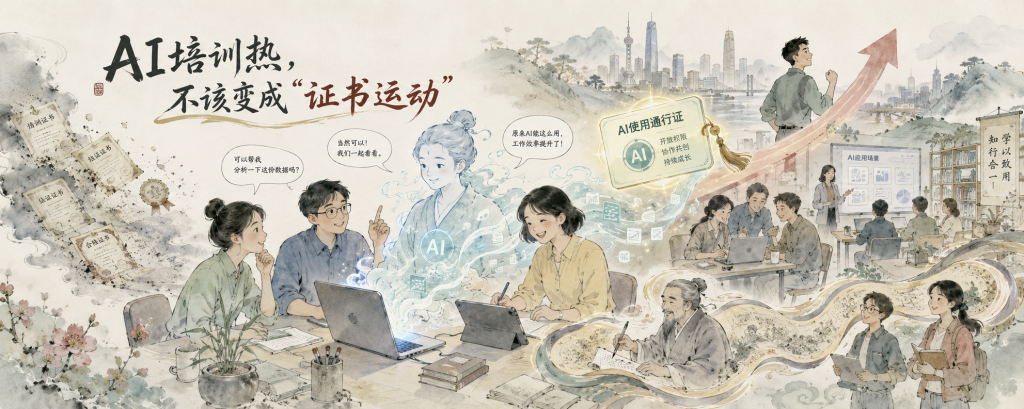
After Singapore’s accounting sector launched AI training for 60,000 people, Hu Yilin talks about the real problem with vocational training: it is not about teaching people to memorize prompts, but about making them dare to use AI, know how to ask questions, and be able to judge.
In July 2026, Singapore pushed AI vocational training into a very concrete industry setting: the Institute of Singapore Chartered Accountants and the Infocomm Media Development Authority launched AIxAccountancy, planning to equip 60,000 accounting and corporate finance professionals with AI usage capabilities over three years. The courses do not just speak in generalities about AI; they put AI into professional workflows such as accounting, auditing, taxation, financial reporting, and internal governance.
This is not an isolated event. The UK has expanded AI Skills Boost into a free foundational course for adults, aiming to cover 10 million workers by 2030; Article 4 of the EU AI Act incorporates AI literacy into organizational responsibility and establishes a practical case library; the U.S. Department of Labor is trying to embed AI skills into registered apprenticeships; China’s State Council policy document on the “AI+” initiative also explicitly proposes supporting AI skills training and strengthening employment risk assessment, while Shanghai has launched a training certification program for “AI promotors.” Platform companies have also joined in: OpenAI has launched AI Foundations and certification courses, and emphasizes that ChatGPT itself can become a tutor, a practice field, and a feedback loop.
From governments and industry associations to platform companies, “AI training” is becoming a common language of occupational transformation. But questions arise along with it: when AI itself is becoming easier and easier to use, and increasingly able to teach people how to use it, what exactly is traditional training still supposed to teach? Can certificates, badges, and certifications prove real competence? If AI automates away a large amount of entry-level work, how will professional inheritance continue?
Freelance scholar Hu Yilin believes that governments’ attention to AI’s impact on occupations is of course a good thing, but if AI training is understood as a set of skills courses that can be tested, certified, and quickly replicated, then it may be missing the point entirely.
The first paradox of AI training: AI first disrupts training itself
Hu Yilin is not opposed to AI training. What he really questions is that many training programs still follow the software-teaching logic of the old era: first package a tool as a fixed set of skills, then deliver those skills to trainees through courses, exams, and certificates. That logic may have worked in the age of Excel, Photoshop, and ERP systems, because tool interfaces, menus, and workflows were relatively stable; but the entry point for large models is natural language, which by nature has the ability to explain itself, demonstrate itself, and iterate on itself.
“AI, rather than disrupting occupational division of labor, first and foremost disrupts education and training,” Hu Yilin said.
In his view, many so-called latest AI usage tips are, in essence, only a brief window of opportunity. Early users may need to learn how to install, configure, and connect a new tool; a few months later, mainstream products are very likely to have built these functions in already, and ordinary people can use them directly without learning complicated procedures. Prompt templates, tool combinations, plugin tricks, and automation scripts may all rapidly lose value as new major model versions are released.
This does not mean that no one needs to keep up with the frontier. Hu Yilin acknowledges that for a small number of people with strong learning ability, high competitive pressure, and a desire to seize a few months’ advantage in the workplace, making a serious effort to learn the latest AI tools is valuable. What they are competing for is a time gap: perhaps something ordinary people will all be able to do three or five months later, but which they master first through more intensive learning, thereby gaining a first-mover advantage in competition.
But he emphasizes that this elite strategy must not be mistaken for a universal training program. For ordinary workers who are not very good at learning, not proactive about learning, or already feel intimidated by new technology, overloading them with techniques may backfire. The more training looks like a “black-jargon class” or a “secret manual class,” the more it is likely to create anxiety and resistance.
More important than skills is “awareness”
Hu Yilin believes that AI vocational training must first adjust its goal: do not focus on short-lived operational tricks, but on a deeper layer of use awareness and learning mindset.
“Cultivating ‘awareness’ is more important than training ‘skills’; first of all, people need to become interested in using AI, confident in using it, urgent but not excessively anxious,” he said.
This awareness includes at least several layers of meaning: knowing that AI can already be brought into one’s daily work; being willing to start with simple tasks; knowing that outputs must be checked; knowing which materials must not be entered casually; knowing that one can directly ask AI, “How should I use you to get this done?”
“AI teaching you step by step how to use itself is more patient and more comprehensive and detailed than any training instructor,” Hu Yilin said.
This sentence points to the reflexivity of AI training: when the tool itself has teaching ability, the task of training institutions is no longer to explain buttons on behalf of the tool, but to lower people’s psychological barrier to engaging with the tool, design real scenarios, encourage continuous trial and error, and help trainees establish a sense of checking, judgment, and responsibility.
Therefore, truly valuable vocational training is not about training everyone into prompt engineers, but about helping different occupational groups learn to work in harmony with AI. What accountants, lawyers, consultants, engineers, teachers, and editors need is not the same set of spells, but the ability to decompose tasks, verify results, protect data, and shoulder interpretive responsibility in their respective high-stakes contexts.
Certificates may be the easiest incentive to go off track
When AI training becomes a policy and market hot topic, certificates, badges, and certifications will almost naturally appear. The UK AI Skills Boost offers a virtual AI foundations badge; Singapore’s AIxAccountancy course has also designed digital badges; the notice for Shanghai’s “AI promotors” includes arrangements for training assessment, certificate compilation, and production; and OpenAI is also advancing AI Foundations and OpenAI Certifications.
Hu Yilin is very cautious about this. He believes that certificates not only may fail to prove real competence, but may also, in turn, change the positioning of the course, turning training from “helping people use AI” into “helping people pass exams.”
“Certificates are basically not very useful to begin with; in the AI era, even graduate certificates have already depreciated,” Hu Yilin said. In his view, if even traditional degrees and graduate diplomas are depreciating under AI’s impact, then a short-term AI course certificate is very hard to become a credential truly trusted by employers.
He argues that AI vocational training should preferably not use certificates at all to attract trainees. Certificates can be replaced by souvenirs, learning records, and project outputs; more importantly, trainees should be given tangible benefits. For example, governments and institutions could subsidize AI usage quotas, allowing ordinary people to genuinely have a period of intensive use.
Behind this lies a very practical observation: many ordinary people do not completely avoid AI, but only use the free version or the lowest paid tier; the number of calls, context length, file handling, deep research, code tools, and multimodal capabilities are all limited. Free quotas are enough to let people try things out, but not necessarily enough to turn AI into a real workflow. Rather than handing out a certificate of questionable value, it is better to fund them to use it freely for a period of time, letting learning and practical benefit come together.
He also believes that if training really can promote employment and improve job performance, then partner enterprises should participate in a deep way. Those unemployed who perform well after training should directly get interview and hiring opportunities; employees who perform well in training should be promoted and receive salary raises, or at least bonuses. The real incentive should come from the employment market and the returns of positions within the organization, not from an external certificate.
“If training is of no benefit whatsoever to improving work ability, and can only hand out a hollow certificate to attract people, then that means this kind of training should not be held in the first place,” he said.
Professional inheritance will not disappear, but will shift from “people teaching people” to “people and AI inheriting together”
As AI automation enters professional work, one common concern is: if basic work is taken over by AI, where will young people still accumulate experience? Lawyers used to begin by searching cases and drafting documents; accountants used to begin by reconciling accounts and organizing working papers; programmers used to begin with small requirements and bug fixes. If entry-level tasks are greatly reduced, will professional inheritance be broken?
Hu Yilin believes that professional inheritance will not disappear, but a new pattern will emerge. The key is no longer to let newcomers repeat all of the basic labor of the older generation, but to let newcomers learn to work together with the AI systems, knowledge bases, workflows, and human seniors within the organization.
“AI will also be a ‘senior employee’ of a company or industry; the memories and skills preserved by AI itself are passed down from generation to generation,” he said.
This metaphor is very important. In the past, a new employee had to learn not only a certain skill, but also how to get along with senior employees: who knew the clients, who knew the historically inherited problems, who understood the company’s informal procedures, and who could remind you that a seemingly standard step actually had exceptions. In the future, the AI inside a company will also accumulate a similar organizational memory: common questions, historical cases, standard procedures, document templates, client knowledge, lessons from failures, and implicit rules.
Therefore, the focus of vocational training will shift from “have you memorized this fixed workflow” to “do you know how to question, verify, supplement, correct, and collaborate with the organization’s AI.” Young people need to learn not only how to complete tasks, but also how to judge whether the experience preserved by AI is reliable, how to identify stale procedures and erroneous inertia, and how to find new breakthroughs within organizational memory.
This also means that companies cannot simply outsource AI training to a few generic courses and call it a day. Real vocational training will increasingly resemble internal knowledge engineering within an organization: preserving reusable experience in AI while also establishing mechanisms for review, updating, responsibility assignment, and confidentiality. AI can become a “senior employee,” but it cannot become a senior employee with no one responsible for it.
The very concept of the “professional” will be overturned
In the short term, what professionals need is the ability to work in harmony with AI. In the long term, Hu Yilin believes that the very concept of the “professional” will undergo a profound transformation.
“I think the concept of the ‘professional’ will be overturned,” he said.
He compares this change to the shifting status of the “erudite person.” In ancient times, broad knowledge and a strong memory were extremely important abilities. The fact that one person remembered a lot, had seen a lot, could recite the classics, and knew allusions meant a knowledge advantage. But after databases, search engines, and online document systems appeared, whatever knowledge was needed could be checked at any time. Erudition still has value, but it no longer constitutes the core barrier of knowledge work as it once did.
In the future, “professionalism” may undergo a similar change. Accounting standards, legal provisions, medical literature, engineering norms, market data—all of these are increasingly easy for AI to access, explain, compare, and use to generate preliminary plans. The value of professionals will no longer be reflected mainly in how much knowledge they remember or how many fixed procedures they know, but in whether they can discover the truly important questions.
Hu Yilin believes that in the future we may return to an environment in which generalists are more important, or rather, that “sharpness” will matter more than narrowly defined expertise. A senior practitioner using AI to complete a certain task may not necessarily be faster than a young person; but he may be sharper in judging where the breakthrough lies, where the innovation point is, where the weak spot is, and where it is merely busywork. “AI can accomplish an infinite number of all kinds of tasks, so deciding what exactly we should focus on becomes especially important,” he said. This is also the point most easily overlooked in AI training. Many courses take increasing efficiency as their default goal, yet rarely discuss what efficiency should serve. If a tool, project, or business model does not really benefit human society, then polishing it to perfection is only making meaningless things more efficient. AI can help people check technical loopholes, but it cannot decide for them whether something is worth doing.“Everyone becoming AI-enabled” is not a slogan, but environmental pressure
Facing the social pressure that “everyone needs to become AI-enabled,” Hu Yilin does not simply see it as anxiety manufactured by companies. He is more inclined to understand it as the pressure to adapt after a change in the technological environment. “Everyone having to become AI-enabled is a kind of environmental pressure; the environment has changed, and the species must adapt,” he said. He used modern transportation as an analogy. Once the transportation system matured, city residents were not, in the legal sense, required to take cars, but their working radius, living radius, and time efficiency were all implicitly built on cars and public transit. Of course you can choose not to ride in a car, but then you may only be able to look for work near your own front door, or else pay extremely high commuting costs. Walking has not disappeared, but it has shifted from a commuting necessity to something for strolling, taking a walk, exercise, and leisure. The marathon is a similar example. When ancient Greek soldiers ran from Marathon back to Athens, it was to deliver news of the battle; modern people run marathons more as a form of leisure, competition, and self-challenge. A bodily capacity once serving an efficiency function has, after changes in the technological environment, been transformed into ritual, sport, and aesthetics. The AI era may be the same. “For matters that are for the sake of efficiency, you have to use AI; but work done in the old-fashioned way without AI may become a form of leisure or competition,” Hu Yilin said. Handwriting, mental arithmetic, writing without assistance, manual drafting, organizing materials by hand, and programming independently of models will not necessarily disappear, but they may shift from everyday modes of production to craftsmanship, training, competition, or aesthetic practice. Just as people still practice calligraphy, run long distances, or do woodworking by hand today, not because these methods are the most efficient, but because they carry values different from efficiency.Conclusion: good AI training should lower barriers, not create new ones
Seen this way, the real question in AI vocational training is not whether it should be done, but how it should be done. Governments and industry associations taking the impact of AI on occupations seriously is a necessary public response; but if the response is merely to turn it into courses, exams, and certificates, then technology that ought to lower barriers may instead become a new barrier. Good AI training should do three things. First, lower the psychological barrier so ordinary people dare to use AI, are willing to use it, and continue to use it; second, provide real resources, including sufficient AI usage quotas, sandboxes where trial and error are possible, real job scenarios, and knowledge support within organizations; third, connect the outcomes of training to actual work returns, with enterprises, industries, and workplace practice doing the validating, rather than a certificate doing the endorsement. Bad AI training does the opposite: it manufactures anxiety, sells tricks, packages short-lived tools as long-term skills, and packages exams and certificates as employability. It looks like it is helping people catch up with AI, but in fact it may simply be getting people to keep taking part in an old-style training program after AI has already rewritten the logic of training. The vocational transformation of the AI era certainly requires learning. But the core of learning is no longer memorizing a set of procedures; it is forming a new working stance: daring to ask AI questions, and daring to question AI; being good at using tools, while also knowing what should not be handed over to them; pursuing efficiency, while also being able to judge what efficiency is serving. In this sense, the greatest value of AI training is not to cultivate a batch of “certified AI users,” but to help society learn how to coexist with a new kind of technological environment.Translated from the Chinese original with AI assistance. The original text is authoritative.