
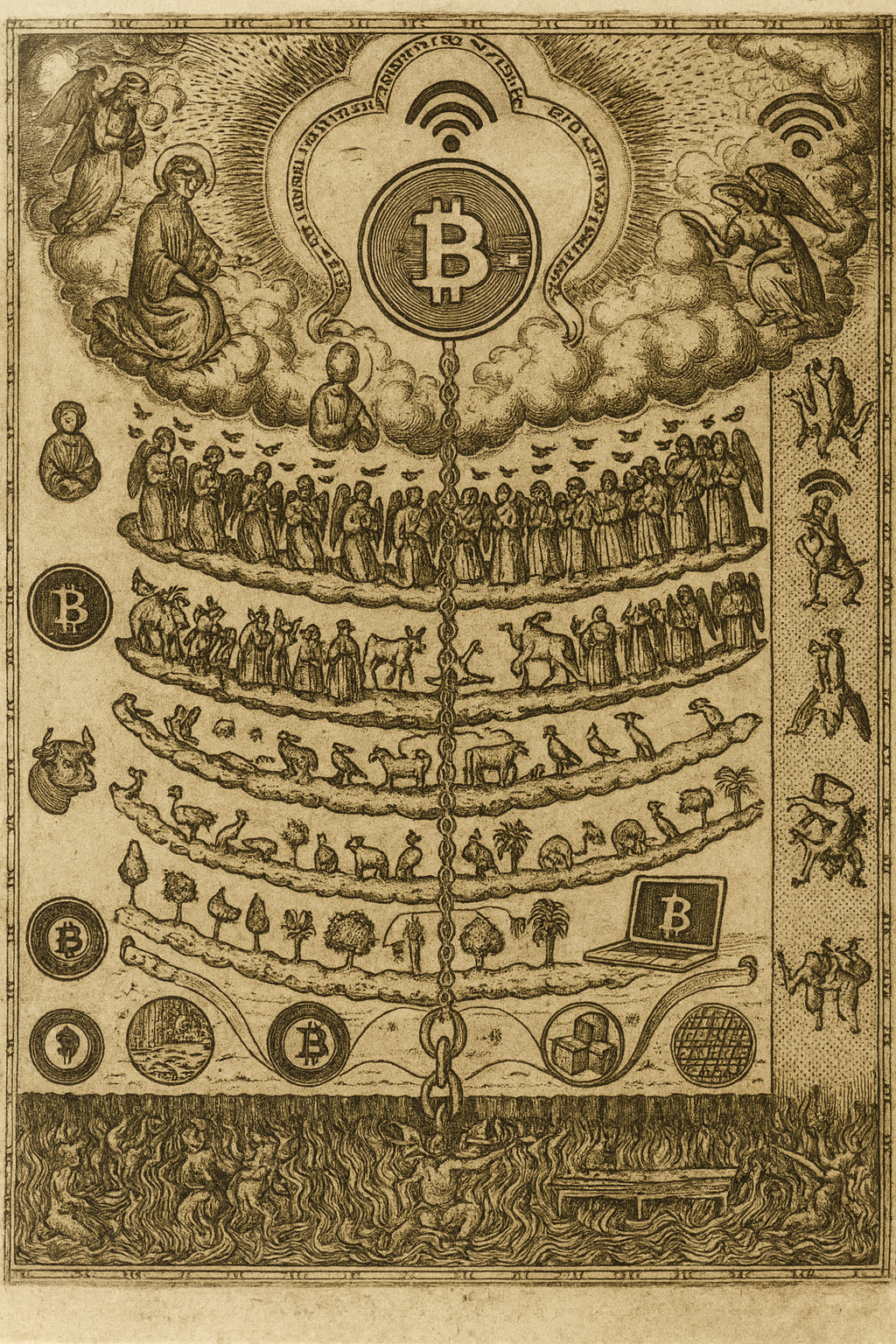
I am in the process of building my own “blockchain philosophy” — not using philosophy to discuss blockchain, but using blockchain to construct “universality,” that is, whether it is possible to pursue universal knowledge in a decentralized (anti-absolutist, anti-dogmatic) way. Universality is philosophy’s eternal pursuit, yet in modern times it has fallen into confusion; I believe blockchain is one way of responding to this. Below is the preface I wrote for Blockchain Philosophy; perhaps this book could also be called The Great Chain (Block) of Being, or Using the False to Cultivate the True, and so on. This book will gather together everything I have learned in my life, so it is rather hard to bring into being; I’ll first post this preface that expresses its ambition, and then we’ll see…
Blockchain technology is an extension of the internet and even of information technology as a whole, a new stage in the information revolution that began in the mid-20th century. “Decentralization” is the meaning of blockchain, and also the spiritual core of the entire information age.
Every age has its own philosophical style. McLuhan said: “Heidegger rides on the electronic wave just as Descartes rode on the mechanical wave” (McLuhan, Marshall, The Gutenberg galaxy: the making of typographic man (Toronto: University of Toronto Press, 1962), p.248).
The philosophy of the mechanical age tended toward centralization (foundationalist metaphysics), systematization, and universalization, whereas the philosophy of the information age has moved in another direction, tending toward decentralization, nomadization, and localization. Descartes’s philosophy represented the rise of the modern mechanistic worldview, and also foreshadowed the opening of the age of mechanization (the Industrial Revolution). Heidegger’s philosophy, by contrast, rejected the mechanistic picture of the world and advocated a kind of non-objectifying ontology: the world was no longer seen as a single and determinate entity, but as the environment in which each person actually lives, as a kind of dynamic “network of referential relations.”
Just as Descartes was the harbinger of the Industrial Revolution, we can regard Heidegger’s philosophy as the harbinger of the electronic age (the network age). And once the wave of mechanization truly began (marked by Watt’s steam engine in the 1770s), philosophy also reached a great summit — German classical philosophy (Kant’s Critique of Pure Reason was published in 1781, and Hegel was active in the early 19th century) was the grand synthesis of modern philosophy since Descartes. By contrast, the wave of everything becoming electronic and networked probably only truly began in the 2010s; perhaps it is time to welcome a new peak in the philosophy of the network age.
“Centralization” is a characteristic of traditional pre-electronic philosophy. By “traditional” I am loosely referring to the mainstream form of the history of philosophy from Plato to Hegel; this is inevitably a simplified shorthand, and somewhat one-sided, but compared with the philosophical trends of the electronic age, traditional philosophy does indeed share certain common features. What I mean by centralization, first of all, is a certain “foundationalist” mode of theoretical construction: traditional philosophers always like to find some solid and reliable “center” (either some substance or concept, or some set of axioms or principles), and from there construct an entire perfectly interlocking philosophical edifice. For example, Thales said that all things are “water”; there is Plato’s theory of Forms, Descartes’s “I think,” Kant’s a priori forms of intuition, Hegel’s absolute spirit, and so on. Traditional philosophers always need to find a central anchor point, to support their entire philosophical system, even to the point of supporting the entire real world.
And like the world as a whole, their philosophical systems are orderly, with one link following another to form a rigorous chain of logic. Medieval Aristotelianists called the order of all things in the world the “Great chain of being,” whose highest point is the “unmoved mover,” the “first mover,” “God,” or the “ultimate substance.” It is eternally unchanging and perfectly self-sufficient; every being exists in relation to a higher purpose on the chain: plants nourish animals, animals benefit humankind, and humankind strives for eternity.
As Lovejoy pointed out in his classic work in the history of ideas, The Great Chain of Being, the idea of the “chain of being” was not the exclusive property of Aristotelianism; rather, it runs through Western thought from ancient Greece to the 19th century, permeating many fields such as philosophy, theology, science, and literature.
After German classical philosophy reached its peak in the 19th century, philosophers gradually rebelled against the old system. Perhaps the earliest representative was Marx, who also tried to resist the production model of the industrial age, but he had not yet encountered a new mode of production and technological environment, so he merely “criticized everything” without forming a new philosophical paradigm.
Nietzsche was another epoch-making philosopher. With “God is dead,” he proclaimed the end of old philosophy, and in the new philosophy of nihilism he awaited the “Übermensch” — an advance expression of the transhumanism of the information age. Yet he was still groping in the dark and had not completely broken out of the old era, and so Heidegger called him “the last metaphysician.”
Perhaps the representatives who more consciously and completely expressed the face of the new philosophy earlier on were Heidegger (who influenced Continental philosophy) and the later Wittgenstein (who influenced Anglo-American analytic philosophy). Their philosophy tended toward “decentralization,” no longer seeking or promising a solid center to “underwrite” the whole world, but instead returning philosophy’s point of departure to each individual, including his actual life and bodily senses.
But anti-system philosophy usually also presents fragmented features; for instance, the later Wittgenstein’s writings are almost a collection of aphorisms, no longer promising a complete and self-consistent worldview. “All that is solid melts into air” — this is our “postmodern condition.” People discover that it seems “anything goes,” yet whatever one does seems meaningless, and consensus is hard to come by.
Is it possible for us to oppose centralizing foundationalism, and yet still seek some kind of stable overall order? Can a “Great chain of being” that has lost its “first mover” still maintain the order of the world?
I believe that the trends of philosophy and the trends of the age respond to one another, so next I will not be summing up contemporary philosophy from within a pile of papers; instead I will first sort out the origins and development of the technological environment of the network age. I will not merely start from philosophy to discuss and summarize the internet and blockchain, but rather, from the internet and blockchain to discuss and summarize a philosophy of the network age.
To establish a chain of overall consensus while remaining decentralized — this is precisely what blockchain technology accomplishes on the internet. And a philosophy inspired by blockchain may perhaps be able to do something similar as well: the traditional philosophy of the chain of being will be replaced by an “existence blockchain,” and we may be able to rebuild a philosophical system of consensus while insisting on decentralization.
Translated from the Chinese original with AI assistance. The original text is authoritative.