
This article is the draft I wrote for a video recording (the very last small section had no draft; it was improvised and then the recording was turned into text), and the video has already been released on Bilibili and YouTube.
The video was actually recorded back in April (at the time, Trump had raised tariffs on China to 104%), but my studio took nearly half a year to piece together these five segments one after another before finally finishing everything (though they mostly had other things to do, this level of efficiency really is hard to defend, so I’m now thinking of recruiting some new people to help me get things done).
The text version still hasn’t been sorted out, so I’m publishing the draft first. The reason I’m in such a hurry to put it out is that this weekend I’ll be doing a new dialogue at Wancheng Bookstore, talking about “digital nomads and sovereign individuals.” This topic is closely related to the concept of the network state.
This text does not mention the concept of the “sovereign individual.” In fact, I originally wanted to bring it up briefly, but as I went along the line of thought didn’t quite flow, so I left it out by accident. The network state is discussed from the angle of the historical evolution of communities; the sovereign individual is more of a bottom-up perspective. After the dialogue, I’ll see about writing some more on it.
Network Without Borders vs. Network With Sovereignty
After Trump returned to power for a second term, he launched a tariff war, using the threat of tariffs to force countries around the world to negotiate with him and submit to his various conditions.
How can tariffs become a key instrument in international power struggles? Because modern international relations are highly dependent on goods trade: when goods are sold from one country to another, they must pass through customs, and when they pass through customs, taxes are paid—that is what tariffs are. Even with zero tariffs, goods still have to go through customs. Customs are the gateway of the modern state, and also a key node in the modern international order.
Imagine a world in which many goods do not need cargo ships or airplanes for transport: they can move instantaneously, be copied infinitely, pass through any checkpoint and be transmitted anywhere, and cannot be detained or destroyed. How, then, would international order be established in such a world?
Cyberspace is just such a world. When we want to produce or purchase a digital object in cyberspace, the situation is very different from that of traditional industrial or agricultural products—it is only a piece of data. This data can be copied infinitely and encryptedly transmitted through multiple channels; no node can “open the box and inspect the goods,” and none can detain it indefinitely, because other copies of the data can be transmitted to the destination through other channels. Clearly, the tariff system is hard to apply to the market economy of cyberspace.
Today, cyberspace is gradually encroaching on physical space, just as each person’s lifeworld is increasingly occupied by being online. So when cyberspace and its market model are playing an ever more important role in today’s world, must the international order built on the customs system also undergo a transformation? That is the topic we are going to discuss next.
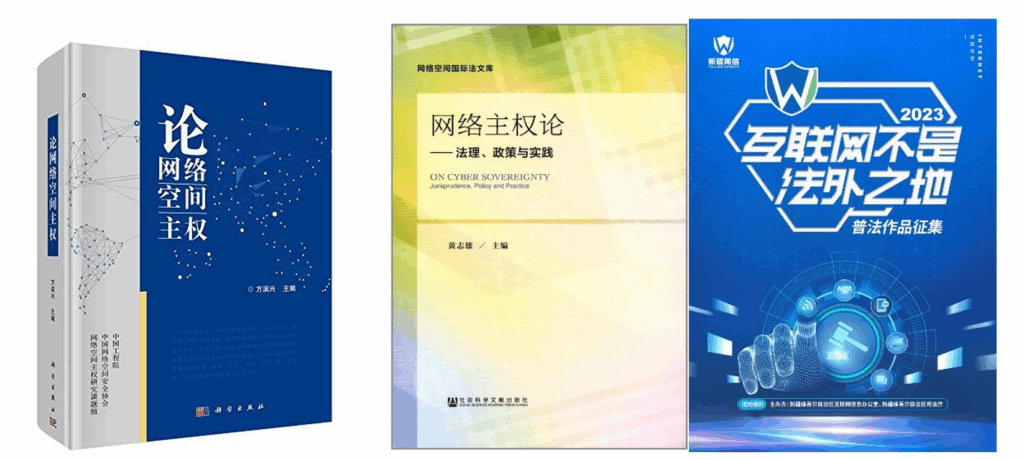
“The internet is not a lawless place,” and state sovereignty applies to cyberspace—that is the official position in our country. Of course, around the world, the concept of cyber sovereignty has aroused much controversy; many people believe that there are no national borders in cyberspace, and naturally no sovereignty either.
But in practice, many countries, including the United States, are also extending sovereignty into internet space—for example, requiring websites that provide AI services to perform IP verification and refusing network access from specific countries. On the other hand, because of strict tax and regulatory policies, some websites, especially projects in the cryptocurrency sector, also block access from the United States and refuse to allow Americans to participate.
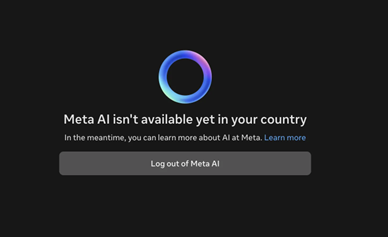

“The internet has no borders” has in fact already become an outdated impression. Early internet really could be described that way, because aside from speech, there wasn’t much else on the early internet. Westerners extended traditional Enlightenment ideals such as freedom of speech and knowledge without borders, and naturally arrived at the concept of a borderless internet. And the Chinese government has always regarded control over speech as part of sovereignty, so it naturally concluded that sovereignty also extends online.
But today is different. The key point is that cyberspace has long since ceased to be merely a space for speech. There are massive industries and technological apparatuses that determine the fate of nations on the internet (such as AI), there is vast economic activity on the internet, and there are enormous quantities of digital currencies and digital assets…
Americans emphasize Free speech and Free thought, but they have never pursued Free tax. So when cyberspace far exceeds the sphere of speech and becomes a new world full of wealth, their sovereignty extends there as well. The United States has always loved extraterritorial jurisdiction—wherever it reaches, taxes follow. The internet is no land beyond the reach of taxation.
Europe has its own distinctive approach to internet regulation: under the banner of protecting personal privacy, it has promoted the General Data Protection Regulation (GDPR) worldwide. Even if a website is not operated in Europe, as long as it provides services to European residents, it must comply with this law, or else face huge fines. It should be noted that GDPR fines are calculated at 2% to 4% of a website’s global total revenue, but even if only 1% of the site’s users are from Europe, the EU can still penalize it and fine it based on the global total.

New Forms of Sovereignty
In short, it really is no longer realistic to speak of the internet as sovereign-free. But if we accept the penetration of state sovereignty into cyberspace, then the next question is that the very idea and form of state sovereignty will necessarily have to change along with the unique “terrain” of cyberspace.
Sovereignty is supreme, independent, and exclusive; that is to say, if A country exercises sovereignty over “this piece of territory,” then B country’s sovereignty cannot interfere. This means there is a very basic requirement: the “boundary” between countries must be made clear.
Ancient states were actually divided by populations rather than land. Of course, some settlements, fortresses, and passes had clearly defined jurisdiction, but on the vast stretches of land beyond them there was in fact no clear concept of national borders. In particular, the fringes of ancient empires were often nomadic tribes: sometimes they had clear objects of allegiance, sometimes they hedged their bets, and sometimes they were independent. So we say that ancient states possessed a certain sovereignty mechanism, but there were many ambiguous areas.
An international order made up of clear and explicit sovereign boundaries is a product of the modern state. It was brought into being by the printing press and capitalism, and spread globally along with the Industrial Revolution and colonial movements.
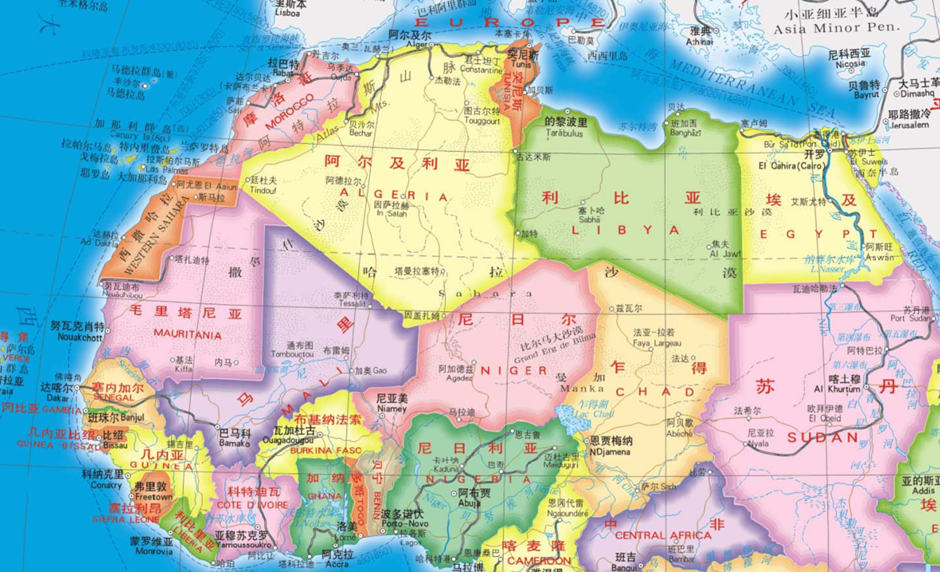
And the modern practice of using land rather than populations to set state borders has not always been successful. We can see that many former colonies, represented by African countries, still suffer from this to this day: because the colonizers of the time simply waved a hand and drew a straight line across the globe to divide territory, ignoring the actual distribution of local tribes, so that when these places later became independent as nation-states, they had to face endless border disputes and identity confusion.
The order of the modern state also means the disappearance of “vagabonds” (including nomadic tribes and the even older hunter-gatherers). Ancient nomads could traverse the entire Eurasian steppe; the Scythians ranged from the Black Sea to East Asia, and the Xiongnu very likely migrated all the way from China to Europe. But as the modern state order matured, and as humanity since the Industrial Revolution has profoundly transformed ways of life and geographic environments, these older ways of life were replaced or marginalized.
Hunters and pastoralists are mobile, whereas farmers and workers are settled; the establishment of the modern state means that the former two ways of life are marginalized, while the latter two become mainstream. But what if, as the times further develop, newer ways of life emerge? For example, beings such as “netizens,” “digital nomads,” and “AI agents”? What if new ways of life no longer depend on a definite piece of land in order to settle down, but once again become mobile?
It is easy for us to feel that in digital life within cyberspace, we are all mobile, and that we have even all become “traffic.” We do sometimes linger on a certain website, but the website itself is built on the “cloud.”
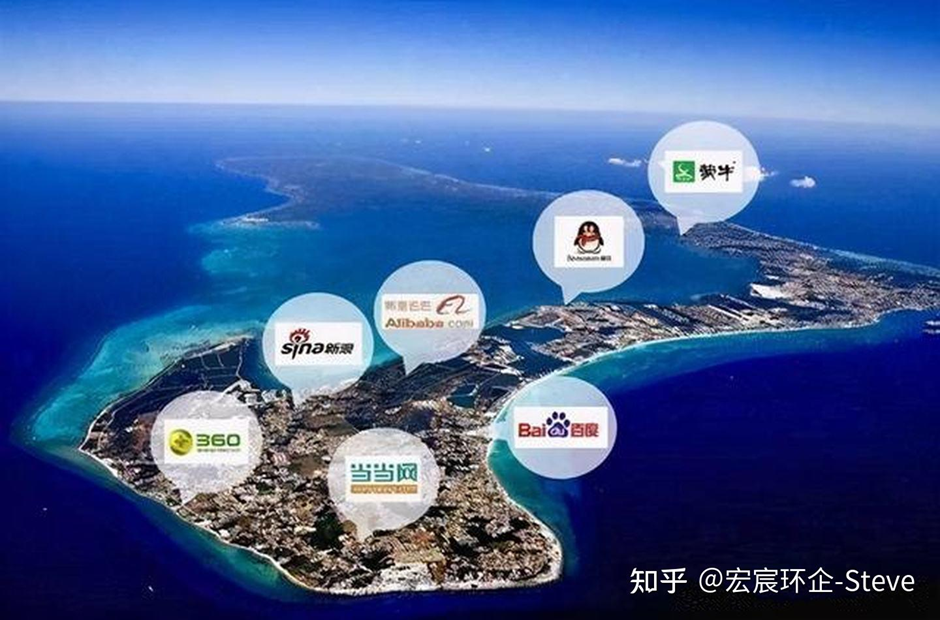
When I visit a scenic spot or a work space in the real world, it is easy for me to determine which country that place belongs to, and thus to apply for a visa and pay taxes according to that country’s requirements. But when I visit a website, into the space of which country do I enter? The location of the company behind the website? You should know that Baidu, Tencent, Alibaba, JD.com, 360, Sina, and many other well-known “Chinese websites” are companies registered in the Cayman Islands; their shares may be listed in Hong Kong or the United States; their major shareholders are spread all over the world; and their founders may also have long resided overseas. So how do we determine that we are visiting a Chinese website?
Probably the official logic in our country goes like this: websites all have data; data all have actual storage locations; then one just determines national borders according to the actual storage locations of the data. But this mode of governance is a Chinese specialty, so China requires Apple to put all data involving Chinese users into “Cloud Guizhou,” and if the data is not stored domestically, it simply cuts off your network access. But this mode of governance is obviously not suitable for most countries in the world, because on the one hand there are countless small countries in the world that simply do not have data centers; the internet platforms their citizens access every day are transnational, such as Luxembourgers accessing Google, which may connect to data centers in places like Belgium or France. It is impossible to require Google to set up a data center in every small country in order to operate. If everything had to be managed in the Chinese way, then small countries would have no net sovereignty at all, and their citizens would not be able to access many websites.
From the very beginning of the internet’s birth, breaking down borders, the free flow of information, and distributed data storage have all been directions it pursued. Many large platforms now do indeed adopt distributed storage, with multiple mirror nodes and databases in various parts of the world, such as Google and Microsoft, which have data centers in dozens of countries or regions around the globe. They could neither possibly set up only one data center for the entire world, nor possibly set up a data center in every country.
China’s approach is in fact to exercise a certain kind of “network sovereignty” and thereby force internet companies to store data within national borders, rather than determining network sovereignty because the data lies within national borders. The geographical location of the data is the result of network sovereignty, not its basis.
So the basis of network sovereignty is actually still people: operators and users. That is to say, if there are websites that Chinese users want to visit, and if the boss wants to make money from Chinese people, then they must be subject to Chinese control. The United States and the European Union are actually the same.
But then there are two more problems here: one is the question of the means of governance—what force one relies on to govern, and to what extent; the second is the question of the object of governance—who is being governed? How does one determine that a certain act was done by a certain “national citizen”?
The means by which the traditional state governs are the so-called “machine of violence,” nothing more than police and army, of course including a whole system of public security and judicial institutions.
There is a saying, “Truth is within the range of cannon fire,” a phrase associated with the “iron-and-blood chancellor” Bismarck. We are not sure whether Bismarck really said this, but the earlier German classical philosopher Kant did indeed say something similar. In his essay “Perpetual Peace,” he wrote: “How far does the right to occupy a piece of land extend? Just as far as the ability to bring it under one’s control. That is to say, just as far as the area one can defend when one wants to claim it as one’s own; as though the land were saying: if you cannot protect me, then you cannot give me orders. Therefore, the controversy over whether the sea is open or closed must also be decided accordingly: for example, within the range of artillery, no one may engage in fishing off the shore of land already belonging to a certain state…” (see Li Qiuling, ed., Complete Works of Kant, vol. 6, China Renmin University Press, 2007, p. 273.)
The concept of maritime sovereignty does indeed originate in the cannon range of the Middle Ages, and today’s law of the sea is more or less a continuation of that concept. We can say that “sovereignty exists only within the coverage of violence.” As for the realms that are “beyond the reach of the whip,” these are the “high seas,” over which no country may exercise sovereignty. Later we will discuss that on the internet there should not only be “high seas,” but even the existence of an entire new continent, or rather, a land without an owner.
Is there also violent means in cyberspace? Cutting off the network counts as one, but the coercive force of cutting off the network is actually limited, because the essence of the internet is a decentralized communications network; its underlying design is intended to ensure that information flow is not obstructed when any transmission node is cut off. Unless, as in China, the power of the whole country is mobilized to set up blocking mechanisms, then indeed the severing of network access can be used as a means of control.
But apart from this crude means, the state machine’s governing power on the internet is actually very limited. Of course, the police can directly go to residents’ homes to control internet users, and bank accounts can be used to freeze funds involved in a case. But it should be noted that these control measures do not take place in cyberspace; they take place in the offline world. This is like saying: I can’t control what you do on the high seas, but once you return to your country and come ashore, I can arrest you. But the ability to impose control on land does not prove that the power of sovereignty has already covered the high seas.
The second question is who is being governed. Sometimes citizens of one’s own country who commit crimes abroad can also be reached by governance. But in cyberspace, how can one determine which country’s citizen the actor is? In the early internet, this was actually very hard to determine, because after people went online they usually did not use real names; they gave themselves a name, registered an email address, and on that basis built their own online identity.
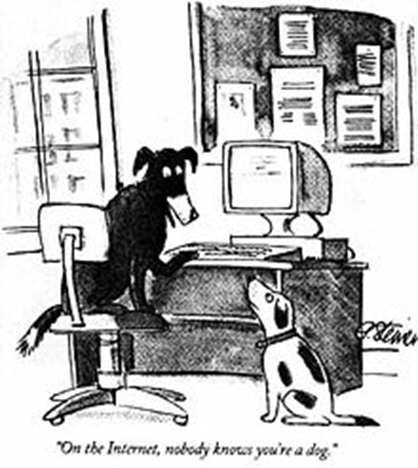
There was a satirical joke in the early internet that said, “On the internet, nobody knows you’re a dog,” which referred to the phenomenon that in cyberspace it is difficult to trace back to a real-world identity. Since one cannot trace nationality or identity, sovereign control naturally has nowhere to begin.
But the state of cyberspace being difficult to manage changed in the Web 2.0 era, not because the underlying technology of the internet changed, but because people superimposed a layer of 2.0 application environment onto the technical foundation of Web 1.0.
There are two markers of the Web 2.0 era, or rather of the mobile internet era. The first stage is the rise of giant transnational social media platforms (represented by Facebook and Twitter); the second is the popularization of smartphones, replacing computers as internet terminals. Both of these steps are conducive to the power of sovereignty regaining control over online life.
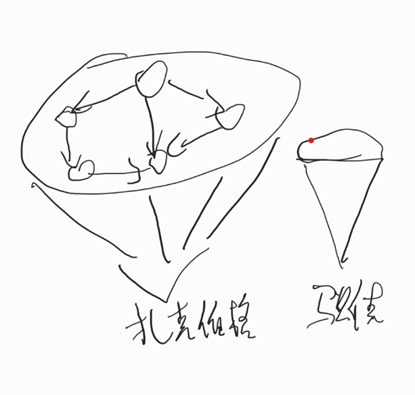
We know that in the internet’s underlying design, the connection between any two points does not depend on any particular intermediary. A can connect directly with B, or communicate with B through C; if C breaks down, communication can still go through E, F, and so on. It is useless for any one node to refuse to let A get online; as long as not all nodes block A, A can always connect to the network.
But what does one do after connecting to the network? In the past, it was nothing more than sending and receiving email, and group chats were also conducted through email lists. Then people hung out in BBS forums; BBS forums were all anonymously registered, and one person could have several sockpuppets. There was also downloading software, downloading games, downloading movies to watch oneself. Of course, many people could also set up their own personal websites, or even host a BBS. All of these behaviors were anonymous and decentralized, and not afraid of being blocked.
But in the Web 2.0 era, we got large social platforms. Sending email became obsolete; email lists were used by even fewer people; BBSs became outdated; and only a small number of scholarly elites would bother with personal homepages. Social activities and entertainment activities in cyberspace became highly dependent on giant social media platforms.
Transnational websites such as Facebook have had the ambition to stand above national sovereignty; Zuckerberg even plotted to issue his own currency. But at the present stage, they have still not become independent, and their existence itself may become a “lever” for the state’s control over the internet. China’s situation is very obvious: social platforms are a direct extension of state power and can decide life and death over everyone’s online identity; foreign countries are actually no better, so Musk claimed to acquire Twitter in the name of free speech, but ironically Musk has now also become part of governmental power.
The replacement of computers by smartphones further strengthened identity verification. Earlier online identities on various websites were established by setting one’s own username and password; sometimes email registration was required, but email was also controlled by a password one set oneself. No matter who I am, or which country I am in, as long as I use this password, I can access my email and also operate all my online identities. Of course, when going online we need to choose an ISP service provider and obtain an IP address, but once I connect to the network, I can easily disguise myself as a node of any country. Of course, back then not so many websites performed IP address tracking either.
But now, registering an online identity in any place, including even an email address, often requires a mobile phone number or binding a mobile phone number. And whether or not mobile phone numbers implement real-name registration, at the very least they have a “nationality,” which is to say that when you go online via a mobile phone, your country of affiliation has already been marked at the point of entry.
The flow of funds is likewise a point of entry for state regulation. Whether it is Alipay or WeChat Pay, or bank cards and credit cards, if you are going to transact online, you must provide a financial account, and these financial accounts clearly have national affiliations.
In short, through three aspects—social centers (social media platforms), identity registration (mobile phone numbers), and the flow of funds (wallet accounts)—state power can penetrate every aspect of cyberspace.
A New Order in a Land Without a Master
But the penetration of power is not something that goes smoothly. After all, cyberspace does not have territory and national borders in the traditional sense, so in the struggle for dominance over cyberspace, there are many troublesome issues, such as sovereignty conflicts and lands without a master.
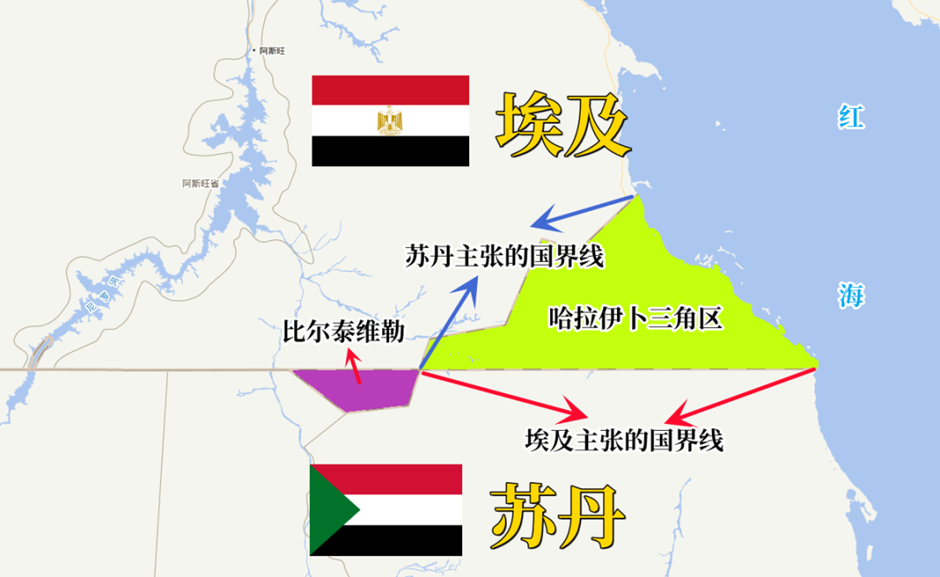
Such contested territories certainly exist in the real world as well, for example the territorial dispute between Egypt and Sudan: both countries claim sovereignty over the Halaib Triangle, and there are many other disputed regions like this; Bir Tawil, by contrast, is a rare “land without a master” in today’s world, over which neither country claims sovereignty. Of course, Western colonizers believed that North America and Australia had once also been lands without a master.
TikTok is precisely a contested zone between China and the United States, because its controllers are Chinese while it has a huge number of American users. The United States wants to eliminate China’s dominance, while China is unwilling to let go. In fact, this kind of situation is universal: that is to say, a certain website, or a certain behavior on the internet, is simultaneously subject to the jurisdiction of multiple countries. But in most cases the demands that countries make of websites are not that high and are compatible with one another, so they do not constitute some sort of exclusive sovereignty claim. But when a country’s demands become too high, to the point of forcibly compelling a website to obey exclusively, then this becomes a “sovereignty” dispute in cyberspace.
As for “lands without a master,” we will come to this shortly: blockchain technology has opened up a new continent without a master in cyberspace. But even before blockchain, cyberspace already contained many lands without a master, or places that the power of traditional states could hardly reach. For example, the “dark web,” accessed with anonymous tools such as Tor, makes online behavior difficult to trace and locate. Another example is the sharing spaces built with P2P technologies, such as eMule and BT downloads: because they do not rely on centralized servers, even if the publisher of the resource goes offline, the resource can still continue to spread; there are also some compromise models, such as setting up data centers even in countries with relatively loose regulation, or directly on the high seas or on satellites. As for using virtualization technologies such as VPNs to disguise IPs and evade localization, that is an even more common matter.
Blockchain technology did not conjure a land without a master out of thin air; rather, it rediscovered the decentralized characteristics of the Web 1.0 era, or of the early internet. In essence, blockchain is a kind of network protocol, and it is still an application layer built on top of the TCP/IP protocol. The TCP/IP protocol is the underlying protocol of the internet, or rather, it is the internet itself; while the so-called application layer is something like HTTP or FTP, where users who accept the same protocol can interact with information in a specific format on the network. The hallmark of HTTP is that it provides visual webpages, the hallmark of FTP is file transfer, IMAP handles email, HLS is a video streaming protocol, and so on. The hallmark of blockchain, by contrast, is decentralized value transfer.
Value transfer itself is not the difficult part; decentralized value transfer is the difficult part. Our online bank accounts, Alipay balances, WeChat red packets, and so on are all forms of value transfer on the internet. I tap my finger and the red packet is sent out; it can arrive in one second. In essence, this is just sending a message through WeChat, something like: “Deduct 100 yuan from my account and add 100 yuan to Zhang San’s account.”
The problem is that the transmission of this information is not simply a matter between two nodes, me and Zhang San. It must be approved through a trusted center (for example, WeChat’s server).
Let us look again at the basic principles of the internet. The basic idea of computer networks comes from the “packet switching” proposed by Paul Baran in 1962; today it is generally called a data packet. It is like sending data as parcel after parcel, with each parcel marked with the recipient and a timestamp.
These parcels do not need to be sent to any central institution. Any node can receive the parcel I send and help me pass it on to the next node, which then passes it to the next node, and so on, continuously relaying it until it reaches the recipient. Different data packets may travel along different routes, and in the end they are gathered and opened at the recipient’s end, to be read in the order of their timestamps. This design avoids a single point of failure: every node in the network can participate in the dissemination of information, but no single node is indispensable. Of course, because the market pursues efficiency, people will set up some data centers to serve as hubs for transmitting information, but these data centers are nothing more than clusters of nodes; in principle, every node is equal and replaceable.
Sending an email, sending an article, or sending a video can in principle all be done within the decentralized network structure described above. I only need to determine the sender and the recipient in order to send the message, without relying on any definite third party as an intermediary.
But sending a red packet is not like that. First, for a transfer such as “deduct 100 yuan from my account and add 100 yuan to Zhang San’s account” to succeed, the premise is that my account actually has 100 yuan in it. Then the fact that Zhang San’s account ends up with 100 yuan more means that in the future Zhang San still has the right to send this 100 yuan to Li Si or Wang Wu or any other possible recipient. I can send an email indefinitely many times, but I cannot send red packets indefinitely many times, because money cannot be conjured out of nothing. So throughout the entire process, all the participants and potential participants in value transfer must trust a single ledger, in which it is recorded how much money Zhang San or Li Si each has, and which changes everyone’s balance in real time according to the occurrence of transactions. This ledger must be something that all participants believe in unanimously. WeChat Pay must trust Tencent; Alipay must trust Alibaba; transactions between Alibaba and Tencent must in turn trust the banking system, and the banking system is ultimately regulated by the central banks of various countries.
This leads to the fact that value transfer on the internet still depends on the traditional form of state sovereignty. Information transmission was originally free and borderless: sending a piece of information to Beijing and sending it to New York differs in cost hardly at all, and the difference is almost negligible. But sending a sum of digital funds to a Chinese person or an American person still encounters different barriers. Transporting a real-world good from China to the United States requires transportation and customs, thereby incurring higher costs, and that is a reasonable result; but sending a segment of information (changing a wallet balance) from China to the United States still requires a high price, and in many cases cross-border transfers are even more difficult than mailing a parcel. Value has been informatized, but it has not been decentralized.
The significance of blockchain technology is that it has designed such a technology, or rather such a network protocol, that allows users who follow this protocol to transfer value on the internet without trust (for example, by transferring funds). Of course, we still need to trust the internet itself, but beyond that, we do not need to trust any third party that holds an authoritative ledger.
The core technology of blockchain is cryptography, which has two main applications. The first is generating “private key–public key” pairs. The public key provides an externally visible “address,” or rather, a “username,” so as to receive transfers; while control of the private key can prove ownership of the “address” without exposing the private key. In this way, the problem of transfers being fraudulently claimed can be avoided. For example, if I send information such as “deduct 100 yuan from Zhang San’s account and add 100 yuan to Li Si’s account,” there is no need for any authoritative institution to verify whether the person registered as “Zhang San” is actually me; rather, any node can equally verify whether I am entitled to issue this transaction in Zhang San’s name.
The second is that it designs a computing-power competition game (commonly known as mining) to ensure that the total transaction “ledger” does not need to rely on any authoritative central institution, but instead that every node can equally possess a ledger, and that these ledgers can maintain synchronized and consistent updates without any fixed leader.
Blockchain decentralization comes at the cost of efficiency—originally, it would have been enough for Tencent to hold one ledger, but now it is as if every node has to record and process the entire ledger, and a great deal of energy is also “wasted” in the competition for computing power. So what is it that it gains in exchange for sacrificing efficiency? It is that value transfer can take place in the land without a master of cyberspace.
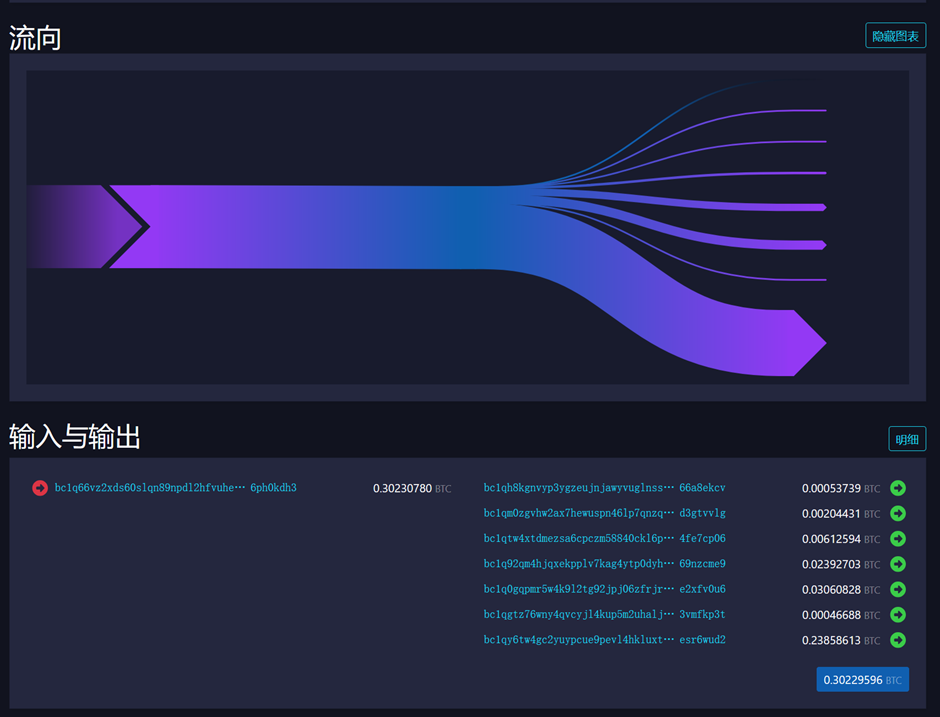
For example, let us casually look at a transfer on the Bitcoin network. This transaction was sent from the address bc1q66vz2xds60slqn89npdl2hfvuheuqh6ph0kdh3, transferring 0.3 bitcoin to 7 addresses, and it cost a fee of 1,184 satoshis (worth $0.97 at the time). In which country did this transaction take place? Or precisely which borders did this transaction cross? We cannot see any national information in the transaction; unless the owner of a certain address proactively announces their location, we cannot know, nor do we need to know, which countries the parties to the transaction belong to and are subject to.
After smart contracts, blockchain can accomplish more complex forms of value exchange. For example, a painter creates a series of digital artworks and sells them through blockchain; the painter can even continue to obtain royalties from the market trading of the works after they have been sold. Yet we may know neither which country the painter is from nor which country the buyer is from.
In short, the key significance of blockchain is that it extends the “decentralized” characteristic inherent in cyberspace into the realm of value, making digitized wealth and property more easily able to break free of the sphere of influence of traditional state sovereignty and enter the land without a master of cyberspace.
Like the “new continents” of the colonial era, lands without a master are inevitably harsh and chaotic, full of deception and robbery. From the early “Silk Road” black markets to today’s various money laundering operations, gray industries, and pyramid schemes, the field of cryptocurrencies is indeed always full of disorder.
But just as in the opening up of the new continents back then, chaos and innovation are often two sides of the same coin. What is brewing in a land without a master is not always disaster; it may also be a new order. The Puritans set foot on the new continents in order to break free from the control of the Church of England. In the end they established new states, implemented new institutions, and in turn influenced and even dominated the order of the old continent.
In fact, rather than saying that the explorers of the new continents were lawless and refused any regulation or order, it is better to say that they broke free from obsolete systems and rules. Traditional tax systems, customs rules, and regulatory models built upon geographical boundaries and the transport of physical commodities had long become strained and difficult to apply in cyberspace. Just as the medieval feudal landlord system could not adapt to the development of capitalism, in the internet age we need a new order, and a new order will not emerge out of thin air. Thus the borderlands of the old order’s sphere of influence became the source and breeding ground for exploring and incubating a new order. For example, it was Spain and Portugal, at the farthest ends of the trade routes, that first broke the old Eastern trade order; it was England, at the very edge of Europe, that first broke through medieval Latin culture; it was the United States, outside the old continent, that led the age of electricity and globalization; it was Shenzhen and Pudong, which rose from almost nothing, that led China’s reform and opening up…
Now, exploring the lands without a master in cyberspace is not about destroying human civilization or wrecking all order. Rather, it is about how we build within them a new order suited to the internet age (the information age). Just as in the industrial age, traditional imperial states one after another disintegrated, and either through constitutional monarchy or through violent revolution denied the order of kingship, thereby establishing the new order of the modern nation-state. We may now need to overturn the order of the industrial age and establish a new order of the “network state.”
Next I will discuss this in two main parts: first, why the old order of the industrial age has become obsolete; second, what features the new order of the network age (the network state) may ideally have.
The Industrial Age’s Paradigm of “Print Capitalism”
Why say that the old order of the industrial age has become obsolete? Here this can also be discussed in two points: first, how this order came into being in response to the times; second, how the environmental conditions of the era to which it was adapted have changed.
As we mentioned earlier, the clear concept of state sovereignty, and the modern state order organized around this concept, emerged in modern times alongside the spread of printing and capitalism.
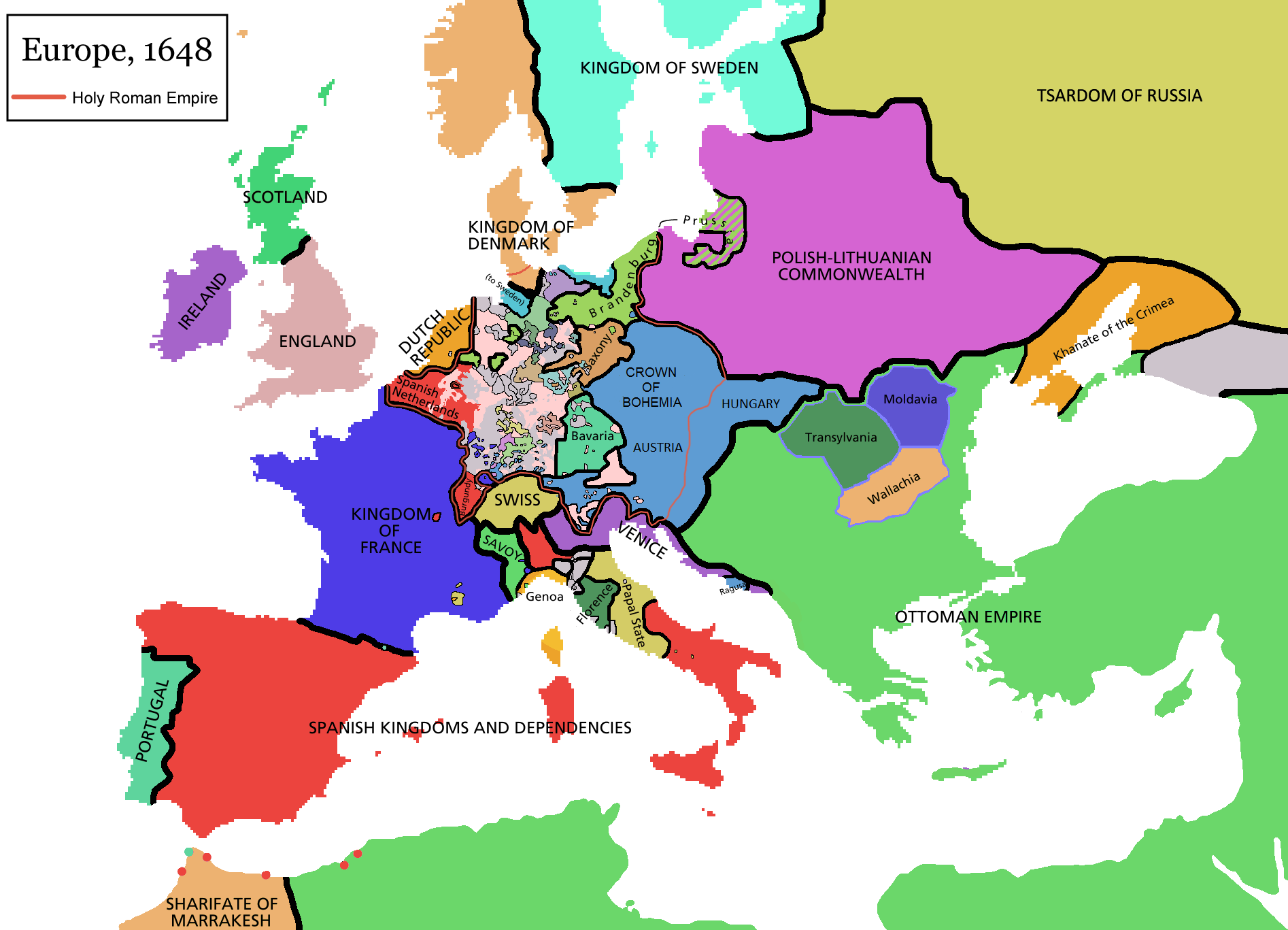
The Peace of Westphalia, signed in 1648, is often regarded as the starting point of the modern system of sovereign states. This treaty was based on territory, emphasized that a state’s authority within its own territory is supreme, and that domestic affairs within the country could not be interfered with by foreign powers.
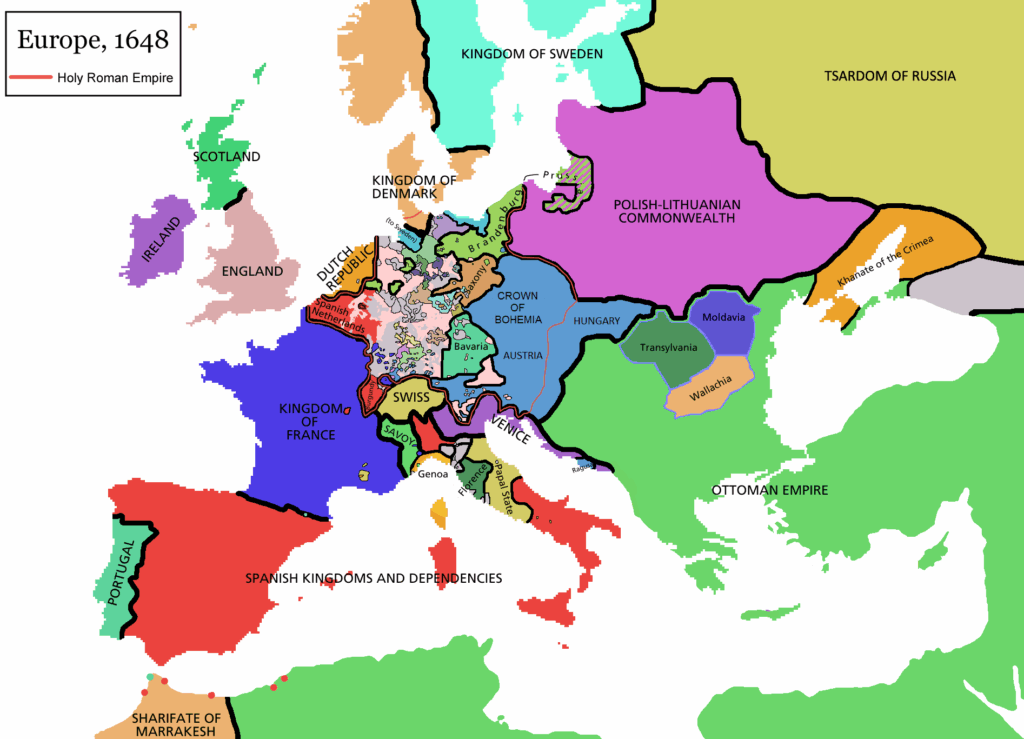
The Peace of Westphalia itself marked the end of a series of religious wars, wars that were largely sparked by the rise of Protestantism. One of the treaty’s great significance was that it excluded the universal efficacy of ecclesiastical theocracy, granting each state the right to determine its own internal religious policy.
The rise of Protestantism depended on the spread of print. Printing gave every believer the opportunity to read the Bible directly, thereby weakening the authority of the clergy. In addition, the various other kinds of new knowledge disseminated by print, especially natural philosophy and natural history, were also undermining traditional sacred narratives. Bacon’s 1620 Novum Organum and Descartes’s 1637 Discourse on Method both marked the rise of modern skepticism. Modern skeptics do not doubt human reason itself; rather, they doubt all old certainties. This shaking of certainty occurred simultaneously in people’s faith in knowledge and in order.
Hobbes’s 1651 Leviathan and Locke’s 1690 Two Treatises of Government marked the dawn of modern political philosophy. These modern political philosophers all tried to bypass the ancient sacred narratives and derive the proper order of human community from “nature.”
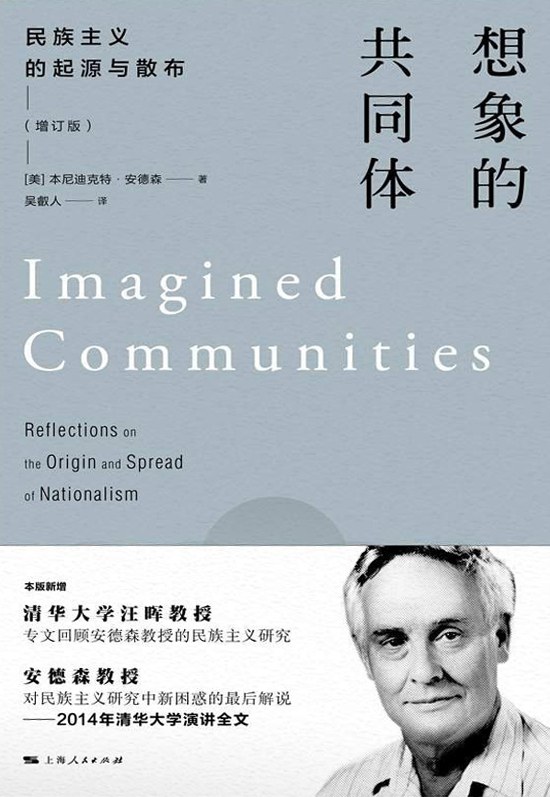
Benedict Anderson’s Imagined Communities is a famous work on the origins of the modern nation-state, and his theory also influenced more popular scholars such as Harari; A Brief History of Humankind can be said to be a popular application of Imagined Communities. In Imagined Communities, the author attributes the rise of the modern nation-state to “print capitalism.” He writes:
“These linked certainties were slowly but unevenly eroded by economic change, ‘discoveries’ (scientific and social) and the more rapid developments of communications. First in Western Europe and later elsewhere, this eroding of certainties had a profound effect on cosmology and history, causing a deep fracture between them. It is no wonder that later people began to search for a new way of meaningfully linking fraternity, power, and time. Perhaps nothing more than print-capitalism made the speed of this search greater, and its results more fruitful, for it made it possible for a rapidly growing number of people to think about themselves, and to relate themselves to others, in profoundly new ways.” Imagined Communities
A community is a group of people who can work together on the basis of consensus. My family, clan, classmates, relatives and friends, and so on, when gathered together, can form a real community, because our consensus and cooperation are reached on the basis of real shared life. But each person’s actual life is always limited; according to the “Dunbar number,” a community made up of mutually familiar shared lives is at most about 150 people. To build a larger community and organize hundreds of millions of people, one must rely on “imagination,” or rather, “narrative.”
For example, a villager may have spent his entire life no farther than the nearby town. By what right would he be willing to accept the rule of someone from a city he has never been to and a person he has never seen? Of course, that person may possess certain instruments of power, such as the army and the police, but most people are already convinced before they are actually hammered by the iron fist; all of this, of course, depends on “narrative.”
What is more important is that a public narrative is conducive to people’s solidarity and cooperation. As the saying goes, “those who are not of our kind must have different hearts”; so why is it that those of the same “kind” are more likely to be “of one mind”? If it is a small family, having grown up watching one another, then of course they can trust one another; but what if you have to cooperate with a stranger? How can I believe that this stranger is someone similar to me?
Public life makes possible the “familiar stranger.” Within a public living space, we have similar environments, similar experiences, similar memories, similar sources of knowledge, and similar aesthetic influences, so we are similar people. As long as I am sure that you and I are located in a similar public space, I naturally feel close to you, and cooperation becomes possible, sparing us the process of conflict, testing, and adjustment that comes after actual contact.
The closer the living space, the more naturally intimate one feels; so why do fellow villagers meet each other with tears in their eyes? Because memories are stirred. They have more memories of “shared life.” Such shared life does not necessarily mean actually seeing one another face to face, but rather living together under the same public environment and experiencing the same public events.
“Public memory” includes both the real and the fabricated, or, in other words, history and myth. But whichever kind of memory it is, it needs a medium in order to spread. Before the invention of writing, memory depended on oral transmission, and the scope of a community could hardly exceed the size of a tribe or chiefdom. After writing was invented, various narratives spread widely through texts, and thus could sustain much larger communities.
However, before papermaking and printing became widespread, books were expensive and rare, so only “classics” could become public knowledge. And canonical works and histories often required a long time to settle down and circulate widely, so in an ancient state, what played the role of “common memory” among strangers was either fictional figures or dead people—such as God, ancestors, sages of old, and so on. Such an order may be called a theocratic state, whose ruling authority comes from these distant beings, and whose rulers likewise need to confirm their legitimacy through means such as divine mandate, serving Heaven, and orthodoxy of the Way.
The mainstream democratic system of the modern state was difficult to realize in antiquity, unless in places like the Greek city-states. The city-state provided the Greeks with abundant public life, something unprecedented and unmatched in human history. The agora, market, theater, bathhouse, stadium, and so on were all public spaces for the Greeks. Rulers could address the public directly, and the public could participate in the discussion of all public affairs. But to sustain such public life for a city-state of several thousand to several tens of thousands was already a miracle; larger-scale cohesion and integration still had to rely on sacred narratives.
Printing is an important condition for the modern democratic order. First came books, later newspapers, and thus things happening at the present moment could also become public knowledge. The very concept of “modernity” became popular together with printed books. The information platform established by printed books is equivalent to an infinitely expanded ancient Greek agora, where public figures and public affairs can be jointly attended to over a very wide range. On the other hand, the authority of the traditional sacred narrative that stood above the state was dissolved, and all these were incentives that made it possible for communities to cohere into a new order. Countries like the United States are completely built on print culture, perhaps with the addition of the railway network and later the telegraph network; without a smooth and rapid medium of information transmission, how could a citizen on the American West Coast possibly vote to choose a person from the American East Coast to be president?
According to Imagined Communities, this process also required the spur of capitalism. Capitalism gave birth to large numbers of free and profit-seeking booksellers, who strengthened writing in national languages in order to expand their readership.
I think capitalism and the later industrial revolution were both foundations of the modern state system, but in the final analysis capitalism itself was also nurtured by a new technical environment. Both Bacon and Marx saw the impact of the three great inventions—printing, the compass, and gunpowder—on society. The spread of these new technologies, combined with the flourishing civil society of late medieval Western Europe, brought about a new state order and stimulated the rise of capitalism and the dawn of the Industrial Revolution. (In China, in fact, printing and gunpowder also contributed to a new order, especially during the Ming and Qing dynasties, though they ended up promoting the strengthening of imperial power instead.)
Capital replaced land and population as the main resource dominating the economy, and capitalists and entrepreneurs replaced landlords and nobles as the backbone of the social order. Thus the entire modern state system was organized around the “commodity market.”
The modern state is a community of interests, just as the “social contract theory” claims: citizens surrender their rights to the government not because the government has a sacred status or noble bloodline, but for reasons of practical interest. Citizens give up rights in exchange for necessary protection, thereby gaining more benefits; this is the source of the legitimacy of modern government. For the modern state, the government’s protection of citizens is not only reflected in defending against foreign enemies and maintaining public order, but also, and even more, in maintaining the order of the commodity market.
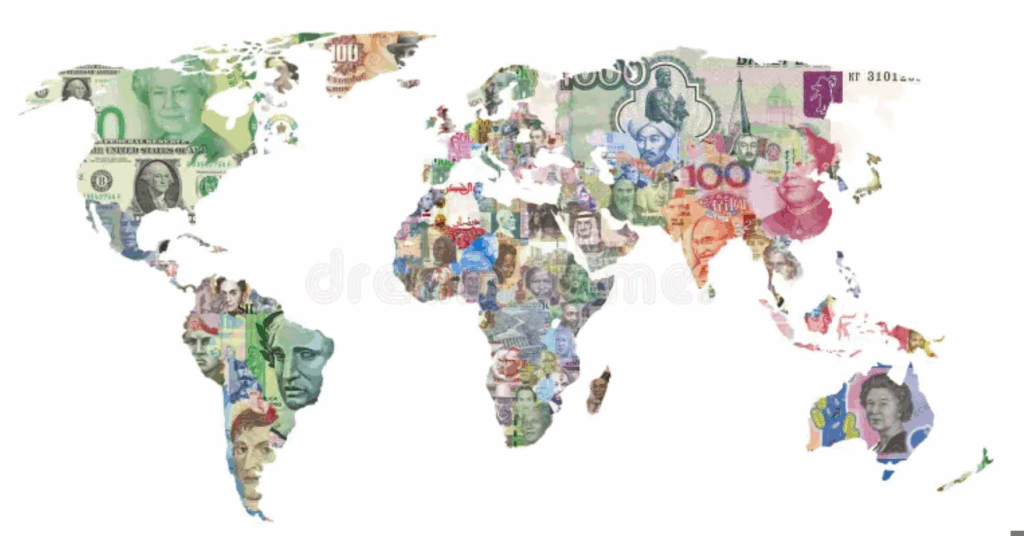
Currency and customs are standard features of the modern state; even tiny states often have their own issued currency. And customs do not merely inspect travelers coming and going; they also manage the flow of goods.
Of course, some later socialist states did practice a planned economy and resist the commodity market. Even so, the commodity market remained the central problem of these states. Internally, they had to use force and planning to control the market; externally, they also had to rely on currency and customs to defend against the market. In addition, socialist states also attached importance to industrial production, and thus likewise needed to regulate the large-scale flow of various resources and goods.
The various institutions of the modern state are all built around the flow of money and goods, whereas in antiquity, apart from a few small states such as Venice, which took merchants as their core, commercial activity did not occupy the center of state affairs.
Even when carrying out those missions inherent to ancient states, the modern state’s response must introduce the commodity economy. Take the maintenance of military power, for example. In antiquity, the core of military power was “people”: how to recruit soldiers, select generals, and hone martial skills were the main topics of ancient warfare. Logistics were certainly important, but they mainly concerned the production and transport of grain, and did not involve complex and large-scale production and trade problems. But beginning with gunpowder, the logic of the age of firearms changed. Firearms became the main factor determining military power, and firearms are not recruited at any moment; they require an entire series of production lines, including gunpowder production and the corresponding production of steel guns and cannons, and eventually aircraft and tanks, all of which demand a complete, large-scale production system.
The saying “if you lag behind, you will be beaten” only became true in the industrial age. In antiquity, countries with advanced technology and prosperous economies were instead more likely to be beaten. Some barbaric nomadic people from the steppe could suddenly emerge and beat a prosperous agricultural country back step by step, forcing it to cede territory and pay indemnities. This was because the main problem in ancient warfare was manpower rather than materiel, so those civilized people who lived in comfort could not defeat the barbarians whose whole people were soldiers. In the modern age, however, no matter how much nomads are all mobilized for war, they cannot defeat the steel torrent of an industrial state, and that steel torrent is positively correlated with advanced technology and economic prosperity.
Many other fields, including scientific research, education, public health, and even religion, have also been evolving in accordance with the logic of the commodity market.
What, then, is the logic of the modern commodity market? — In a word, “speed.” The operating mode of the capitalist market is a continuous acceleration of the cycle of capital expansion and productivity improvement. The meaning of capital is to raise production, and the meaning of production is to increase capital; the modern market cycles on and on in this way, entering a phase of exponential growth. The faster the speed of cyclical iteration, the stronger an economy becomes, and once your rate of growth falls behind, you will be beaten.
The significance of technological innovation no longer lies in the pursuit of truth, but in providing the “first productive force”; the significance of education no longer lies in cultivating free citizens, but in producing human resources; scholars are no longer there to transmit the Way, but to produce papers; environmental protection is for developing tourism resources and ecological resources; artistic creation has become a cultural industry; all kinds of entertainment, sports, services, and so on have all been folded into the “tertiary industry.” All values have become “resources,” all fields have become “industries,” and all actions have become “production.” This is the theme of the industrial age, the background color of the modern state system.
The logic of “assimilation” is the flip side of the logic of “speed.” The reason is simple: only by being pulled onto the same track and abiding by the same set of rules can one compete in speed. The modern state, on the one hand, speeds up through assimilation; on the other, it brings about sameness through acceleration. The two mutually reinforce each other.
Printing is precisely a technology that speeds up through assimilation: in handwritten manuscripts, every book is different, every stroke and line is different; but movable type printing, through standardization, makes all type blocks interchangeable, enabling books to be mass-produced. Modern science also originates in assimilation, that is, mathematization: it switches all kinds of qualitative questions in ancient natural philosophy into all kinds of quantitative questions in modern science, and understands the qualitative differences among things as differences of quantity (Descartes’ extension). This is the key to the Scientific Revolution. Industrial Revolution goes without saying: interchangeable parts, standardized processes, centralized labor, assembly-line production—these improvements all follow the logic of assimilation, simplifying all the fuzzy, individualized links in production, and using reproducibility to guide everything.
Ancient craftsmen prized slow work yielding fine results, prized the pursuit of perfection, prized secret techniques unique to one’s own house; quality and distinctiveness mattered more than speed. If a craftsman’s skill could not improve, and was easy to imitate, then of course that craftsman deserved scorn. But in modern industrial production, a worker who is alternately fast and slow, alternately good and bad, and not easy to replace by anyone else, is someone no assembly line can accept. If you do slow work for fine results, what about the next station on the line? If your craft is one of a kind, when you get off work who is supposed to take your place? Is the assembly line supposed to adjust its speed at any moment for you alone, and stop for sixteen hours every time it runs eight? What an assembly line needs is average and stable, not outstanding excellence.
Apart from industrial production, everything else that has become an “industry” is the same: whether politics or education, at more and more posts and positions, what the modern state needs is that you play the screw or the gear properly, not your free will and your refusal to conform. So we see that human “alienation” is the general trend of the industrial age: from human resources to human ore, from screws to draught oxen and horses, the machines are becoming ever more intelligent, while human beings are becoming more and more like machines.
From Marx onward, we can see warnings and critiques of this modern trend in countless thinkers, but we are still utterly powerless, because “if you fall behind, you get beaten” — you may refuse the model of productivity above all else, but once your speed of iteration falls behind, you will become “outdated,” marginalized, and even brutally eliminated by the market.
Marcuse, famous for his critique of modern technology, suggested in One-Dimensional Man: modern people have already lost the capacity for critique, because reason has been swept up by operationalism. When we criticize, the voice of reason immediately comes out to interrogate us: then what should be done? We then need to find a way, figure out what should be done first, what should be done second; if we cannot come up with a concrete plan of action, then our criticism is nothing but mere complaint, a non-rational outburst, of no constructive significance whatsoever. But the problem is: how can one possibly find an actionable plan? The premise of operability is that we must find materials from the existing toolbox and do things within the existing overall framework. The more a proposal conforms to these tools and this environment, the more “operable” it is. But what if what I want to say is that the overall framework of the modern order, or the underlying logic of modern technology, itself has gone wrong? Yet I also do not want to overthrow the whole of modern civilization and start over, and that is completely impossible anyway; so how could I possibly provide an action plan with clear operability? The result is that those dissatisfied with modern civilization can either only grumble, or at most withdraw from the world and live in seclusion, being marginalized until they are eliminated—there is no other way.
Heidegger, renowned for his criticism of modern technology, offered the advice of “releasement”: neither embrace nor resist, but persevere in contemplation. The meaning of contemplation is not to provide an operational plan, but to help us “accept our fate” — to recognize the “destiny” that we must undergo. Through contemplation, we come to see clearly that modernity is the fate human beings must pass through; this insight contains the following understanding: we cannot accomplish self-salvation by a series of precomputed steps, we can only wait for the arrival of a new destiny. As Heidegger said: “But the undergoing of an being-destiny always happens with the arrival of another destiny, which can neither be precomputed by way of logic-historical procedure nor invented metaphysically as a sequence of historical processes.” (Identity and Difference) In his later years, when a Hong Kong reporter pressed Heidegger on how to provide a solution, Heidegger replied that “philosophy becomes cybernetics” is the sorrow of this age, and that “only a god can save us.” Clearly, he did not mean that he himself believed in some messianic or apocalyptic religion; what he meant was that you should not make philosophers provide solutions. The task of philosophy is contemplation, not control; as for drawing up a plan to save all humanity, only God can do that.
But if one cannot provide a plan, what meaning does contemplation have? One meaning is that it helps us “wait” for the moment—when the fate of the age turns in a new direction, those who have thought will be better able to seize the opportunity—these opportunities cannot be precomputed, but when they actually arrive, we can better understand the possibilities contained within them.
In my view, this new destiny that may help us step beyond the fate of the industrial age and bring new possibilities had already begun to emerge in Heidegger’s lifetime, and today it has fully revealed itself. As Heidegger quoted Hölderlin’s verse: “Where there is danger, there grows the saving power.” “Cybernetics” is both the summit of the modern crisis and the harbinger of a new era.
The Arrival of Transformation
What we see today is that with the information age opened by cybernetics, on the one hand many modern crises are continuously intensifying; human beings are further alienated, resourced-ified, turned into oxen and horses, while the world is further mathematized, numerized, and datafied; productivity-above-all-else-ism and accelerationism remain rampant. But on the other hand, the information age is upending many of the underlying logics of the industrial age, making an all-around transformation of the international order, the national system, market forms, modes of production, patterns of thought, and ways of life possible.
The possibility of transformation first appears in a destructive form. We see that in the internet environment, especially in the age of social media, traditional barriers to information have been flattened, yet new forms of informational cocoons have formed. Deep discussion has gradually been marginalized in public space; low-IQ, inflammatory information floods cyberspace, giving rise to the flourishing of populism and nationalism. And this amplified popular voice is often anti-universalist and anti-globalization. On the one hand, ordinary people complain that they have not enjoyed the benefits of globalization (this complaint does have its reasons); on the other hand, the desire to revive national culture also strengthens the anti-globalization movement.
Globalization is the ultimate expanded version of modernity. Every country in the process of globalization has a fate more or less like that of every worker on an assembly line: some simply never earned much money at all, only barely maintaining a life of food and clothing; some earned some money, but fell into a spiritual crisis because their individuality or specificity was stripped away, turning them into a part of the gigantic chain of the machine. Chinese people think Chinese culture is being swallowed by Western culture, while Westerners also believe that traditional Christian culture is being eroded by paganism or atheism; Chinese people think universal values are destroying traditional values, while Westerners use DEI to disintegrate classical universal values. In essence, this situation is not a problem of any particular value tradition, but the result of the fact that “the world has become flat”: the globalizing big brush tries to smear everything evenly, so each side will feel contaminated.
We said earlier that the modern state operates around the commodity market, around the circulation of money and goods, and pursues the ever-accelerating iterative cycle of capital and productivity; a conveyor-belt factory is the paradigmatic model of the modern world. From the smallest person to the largest state, all must become a gear inserted into the production-trade chain of the global market. Just as the assembly line enables each worker to specialize in doing only one thing so as to maximize efficiency, globalists even hope that every country or region will function like workers in an industrial chain, each doing its own part: some countries provide energy, some are responsible for manufacturing, and these countries’ agriculture or other industries need not be self-sufficient—buying from abroad is enough. The costs saved by intensive production are sufficient to cover the cost of container ships crossing the Pacific. An American wrote a book in 2005 called The World Is Flat, which was precisely about how globalization broke through all sorts of barriers in the world and flattened differences and borders.

The early twenty-first century was the most prosperous period for globalizationism. From 2001 on—9/11 marked the desperate counterattack of the anti-globalization movement, yet China’s accession to the WTO in December of the same year marked the unstoppable march of globalization; up to 2008—August that year’s Beijing Olympics displayed the grand vision of “hearts connected, living together in the global village,” and the whole world was immersed in the magnificent panorama of globalization. Who could have imagined that what Zhang Yimou was directing was actually the farewell performance of the globalization era? And the U.S. financial crisis that erupted in September that year announced the abrupt end of globalization’s heyday. Of course, many people had not yet awakened from their beautiful dream; it was only when Trump was first elected President of the United States in 2016, or when the COVID-19 pandemic broke out and Brexit happened in 2020, or not until Trump was elected a second time in 2024, that many finally came to: so the climax of globalization had already come to an end. Even now, many people still refuse to wake up, thinking that Trump is merely an accidental anomaly.
The financial crisis exposed the problems of globalization. First, this model of excessive dependence on global trade dragged many countries passively into the crisis, leaving them even unable to extricate themselves on their own. Second, many people finally woke up to the fact that globalization had not brought them benefits—the ones enjoying the fruits of globalization were those giant predators at the very top of the pyramid. Even after the financial crisis, aside from a few of those predators going bankrupt, the wealth gap actually widened further on the whole. Globalization not only failed to bring about a global heart-to-heart, but instead intensified fracture and hostility among different classes within each country. The bottom layer of the people did not, or at least did not sufficiently, feel the benefits of globalization.
Occupy Wall Street in the United States in 2011 marked the beginning of globalization’s self-subverting movement—before that, terrorism had been a resistance from external forces not yet globalized, while Occupy Wall Street marked the rebellious forces emerging within the United States, the “beacon” of globalization. However, this movement was quickly defused by Obama. The Black Lives Matter movement that arose in 2013 can be said to have been a calculated maneuver: it shifted the issue of inequality between classes toward conflicts of skin color and sexual orientation, instantly diverting public attention and the direction of public opinion, ultimately letting the demands of Occupy Wall Street come to nothing.
So rather than saying that Trump is the anomaly, it is better to say that Obama was the anomaly; he gave the globalization that had already bowed out in 2008 another ten encore performances. Of course, on the other side of the globe, the 4-trillion stimulus was also a shot of stimulant for globalization teetering on the brink。。The result was that in the more than ten years after 2008, the globalization movement returned in an even more uncanny form: on one side, real-estate-national-strength and infrastructure-madness; on the other, Black Lives Matter all the way to LGBTQDEI.
So this round of Trump’s return to the stage, brandishing the tariff club and breaking with old flames like Europe and Canada, is a complete rejection of globalization and a turn toward isolationism. Many people think Trump is an anomaly, but in my view this is merely a belated trend: the dying globalization was temporarily revived by Obama and Wen Jiabao, but after a burst of dying lucidity, it still had to draw the curtain in the end.
So the anti-globalization movement marked by trends such as Brexit, China’s internal circulation, and American isolationism is, to some extent, an opportunity to tear everything down and start anew. Of course, if we cannot change the underlying logic of the industrial age, cannot change the existing modes of production and circulation, then anti-globalization is of course not a good thing. So what matters more is what constructive support the information age can bring to a new order.

Abstract Needs in the Post-Industrial Age Can Be Satisfied in Virtual Worlds
The word “constructive” is also liable to cause misunderstandings. Under the logic of the industrial age, “constructive” often amounts to raising productivity, but what we now need is precisely to move beyond productivity-ism. So then, apart from production, what should real constructiveness be directed toward? It is hard to measure it with a linear, monotonous indicator, but that does not mean we cannot understand it. In fact, one might say that this is the original meaning of “construction” itself: building our homeland.
The construction of a homeland is not always measured by productivity. Even in the industrial age, after the meaning of “home” had already shrunk dramatically and had almost become nothing more than a “sleeping tool,” wage slaves still wished to carve out, in their home décor, more or less a bit of individual flair.
What, after all, are human labor and innovation for? Of course, for a better life. So when we say that technological development is a good thing, that the Industrial Revolution is a good thing, the key point is that technology and production have indeed brought enormous enrichment to human life. But we cannot turn the order of means and ends upside down, and instead suppose that the purpose of human existence is to develop technology and raise productivity. Such an attitude treats tools as ends and human beings as tools.
To sacrifice oneself for some political revolution and devote one’s personal life to it—such a person is great. But the reason he is great is that he has sacrificed the richness of individual life in exchange for the happy lives of others and of future generations—he believes that after the revolution or the struggle succeeds, a peaceful future will allow more people to live and work in contentment. But to sacrifice and take risks for a technological revolution—that value system is dangerous. For political revolutions have goals and limits, whereas technological revolutions are endless. So when our generation sacrifices personal life, working like beasts of burden to push technological development forward, what about the next generation? They discover that technological development has not been “completed.” If the sacrifice of this generation is correct, then for the next generation to do the right thing, they too must continue to sacrifice. Thus it goes on, generation after generation without end; in the end, technology keeps innovating, productivity keeps rising, yet each generation still has to sacrifice life, and may even have to sacrifice more and more just to keep up with the pace of technology. In this way, technology and production are no longer for the sake of making human life better, and then the whole purpose to which we have devoted ourselves is no longer a lofty thing at all; rather, it becomes something that will bury the happiness of all humankind.
So productivity-ism or technology-ism may, like some fanatical religion, attract a small band of ascetics to throw themselves into it, but it can absolutely never become the mainstream value system of human civilization. If technology makes human beings live more and more frantically, then perhaps only refusing to have children can break out of this endless cycle of sacrifice.
Technological progress and productivity gains are not always, and inevitably, conducive to the enrichment of life, because the logic of production is the more the better, whereas the logic of life is to stop at the highest good—that is, to “call it a day when things are good enough.” For the “capital—production” cycle, earning 2 yuan is better than earning 1 yuan; earning 100 yuan is better than earning 10 yuan; producing 10 loaves of bread per minute is better than producing 5 loaves per minute. The pursuit has no end. But for a person, eating 3 slices of bread a day is better than eating 2 slices a day; 4 slices may be better than 3 slices, but what about eating 40 slices of bread a day? What about 500 slices? That clearly is no good thing. For human life, apart from money, any good thing has a limit; beyond a certain threshold, an increase in quantity is not necessarily an enrichment of life.
When most human beings cannot even secure basic food and clothing, the development of technology and industry, by continuously enriching material life, can obviously improve people’s quality of life. So in the middle and early stages of the Industrial Revolution, raising productivity and enriching life were in step: the higher a country’s productivity, the more enriched and happier its people’s lives would also be.
But the question is, what happens when material abundance reaches “great abundance”? Marx said that at that point capitalism would become obsolete and a new system would be needed. So what does material great abundance mean? Many people think it is something unattainable and far off. But if you exclude abstract things such as money from the category of “material,” and instead return to the visible, tangible, sensory needs of real human life, then great abundance in many respects is not far away at all. Take bread, for example: if each person eats 5 slices a day, that is basically enough, so 10 to 20 slices a day is already “great abundance.” Human productive capacity has actually been able to reach that level for a long time. Today, as far as all of humankind is concerned, food production is already greatly abundant; the key issue next is not production but distribution.
We always feel that material things can never become greatly abundant; this is how we have fallen into capitalism’s open secret. On the one hand, capitalism promotes the value system of money above all else, measuring everything in monetary terms; on the other hand, it keeps endlessly producing those abstract products—it continuously manufactures needs, virtual and abstract needs, and attaches them to products.
Capitalists are producing desire, not simply products. For example? Luxury goods are just such a case. You do not really need to spend that much money on clothing; clothes have long since been enough, and that clothing is not even very good. But because it is attached to an immaterial brand value—brand value is an abstract concept—say, if you print the two letters LV on it, this thing suddenly becomes worth a lot of money. It is like writing a 0 and having its value double. This value, in a sense, can be fabricated. Add one more 0 to a bank account, and its value doubles. We say that the first commodity to be reproduced in modern times on a mass scale—the printed book—is actually a commodity in which materiality and immateriality are superimposed. Although materially it is just a mass-produced item, its value is precisely spiritual, precisely immaterial. The knowledge inside it does not dissipate because it is copied. The same knowledge: one person reads it, that person has learned it; another person reads it, another person has learned it; 100 people read the same book, and all 100 people have learned the knowledge inside it—that is, they have obtained the value of that book. This is not the same as apples, and it is not the same as bread. If one person eats bread, they consume it; if two people come to eat it, each can only have half; if 100 people come to eat it, each can only have a crumb.
So, in being bread, bread is likewise a copy, likewise an industrial product, likewise a commodity, yet its value is conserved—you consume a bit of value, and it decreases by a bit. But book knowledge, as knowledge, has a value that is not conserved—you gain value, yet its value remains; two people gain value, and its value still remains. The example Wiener himself gave was works of art, and works of art are also a typical case: one person comes to view it, you obtain one unit of value; two people come to view it, you obtain two units of value. The value of that work of art will not be consumed away just because more people look at it; the more people look at it, the deeper its value becomes in a certain sense. This is different from industrial products like bread, cars, and clothes. Those industrial products are conserved, whereas the value of these things is not conserved. But we can see that, in the traditional industrial age, this kind of non-conserved value was relatively marginal and minor, not mainstream. In the information age, especially with those digital objects and digital models, according to Wiener there should not even be commodities, because their form is different. They do not have the supply-and-demand relationship of the traditional commodity market—how many units of commodity I have, how many people want them, whether supply exceeds demand or demand exceeds supply.
Digital things can always satisfy demand, because copying is infinite. They are more like works of art and knowledge—one person downloads it and that is one copy; two people download it and each gets one copy. It is not conserved; it can be copied without limit. Do such things have value? Of course they do, and in a certain sense they are the higher value we pursue. When our basic material needs have already been greatly satisfied, and humankind wants to climb further upward, to develop and enrich life, what it relies on are those virtualized needs. Human civilization seems to advance as grain production increases, but there is always a limit. When a stage is reached at which everyone is satisfied and everyone can eat their fill, then you must pursue higher needs. Higher needs are often virtualized needs, and these virtualized needs are often more easily satisfied in cyberspace.
Resisting efficiency-ism, returning from production to life
In such an environment, can they still be managed by the traditional capitalist market order? Can tariffs still be imposed on digital products? Can they still be tracked through logistics as in the past? Can it still run by means of iterative circulation between money and goods? Wiener says we need to call for a new value system, a new system of values, and a new social order to deal with the new goods environment and market environment of the internet age. We have already seen this ideal new—what we call the “network state,” or a new kind of state order, international environment, and lifeworld. What features might it have?
First, we must move beyond the productivity-ism of the industrial age and return to human value. We must also move beyond the logic centered on buying and selling, centered on the commodity market; we must move beyond the logic of money and goods iterating back and forth in cycles. We must move toward a human-centered value system, avoiding the inversion of tools and goals. Human beings are the end; human life is the end; production and technology are means, meant to promote a good human life. We must avoid the atomization, cloudification, and homogenization of human beings, and once again let each person recover individuality and build uniqueness. This is the trend the network age ought to have—of course, in the idealized sense. In fact, people are also pursuing in this direction. Why is it necessary to adjust institutions, rules of society, and economic systems? Because if we use old modes of production and old capitalist iterative modes of production to understand and govern the network age, then all it does is intensify the basic logic of the industrial age.
If we merely say that AI is very useful, and fully exploit AI, algorithms, and such tools, the result may be a harsh system. This system not only turns you into a screw on the workbench, stripping away your selfhood; it does the same on the road. Take the food-delivery rider, for example: although he roams the streets and alleys, his life, every footprint, every trajectory of action are all dominated by algorithms. Algorithms prearrange all your routes and delivery times, forcing you into a merciless delivery tool like a machine, allowing no individuality to exist. Even knowledge workers and office white-collar employees, who seem to do work that is less monotonous and more creative, may, as technology develops, become like beasts of burden too. Even much of scientists’ work has now been alienated. Young graduate students in the sciences often feel a gap in their hearts: the scientists they imagined were Einstein or Newton, speaking of the essence of the universe and nature. But in reality, they spend all day washing test tubes, staring at data, making charts, running back and forth to help their advisors with menial tasks, like research migrant workers, like peasants, doing repetitive labor.
Technological development, the information age, and remote work let you work from home, but your form of work may turn into being on call at any time, being constantly controlled by time, and submitting to assembly-line arrangements. This includes what we often call the information cocoon: on the surface you seem able to choose freely, but in fact you have woven for yourself an environment of directed feeding, making it harder and harder to accept different viewpoints and outsiders, and lacking tolerance. To a large extent, these problems arise because we have not used new models, institutions, and orders to respond to the characteristics of the information age; instead, we have further expanded the old model. The peak of the expansion of the old model is Web 2.0. Those social media platforms, the so-called tech companies, are the most advanced internet companies, but at the same time they are also extensions of the traditional order—managing human beings in a relatively traditional way. To break the old model, one must recognize that at its core it is still the capitalist operating logic of constantly iterating capital and commodities. In internet companies, commodities are no longer products on an industrial assembly line, but have become human attention, traffic, click-through rates, and the like. What they produce are things that attract attention, create controversy, and manufacture opposition, so that we consume them.
This logic continues the industrial age’s “must keep refreshing,” because if clothes could be worn for 20 years without wearing out, people in antiquity would think that was a good thing, but modern people would not produce such durable goods—if they did not keep replacing them, factories would have to close. So they must continuously produce new products, new styles, new seasons of fashion, making you replace things frequently. Now this logic has spilled over into digital products as well, where there is constant iteration, accelerated production, and the filling of desire. The spiritual pressure this brings is that things look abundant on the surface but are actually impoverished. The true richness of life sometimes requires depth, not frequent replacement. Some people spend their whole lives playing with one thing, studying one collection; that is also a kind of richness, not changing to something new every day. Technological products, news, and knowledge are constantly refreshing on the surface, but this is a kind of shallow, passing glance poverty. Short videos keep sliding past; there is lots of information but no sedimentation; novels feel too long even to read once, and patience for films has also disappeared. Chaos is not richness, and monotony is not richness; true richness is “know when to stop and stay within proper limits, just right.” One must ensure a just-right rhythm: both rich and bounded, not infinitely rich. The so-called “global village,” as McLuhan saw it, is terrifying—if you only know one person for your whole life, that is monotonous; knowing 3 people is richer than knowing 1; 5 people is richer than 3. But if 50,000, 500 million, or 5 billion people are all around you at every moment, then that is not richness, but the loss of individuality, becoming a monotonous noise of everyone-everyone-everyone.
Richness must have boundaries. Do not immediately come into contact with everyone and everything in the world; there should be small circles, and one should contact and become familiar gradually. Whether people or things, all need to be slowly contemplated and adapted to first, and only then do they truly become rich.
A life with flavor requires depth. Under the old industrial system and the Web 2.0 model, this depth has been taken away—deep reading, thinking, and discussion have been replaced by superficial, fast-food information.
This is because we refresh too quickly, and accept new products without boundaries, so all we can do is skim the surface. To avoid this, one major key lies in the economic or financial model—the motivations of producers and the way they make profits determine the whole system. The current model is still a capitalist model: capital iterates rapidly, pursuing the idea that the more money the better. In the internet, this turns into an exchange between money and traffic: with traffic comes money; money buys traffic; traffic generates money. Thus a traffic-first logic emerges, just like the traditional efficiency-first logic. Under the traffic logic, a doctoral student may be worth less than a primary school student—because conversion rates are low; whereas primary school students are impulsive and easily influenced by advertising, so their conversion rates are high. Distinctive people are instead marginalized—they are a minority and hard to attract with a single viral hit. Why make professional articles suitable only for a small number of people? Better to make content suitable for 95% of ordinary people. AI training is similar, with the problem of “hallucination”: the content is plausible but false, yet if it can bluff most people, that counts as success, while expert opinion becomes secondary. If all one pursues is attention and traffic, the internet environment will become like this.
How can efficiency-ism be avoided? Marcuse believed that once one starts looking for workable solutions, one will choose the existing tools, and thus fall into the existing framework. But now there are new tools; the internet itself is an environment that can break away from mere material needs and pursue the self. Blockchain is also an important new tool. The decentralized character of blockchain can help the internet’s logic and ecology develop independently. If there is no boundary between the world of the internet and the traditional industrial world, then it will be swallowed up by the traditional system. Web 1.0 once had a tendency toward personalization and decentralization, but by Web 2.0 it was taken over by old forces because of massification.
Concepts such as Web 3.0 and the metaverse are, in essence, all about competing for an independent economic order for the internet—an internet-native currency, internet-native platforms, internet-native boundaries—so as to break free from the direct control of real-world state institutions. Only in this way can a relatively isolated new order be established and new possibilities be explored. An independent space on the internet is not for lawlessness, but for exploring a new order. Blockchain makes it possible for small-scale economic autonomous communities to exist on the internet, opening up a path for the transition from nation-state to network state, and from the industrial age to the information age.
Translated from the Chinese original with AI assistance. The original text is authoritative.