
Published in Science Times (2025-08-28, p. 3, general), with the title changed to “The first users of science museums should not be teenagers, but scholars”
In this summer vacation, which is about to end, science museums have joined the ranks of the many must-check-in tourist destinations. For parents, if they want their children to take part in some edutainment-oriented activities, science museums are obviously one of the best choices. In recent years, our country has continuously increased investment in science museum construction. According to Xinhua News Agency, the number of science museums open free of charge in China increased from 92 in 2015 to 409 in 2024, with an average annual increase of 35 science museums.
The relationship between science museums and the scientific and cultural literacy of the public follows the rule that “as the water rises, the boat rises too.” The more science museums develop and grow, the higher the demands they place on the scientific and cultural literacy of the public. This means that science museum construction in China must keep moving at the forefront of the times, “always on the road.”
Learn First, Innovate Later
First of all, we must acknowledge that China, as a late-developing country, follows a development pattern in many fields of first learning from and imitating advanced international experience or popular styles, and then using its large population base to “roll out” products on a massive scale—an approach that inevitably brings some homogenization, but can also occupy the market at the lowest cost, and then, under the positive feedback of a huge market, further innovate.
The construction and development of China’s science museums also began in this mode, but what deserves attention is how to consolidate the market and renew and innovate once science museums have been initially popularized.
In this respect, science museums differ greatly from other commercial fields, because in consumer sectors like mobile phones and automobiles, China always has many companies engaged in brutal competition. After an initial stage of imitation and transplantation has cultivated a vast consumer market, enterprises, in order to seize that market and compete for increasingly discerning consumers, must constantly bring forth the new and discard the old. This fiercely competitive market environment has made China very good at all kinds of “micro-innovation” in many fields, especially in user experience, where it can always quickly reach global leadership.
In the case of science museums, however, China has not operated in a fully marketized way. Major science museums are basically free to enter, with operations maintained through government funding, and without life-and-death competitive pressure; as a result, they are not very sensitive to market demand or to visitors’ experience. One solution to this is to move gradually toward marketization, or, as with new-energy vehicles, combine government subsidies with market competition. Another solution is to remain non-profit while increasing the dimensions on which science museums are evaluated.
On the one hand, marketization is reasonable, because science museums have a broad market base, and in effect they resemble a hybrid of after-school educational institutions, public entertainment venues, and youth activity centers; in fact, all these institutions have private or fee-based models. On the other hand, keeping admission free also has its rationale, after all, only in this way can the scientific and educational needs of the broadest masses be met. The key is how to establish an effective and long-term feedback mechanism that incentivizes the maintenance and innovation of science museums.
Bring in the Business World, Academia, and Civil Society Organizations
In my view, in addition to connecting with the government and receiving government support, science museums can also bring in participation from various groups in the business world, academia, and civil society organizations.
Science museums in the West are usually sponsored by many charitable foundations and commercial companies, such as the Rockefeller Foundation and Shell Oil. Science museums receive a continuous infusion of funds, while commercial companies gain opportunities for brand exposure; and because commercial companies need a larger audience, this in turn incentivizes science museums to keep improving their exhibitions, which benefits visitors.
In China, there are also cases of commercial companies sponsoring science museums, but on the whole no routine mechanism has been formed. Of course, introducing commercial sponsorship inevitably stirs controversy, even in the West, but we need not fear controversy. If there is an additional mechanism that can supervise the displays and ensure that science museums remain neutral and do not spread bias because of sponsors’ demands, that would be even better.
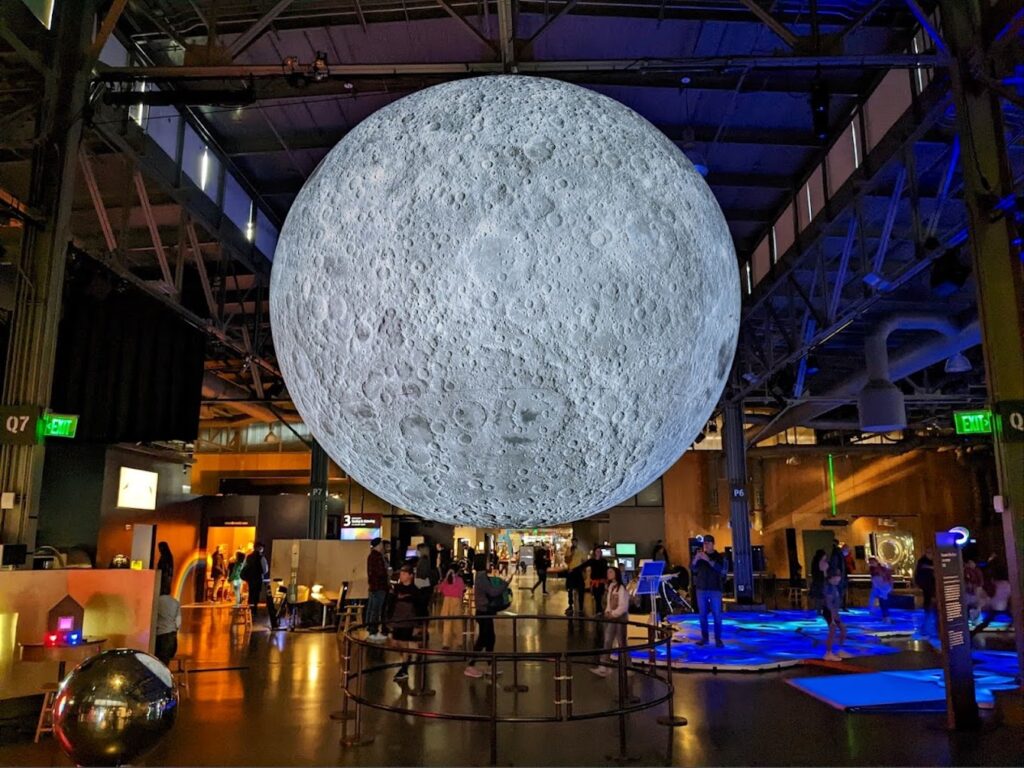
An additional supervision mechanism means bringing in academia. In the West, science museums often have their own R&D teams, or they are good at gathering R&D personnel from multiple fields. For example, the leader among science museums—the Exploratorium in San Francisco, United States—designs and manufactures almost all of its exhibits itself. It has a dedicated exhibit workshop, bringing together scientists, artists, designers, and engineers, and even their development process is open to visitors. In addition, the Exploratorium has long-term cooperative relationships with research institutions such as NASA and CERN, as well as major universities. The Exploratorium also frequently launches artist-in-residence programs, attracting artists and scientists for interdisciplinary exchange.
In China, the exhibits in science museums often do not have such a strong or diverse R&D team behind them; many times they are led by factories, which borrow from some foreign exhibits and produce them in batches. Science museum operators place direct orders with factories for complete sets of exhibits; even the interior design and decoration of exhibition halls can be custom-bulk-ordered all at once, without any complicated R&D process. Of course, there is cooperation between science museums and scientists, but it is basically the science museum serving as a venue for scientists’ popular science activities, rather than scientists directly participating in the design process of exhibition halls and exhibits. A platform for interdisciplinary collaboration among science, the humanities, and the arts still remains to be formed.
In my view, the first “users” of a science museum should not be the general public or teenagers, but scholars. It should first be opened to them, forming a platform for scientists, engineers, historians, artists, and educators to communicate and collaborate together. Only after it can continuously attract these “high-end” participants can it then provide ordinary visitors with exhibitions that are constantly updated, scientifically grounded, creative, easy to understand, respectful of history, and imbued with humanistic care.
Integrating the Two Models
Finally, one further point needs to be added: Western science museums are divided into two models, “science museums” and “science centers.” The former are mainly collection-based, such as scientific instruments, industrial machines, scientists’ manuscripts, and related artifacts; the latter are mainly interactive exhibits designed and produced today. In the West, “science centers” rose to prominence in the second half of the twentieth century, while the tradition of “science museums” has never been interrupted. In China, however, “science museums” are very rare, and the few that exist are mostly private or thematic. The Science Museum of Tsinghua University may be China’s first comprehensive science museum, and this direction is worth promoting.
Collections bearing deep historical weight are more likely to stimulate visitors’ emotional resonance, allowing them to feel both the greatness and the gravity of the road of science, and to develop a sense of closeness to science as well—through the collections, it is as if we are together with the scientists of that time. In addition, centering on collections objectively strengthens the uniqueness of a science museum and can prevent the situation where “all museums look the same.”
Perhaps in China, these two models—“science museum” and “science center”—can be integrated. For example, a science museum could collect a few science artifacts of profound historical significance as its signature treasures, and then, around these collections, design and develop interactive replicas or related scenes, allowing visitors to immerse themselves in the stories of the history of science.
Translated from the Chinese original with AI assistance. The original text is authoritative.