
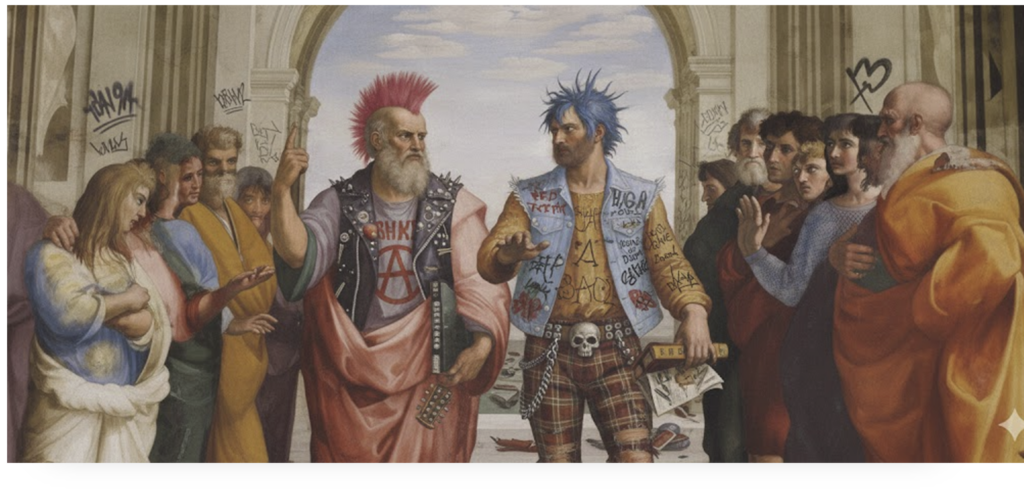
On January 30, 2026, I came to Chiang Mai to attend GCC’s first Chinese-language “Cypherpunk x Thinker Gathering,” where I gave a 20-minute talk, “How to Be a Punk Philosopher.” I had actively asked to join this event after seeing the announcement, because I was very fond of this theme. On the one hand, “cypherpunk” is a current of thought I very much hope to spread in the Chinese-speaking world; on the other hand, “cypherpunk thinker” is also how I position myself, and it is much cooler than “independent scholar.”
My talk introduced what “punk” is and elaborated the claim that philosophers ought to be punk. But the time on site was limited, so I spoke rather briefly; here I am posting a fuller version of the essay.
I entered the Department of Philosophy at Peking University in 2004 as an undergraduate, and remained there until earning my doctorate in 2014. I then spent three years doing postdoctoral work in the Department of Philosophy at BNU, and from 2017 I was in the Department of the History of Science at Tsinghua University, focusing on the history of technology and the philosophy of technology. In 2024 I left the university of my own accord and moved to Singapore to enjoy an early retirement, while also doing tech art and startups with students on the side. My own experience is one of transforming from a classically trained, academic philosopher into a “punk philosopher.” (Somewhat ironically, scholars who come through the standard philosophy curriculum are usually not very daring when it comes to calling themselves “philosophers”; once I call myself a “philosopher,” that is already a bit punk.)

What Is Punk
The word punk, as we use it today, comes from a strain of rock music culture in 1970s Britain. Earlier than that, punk was a vulgar dirty word, roughly meaning a hoodlum or loafer, and even dirtier and lower—prostitute, male prostitute, or someone roughly analogous to a butt-licker. Literally speaking, punk music means “low-class music,” but people embraced the term with confidence, thereby challenging the condescending elitism of mainstream culture.
The concept of punk quickly moved beyond music and became a cultural trend or a spiritual temperament. I have summarized three basic characteristics of the punk spirit, and the following traits also apply to the punk philosopher I want to discuss:
1.Vulgarity — opposing affectation, embracing lowbrow street slang
2.Rebellion — opposing authoritarianism, advocating freedom and decentralization
3.Action — opposing elitism, refusing to set limits (“you must do X in order to do Y”), insisting on active practice, the DIY spirit
The later cyberpunk, or cypherpunk, movement was launched by a wave of cryptographers, programmers, and hackers. They borrowed the name punk and, on the basis of the punk spirit, added one more element:
4.Privacy — opposing surveillance and censorship, insisting on the independence of digital identity (advocating anonymity or pseudonymity)
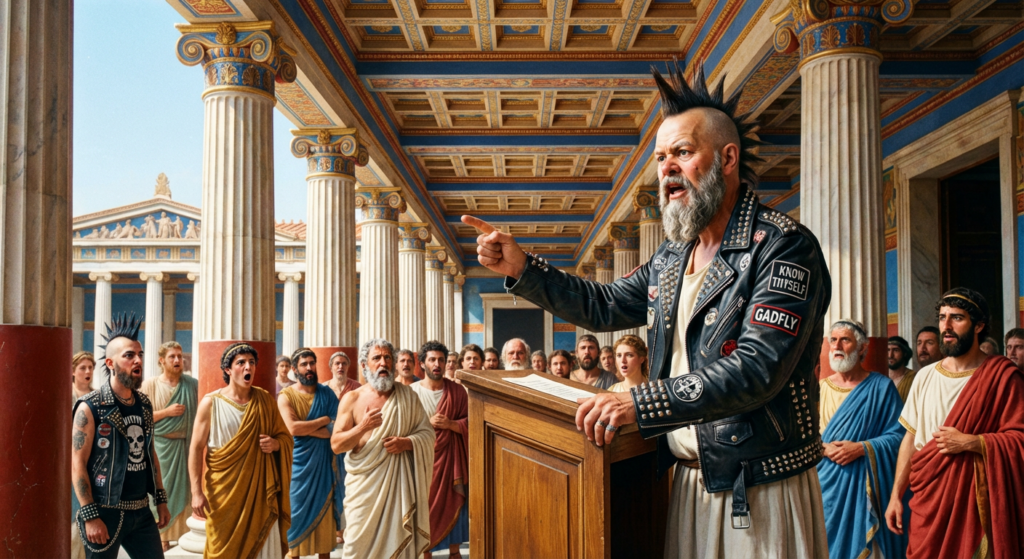
What Is Philosophy: Socrates as a Punk Philosopher
Having said what punk is, let us move on to what a philosopher is. Philosophy originated in ancient Greece, and the image of the philosopher was more or less established by Socrates, then carried forward and glorified by his disciples and their disciples (Plato and Aristotle).
1. A Lover of Wisdom
Philosopher (Philo-sopher) literally means “lover of wisdom,” and this concept itself arose out of a rebellion against the Sophists. According to legend, the first to call himself a lover of wisdom was Pythagoras, though this story may be an embellishment by later generations. The more certain emblematic figure is Socrates. Socrates consciously distinguished himself from the Sophists of his time, stressing, “I do not possess wisdom; I merely love wisdom.” But you do not possess wisdom either. The thing that makes me better than you is that I know I am ignorant, while you do not even know that much.
2. Don’t “Sell Out”
“Sell-out” is a phrase from punk circles. It means accusing someone of “selling themselves,” referring to the other party’s surrender to commercialization, singing for money. Of course, punk musicians cannot possibly make no money at all, but what they oppose is yielding to the demands of record companies or currying favor with mainstream culture in order to make money, thereby losing the purity of music.
Philosophers oppose the Sophists, first and foremost, in opposing their “peddling” of wisdom. Philosophers accuse the Sophists of being willing to teach anything, including sophistry, for the sake of money; of choosing whatever position suits the argument; of pursuing dazzling rhetorical tricks while not caring about truth.
3. Open to the Public
Constrained by their era, the philosophers of ancient Greece were after all mainly an activity of the leisured classes (the free citizens), but Socrates, relatively speaking, had already transcended his time and no longer treated the pursuit of knowledge as a privilege of the elite,
Socrates not only charged no tuition, he also set up no walls. He conversed and debated with anyone in the agora and the colonnades of Athens; if you simply followed Socrates around, you became his follower, regardless of your status. Socrates talked with the lofty politicians and exposed how self-righteous they were, but he also proactively talked with craftsmen, and of course in the end he exposed their ignorance as well, treating them no differently from the high and mighty. Even in the Meno, Socrates converses with a slave boy to prove that slaves lacking formal education can likewise understand mathematics (this dialogue may have been created by Plato).
4. Provocation and Offense
Like punk musicians, Socrates liked to provoke and offend. He debated all kinds of self-important people, exposing their hypocrisy; he was branded “the gadfly of Athens.” In the end he offended too many people, and of course also because of certain struggles over political lines, Socrates was tried and sentenced to death by the citizen assembly on charges of impiety and corrupting the young. He could have paid a fine to avoid death or chosen exile, but he refused to compromise and even launched into mockery, enraging the jurors and ultimately meeting death with magnanimity.
5. Anti-Authority
Socrates’s two charges ultimately amount to rebellion against authority, which is also typical punk spirit: rebelling against authority and rules.
Impiety—this means that Socrates doubted Athens’s authoritative beliefs, urging people to listen to the voice within rather than blindly obeying oracles;
Corrupting the young—the verdict said that Socrates “taught young people to doubt tradition and challenge authority, causing them no longer to obey their fathers and the laws of the city-state.”
6. The DIY Spirit
Punk insists that everyone—without needing elite patronage, without expensive equipment, without specific training, without any threshold of status—can pick things up and make music themselves. Socrates likewise maintained that everyone can think and argue for themselves. Socrates said: I am the midwife—not that I persuade you, but that I help you persuade yourself. “Know yourself” is the eternal theme of philosophy, and in a certain sense even its only theme. Everyone can, at any time—without first learning all sorts of elaborate concepts—begin reflecting, come to know themselves, and come to know the environment in which they live.
What Is Vulgarity: Grounding Philosophy in Everyday Language
Punk musicians love to swear, but the key point is not the swearing; it is being grounded, speaking “plain talk.” For the punk philosopher, the first thing is to remain grounded in everyday language, to use everyday language skillfully, while avoiding obscure terminology and jargon as much as possible.
This is not to say that philosophy must be “easy to understand.” Plain talk is not necessarily easy to understand; if you are unfamiliar with the context, you may still not get it. For example, swearing in a dialect is crude, but people from other regions may not understand it. For example, you may tell a story in plain speech, but if people have not heard the background or the plot and only catch a few fragments, of course they still won’t understand.
Grounding oneself in plain speech is not for the sake of “pandering to vulgar taste,” nor for the sake of “being trendy”; punk music is not the same as pop music. Grounding oneself in plain speech still stems from anti-authoritarianism and anti-elitism, and also from philosophy’s inner requirements.
1. Opposing Professionalization
Among academic philosophers, especially in China’s scholarly circles, profound-sounding terminology and obscure prose are often used to highlight professionalism, forming a kind of jargon or cant—outsiders cannot understand it, and therefore cannot join in. Even within the philosophy world, someone who specializes in Kant cannot enter the circle of Hegel scholarship, and someone who specializes in Heidegger cannot enter the circle of Husserl scholarship; these are all historically closely related philosophers, let alone the gap across major philosophical schools.
Specialization is the basic paradigm of modern science. Factory assembly lines and science-and-engineering education both follow this logic: break work down as much as possible into mutually isolated subfields, so that each person is responsible only for the little patch of business right in front of them, without having to think about any other station. This mode of production has indeed vastly improved efficiency in most fields. But philosophy alone cannot be specialized, because the object philosophy confronts is an indivisible whole: myself. Self-knowledge is the eternal theme of philosophy, and knowledge of the “self” contains questions such as “Where am I? Where did I come from, and where am I going?”—that is, it contains questions about the “world” and the “age.” Yet in any case, all knowledge must ultimately be unified upon the “I,” and the “I” is always one person.
Theoretically speaking, the more specialized the age, the more each of us needs philosophy—because philosophy’s mission is not to expand humanity’s knowledge in any one subfield; on the contrary, philosophy tries to “synthesize” countless fragmented pieces of knowledge and reflect on the relations between the various fields and myself (the human being).
Philosophy also divides by theme, just as a complete and unified novel story is also divided into chapters and topics. Philosophy of technology asks about the relation between technology and human beings; political philosophy asks about the relation between politics and human beings. Depending on the philosopher’s temperament and the differences in historical context, a philosophy may place different emphasis on different things, but on the whole these themes and emphases are not severed from one another.
So philosophy does not need, and should not have, “professional barriers.”
2. Immediate comprehension
The task of philosophy is “knowing.” What does knowing mean? These two Chinese characters both have the “speech” radical (識 has two “speech”s), hinting that language is the foundation of knowledge. An arrow shot from the mouth is “knowledge”; to know is to “blurt it out.”
In short, being able to say something clearly—and in the most direct language, blurt it out—is what it really means to know. If one cannot explain it clearly, or must rely on someone else’s mouth in order to speak, then this is a lack of cognition.
If I can only state the name of a thing, does that count as knowledge? It does. Because this requires me to distinguish that thing from the disorderly multiplicity of the world—you can shout “apple” at an apple, and when you face a peach or a pear you no longer shout “apple”; this shows that you have at least some ability to recognize things, even if you still do not know what an apple tastes like.
But the problem is that, with the development of written texts, in many cases people are not only “able to state the name of a thing,” but even “able to state the name of a set of characters.” That is to say, I may not even be able to recognize apples or pears in the real world; I can only recognize the two characters “苹果” on the page (or the five letters apple), and then pronounce them aloud (or even, sometimes, I cannot read them and can only copy them down). So when I blurt out the two characters “苹果,” does that still count as knowledge? I’m afraid it does not. In such a case, although I have shot an arrow from my mouth, there is no target for it, no place for the arrow to land, and it is all meaningless.
True knowledge must be based on immediate experience. This is not to say that I must personally have seen an apple in order to learn the concept “apple”; rather, if I truly have learned the concept “apple,” then when I do personally see an apple, I should be able to recognize it. Human beings can of course, through imagination, deduction, analogy, diagrams, and the like, extend the range of our knowledge far beyond the range of our direct experience. But any true knowledge can be recognized immediately through experience; if it forever remains only on the level of textual symbols, forever can be understood only in the relations between symbols and symbols, without ever being linked to immediate feeling,
3. Anti-abstraction
Some words, in the immediate feeling they display on the surface, do not match how people actually and accurately know them. For example, concepts in science, such as elementary particles: electrons, photons, neutrinos. According to the surface meaning of these concepts, we understand them as tiny balls, or as “waves” (we imagine ripples on the surface of water as an analogy). But such understanding produces a paradox: it is said that light is both particle and wave, and then we no longer know what it actually is. In reality, people know these scientific concepts through an “operating system” made up of a whole set of experimental apparatuses and mathematical symbols. To explain what elementary particles really are, we need to tell not only the visual analogies based on balls and water waves, but also an entire set of experimental apparatuses from diffraction experiments to cloud chambers, and a whole series of scientific theories from Maxwell to Bohr. An outsider can be satisfied with understanding electrons as little balls, while an insider scientist must begin from the foundations.
Philosophy is the same. There are many concepts that are actually far removed from immediate experience, such as substance, accident, entelechy, transcendental, monad, thing-in-itself, and so on. Some philosophers, through lengthy exposition, slowly bring these concepts out within the narrative they have set up themselves; this is acceptable. But if later philosophers, instead of retracing the “operating system” that formed these concepts, simply seize those refined concepts and use them directly, then more often than not they are merely being obscurantist, or even leading thought into error.
More important still, philosophy also bears a mission: to re-sort the various ambiguous “big words” that appear in everyday life or other academic fields, to reflect on and settle accounts with our half-right understanding, and to rebuild the link between these concepts and immediate experience.
For example, Augustine has a famous line: “What, then, is time? If no one asks me, I know; if I wish to explain it to one who asks, I do not know.” There are many such concepts: time, space, justice, goodness, humanity, the state, reason, value, truth, and so on. Though they are everyday words, and though we more or less know their meanings, they are always vague and full of disagreement. One of the key aims of philosophy is to help oneself clearly recognize the knowledge one has long known yet has always left ambiguous.
Because these “big words” often appear in proverbs, slogans, boilerplate, and dogma, they intensify certain dangers—something like the danger Marx called “standing on your head,” or the danger Heidegger called “concealment”: using abstract, empty things to cover over, even distort, concrete, immediate feeling. We have seen many cases of defending power in the name of justice, depriving freedom in the name of the state, suppressing dissent in the name of truth, and so on. The mission of philosophy should originally be to clarify concepts and prevent obsession with abstract big words. Yet in reality many philosophical people do the opposite.

4. The Feynman learning method
In short, philosophical discourse is first and foremost for making oneself understand, not for making others think one is impressive. Deterring laymen, pleasing experts, earning promotion titles, and other external goals are not the task of philosophy.
What counts as making oneself understand? It still means being able to explain it clearly, but one must explain it in the most elementary, accessible language. Philosophy is like that, and science is like that too.
The physicist Feynman had considerable insight into this, and his views were later summed up as the “Feynman learning method.” Feynman emphasized that “The first principle is that you must not fool yourself—and you are the easiest person to fool.” This too emphasizes the same point: one must wake up from pretending to understand and honestly face oneself.
The essence of the Feynman learning method is “teaching instead of learning.” As Augustine’s famous line mentioned earlier suggests, there are many things I think I know, but when I am asked to explain them, I become muddled. So teaching can force one to reflect and sort out concepts.
Teach them to whom? Feynman suggested taking first-year college students as the actual or imagined audience. This means not presupposing prior knowledge, and only requiring the listener or reader to have the common knowledge of a basic education. Feynman said: “If you can’t reduce it to the freshman level, that means we don’t really understand it.”
Of course, sometimes it would be even better if one could explain it so that younger children could understand, but setting the first-year-student level as the baseline is reasonable, because younger children require far too much preparatory “backstory,” and some of that preparation cannot be accomplished by spoken teaching alone. We hope to activate each person’s immediate experience through verbal narration, but young children simply have not yet had rich enough immediate experience, and it is hard to make up the missing pieces quickly through explanation. First-year college students, by contrast, represent bodily adulthood, and having received the basic education of their time, they have learned enough social consensus; their cognitive ability is “ordinary.”
Feynman clearly understood that merely knowing a concept does not mean knowing anything; only by appealing to immediate observation can one obtain knowledge. He said: “You can know the names of this bird in all the languages of the world, but when you’ve finished learning all those names, you still know nothing about the bird. You only know what human beings call it. … The real knowledge is to observe what the bird is doing, what it’s up to.”
5. Terminologization that can be excused
So, philosophers should use plain language as much as possible. But that does not mean that no “technical terms” should appear in philosophical writing. Some technical terms arise naturally; some are designed to help break prejudices.
Some technical terms were originally merely colloquial expressions in use, and because that usage became too influential it overwrote the original meaning. “Punk” itself is exactly such a word: originally the crudest slang, referring to prostitutes, hooligans, and the like, it was put to use by punk musicians and thereby covered over its original meaning.
Many concepts in the history of philosophy are similar. The Greek Eidos originally was an everyday colloquial term meaning “appearance, look”; after Plato’s use of it, it became a technical term that influenced the whole history of philosophy, and its meaning changed into idea, form, and the like. Another Greek word, Ousia, originally meant “property, estate”; through Aristotle’s elaboration it came to mean substance and essence. In more recent times, Heidegger also played word games extensively with German colloquial speech. Dasein is a word similar to “being there,” and after Heidegger’s use it was translated into the seemingly highly specialized term “being-there.”
Another kind of case is when philosophers actively transform colloquial expressions, using analogy or recombination, in order to make their exposition more vivid and concrete. For example, punk music also has many concepts—Mosh, Pit, Stage dive (because I’m not very familiar with them, I’m only giving random examples).
Many of Heidegger’s concepts are like this. Gestell, for example, borrows the image of a “big frame” while also playing a word game: split apart, Ge-stell also has the meaning of “gathering-placing,” and because he combines both meanings in one word, Chinese sometimes translates it as 座架 and sometimes as 集置. Likewise, Lichtung means a clearing in the forest; in Chinese it is translated as 澄明, but a literal translation as “forest clearing” would also be fine, because it evokes a vivid image that helps us understand. As for these concepts, Heidegger himself never treated them as terms to show off. After he had spoken a set of terms, he rarely dragged them back out again and again; in new articles or lectures, he would often pick up yet more new terms. Some third-rate philosophical researchers like to keep turning over and flaunting the concepts left over from these philosophers, and that is something that makes one a laughingstock.
What is rebellion: rebelling against authority, rebelling against oneself
What has been said above has in fact already involved the rebellious spirit of the philosopher—not only rebelling against authority, but rebelling against oneself as well—including one’s own entrenched prejudices masquerading as common sense, as well as one’s already completed works and statements.
The constant renewal of terminology I mentioned earlier is a kind of self-rebellion. So long as a philosopher keeps thinking, he will not be satisfied with the status quo; much more so when the surrounding conditions of the age are also changing constantly, and one always has to keep surpassing oneself. Heidegger, Wittgenstein, and the like all have obvious “late turns,” and Plato, Marx, and so on also have early and late periods. Ironically, these periodizations have fed more textual-exegesis specialists, who sink into textual minutiae and forget to return to themselves.
Self-rebellion and self-surpassing do not necessarily mean self-negation, just as rebelling against authority does not necessarily mean negating authority. To give a crude example: Hitler does not eat shit, I oppose Hitler, so I insist on eating shit—that is not rebellion, that is just being an idiot.
Many times, the shackles of authority and dogma are not merely reflected in whether the conclusions to certain questions are black or white; the way of posing the question and the framework of thought are the deeper fetters. Some people appear rebellious, but merely move from his saying black to my saying white; in many cases they sink even deeper.
In the history of philosophy, rebellion is neither nihilism nor a simple black-and-white opposition; rather, it is about breaking through stale conventions and blazing a new path. For example, Kant agreed neither with rationalism nor with the other camp of empiricism, but synthesized and surpassed opposing currents of thought to create his own transcendental idealism.
Philosophers rebel against anything that is labeled and simplified, including their own labels. Marx said he was not a Marxist, Heidegger said he was not an existentialist, Foucault did not think of himself as a structuralist……
Self-rebellion does not mean abandoning one’s unity of personality. On the contrary, what great philosophers leave to human civilization are precisely one dazzling personality after another. Because their personalities are unified, because their intellectual journeys are coherent and whole, they are even more averse to defining themselves with simplified labels.

What Is Action: Arendt on Active Life
The key element of punk spirit is DIY—do it yourself. Punks are action-oriented: I don’t need expensive equipment, institutional endorsement, professional stages, or permission from authority; I can just pick up my crude instrument and perform anytime on the street or in an alley.
So, for philosophers, where does active action show itself?
Here please allow me to cite Arendt’s threefold distinction of “active life.” Philosophers also need to cite the words of their predecessors, but this is not to show off learning; it is out of respect, and to compress the argument. I only cite when I think I’ve understood it, and I also try, as much as possible, to explain it in my own way.
Arendt distinguished “active life” into three kinds:
1. labor—naturalness, endless repetition, necessities
2. work—worldliness, purposiveness, durability
3. action—politicality, interpersonal interaction, the public realm
For Arendt, opposed to “active life” is “contemplative life”; the activities of philosophers in the traditional sense fall into this category. Arendt herself did not like others calling her a philosopher, and this probably had something to do with it. Being absorbed in contemplation is not an active way of life.
But not all philosophers only “contemplate.” Starting with Socrates, many philosophers have also been actors. A punk philosopher also needs contemplation, but more important is active action.
“Labor” is about coping with those endlessly recurring tasks that can never be fully dealt with—namely, “survival.” Life itself requires metabolism, which means one must keep eating, drinking, and eliminating. After dealing with “What are we eating today?”, tomorrow one still has to deal with a new round of “What are we eating today?”
What makes humans a bit more ingenious than animals is that they develop more complex cycles to replace the simple cycles of plants and animals. For example, the aim of an animal’s foraging is eating; once it is full, it has the strength to go forage again. Humans work for the sake of making money, which seems like a purpose animals do not have. But what is the purpose of making money? In a laborer’s society, or a consumer society, the purpose of making money is often consumption, to satisfy one’s living needs; in essence, it is still for “eating,” so that one can ultimately work with more strength. If one cannot break out of this cycle, then laborers and slaves or draught animals are not essentially different.
Labor is important, just as survival is the foundation of all pursuits. But precisely because it is so basic, it is not a lofty pursuit. We must recognize that this elementary pursuit—subsistence—is endless, so we must carve out time to step beyond it. Sometimes we need some external boundary. For instance, Arendt thought the boundary between the private realm and the public realm was extremely important: in the private realm we have to face endless problems of survival, but once we enter the public realm, we must set aside livelihood and isolate labor, so that we can devote ourselves to higher forms of action. Another way is to isolate it through time rather than space; for example, Marx also called for an eight-hour workday. The eight-hour workday aims to confine the dreary repetition of “labor” within eight hours—that is, within half of human active life besides eight hours of sleep—so as to leave the other half of the time free to set aside livelihood issues and unfold active action.
Above labor, there are two even higher forms of active activity unique to humans: work and action. What Arendt calls “work” is actually closer to what we usually call “creation.” Unlike endless repetitive labor, creation has an endpoint. When a work is completed, creation temporarily comes to a stop. The aim of labor is to sustain the life cycle, to join nature’s metabolism and ecological cycles; the aim of creation is to leave behind in the world, beyond one’s own life, something that endures, something that will not be rapidly consumed and degraded, thereby transforming our world.
The Industrial Revolution blurred the boundary between labor and work. Many durable crafted objects, even buildings, became perishable consumer goods. The craftsman in the traditional sense has disappeared; what comes closer to Arendt’s so-called “worker” is probably the artist. And then there are many writers, including many philosophers who are also given to contemplation but write as well.
The goal of labor points toward one’s own life, the goal of work points toward “external things,” and the goal of action points toward “other people.” “Action” means exerting influence within human collective life.
Displaying one’s work in the public realm in an appropriate way also exerts influence on others, but that is something that happens passively. Only when a person actively intervenes in the public realm and positively presents himself does this count as active action. And for human public affairs, in many cases speech and writing possess more striking and lasting power. In a word, the most typical actors are actually those we call “public intellectuals,” who, as independent individuals, speak or exert influence in the public realm.
A punk philosopher should also be a public intellectual, using the pen as a knife to pierce dogma, expose injustice, and voice an independent position on all kinds of public issues. Punks are always critical. This does not mean they are cynical and world-weary; on the contrary, it is precisely because they love the world and care about others that they must express dissatisfaction. Only by expressing dissatisfaction can one find the direction of progress.
Let me especially emphasize one point: active action is not mindless toil without reflection, not a frantic pursuit of productivity or monetary returns, nor is it necessarily a set of step-by-step operational blueprints. This kind of productivity-first-ism is precisely one of this age’s authorities, a kind of ideological stamp. A punk philosopher ought instead to rebel against and transcend the efficiency-ism that has dominated since the Industrial Age.
Kant was the greatest contemplator, but he was also an actor of the Enlightenment. He proclaimed one of the greatest slogans of the Enlightenment: “Sapere aude!” (“Dare to know!”) Philosophers promoted social change by courageously displaying the light of reason.
In many cases, people are in fact unable to bear the weight of “freedom.” Because freedom is not only a right, but also a responsibility—my actions can no longer hide behind others, escape responsibility by saying “the leader told me to do it,” “everyone else does it,” “that’s just the rule,” and so on; nor can one avoid accusations such as “talking nonsense,” “being self-righteous,” “being loose and undisciplined,” and so on. So people would rather place shackles on themselves and mix into the crowd of ordinary people.
The philosopher’s action first of all must be brave enough to shoulder the responsibility of independent thought, and then brave enough to express that thought to the public.
What Is Crypto-Punk: The Tradition of Anonymity
Finally, our theme is “cypherpunk” (I prefer to call it crypto-punk). This is a new word created by a small group of people by borrowing the concept of punk. In addition to ordinary punk spirit, crypto-punk especially emphasizes privacy rights and emphasizes that everyone can selectively present themselves on the internet. I can set up multiple identities, and these online identities are all independent from one another and from my real-world identity; they cannot be tracked or censored, and can only be made public with my consent.
We philosophers are completely familiar with this point. Historically, literati and intellectuals have always had the tradition of using pen names or remaining anonymous; I can casually cite many examples:
- A representative Enlightenment thinker, Voltaire, is itself a pen name; his original name was Arouet.
- Tractatus Theologico-Politicus was originally published anonymously (Spinoza)
- A Treatise of Human Nature was originally published anonymously (Hume)
- Two Treatises of Government was originally published anonymously (Locke)
- The Persian Letters was originally published anonymously (Montesquieu)
- The Federalist Papers used a collective pen name (Hamilton, Madison, and Jay)
- An Essay on the Principle of Population was originally published anonymously (Malthus)
- The Communist Manifesto was originally published anonymously (Marx)
- Orwell, who wrote 1984, was a pen name (original surname Blair)
- Mao Zedong used 80–100 pen names
Why are so many intellectuals fond of anonymity? The primary reason is, of course, censorship resistance: they know they are rebelling against the mainstream and provoking authority, so they expose their real identities as little as possible. Another reason is confidence in one’s ideas. Some people believe that their work itself has enough force, and need not rely on their real-life identity to vouch for it, nor let that real-life identity weigh it down and hinder its circulation. When they see an anonymously published work exerting a major influence, such authors are very likely to reveal their identities.
Unfortunately, among today’s academic philosophers, the tradition of pen names and anonymity is almost gone. I am no exception. When I was an undergraduate, I even tried to use a pen name (Gǔ Chì), but this pen name seems to have been used for only one newspaper article before being abandoned; in the end, even on my blog I let the pen name fade away and exposed my real name. To put it bluntly, one major reason is that “a pen name won’t get you promoted in rank.” Within the academic system, when you publish an article, you must not only sign your name but also indicate your “institution,” so that it can be properly counted as an academic achievement and thus play a role in matters such as promotion and awards. Since matters have come to this point, I may not necessarily go back and pick up a pen name now, but I must admit that this is a regrettable thing (if there were a suitable platform, I would try anonymous writing).
The Times Call for Punk Philosophers
When I speak of punk philosophers, I mean them in a broad sense, including the ancient Greek philosophers represented by Socrates, as well as the Enlightenment thinkers represented by Voltaire and Kant. But not all philosophers can be called punk; for example, typical scholastic philosophers and analytic philosophers are not punk enough.
Punk music has its own historical background, and punk philosophers do as well; they often cluster together at moments of epochal change.
Just as the Industrial Revolution and the Enlightenment movement illuminated one another, the AI revolution calls for new Enlightenment thinkers.
The development of AI and information technology may reinforce the order of the industrial age, but it may also become an opportunity for reform. In this era, philosophers have their own mission—in the face of AGI’s arrival, we urgently need to ask after and carry forward the value of the human being; we need to rebel against the panoptic surveillance and information cocoons brought by digital technology; we need, under the trend of transformation in the production paradigm, to explore new political and economic systems, and, at a time when globalized universalism is under heavy suspicion, to establish bottom lines and consensus. All of this requires philosophical action.
Translated from the Chinese original with AI assistance. The original text is authoritative.