
This article was published in China Business Journal (2023-02-07). The final section of social critique in this article is written extremely tersely, but it can be read together with the previous article, “Play to Action—On Human Liberation in the Digital Age.”
In 1948, Norbert Wiener published Cybernetics, one of the foundational texts of information science. In the preface to Cybernetics, Wiener wrote: “The first industrial revolution, in depreciating human hand because of its competition with the machine…the present industrial revolution is likewise to depreciate the human brain, at least in its simpler and more routine decisions.” (Hao Jiren translation)
This was not an optimistic prophecy. In fact, Wiener noted that in the early years of the First Industrial Revolution, the spread of labor-saving machines caused massive unemployment among workers, and even those who remained employed suffered ever-worsening conditions in sweatshops. Desperate laborers launched various uprisings, such as the Luddite movement of machine smashing, producing sharp social contradictions. The “side effects” of the Industrial Revolution did not gradually improve until several generations later. Wiener believed that another industrial revolution led by cybernetics would likewise be difficult to avoid similar consequences, and that the impact would not be limited to the lower strata of laborers but would also spread to most of the knowledge class and professionals. Wiener said: “If the second industrial revolution is complete, the man of average academic ability, and perhaps even one with a somewhat lower capacity, will have nothing worth anyone’s money to buy.”
Wiener’s prophecy does not seem to have come true. In the more than half a century since Cybernetics was published, we have seen automation and information technology apparently fail to produce a wave of unemployment; at least the work of professionals has not been threatened, and white-collar occupations such as office workers and programmers can even be said to have benefited from information technology.
But perhaps Wiener’s prophecy did not fail—it was simply too far ahead of its time? “The depreciation of the human brain” did not happen decades ago; it has only just begun to show itself in the past couple of years.
From last year’s hot AIGC to the recently explosive ChatGPT, the latest advances in artificial intelligence are astonishing, while also bringing old questions back into focus: “Will machines replace the human brain?” “Will artificial intelligence cause a wave of unemployment?”
We can see that ChatGPT is already able to participate in writing academic papers, can assist a president in drafting a speech, can tell jokes and perform crosstalk, and is even said to have passed Google’s L3 hiring test, qualifying it to become a software engineer.
Is the AI created by programmers really going to turn around and snatch programmers’ bowls of rice? Interestingly, ChatGPT itself gives a negative answer; it says it will not replace software engineers: “ChatGPT is a tool that can assist with certain tasks, but it cannot completely replace the creativity, problem-solving ability, and critical-thinking ability of human software engineers. In addition, ChatGPT requires human supervision and guidance in order to function effectively.”
Not to mention that, after seeing AIGC and ChatGPT perform beyond the ordinary, it is perhaps a bit self-deceptive to still insist that AI has no “creativity” and no “problem-solving ability.” Even if that is true—that AI indeed requires human supervision and guidance—does that mean humans no longer need to worry about unemployment?
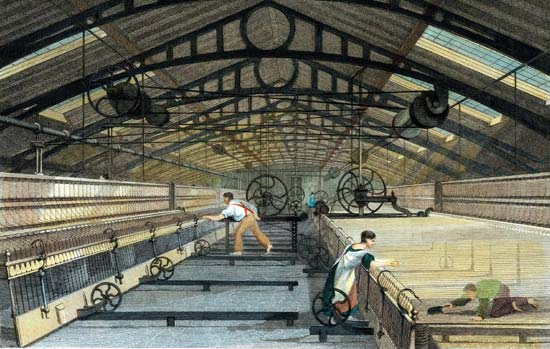
During the First Industrial Revolution, the machines that caused textile workers to lose their jobs in large numbers were of course not running entirely automatically either; they too required “human supervision.” In 1779, Crompton combined the spinning jenny and the water frame to invent the mule, and until the early twentieth century the mule was the main machine in textile factories. A typical mule was nearly 50 meters long; when operating, it moved back and forth about 1.5 meters, and could simultaneously drive 1,320 spindles under water or steam power. Such a machine needed only one adult supervising, operated by two underage boys, plus one child of four to eight years old responsible for cleaning cotton lint, and then it could run.
From the earliest household workshops, where one person operated one spindle, to the spinning jenny, which let one person operate more than ten spindles at once, to the mule, where one person managed hundreds of spindles. Textile machines have never been separated from “human supervision and guidance,” yet the unemployment and rat-race effects they caused are undeniable.
As things stand now and for the foreseeable future, AI indeed has not completely replaced humans, but has only played an auxiliary role. Yet if one engineer assisted by AI can already now work more efficiently than the cooperation of two original engineers, then AI has already quite concretely replaced one engineer. As AI technology develops, in the future one engineer using AI may be able to do the work of ten or even a hundred people, and then the work of nine or ninety-nine people will have been replaced by AI.
Whether AI can replace humans in intelligence or even in terms of free will is a philosophical question that still has no settled answer. But whether AI can replace humans in various concrete jobs is already a real-world problem that all entrepreneurs and job seekers must face.
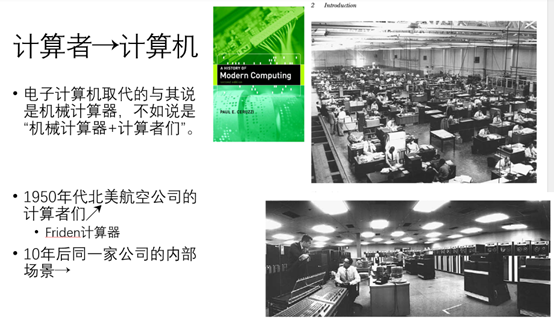
Of course, computers taking over human jobs is not something new. In fact, the word Computer originally referred to a class of workers, and this occupation reached its peak around 1950. Computers usually used mechanical calculating machines, and sometimes paper and pencil, to collectively complete various complex calculation tasks. Tasks would be broken down into multiple links and steps, then distributed in assembly-line fashion to dozens or even hundreds of computers for processing and checking. With the development of electronic computers, these “calculation workshops” turned into “machine rooms,” and the work of several hundred computers could be replaced by one person operating a computer.
So why didn’t the spread of computers at the time cause mass unemployment? Because computers not only replaced some old jobs, but also created countless new forms of work, such as “programmers.” Moreover, there were never all that many computers to begin with, and their mathematical abilities also had uses in other fields.
The current development trend of AI technology seems much more aggressive, like the early years of the First Industrial Revolution, with its replacement of old jobs outweighing its creation of new ones.
So how did humanity ultimately get through the unemployment crisis caused by the First Industrial Revolution, and finally make the “Industrial Revolution” into a monumental achievement? Taking history as a mirror, we find that humanity cannot simply place its hopes in machines; it also needs social transformation in order to adapt to drastic changes in the technological environment. Alongside the First Industrial Revolution, through wave after wave of workers’ movements and the efforts of countless people of insight, social ideas and laws kept changing. For example, the gradual spread of compulsory education gave ordinary people more opportunities to enter the knowledge class or become technical talents; for example, the implementation of various laws such as the eight-hour workday and the prohibition of child labor improved workers’ conditions; globalization and free trade promoted the diversification of industrial chains, making jobs more flexible and varied… Such “social revolutions” are just as important as “technological revolutions.”
Wiener himself also offered a solution to the second wave of unemployment he predicted: “The answer, of course, is to create a society based on human values rather than on buying and selling. To achieve this society, we shall need a great deal of planning and struggle.” Wiener believed that it was dangerous to regard intelligent machines as slaves that replace humans in work. On the surface, this attitude merely treats machines as slaves, but in essence it would lead humans who enter into competition with machines to fall into the fate of slaves as well. Have those whose livelihood is stolen by slaves not become slaves of slaves? Wiener believed: “The machine will demand of us a use of human understanding; otherwise we may ourselves become the slaves of our machines.”
Wiener’s view seems strange, but it is worth pondering carefully. The threat posed by machines in fact originates in the deeply ingrained “instrumentalist” attitude that has long taken root in people’s minds. Before discussing whether machines should be seen as human, people had already begun to see humans as machines—in other words, to see humans as “tools”: a company measures the humans it hires entirely in terms of “efficiency” and “cost performance,” while a job seeker simply treats a position as a kind of “transactional relationship” of exchanging labor for money, working only to make money rather than to realize human value. This instrumentalist logic is not something caused by AI; it has long been deeply embedded in modern people’s ideas and social institutions. Under this logic, once machines become superior to humans in “cost performance,” then humans will naturally and rapidly lose their footing.
Many philosophers have long made profound critiques of the instrumentalist logic of modern society, for example Marx’s so-called “alienation of labor”; Marcuse’s so-called “one-dimensional man”; Arendt’s distinction among labor, work, and action… These philosophers tried to advance revolutions at the levels of society and ideas, but their voices often were lofty yet lonely, lacking response. Perhaps their problem was also that they were too far ahead of their time; revolutions in society and ideas, if they do not resonate with a new technological revolution, often also fail to make much of a splash.
Perhaps now the time has finally come—whether it is Wiener’s prophetic foresight or Marx’s and others’ forward-looking critiques, they have finally converged on the same historical opening. If humanity can take both technological revolution and social reform into account, then I believe AI technology will not only fail to diminish human value, but will instead become the opportunity through which people can be liberated from the alienated condition of being “corporate livestock” and “wage slaves.”
Translated from the Chinese original with AI assistance. The original text is authoritative.