
I’ve recorded another introductory lecture for Chaoxing. The video course should already have been published on Chaoxing, and here I am posting the verbatim script I prepared when recording the program.
I
Hello everyone, I’m Hu Yilin, a teacher in the Department of History of Science at Tsinghua University. Today I’m giving you an introductory guide to Thomas Kuhn’s The Structure of Scientific Revolutions.
II
This book’s influence is enormous. The Stanford Encyclopedia of Philosophy puts it this way: “Thomas Kuhn (1922–1996) was one of the most influential philosophers of science of the 20th century (perhaps the most influential). His 1962 book The Structure of Scientific Revolutions is one of the most cited academic works of all time.”
With such huge influence, of course it long ago “broke out of the circle.” Kuhn’s influence extends far beyond the fields of history of science and philosophy of science, and it has had an impact in the natural sciences, sociology, economics, and even in the humanities and the arts; “paradigm shift,” one of Kuhn’s key terms, has nearly become a popular expression.
Of course, broad influence often also means being widely misunderstood. Kuhn’s prose is not particularly obscure, but because his views are so subversive, many people instinctively resist them very strongly. They often seize on a phrase or two to criticize him loudly, without grasping the whole. And some of Kuhn’s admirers also tend toward extremes, even interpreting Kuhn as a nihilist who is anti-science and anti-rationality.
III
Kuhn’s views are actually not all that radical; his basic ideas can already be found in earlier philosophers and historians. For example, if we look at Husserl’s The Crisis of European Sciences and Transcendental Phenomenology, Heidegger’s “The Age of the World Picture,” and so on, we can see a very profound account of the revolutionary transformation of the modern scientific worldview. In a certain sense, Kuhn’s distinctive feature is precisely that he is more “narrow.” Earlier thinkers often discussed the transformation of modernity in a broader sense, whereas Kuhn concentrated the discussion squarely on the history of science, and did so in a much more fine-grained way. What others called “scientific revolution” was capitalized and singular—there was only that one revolution from antiquity to the present—but Kuhn refined the category of “revolution”: revolution does not occur only between large historical periods; within every specific field, there are often all sorts of big and small “revolutions.”
After The Structure of Scientific Revolutions had gained wide influence, many scholars extended and generalized Kuhn’s views, carrying them beyond science into other fields. In the “Postscript” Kuhn added seven years later, he mentioned this phenomenon and expressed “puzzlement.” He wrote: “The book’s theses are undoubtedly applicable very broadly. But this was to be expected, since the theses were borrowed from other fields. Historians of literature, music, art, political development, and many other human activities have long been describing their subjects in the same way. … If I have had any originality at all in these notions, it has been primarily in the way I have applied them to science, a field previously thought by many to develop in quite different ways.”
Even on the point of “applying them to science,” Kuhn was not the first. As mentioned earlier, phenomenologists such as Husserl and Heidegger, and his contemporary Foucault, all covered the scientific domain, spanning science, technology, history, economics, and so on. Kuhn’s advantage still lies in “focus.” Compared with those other wildly imaginative thinkers, Kuhn’s discussion is clearer, more fine-grained, and more concrete.
The “structure” in “the structure of scientific revolutions” is precisely Kuhn’s original contribution. What he gives us is not merely some vague and abstract generalizations, but a depiction of specific “structures,” explaining the rise, development, turning point, and conclusion of scientific revolutions in very fine detail.
So if one reads Kuhn’s book and merely plucks out a few isolated conclusions, there’s really not much point. The charm of Kuhn’s book lies precisely in the details. We can see that between the lines Kuhn offers a large number of concrete cases from the history of science; from those concrete cases he presents a general “structure,” and these details are extremely interesting.
No fast-food style introductory guide, including what I’m doing right now, can delve into those details, so the real delight of this book still requires interested readers to go and read it for themselves. My emphasis here is to correct some common prejudices and to provide a broad presentation of the book’s style.
IV
To begin reading this book, Chinese readers first have to find a Chinese translation. Until this year, the most popular Chinese translation of this book had mainly been just one, translated by the teacher-and-student pair Jin Wulun and Hu Xinhe; both gentlemen have already passed away. In fact, there are two other translations as well, one an old translation from 1980 and the other a Taiwanese translation.
A latest new translation has also recently appeared, translated by Zhang Butian, who is also in the Tsinghua Department of History of Science. He is a very well-known translator in the history of science world, and though still very young he already has “translations as numerous as his own body.” Personally, of course, I recommend this newest translation more strongly.
V
But all readers know that translation is a very difficult thing, and it is not easy to judge the quality of a translation. A new translation is not always better than an old one. Very often two translations may each have their strengths and weaknesses, making it hard to say which is better. For example, when translating, Zhang Butian also consulted both the mainland and Taiwanese translations; he remarked that although the Taiwanese translation is smoother in language, it indulges in free variation more often, “abundant in elegance but lacking in faithfulness.”
But can we say that translation quality cannot be assessed? Certainly not. Even laypeople can tell that a professional translation is far better than “machine translation.” It is obvious that there are differences between good and bad translations.
So the question is: what exactly is the “measure” by which we judge? What rules must translators follow? Are the correspondences of meaning and the grammatical rules described in authoritative dictionaries sufficient to assess the quality of a translation?
We find that translation is not “without rules to follow”; it does indeed have a certain objective set of routines and established rules. For example, translating How old are you as “How old are you always” would certainly be wrong. But simply following rigid routines does not make a good translation, and readers also find it hard to construct, on the basis of such rigid routines, a universal evaluative standard that could completely and objectively assess translation quality.
In short, translation has rules and is comparable, but there are always also practices that go beyond the rules and super-rules, and there are always cases where different versions have their own merits and are impossible to rank.
This is in fact what Kuhn called the phenomenon of “incommensurability.”
VI
Using translation to explain the concept of “incommensurability” is not my invention; it is Kuhn’s own line of thought. In fact, the term “paradigm” itself is a term Kuhn borrowed from linguistics, and in the Postscript he stated this analogy even more plainly. He said: “Those who take an incommensurability position should be regarded as members of different language communities, and the problems of communication between them should be analyzed as problems of translation.”
Many people who misunderstand Kuhn think that his claim about incommensurability means non-communication and non-comparability, and that judging the quality of scientific theoretical systems is a wholly subjective and arbitrary affair. But that is not what Kuhn means. The two sides of “incommensurability” can be translated into each other; the point is simply that there is no once-and-for-all “common measure” by which everything can be judged.
Like many human activities, translation embodies objectivity and subjectivity, accuracy and ambiguity, rule-governedness and contextuality at the same time, and Kuhn wants to say: scientific activity is the same. Kuhn did not argue for the impossibility of communication between different scientific paradigms; on the contrary, he tried to interpret how such communication takes place.
VII

Many people think in polarized terms: either there must be a fixed, absolute standard, or there is no standard at all and anything goes. But real activities often follow multiple standards.
For example, when judging translation, we all know about “faithfulness, expressiveness, and elegance.” These are not one standard but three standards that are nested within one another yet relatively independent. “Faithfulness” requires conformity to the original text and its original meaning; “expressiveness” requires suitability to the reception capacity of readers within a particular linguistic and cultural community; “elegance” requires the writing itself to be concise and beautiful. Each standard also has different contexts of application. For instance, with “faithfulness,” are we talking about accuracy at the level of words, or at the level of sentences, or of the whole article? For example, if the same term appears frequently throughout a book, fixing it to one translation may be accurate for understanding the book’s key concepts as a whole, but in a specific sentence such a rigid rendering may no longer be accurate enough. Or again, with “expressiveness,” is one aiming at a professional readership or at the general public? And with “elegance,” is the emphasis on ornate diction, or on brevity and fluency?
In short, translation is not without standards; rather, it has many standards large and small. Judging the merits of scientific theories also involves a similar multiplicity of standards. For example, “faithfulness,” that is, correspondence with observational experience; for example, “expressiveness,” since the culture and psychological condition of the scientific community also affect the development of science; and for example, “elegance,” since many scientists care most about the theory’s own simplicity and beauty, pursuing simplicity and symmetry, and so on. Even when one speaks of “corresponding to observational experience,” different fields of experience differ. For example, Copernicus’s heliocentric theory corresponded better to observational experience of astronomical phenomena (though the Ptolemaic system could also account for them), but it did not accord with people’s observational experience of atmospheric phenomena at the time (for example, why weren’t the clouds flung off into space?). And even within astronomical phenomena there were different aspects: Copernicus’s system answered the question of the order of Venus and Mercury better, yet it was hard to explain in terms of stellar parallax. So when the Copernican system was first proposed, there was no objective and precise standard that could guarantee it was better than the old geocentric system, and the scholars who switched over to the new system did so with varying degrees of subjectivity; Neo-Platonism, Hermeticism, and other social currents of thought also constituted key forces in the eventual flourishing of the Copernican system.
VIII
The term “incommensurable” used here is Zhang Butian’s translation; the older translations called it “non-commensurable.” This is a mathematical concept meaning “having no common divisor.” For example, 2 and 4 are commensurable, with common divisor 2; but 2 and the square root of 2 are non-commensurable, since one cannot find an integer or decimal that divides both. I think both translations are acceptable, but “non-commensurable” is too technical and can sometimes more easily lead to misunderstanding. “Incommensurable,” by contrast, highlights the two keywords “common” and “measure,” and is a bit smoother to understand.
The following passage is Kuhn’s exposition of incommensurability: “These differences between schools do not lie in some defect of method—they are all ‘scientific’—but rather in what we may call the incommensurable ways in which the different schools view the world and practice science in it. Observation and experience can and must greatly constrain the range of acceptable scientific belief, else there would be no science. But by themselves they do not determine a particular body of such beliefs. There is always an apparently arbitrary element, compounded of personal and historical accidents, that has a major effect on the beliefs espoused by a scientific community at a given time.” First, what Kuhn means is that science in history contains different schools or different theoretical systems. Most schools in history have been eliminated or superseded, but one cannot say that because they have now been eliminated, they were never part of “science” to begin with. For “science” is itself an enterprise of continual renewal. What is no longer science today was once part of science in its own day. We can say that they are no longer science because they have been superseded, but we cannot say that they were superseded because they were not science. So how are old schools eliminated, and how are new theories recognized? “Observation and experience” of course play a key role. But Kuhn believes that the accumulation of observation and experience is necessary but not sufficient for the development and renewal of science. In actual history, personal and accidental factors also exert a significant influence. That last phrase, “apparently” arbitrary element, was rendered in the older translation as “obvious arbitrary factors,” and I should say that the older translation is not very accurate. Apparently does indeed have the sense of “obvious,” but it refers to what appears on the surface, while what is not exposed need not be so. In Kuhn, these factors are not really “arbitrary” in their impact on the history of science; they are actually traceable. It’s just that, unlike the traditional view, they are not a simple matter of data accumulation or logical deduction, but are more likely objects of sociological or psychological study. Nine The “personal and accidental factors” Kuhn emphasizes are directed at how a scientific community or human society decides which particular theory or school prevails. But for the individual person, the fact that he chooses one school or another is obviously full of “personal and accidental factors”; Kuhn did not need to come up with this point. Kuhn certainly does not advocate nihilism: since there is no absolute truth, then let’s just ignore everything and do whatever we please. That would of course be wrong. Although there is “incommensurability,” you can still “private-commensurate” if you like—each person can and should establish his or her own standards of judgment, so long as you do not mistake your own private standards for an absolute, universally valid divine standard. Human beings are not God, nor are they prophets or seers. Even if an absolute standard exists, no one can be born already knowing how to grasp it. Everyone comes to master standards of judgment for various things only through personal experience, through acquired learning and growth. So when the learning and growth experiences of a certain group converge in some respects, some relatively “public” standards may take shape within that group. The more public and convergent the experiences of learning and growth are, the more the public standards they acknowledge will seem objective and determinate. So in Kuhn’s view, what we call a “paradigm” often takes the form of “the beliefs espoused by a scientific community at a given time,” and the communal character of the community is formed through repetitive patterns of education and training. The crucial point is that what each person must learn after birth includes not only all kinds of “knowledge” systems, but also the “standards” by which such knowledge is evaluated and measured. The standard by which some kind of knowledge is judged credible is often taught together with that knowledge, “bundled” with it, as it were, in a kind of combined sales package. Communities come in different sizes. “Scientists,” “physicists,” “quantum physicists,” “quantum physicists of the Copenhagen school,” and so on can all be called “communities.” So in some cases we really can find some public standards between different communities, but in fact this is because they all belong to some larger community. Publicness and communality are always consistent with each other: to whatever extent there is communality, to that extent publicness can be established. Scientific communities, like political, economic, cultural, religious, and various other kinds of communities, are all mutable. Communities split, merge, die out, and renew themselves. Kuhn’s work is precisely to sort out and summarize the pattern of development of scientific communities. Ten We have already seen that shared standards come from shared education, and as far as modern science is concerned, the publicness and determinacy of teaching are chiefly embodied in the recognized “textbook.” So in Chapter One, Kuhn immediately aims his critique at the “textbook.” Kuhn observes that the popular understanding of “what science is” fundamentally depends on science textbooks; thus when Kuhn wants to challenge the traditional view of science, he first has to dispel the fetishization of textbooks. Kuhn states his point clearly in the very first paragraph of Chapter One: “If history were viewed as something more than a storehouse of anecdotes or chronology, it could transform decisively the image of science by which we are now possessed. That image had previously been drawn largely from the study of the scientific achievements recorded in the classics and in more recent textbooks from which each new generation of scientists learned to practice its trade. Inevitably, however, the aim of such books is persuasive and pedagogic; a concept of science drawn from them is no more likely to fit the enterprise that produced them than an image of a national culture drawn from a tourist brochure or a language text. This essay attempts to show that we have been misled in fundamental ways by the textbook. It aims to sketch out a very different conception of science that can emerge from the historical record of the research activity itself.” It is worth noting that Kuhn is not opposed to the way science textbooks are written; rather, he thinks this way of writing is “inevitable.” This is discussed even more fully in Chapter Eleven, “The Invisible Revolution.” That is to say, once the dust of a scientific revolution has settled, the corresponding field enters the stage of “normal science,” and the normal stage ought to be conservative and cautious, and should also provide relatively definite and clear methods for beginners. The mission of the textbook is to help the novice enter a normal field of research step by step. The problem lies not with the textbook, but with our attitude toward textbooks. As Kuhn says, “an image of a national culture cannot be drawn from a tourist brochure or a language text” — this does not mean that tourist brochures are badly written, but that tourist brochures should be tourist brochures, and should not be expected to shoulder the mission of general cultural education, still less can one hope to obtain a profound understanding of the history and culture of a country from a tourist brochure. The mission of the textbook is to enter the discipline from within; but if one wants to break out of the ready-made framework and understand the genesis and evolution of the entire discipline from a more macroscopic perspective, then one cannot rely on textbooks. So what should one rely on? Kuhn’s answer is: historical records. Kuhn believes that if we want to understand the genesis and evolution of science, we must not seek the answer within science itself, but must go to history to find it. In a sense, this turn is meant to overturn the special status of “history of science” as a discipline. Traditionally, “history of science” has often not been regarded as an independent discipline, and is not even considered a subcategory of “history.” For example, in the official Chinese disciplinary catalog, history of science long occupied the position of a first-level discipline under the category of science, rather than a second-level discipline under history. “History of science” was listed alongside “natural science” fields such as physics and chemistry. But under the heading of “history of science” there were no second-level disciplines, which is actually a rather awkward position, because history of science itself has no clearly defined disciplinary paradigm, nor does it follow the paradigm of history. Those who specifically conduct research in the history of science may be affiliated with departments of science, such as a school of physics, and are often scientists who have stepped down from frontline research or have simply retired and turned to doing a bit of history of science. The period when Kuhn was active was precisely the moment when “history of science” was just beginning to become independent and was in the process of forming its own disciplinary paradigm. Eleven
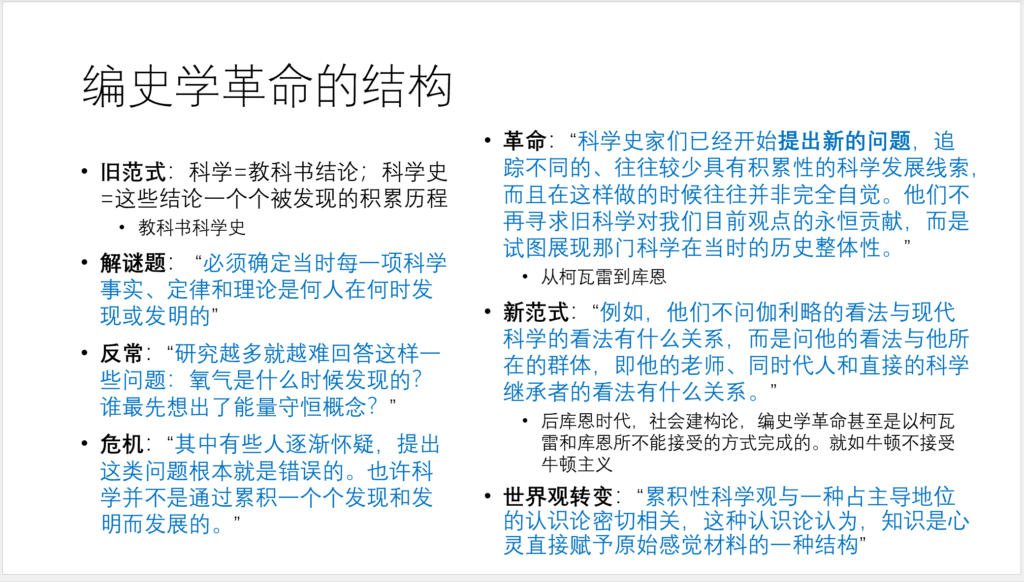
Textbooks are the yardstick for measuring the importance of history. How important a historical figure or historical event is depends on whether it can add a line to today’s science textbooks.
As for those figures who have left no trace in today’s textbooks, their historical status can certainly not be positive. Take Aristotle, for example: he was once immensely influential, but his physics has not provided today’s physics textbooks with a single parameter or formula. If we are to write a few lines about Aristotle in the history of science after all, then it can only be to describe him as an evil villain. So the rise of modern science as a whole is often portrayed as a story of how righteous seekers of truth, after countless hardships, revolted against Aristotle.
2. Puzzle-solving
Guided by this yardstick, the old paradigm of the history of science determined its “normal” mode of research.
Kuhn called the ordinary research work carried out within a normal scientific paradigm “puzzle-solving.” Or, to make an analogy, it is like a jigsaw puzzle. Under a broad framework in which most of the structure is already clearly determined, one works hard to fill in some less distinct gaps. And once these gaps are filled, as long as the established rules are followed, the work is very easily recognized by one’s peers.
So what is the normal task of Whiggish history of science? Kuhn says it is nothing more than “the necessity of determining who discovered or invented each scientific fact, law, and theory, and when.”
This seems like a simple task. For example, when a textbook discusses the law of universal gravitation, the historian of science needs to provide the “who and when” of that law, and the conclusion is that Newton discovered the law of universal gravitation in the 1687 Mathematical Principles of Natural Philosophy. The work that follows is nothing more than adding some historical details and a few decorative embellishments to this conclusion.
3. Anomalies
Because normal work consists in filling in one gap after another, adding one puzzle piece after another, the development of normal science displays a clear cumulative character.
But Kuhn found that, as normal science keeps accumulating, the remaining puzzle-solving work often becomes harder and harder. The easy puzzles have all been done, and the difficult ones come to the fore. Some gaps simply cannot be filled however you try; for others, you may find several mutually conflicting ways of filling them. This is what an “anomaly” is. An anomaly is one of those less-than-normal problems encountered in normal work.
Many times, anomaly and normality are not opposed to each other; on the contrary, they make up the challenging moments in otherwise routine work. Anomalies have no fixed boundary, because once someone finally solves the problem, it becomes a normal problem again.
It is precisely the existence of “anomalies” that keeps research from looking rigid and mechanical. Normal research still requires talented people who are rich in creativity: people who can notice details others overlook, who can deploy ingenious methods that ordinary people would never think of, and who can bring stubborn anomalous puzzles into the normal system.
In the history of science too, there are difficult problems that are not easy to crack. For example, Kuhn mentions that “the more research there is, the harder it becomes to answer questions such as: When was oxygen discovered? Who first came up with the concept of the conservation of energy?”
These questions also seem to admit certain answers. For instance, the familiar conclusion is that oxygen was discovered by Lavoisier, and conservation of energy was proposed by the German physician Mayer.
But if we examine the sources in the history of science carefully, we will find that these answers are not so obvious. For example, Priestley isolated oxygen earlier, but he did not understand the nature of this gas and called it “dephlogisticated air,” in other words, he did not treat it as an independent gas. But in fact Lavoisier also did not understand this gas entirely correctly; Lavoisier mistakenly thought oxygen was the element that formed acids, and so named it “oxygen” or “acid-former.” Around the same time, Scheele also isolated oxygen and named it “fire air.”
The concept of energy conservation is even more elusive, because the concept itself is actually quite old, but in the past it existed implicitly in mechanics, chemistry, electricity, thermology, and other fields in different forms. What we usually mean by the “law of conservation of energy” is a cross-disciplinary synthesis, a way of thoroughly connecting the various forms of “energy” treated in different disciplines. So as far as the discovery of this concept is concerned, systematization and rigorization are also crucial. Mayer’s status lies in being the first to carry out the heat-work equivalent experiment, but his experiment was relatively crude. In terms of rigor and systematization, Mayer cannot compare with Joule; and if one speaks only of the proposal of the abstract concept, then many people had already come before Mayer.
4. Crisis
Some difficulties can be resolved through closer examination. For instance, if I were to discover a manuscript by Lavoisier proving that he prepared oxygen earlier than anyone else, then the priority dispute between Lavoisier and Priestley might no longer be controversial. But the problem is that history is often complicated. The facts may simply be that Priestley prepared it earlier, while Lavoisier’s theory was more complete.
Then someone may wonder: is it possible that these questions simply have no clear answers at all? Kuhn says: “Some of them gradually began to suspect that the very posing of such questions was wrong. Perhaps science does not develop by accumulating one discovery and invention after another.”
What this doubt points to is not some particular answer to some particular puzzle, but a general problem: the very way the puzzles are designed may be inappropriate.
Textbooks are always neat and orderly, and science seems to consist of one clearly defined concept, symbol, datum, and law after another. Each contribution has a clear definition and boundary, so the puzzle posed by textbook-based historiography of science is certainly also clear and precise.
But if historical inquiry fundamentally cannot meet the seemingly simple task of “determining the chronology of discoveries,” then perhaps we need to change the way we ask questions at a fundamental level.
This is what Kuhn calls the emergence of a “crisis.” There is no absolute dividing line between “crisis” and “anomaly”; the key lies in the researcher’s attitude toward these problems. In the condition of “anomaly,” the researcher still expects to solve the problem under the normal paradigm by using some ingenious method or by discovering some overlooked detail. But in the condition of “crisis,” the researcher grows increasingly desperate about solving the problem in the normal way, and instead turns to overthrowing the entire normal order and changing the very formulation of the problem.
5. Revolution
Thus the “revolution” of paradigms begins to take shape. When many people no longer work hard to propose new “answers,” but instead try to propose new “questions,” revolution has occurred. For example, Lavoisier’s key contribution was not to provide a new answer to the problem of combustion, but to replace the traditional phlogiston paradigm wholesale with the theory of oxidation-reduction, thereby abolishing once and for all old questions such as “does phlogiston have weight or not?” The “oxygen” that Lavoisier discovered was not a new solution to an old phlogiston-chemistry puzzle, but a key role in the new oxidation-reduction paradigm.
The same is true of the history of science. Before Kuhn, many pioneers had already launched this historiographical revolution. Among them, Alexandre Koyré had the greatest influence on Kuhn. Of course, Kuhn believed that although earlier historians of science had already practiced it, they were not especially self-conscious about the historiographical paradigm, nor did they have a systematic theory of historiography. Kuhn’s work can be seen as the theoretical self-consciousness of this historiographical revolution that had already taken place.
Kuhn said: “Historians of science have already begun to pose new questions, to follow different and often less cumulative lines of scientific development, and in doing so often not entirely self-consciously. They no longer seek the eternal contribution of old science to our present views, but instead try to display the historical integrity of that science as it existed at the time.”
Suspending today’s dogmas and returning to historical context is an exploration historians had long since undertaken. But many people like to nitpick and say, “All history is contemporary history,” that historians cannot and should not abandon the standpoint of the present, so returning to historical context is impossible. Yet this attack is rather superficial, a typical “diode” way of thinking—apparently treating “historical context” and “contemporary purpose” as an either-or, all-or-nothing relation.
To be fair, the old Whiggish history would not completely ignore the context of the times either, nor would it regret that Newton did not understand quantum mechanics. Historical context and contemporary purpose are not contradictory. The key is: what exactly is the “contemporary purpose” to which history is serving? Is it the rigid contemporary textbook, or something else?
Koyré’s work included both a conscious return to historical context and a conscious service to contemporary people. But what he served was not the contemporary textbook, but contemporary self-understanding—how do modern people understand the age in which they live? Where do the various ideas of this age originate? Koyré’s return to historical context was precisely in order to bring contemporary people an understanding of the roots of the age. Among historians of science represented by Koyré, historicity and contemporaneity are completely unified.
Using historical views such as “all history is contemporary history” to oppose Kuhn is very likely a double misunderstanding of both Kuhn and history. As far as history is concerned, what Kuhn proposed was nothing novel. A historiographical attitude that returns to historical context, and the hermeneutic relation between historical texts and contemporary readers, are by no means heretical claims. Kuhn merely inverted the status of “science” and “history,” arguing that the history of science should be guided more by the yardstick of “history” than by the yardstick of contemporary science.
6. New paradigm
This new historiographical paradigm was already in sight. The basic strategy was simple, Kuhn said: “For example, instead of asking how Galileo’s views relate to those of modern science, they ask how his views relate to those of the group in which he lived—his teachers, contemporaries, and direct scientific successors.”
But this change in perspective brought far-reaching consequences, so much so that the new generation of historians of science, developing under Kuhn’s influence, came to practice the history of science in ways even Kuhn himself found hard to accept. For example, once the perspective shifts to “the group in which Galileo lived,” the core question of the history of science becomes a sociological one. From the 1970s to the 1980s, the sociology of scientific knowledge (SSK) gradually became mainstream, and Kuhn himself opposed their approach. But this ironic outcome may also have been predicted by Kuhn, because in the history of science, the mature new paradigm after a scientific revolution is often one that the pioneers and participants in that revolution themselves cannot accept. For example, Newton himself did not accept Newtonian classical mechanics that completely excluded God’s place; Planck and Einstein did not accept quantum mechanics that shook the idea of determinacy. Kuhn himself could not accept “Kuhnian” new historiography, and that is not at all strange.
7. Worldview
Finally, it is worth mentioning that Kuhn believed scientific revolutions are not only revolutions in scientific method, but also revolutions in worldview. The revolution in historiography is no exception: it is not merely a reform of the methods of historical writing, but also accompanies a more profound revolution in ideas, touching on major issues of worldview and epistemology, such as: What exactly is science? Why is scientific knowledge reliable?
Corresponding to the traditional textbook history of science is a “cumulative view of science.” Kuhn notes: “The cumulative view of science is closely linked to a dominant epistemology, according to which knowledge is a structure directly bestowed by the mind upon raw sensory materials.”
The philosophy of science before Kuhn was dominated by positivism and falsificationism, which in different ways established a clear criterion of “demarcation of science,” distinguishing scientific activity from other activities. But earlier philosophy of science encountered many “difficult problems,” and Kuhn believed that this by-product of the historiographical revolution—a revolution in epistemology or in the philosophy of science—would also dissolve these problems. He said: “If these epistemological counterexamples provoked serious disturbance, it was because they contributed to a new and different analysis of science, in which these counterexamples would no longer cause trouble.”
Kuhn did not provide a new answer; rather, he eliminated the problem itself—Kuhn believed that only in the phase of normal science are the boundaries of science relatively clear, whereas in the phase of scientific revolution there is no once-and-for-all standard of demarcation, because the very尺度 of demarcation is itself part of the paradigm.
So this The Structure of Scientific Revolutions has had a profound impact on both the history of science and the philosophy of science, and these two disciplines have since been bound together, each serving as the basis for the other.
That concludes my reading guide for today, thank you!
Translated from the Chinese original with AI assistance. The original text is authoritative.