
Thanks to the introduction by Unfinished Bookstore and the invitation from Teacher Ye Xiaozhong, I wrote a postscript for this reissued local Singapore book. 《My Singapore, My Street, My Walk》 Chen Zhirui, Ye Xiaozhong, Zhou Decheng / 𨑨迌 Publishing, ISBN: 9789819444915
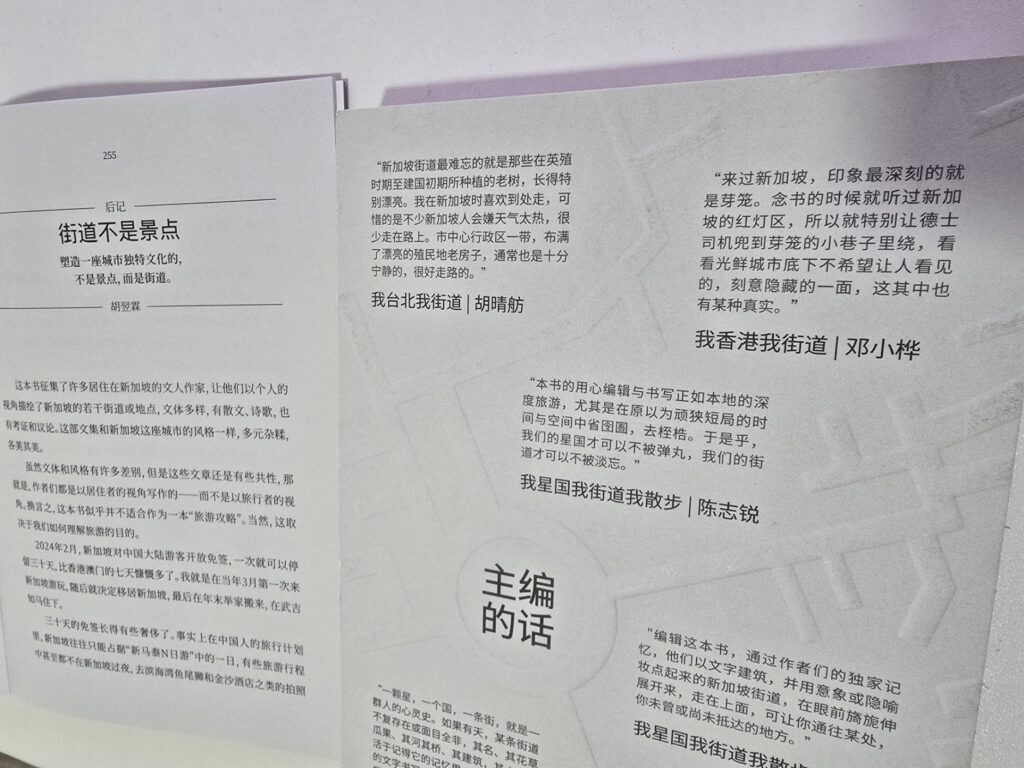
This book brought together many literati and writers living in Singapore, inviting them to depict, from their personal perspectives, various streets or places in Singapore. The styles are diverse: essays, poems, as well as textual research and arguments. Like the city of Singapore itself, this anthology is multiple and mixed, each beauty prized in its own way.
Although there are many differences in form and style, these pieces still share certain commonalities: their authors all write from the standpoint of residents—and not from the standpoint of travelers. In other words, this book does not seem well suited to be used as a “travel guide.” Of course, that depends on how we understand the purpose of travel.
In February 2024, Singapore opened visa-free entry to mainland Chinese tourists, allowing a stay of 30 days per visit—far more generous than the seven days offered by Hong Kong and Macau. I first came to Singapore for a trip in March that year, and then decided to move here; by the end of the year, my family and I had relocated here and settled in Bukit Timah.
Thirty days of visa-free stay feels somewhat luxurious. In fact, in Chinese travelers’ itineraries, Singapore often occupies only one day of a “New Malaysia Thailand N-day tour”; in some tour schedules, people do not even stay overnight in Singapore. They snap photos at places like the Merlion at Marina Bay and the Marina Bay Sands hotel, drive past Chinatown or Orchard Road for a bit, and finally go to Changi Airport to look at the waterfall, and that is more or less it. Even for those who come specifically for a self-guided trip to Singapore, the itinerary is usually only three or four days.
My first trip to Singapore also lasted only four days. Excluding the time spent attending a conference, I had roughly two days of free time, but aside from walking to Chinatown and Marina Bay, I did not go to any of the “attractions” listed in mainstream travel guides. Most of the time, I was simply strolling the streets—fashionably speaking, citywalk—walking from one street to another, browsing malls and small shops, eating and drinking at street cafés and food courts.
“Attractions” and “streets” are entirely different things. Singapore’s attractions are not very numerous, and many of them are artificially fabricated. The symbol of the Singapore Tourism Board—the Merlion—is a typical man-made invention. By forcibly joining a lion and a fish, one creates a photo-op attraction. Marina Bay Sands and the airport waterfall are similar; they are typical industrial constructions, serving in the tourism industry as little more than backdrops for photographs.
An “attraction” is often merely a thin “point”; it has no depth or thickness. After visiting a number of attractions, I do not learn anything more than I would from reading travel guides online, and what I gain is nothing more than a few photos with the attraction as the background. If Photoshop techniques were good enough, it seems there would be no need to exhaust ourselves running from attraction to attraction.
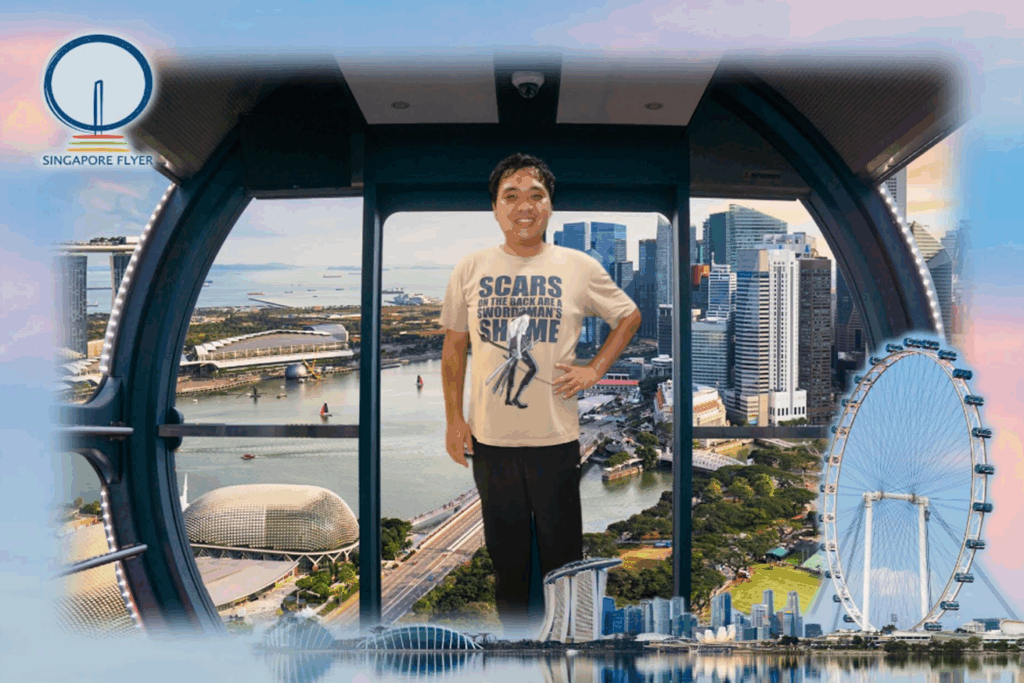
The Singapore Tourism Board also seems to understand this well. Before taking the Ferris wheel, there are people who specially take photos for tourists and turn them into exquisite prints to sell to you. If you buy them, you receive a whole stack of photos—nothing more than the same image with various scenes PSed onto it. I once spent this unjustified money, though on reflection it may not have been unjustified after all, because this is precisely the thing that strikes at the essence of tourism.
In recent years, PS-style tourism has reached a certain extreme: tourists no longer even need any elaborate scenery; they only need a road sign. The sign itself is treated as an attraction, to the point that some internet-famous scenic spots deliberately fabricate signs in the style of “I miss you so much in XX” to serve as photo backdrops. Tourists line up to take commemorative photos with a board that merely has a string of characters written on it, which shows how abstract and absurd the tourism industry has become.
A road sign may become an “attraction,” but a “street” is different. A street is not a spot for hurried passersby to check in and take pictures; it has depth and history.
Attractions and tourists are separate, just like those photos I took by the Ferris wheel—there is me, and there is the background; travel is nothing more than moving this thing that does not belong to the background around, embedding it in this background for a while, then moving it to that background for a while. But streets and residents are unified. Streets are composed of residents (including both long-term inhabitants and visitors), and streets in turn constitute an internal part of residents’ lives and memories, even becoming part of their character and disposition.
What shapes the distinctive culture of a city is not attractions, but streets. What shaped the cultural character of old Beijing and old Shanghai were Beijing’s hutongs and Shanghai’s longtang, not things like the Oriental Pearl Tower. Recently there has been a joke saying that “a Shanghainese who goes to the Oriental Pearl Tower will be stripped of their Shanghai hukou,” and there is actually some truth to it: such attractions are obviously there to “take advantage of country bumpkins,” and they have nothing whatsoever to do with local life. Singapore is no exception. Marina Bay Sands, the Merlion Park, or the airport waterfall—they have little connection to the lives of ordinary residents.
Singapore’s attractions are sparse and stiff, but Singapore’s streets are rich and lively. That is exactly what I noticed during those brief two or three days of citywalk back then. At the time, I was not surveying the city with the intention of settling down there; rather, it was because I was never much fond of “travel check-ins,” and whenever I go to other unfamiliar cities, I also like to wander aimlessly along the most ordinary streets, eat some street snacks, and browse the little shops by the roadside. Though it is all a superficial glance, I think it allows one to feel more deeply the diversity of the world and the diversity of ways of living.
Regrettably, with modernization and urbanization, the streets of many cities are becoming increasingly alike. Now, when I return to Shanghai, I can no longer find the longtang; the lane where I lived as a child was long ago flattened and rebuilt into a modern commercial district, but these commercial districts do not differ much from the ones I see in Beijing or Shenzhen, and even the restaurants inside them—now basically all chain brands—are much of a muchness.
In this regard, Singapore has actually preserved more “substance” than many cities in China. Although modular, copy-and-paste modernization is also hard to avoid here, many places still retain, to a greater or lesser extent, their own character. In particular, thanks to support from the government and society, hawker culture is still able to tenaciously resist the impact of pre-made-food chain stores. In short, in the everyday matters of clothing, food, housing, and transport, Singapore is rich and abundant.
Singapore’s richness does not just mean the presence of the cultures of different ethnic groups such as Malays, Indians, and Europeans; even Chinese culture here is diverse and mixed—there are Cantonese and Hokkien people, as well as people from the Northeast, Hunan, and Shanghai; there are old-fashioned department stores in the style of the 1980s and 1990s, and there are also stylish, cosmopolitan shopping malls. And the common feature is that people mostly seem very relaxed and very friendly.
To this day, I have lived in Singapore for less than a year, so I cannot claim to have any especially deep feelings or memories. The other authors in this book are mostly seasoned hands, each with their own distinctive insights. Their essays may not necessarily pursue dramatic twists and thrilling incidents, but they are a pleasure to read: delicate, full, and unhurried. This calmness and composure also reflect Singapore’s distinctive temperament.
Translated from the Chinese original with AI assistance. The original text is authoritative.