
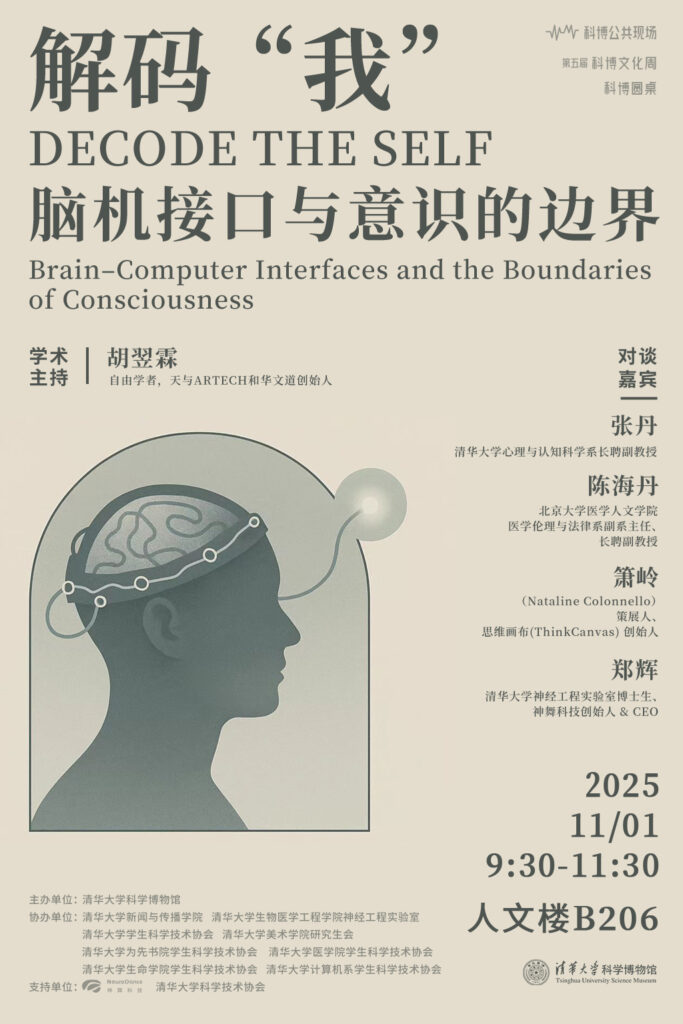
On November 1, 2025, I was invited back to Tsinghua to take part in the third event of the Science and Culture Week, “Me in the Interface: Brain-Computer Interfaces and the Future of Consciousness,” namely the roundtable discussion “Decoding ‘Me’: The Boundaries of Brain-Computer Interfaces and Consciousness.” I served as the academic moderator. In fact, this was probably the first time I had acted as a moderator at a relatively formal event, but I felt I did rather well: I managed both to slip in some of my own private agenda and to let the guests each give full play to their strengths. I am posting here the guiding remarks I prepared in advance; in the actual moderation I improvised on the spot, quite differently from the prepared script. For each guest, I asked two questions in succession.
The title of our Science and Culture Week was “Me in the Interface.” In fact, “interface” in English is also interface, and the “interface” in brain-computer interfaces is likewise interface. But the imagery in Chinese is quite different: “接口” feels more like a one-dimensional line of connection, whereas “界面” is a two-dimensional surface of contact.
When we speak of applications or operating systems as having the so-called UI (User Interface), we usually call it a user interface, but if you say “user interface” it sounds rather odd. That is because the so-called UI is usually indeed a plane, a surface spread out before us, which we can survey at a glance and then make our selections and operations. We also speak of “network interfaces” (Network Interface), and if you translated that as “network interface” it would sound strange, because it is usually just a network cable plugged into a network card, rather than a plane that unfolds before a person.
Let me begin with some of my own private agenda: the theme of our roundtable is to discuss the “boundaries of self-consciousness.” In my view, the boundaries of self-consciousness have always extended beyond the narrow scope of the brain alone; self-consciousness usually exists right on the “interface.” For instance, when I draw on paper, the brush or pen, as the boundary between paper and hand, is where my consciousness attaches itself. Through my body and the brush, my consciousness externalizes itself as a picture on the paper. And this interface contains a free space, allowing my consciousness to drift and focus selectively upon it; much of our sense of “agency” in consciousness lies precisely here.
Imagine removing the interface and leaving only the most direct point-to-point connection—what would that be like? For example, instead of pointing at items on a menu and selecting what I want to eat, transmitting my choice to the kitchen through layer upon layer of mediation, suppose that, all at once, the consciousness of what I want to eat directly appears in the chef’s brain, or is transmitted into the memory of a cooking robot. Would such a way of ordering be freer than ordering from a menu in hand?
I might actually be more willing to accept a direct connection between my own brain and a cooking robot than to be in mind-to-mind communion with a chef; the latter feels rather weird. If everyone were to be linked in this way, could we still preserve our “selves”? Would we become some kind of “zerg”-like life form? But if direct brain-to-brain connection between people is frightening, and even capable of shaking the very existence of the “self,” then wouldn’t direct connection between humans and machines also alter the form of self-consciousness? I think this is also the sort of reflection our forum theme seeks to provoke.
So let me first put forward this view: no matter how brain-computer interface technology develops, we will always still need a degree of indirectness, and need a visualizable interface to sustain the boundaries of the self. Of course, all of you can also supplement or refute what I have said.
So the first question I posed to the teachers was this: the kind of direct brain-to-brain connection I am imagining—technically speaking, is it actually possible? Is direct communication without language and without mediation really possible? Is a collective mind like the “zerg” in science fiction possible? (Zhang Dan) If it is possible, what would that mean? Do we need to place ethical and legal limits on the overuse of brain-computer interfaces? (Chen Haidan) Of course, some of the questions just now—brain-to-brain connection, hive consciousness, and so on—are close to a kind of science-fiction imagination. But the public is always prone to all sorts of imaginings about cutting-edge technology; I have even seen many people earnestly discussing how brain-computer interfaces might one day help us “upload consciousness” and achieve “digital immortality,” and so on. From the perspective of an entrepreneur (Zheng Hui), how do you view the various overly advanced or mistaken imaginations and fears surrounding brain-computer interfaces?
I also especially wanted to ask Teacher Xiaoling some questions. Of course, the other teachers could also answer, because I myself am now also engaged in a technology-art studio. Personally, I feel that one of art’s missions is to discover and unfold the “operating interface” of technology. For example, if we merely regard a pen as a tool for writing, then we may hope it writes as clearly and neatly as possible; in that sense, a hard pen is often better than a soft brush in many contexts. But the arts of calligraphy and painting have enabled the function of the brush to exceed the requirement of writing characters clearly, turning it into a medium of artistic expression. In this sense, hard pens and soft brushes are neither superior nor inferior; different artists can freely use different strokes to present different artistic styles.
I know that you have curated ink-wash art exhibitions and also make use of all kinds of modern digital technologies in artistic practice. How do you view the different tendencies of different technological tools in artistic creation? Brain-computer interface technology, in particular, seems to me to look different from the perspectives of tool and art. For example, if a brain-computer interface is merely a tool—one meant to objectively and accurately reflect brain consciousness—then because human brains are all more or less the same, and people of different skin colors and cultures do not have different brains, brain-computer interface technology may tend toward convergence and become universal; the Elon Musk version of brain-computer interface technology and the Shenwu Technology version should, in the end, develop into something much the same. But if a brain-computer interface can also be a tool for artistic creation or conceptual expression, then perhaps it may also develop forms as different as the brush and the fountain pen. What do you think?
What I next want to discuss is the issue of the body. Apart from external tools as an “operating interface,” our bodies are themselves the most natural “interface,” or rather, the natural “boundary” of consciousness is our body. The way I become aware of where my hand is, and the way I become aware of where the apple in front of me is, are very different feelings; the former can be said to be part of “self-consciousness.” Moreover, if thought is mainly a function of the brain, emotion is not necessarily produced entirely by the brain; the body’s various hormones and faculties should be the source of emotion.
But we see that many popular accounts, including the introduction to our roundtable forum, actually assume that consciousness is only some sort of brain phenomenon, that reading the state of the brain is reading the content of consciousness, and that the body is not part of consciousness but a replaceable “input-output device.” In that case, the body will sooner or later be replaced by machines; one day everyone really will be cyborgs. I would like to ask all of the teachers how they view the future fate of the human “body.” Through brain-computer interfaces, if machines replace the body and connect directly to the brain, is that an inevitable trend? What is the endpoint of this trend? Will the “brain in a vat” become reality? How does Teacher Zhang Dan view the relationship between the body and emotion?
Another question for Teacher Xiaoling: I know that your curatorial work in art has previously focused on the relationship between body and mind. Then do you think that if brain-computer interface technology becomes widespread, how will it affect humanity’s conception of “body and mind”? When everyone can use a brain-computer interface to control machines just as they control their own bodies, what will “the body” mean for human beings? What will our ideal body become? Will we have some kind of “cyborg aesthetics”?
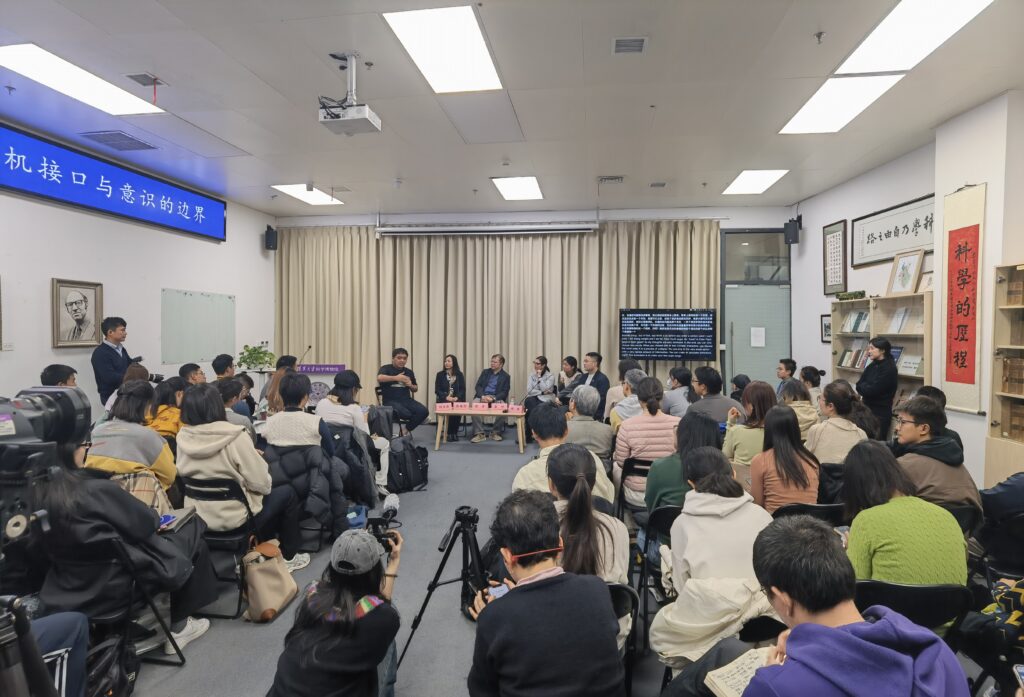
Finally, for the last question in the on-site Q&A session, I added one more line in my response: if brain-computer interface development continues, humans will be able to directly transmit multimodal information—so won’t language be unnecessary? My answer was (I didn’t say this much at the time; I am filling it out here): language is precisely a medium of communication with a small amount of information; in communication it plays a role similar to the collapse of a wave function in the sense of collapsing meaning. For example, the dish names on a menu are only a few simple words, but when I think, my consciousness is actually extremely variegated: impressions of color, aroma, and taste; memories of home; the desire to diet; the impulse to indulge; scientific knowledge about calories; calculations and trade-offs about price, and so on. These tangled thoughts are very hard for machines to read, and even if they could be read, it would still be hard to determine what my intention actually is. We need to find some anchors to gather this mass of thoughts into simple options, to focus the turbulent stream of consciousness onto a single cross-section. That cross-section can be a visualized operating interface, or a menu with pictures, but more often it is actually language and text. Precisely because of their abstraction and concision, words are irreplaceable. Of course, the status of text may weaken, and grammatical structures may also change; this change is happening now. People in the short-video era are less and less inclined to read text, and this also causes their thoughts to fall easily into turbulence, lacking any clear order. But if
Translated from the Chinese original with AI assistance. The original text is authoritative.