As usual, I asked ChatGPT to engage in a philosophical dialogue: GPT first posed the question, and after several rounds of discussion it helped me turn it into a polished essay. The question is as follows:
Does freedom necessarily mean “I make the decisions myself”?
Imagine an artificial intelligence that knows you better than you know yourself. It is familiar with your character, your physical condition, your long-term goals, and it remembers every choice you have ever regretted.
It does not force you; it merely arranges your life for you:
- It recommends the books, jobs, and trips that suit you best;
- it judges which people are worth befriending and which disputes are best avoided;
- it reminds you before you make an impulsive purchase;
- it discourages you when you are about to stay up all night, binge eat, or make an emotional mistake;
- it can even predict that an arrangement that displeases you in the moment will make you happier three years later.
You always retain the right to reject it. But because it is almost never wrong, you gradually stop rejecting it. Your life therefore becomes healthier, more successful, calmer, and more in line with the values you truly endorse after careful thought.
The question is:
At this point, have you become freer, or less free?
The revised full text is as follows:
Whether artificial intelligence will weaken human freedom is, on the surface, a new question in technological ethics; in reality, however, it continues a series of ancient questions in the history of philosophy: can someone who is more knowledgeable, more rational, and understands me better than I do make decisions for me? Does obeying parents, teachers, leaders, or reliable collaborators necessarily mean giving up freedom? If a master hands over all affairs to a capable slave, has he in fact gained liberation, or is he gradually losing the ability to deal with reality?
Artificial intelligence merely concentrates these questions into a new technological apparatus. It can provide advice like a teacher, handle affairs like a secretary, participate in creation like a collaborator, and it may even influence judgment like a leader. But to assess its relation to freedom, one cannot ask only “how many things does AI do?” One must first answer: what is freedom, and what is the self?
1. The self is not a ready-made fact, but an end yet to be realized
My basic position is this: “I” am not an entity already completed and simply waiting to be discovered. The self is first of all potential, not actuality brought to completion; it is not a complete answer at the point of departure, but the end toward which life is continually moving.
What is called “self-realization” is not the simple expression of a true self that already exists deep within, but the gradual creation of a self in life. The meaning of freedom is not merely choosing from among a number of ready-made options, but forming oneself in a unique way.
The materials that make up the self are complex. The body, desires, emotions, reason, memory, family, social relations, linguistic traditions, and technological environments all participate in the formation of the self. Some of them seem to belong to the inside, while others seem to come from the outside, but this distinction between inside and outside is not absolute.
Emotion, though it occurs “within me,” is often beyond my control; reason, though it seems closest to autonomy, may also resemble a mechanical calculation program; technology and society, though they appear to belong to the external environment, have long since entered my memory, habits, expressions, and judgments. No single element can by itself represent the true self.
Therefore, freedom is not about excluding all external influence, nor is it about having a pure rational homunculus rule over the body and emotions from within. Freedom itself is a synthesis: a unique structure of life formed through the interaction of heterogeneous materials.
Just as artistic creation is not the one-sided conquest of materials by ideas. Stone has its own grain, weight, and brittleness; cotton has its own softness and pliability. Stone cannot easily be made into a stuffed doll, and cotton is not suitable for bearing the function of a monument. A good artist does not annihilate the “will of the material”; rather, by accommodating the tendencies of the material, the artist creates a work that did not previously exist.
The formation of the self is the same. Freedom is not defying every limitation, but gradually forming one’s own style amid the tendencies of the body, emotions, society, and technology.
2. Being liberated from labor is not the same as withdrawing from all affairs
According to Arendt’s distinction, the activities human beings must face include at least labor, work, and action.
Labor serves to satisfy the endlessly recurring needs of nature: eating and drinking, cleaning, warmth and shelter, rest, and care of the body. It is repetitive; after being completed today, it must begin again tomorrow. In this respect, technology replacing humans in making a large number of judgments and operations is, in principle, a liberation. If AI arranges my daily affairs, optimizes my diet, handles bills, and plans transportation, this does not necessarily weaken freedom. It may spare me from wasting my limited life on endless necessity, thereby freeing up time and mental energy for higher-level activities.
The problem arises in the domains of work and action.
Work creates a relatively lasting human-made world, including objects, buildings, works of art, books, and institutions. Action, by contrast, takes place between people, and through speech, promises, association, dispute, and public participation, a person appears as the unique “who.”
But work and action never require everyone to go it alone.
A work of art can be completed by many people together. The participants may not all be leaders, yet they can still realize freedom in the activity of creation. Political action is even more inseparable from association, organization, and common cause. Joining a political party, following a certain opinion leader, or accepting a division of labor does not automatically constitute a loss of freedom.
The cooperation between humans and AI should likewise be viewed in this light. Accepting AI’s deep participation is, in principle, similar to seeking a reliable collaborator. The issue is not whether the collaborator is powerful, but whether the cooperative relationship still allows my judgment, desire, and action to genuinely enter the process.
When a person excessively idolizes a leader and develops comprehensive dependence on that leader’s judgment, he may well move toward the opposite of freedom. Likewise, when AI is no longer merely participating in work and action, but begins to monopolize the formation of ends, the explanation of reasons, and the weighing of values, cooperation may also turn into domination.
3. Directness and recursion
The formation of the self can be divided into two most basic levels: directness and recursion.
Directness is everything that happens in me first: bodily sensation, emotional fluctuations, desires, likes and dislikes, impulses, a sense of honor, a sense of closeness, vanity, boredom, sudden interests, and a certain “I just want to do this” for reasons that cannot quite be explained.
These things are not pre-designed by a central will, yet they cannot therefore be excluded from freedom. Without desire and feeling, reason would have no material to work on; without a life of directness, recursive reflection would only become a set of hollow management procedures.
Recursion, by contrast, is the self taking its own state back into observation and action.
I am not only angry, but also aware that I am angry; I not only desire honor, but can also ask myself why I care so much about others’ evaluations; I not only use technology, but also think about how this technology is shaping my habits, language, and desires; I not only make choices, but also rearrange my future self according to the feedback those choices bring.
Free will is not a new component that suddenly appears outside the synthesis; it is the entire system acquiring the capacity for self-reference, self-observation, and self-reform.
Kant’s and Mill’s emphasis on autonomous judgment can be incorporated into this recursive level. If a person is always judged for him by others, then even if each answer he receives is correct, he may gradually lose the ability to reflect and choose. But this does not mean that freedom must be accomplished by isolated reason alone.
Foucault’s insight into the formation of the subject can likewise be made compatible with this understanding. The self is not first completed outside society and only then affected by social power. It is formed from the start in language, institutions, norms, and technology. The question is not how to restore a pure self untouched by contamination, but how to let these formative forces enter the recursive process and become materials that can be reflected upon, adjusted, and recombined.
Directness and recursion are not a hierarchical relation between the lower and the higher. With directness alone and without recursion, a person may fall into the slavery of impulse and compulsion; with recursion alone and an attempt to eliminate directness, a person in turn becomes a cold system of self-monitoring.
Freedom occurs in the continuous back-and-forth between the two.
4. Subjectivity is not a deficient version of objectivity
When discussing freedom, there is no need, out of fear that “subjective” will be understood as arbitrary or wrong, to rename it “the first person.”
What is called the first person is “one” precisely because it is the position of “I.” Subjectivity is how the world appears from my perspective, how it has meaning for me, and how it becomes my desire, fear, honor, and responsibility.
“Objective” does not naturally equal correct, nor does “subjective” naturally equal arbitrary. A statistical model can be objectified yet completely wrong; a subjective feeling, by contrast, may accurately reveal the true meaning of a relationship for me.
More importantly, some questions simply do not have objective answers independent of the life of the subject:
Whom I love, what makes me ashamed, what kind of life is worth living through, what things are not cost-effective yet still worth bearing, in what way I am willing to be remembered by others—these questions are not still awaiting objective answers because we temporarily lack data. Their answers are, from the outset, things that the subject must create in life.
Subjectivity is not noise in cognition; it is the place where value enters the world.
Arbitrariness does not have to be seen entirely as a negative either. Absolute rationality and absolute caprice are both not freedom, but spirit, accident, preference, and willfulness are in fact components of personal freedom.
If every choice could be uniquely derived from sufficient reasons, then freedom would shrink into calculation. Given the same information, all sufficiently rational people ought to arrive at the same answer; people would only need to execute correctly, and would no longer need to create themselves.
In many domains where no one is harmed, “I just like it,” “today I insist on doing it this way,” and “I don’t want to turn life into an endless optimization project” are, in themselves, legitimate reasons. They may not be universal, but they can constitute the style of a personality.
Willfulness is not the whole of freedom, but freedom needs a margin that does not have to give a full account to universal reason.
V. Unsubstitutability Is a Subjective Will–Feedback Relation
One of the key standards of self-realization is unsubstitutability.
Unsubstitutability here is not objective difference from the God’s-eye view. There are no two completely identical leaves in the world, but if I casually pick one, I would not thereby think I had completed something unsubstitutable. For me, this is still only “a random leaf”; swapping it for another makes almost no difference.
Likewise, AI can generate, on the basis of all my diaries, photos, experiences, and linguistic habits, a novel that is statistically unique. But if I cannot see my own will and action in it, this so-called “novel exclusively for me” is not essentially different from a unique novel generated by random numbers.
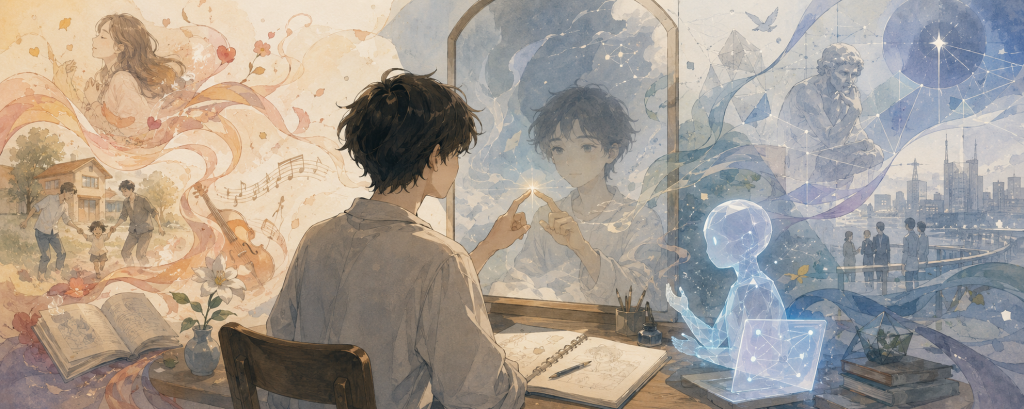
The mirror provides a more accurate model.
How do I confirm that the person in the mirror is me? Not merely because that face is objectively similar to mine. More importantly, I smile, and he smiles too; I raise my hand, and he raises his hand too; I change my movement, and the image changes accordingly. I see my own will leaving its mark on the external world, and then returning to me through external feedback.
A work becomes my self-expression only if it also forms this will–feedback relation. My choice changes the work, and the change in the work in turn affects me; I recognize my own action in it, and through that recognition continue to shape myself.
Therefore, “based on my data” does not mean “coming from my action”; “about me” does not mean “brought about by me.”
The same goes for caring for a child. If we look only at function, both a father and a nanny can make the child well fed. But “the child is fed” is not the whole event. The father cared for his own child, the child responded to the father, the father–child relationship changed as a result, and the father also understood himself in the course of caring for the child—all of this belongs to the outcome.
A nanny can substitute for certain caregiving functions, but cannot substitute for the relational act of “me, as the father, caring for my own child,” nor can she substitute for the feelings, responsibilities, and feedback I gain from it.
It is the same when speaking in a meeting. Others may express exactly the same opinion as mine, yet they cannot publicly take my position on my behalf. The propositional content can be the same, but who bears the controversy, reputation, sense of accomplishment, and responsibility is itself part of the action.
Unsubstitutability does not mean “no one else can achieve a similar effect,” but rather: this matter occupies in my life a position that cannot be transferred.
VI. Death Reveals the Unoutsourcability of Life
Heidegger’s discussion of death gives this unsubstitutability its sharpest form.
From the standpoint of an objective event, death can of course be replaced to a certain extent. A revolutionary cause needs a sacrificer; Zhang San steps forward, and Li Si need not die in this particular event. Zhang San seems to have taken Li Si’s place.
But Zhang San cannot bear Li Si’s own mortality for him. Even if someone sacrifices himself for me, I still have not escaped my own possibility of death. Others can do tasks for me, bear office for me, continue my work for me, but they cannot live my life for me, nor can they die for me.
Precisely because life is finite, I cannot realize all values, cannot try all possibilities, and cannot postpone life indefinitely. I must arrange among goods that are not fully commensurable: family, honor, pleasure, creation, peace, truth, friendship, and adventure. There is no single weighting that can prove that everyone ought to accept it.
This finitude is not an obstacle to freedom; on the contrary, it constitutes the condition for self-creation.
Exteriorizing the self into works, speech, institutions, and history is one way of overcoming death; in actual life, attaining a peace, a relationship, and an experience uniquely one’s own is also self-realization. The key is not whether the result can be preserved forever, but whether I have organized finite life into a trajectory that belongs to me.
Others can do many things for me, but they cannot live through those things as my life.
VII. Freedom Is Not the Elimination of Contradiction, but the Sustaining of Tension
A rich self is bound to be full of contradictions.
I want pleasure, yet I care about health; I value family, yet I need solitude; I long for honor, yet I hate ingratiation; I want stability, yet I fear mediocrity; I am willing to plan rationally, yet I also want to preserve room for improvisation and waste.
These conflicts do not necessarily need to be thoroughly resolved. Freedom is not one force eliminating the others, but the formation of temporary combinations amid continual tension.
So rather than saying freedom requires “negating the self that has already been recognized,” it is better to say that freedom requires preserving the possibility of conflict, tension, and recombination.
An algorithm tells me that, based on past data, I will most likely choose a certain option. I do not necessarily need to prove freedom through reverse choice. If it says A, and I mechanically choose B, that may still be a kind of reverse dependence. What really matters is that the algorithm’s judgment is only one force entering the inner tug-of-war of the self, not the final verdict that ends the struggle.
“I insist on the opposite” sometimes has important value. It may bring some repressed desire back into the process: retaining the right to fail, not treating friendship as a social-capital investment, staying true to a certain moment’s mood, choosing an expression that is not efficient enough but better matches one’s own style.
But willfulness cannot become the new dictator either. If a person insists on opposing prediction, opposing advice, and opposing reason in everything, they too will be compressed into a single temperament.
Freedom is not reason defeating willfulness, nor is it willfulness defeating reason; it is that no force may permanently monopolize the self.
VIII. AI’s Prediction Does Not Equal Mastery of the Self
AI may predict certain behaviors more accurately than I myself can: what I will click, what I will buy, when I will be tired, and under what wording I will be more likely to accept advice.
But the accuracy of behavioral prediction does not equal a full understanding of the self.
An algorithm may accurately predict what I will buy tonight, yet it cannot thereby decide what kind of person I am willing to become. It can discover my habits, but it cannot directly elevate those habits into my purpose.
Human complexity also lies not merely in the number of variables. More importantly, a person’s different desires and values cannot be fully converted into a common scale. Kinship, glory, pleasure, loyalty, health, and creation do not naturally possess a unified unit of measurement.
AI and modern management systems naturally tend to turn problems into optimization problems: define the goal, set the indicators, estimate the weights, and search for the best path. This method is extremely effective when dealing with labor and many technical tasks, but a complete life is not a single objective function.
Even if a model incorporates tens of thousands of variables, so long as it ultimately tries to compress all values into some unified utility, it may gain predictive power while losing human conflict and tragedy.
The human self also has a recursive quality. Once a model about me is known by me, it becomes new material for life. I may identify with it, resent it, ridicule it, exploit it, or deliberately deviate from it. A model is not a photograph taken from outside the system; it enters the system it describes and changes the next round of self-formation.
This does not necessarily prove some mystical freedom detached from causality, but it does show that a person is not a stone that is completely unresponsive to description. The subject can fold predictions about itself back into its own life.
IX. AI Is Not an Omnipotent Shaper, but More Like a Paper-Talking Consultant
Some may worry that AI can actively plan people’s entire desires, conflicts, and richness, manufacturing a personality that appears plural while in fact being uniformly managed.
At least as far as present-day AI is concerned, this situation is not realistic.
Human desires and conflicts arise to a large extent from bodily states, hormonal changes, family relations, work circumstances, chance events, illness, aging, love, friendship, region, and social life. AI can neither directly control the whole of a person’s body nor fully arrange the real environment and social relations.
It remains, more than anything, a consultant who can talk only on paper. It can provide language, advice, information, and explanations, but it cannot plan everything in a unified way.
This does not mean that the technological environment has no formative power. Heidegger’s “Gestell,” as well as Marcuse’s critique of “one-dimensional society,” both point to a broader danger: the entire industrial and social environment predefines how people understand the world, presenting everything as resources, efficiency, and manageable objects, and gradually weakening other possibilities of life.
But this danger should not be simply blamed on AI. In fact, AI may also become a force that counterbalances industrial society.
Industrial society tends toward standardized production, unified occupational division, and mass cultural consumption, whereas AI can lower the threshold for creation and knowledge production, making it easier for individuals to obtain customized tools, reduce repetitive labor, express niche tastes, and explore ideas that were previously impossible to realize because of their excessive cost.
It may both reinforce platform-based management and help individuals break free from traditional institutions and professional barriers; it may both further fold people into unified metrics and provide new technical space for different ways of life.
Therefore, the relationship between AI and freedom is not one-way. Whether it ultimately becomes part of Gestell, or becomes a tool for resisting one-dimensional life, depends on how it enters the process of human self-formation.
X. Freedom Is a Synthesis That Preserves Difference
From this, a fairly complete judgment can be reached.
Freedom is not an isolated subject excluding all external forces, but rather a finite human being organizing bodily existence, emotions, reason, social relations, and the technological environment—materials not entirely of his own choosing—into a stretch of life that can be recognized, borne, revised, and continually created by himself.
This kind of organization is not a perfect unity after conflict has been eliminated, but a synthesis that preserves difference.
AI replacing human beings in handling labor and matters of necessity will often be able to expand freedom. AI’s participation in work, creation, and public action does not necessarily harm freedom either, because human activity has always included cooperation, division of labor, and technical mediation.
What is truly worth vigilance is not how much AI has done for me, but whether it makes the self flat: whether it recognizes only one scale of value, whether it compresses all conflicts into problems to be optimized, and whether it gradually causes me to lose the capacity for recursive observation and for recombining life anew.
Conversely, if AI helps me reduce necessary labor, expand means of expression, encounter different viewpoints, understand my own body and emotions, and allow my will to receive richer feedback in works and actions, then it may promote freedom.
Freedom is not doing everything by oneself, nor is it refusing all guidance. Freedom lies in this: even with the help of countless collaborators, traditions, and technologies, I am still creating a life that no one else can undergo in my place.
AI can become a tool, a material, a mirror, a counselor, and a collaborator, but it cannot become me in my place.
And what is truly hostile to freedom is not necessarily any one specific technology. The more fundamental enemy is any environment that seeks to eliminate human inner conflict, belittle subjectivity as error, regard willfulness as malfunction, compress complex life into a single function, and ultimately make people increasingly easy to manage and predict.
Translated from the Chinese original with AI assistance. The original text is authoritative.
Leave a Reply