
On November 8, the third session of the reading group on The Human Condition continued our reading: we finished the last four paragraphs of Section 1 of Chapter 1 and moved into Section 2, reading the first three paragraphs.
In the second half of Section 1, Arendt stresses that man-made things can in turn become the conditions of human existence, but human conditions are not the same as human nature; Section 2 turns to the origin of the term “active life,” beginning with Aristotle’s three ways of life for free men. Our discussion revolved around several questions: does stock trading at home count as labor or work? Who is still working? Was ancient Greece really that wonderful? What did the Greeks mean by freedom, and would refusing to pursue usefulness mean falling into emptiness?
What follows was organized by Claude from the live recording and revised by Hu Yilin; the quotations are from Wang Yinli’s translation.
Opening: Three Conditions, Three Activities
Let me first review the previous two sessions. The first session was about the background of the age: technology is becoming ever more specialized, while ordinary people are becoming ever more distant from politics. Technology is becoming ever more closely tied to human life, and politics, after all, is about discussing how people should live and how they should live together, so the relationship between technology and politics is becoming ever closer; at the same time, technology is becoming ever more specialized, and ordinary people are increasingly unable to understand it. This is Arendt’s historical background, and it is also the condition of our own age.
The second session discussed “the human condition.” The title of this book is rendered by Wang Yinli as “The Human Condition,” while in the main text it is translated as “condition.” I think either is fine: environment, condition, condition of existence—all work. “Condition” has the sense of prerequisite, the precondition for being human, but do not understand it in the logical sense of condition, nor in the essentialist sense of a premise; it is more like the “family conditions” someone asks about on a blind date. In fact, it is not all that different from “condition of existence”; the two terms can be understood together.
Arendt divides active life into three kinds: labor, work, and action. Active life stands opposed to contemplative life; the life of meditation and seclusion is not our concern for now. Active life is the life that ordinary people, everyday people, all live. Why exactly these three kinds? Because each corresponds to one of human beings’ basic conditions. Of course, the correspondence is not perfectly one-to-one; later we will talk about their alienation and misalignment, which is a problem of modernity.
The first condition is the condition of human beings as animals: we need to eat and drink, to defecate and urinate, to be clothed and fed; without clothes we freeze to death, without food we starve to death. For humanity as a whole, reproduction also belongs to this level. The activity corresponding to these animal needs is labor.
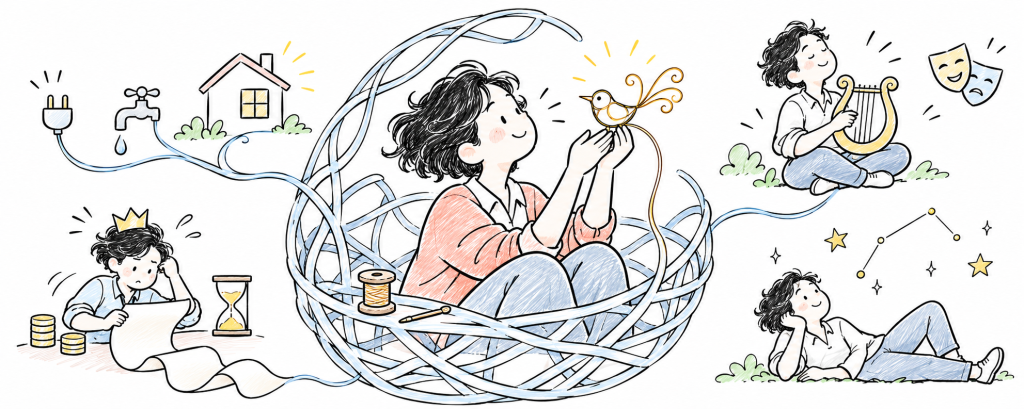
The second is work. Unlike birds building nests—simply by instinct written into their genes—human beings build within the cycle of life, or they can choose not to build at all, or continue building on the basis of what their predecessors have made. We build towers, we build with steel and concrete; we are far more independent and far richer than ordinary animals. This is what Arendt calls worldliness, inheriting Heidegger here: animals are poor in world, while artifacts have no world; a cup, a chair, has no world of its own. They form a whole only within the human world. Human beings live outside themselves, dwelling in implements and external things. Work is not about solving animal needs, but about unleashing what is distinctive about human beings and adding to this world things that were not there before.
The third condition is plurality, corresponding to action, and is closer to politics. Wang Yinli translates it as “plurality,” while Zhong Shu translates it as “multiplicity.” Literally, plurality is accurate; in terms of meaning, multiplicity also gets it right. What Arendt wants to emphasize is not that humans are numerous like cockroaches—tens of thousands of cockroaches are also a plurality—but that human plurality means there are many unique individuals. What action must respond to is precisely this plurality. Negatively speaking, people rub against one another: I want to hold a reading group here, someone else wants to dance here, someone else wants to watch a movie—this little patch of space, who does it belong to? That requires negotiation, and negotiation is a political activity. Positively speaking, once there are many people, I want to stand out, to display myself, to realize myself, to show my uniqueness in the crowd. This uniqueness cannot be realized simply by lying around; one’s latent uniqueness has to be realized through action among others.
The three forms of active life also correspond to a larger condition: natality, which stands opposed to mortality. Contemplative life corresponds to mortality; active life corresponds to natality. This is a supplement to, or correction of, Heidegger. Heidegger emphasizes that human beings are beings-toward-death; this finitude forces you to cherish the present and seriously take responsibility for your own fate. Arendt, by contrast, speaks from a more affirmative angle about the basic human condition. My understanding of natality is that new things are always arriving. The birth of a child does not merely mean one more thing has appeared in the world; it means there is once again one more world within the world, because the possibilities he can unfold are new and unique. Why is human life worth living? Because this world is always full of possibilities.
Spinning a Cocoon Only to Be Trapped in It: Man-Made Things Become Human Conditions
Arendt says:
The human condition includes not only those conditions that life gives to human beings. Human beings are also conditioned beings, because anything they come into contact with instantly becomes a condition for their next existence. The world in which active life finds itself consists of things produced by human activity; but these things, which owe their existence entirely to human beings, often in turn limit their human creators. In addition to those conditions given to human life on earth, human beings also often create, partly beyond them, their own artificial conditions; though the latter come from humans and are therefore changeable, they nonetheless acquire the same power to constrain human beings as natural things. … Since human existence is conditioned existence, human beings cannot exist without things; and if things are not as conditions of human existence, then they are merely a heap of unrelated objects, a non-world.
There is a very Heideggerian flavor here. Things in themselves have no world; it is within the human world that things become related and mutually referential. Things are defined by human beings, and in turn human beings are defined by things. Human beings are “conditioned beings”: we are always manufacturing and changing our own conditions; human conditions are also man-made. Whether natural things or artificial things, once they enter the human lifeworld, they become human conditions. So translating condition here as “environment” or “circumstance” might make it a little easier to grasp, but “circumstance” is also a bit too weak, because there is an element of coercion here: you cannot get out from under your conditions; you cannot speak of what a human being is apart from conditions.
So human beings are historical, and this history is created by human beings themselves: you create a new thing, and it in turn becomes a condition, a premise, for you, for your descendants, and for others. The same is true today. If, all of a sudden, there were no running water and no electricity, half of us would probably die very quickly. But these conditions were made by us; decades ago, there were still many people who dug wells and drank well water, and had no electricity, yet they still lived. If we had none of these, we would be in trouble. Especially in a densely populated place like Singapore—turn off the electricity for a year and see what it becomes. Electricity is something human beings made, and once made, it in turn becomes a limitation on human beings; we become dependent on it. If you trace things back to the Ice Age, it seems humans could survive without so many conditions; today, though, that won’t do. We keep changing conditions through making things. I have a phrase for this: “spinning a cocoon only to be trapped in it.” Human beings weave a cocoon, wrap themselves up in it, and hide inside. That is the human condition.
Human Conditions Are Not Human Nature
We should avoid a misunderstanding: human conditions are not the same as human nature; the sum total of all human activities and capacities corresponding to human conditions does not amount to anything like human nature. Neither the human activities and capacities discussed in this book, nor activities or capacities left out—such as thought and reason—or even the most exhaustive catalog of activities and capacities, constitute what might be called the essential attributes of human existence (meaning that without them existence would no longer be human existence). The most extreme change we can imagine within the human condition is human beings moving from the earth to another planet. This, which is not entirely impossible, would mean human beings would have to live under artificial conditions, completely different from the conditions given by the earth. Indeed, by then labor, work, action, and even thought as we know it would no longer have any meaning. However, even those wanderers we imagine leaving the earth would still be human beings; the only statement we can make about their “nature” is that they remain conditioned beings, even if their conditions are now to a large extent made by human beings themselves.
This is an inference from the previous paragraph: human beings continually shape their own conditions, which also means that human beings do not have fixed conditions. The conditions of our life today may no longer be the conditions of human beings in the future; the most extreme example is migration to Mars, where all the conditions now existing on earth would no longer be conditions of existence for them.
One participant said they did not quite understand: why, once humans reach Mars, would labor, work, action, and thought all no longer have any meaning?
My understanding is that the phrase “as we know it” modifies not only thought, but also labor, work, and action. Mars inhabitants may still have to labor and still have to act, but not in the way we know it. Arendt may also be trying to make a declaration here: her tripartite division is also historical, not an absolute classification. No matter how one enumerates them, these categories do not constitute human nature. If human nature has anything unchanging about it, it is that human beings are always conditioned beings; but conditions change, and the forms of active life corresponding to those conditions also change. She is not saying that these categories have absolutely no meaning for Mars inhabitants, but that we cannot know how things will be then. She is narrowing the scope of discussion: do not take labor, work, and action as revelations of human nature.
Another participant asked: how should we understand the claim that thought and reason also “do not constitute what might be called the essential attributes of human existence”?
I said that thought and reason belong to contemplative life, which this book sets aside. Labor, work, and action are not the whole of human activity, only the three forms of active life. But Arendt also says that thought and reason are likewise not human nature. To define human beings as animals of labor, animals of work, or animals of thought, or rational animals, is all questionable. Human circumstances change, and it is hard to compile a clean checklist that says, “human beings are just the beings that do these things.”
Discussion: Who Is Still Working?
One participant said that they still did not quite understand the distinction between labor and work in their definitions: the need for labor comes from the instinct for survival, while the need for work comes from affirming one’s uniqueness, but the distinction does not really come through from the words themselves; at first glance, they seem like two sides of the same thing, one and the same.
I said that one of this book’s major themes is precisely the confusion between labor and work. People in our age easily confuse labor and work; that is the fate of modernity. But in terms of the corresponding human conditions, the condition of human beings as animals and the condition of human beings as creators are actually fairly easy to distinguish. Marx also said that the difference between humans and animals lies in the fact that humans can transform the world; transforming the world is not the same as surviving and reproducing within the world and maintaining one’s own life. Humans and cattle and horses are not the same, but the problem today is that humans and cattle and horses have been confused, and so labor and work have also been confused.
That participant then asked: can we temporarily understand labor as survival-oriented and work as creation-oriented?
Yes. Work is cumulative; it adds something new to the world. Labor is cyclical; it is an eternal circuit. As we will discuss later, labor has no purpose. Of course, being fed is a goal, but once you are full today, you have to eat again tomorrow; if you are full today, you still have to eat tomorrow. You can never solve the matter of needing to eat your fill. Work has a purpose: I want to build a bridge, and once the bridge is finished, there is a bridge in the world; tomorrow it is still there, and you can think about building a pavilion on the bridge. Human beings finish building a pyramid, and the pyramid stands there; later generations live in a world that contains pyramids. Things are always becoming human conditions; what human beings make becomes new human conditions. That is work. Labor simply keeps dealing with repetitive needs.
Another participant asked: if a person stays at home trading stocks, does that count as labor, work, or action?
I said that, to a large extent, trading stocks at home is an alienated form of labor, and the key is money. Build a bridge, and when the bridge is done, it is done; but you can never finish earning money. You earn today’s money and still have to earn tomorrow’s; even if you earn more money than you could spend in eight lifetimes, it still doesn’t feel like enough. It is endlessly repetitive. Stocks, finance, and games all have this problem.
The participant who had earlier asked about Mars followed up: then can we say that Buffett has done nothing but labor his whole life?
Buffett is another question; in a certain sense, he has already become a kind of political life, or rather, a kind of conspicuous labor. But Buffett’s problem really is the problem of our age: making money has no end. Even if you make Buffett-level money, it would be enough for eight generations; what else is there to make? Money is a medium; the meaning of money is to make things. I want to build a bridge, so I need to raise funds; once I have raised them, the bridge gets built, and the money has been spent where it was meant to be spent. But if the purpose of making money is to make more money, compounding on compounding, money breeding money, then it is endless. Arendt says that this sort of endless thing is precisely what labor is there to deal with: you are full today, but tomorrow you have to eat again; it will never be enough to satisfy you. That participant then said: the human need to build bridges is also endless. Build one here today, another there tomorrow, and the day after tomorrow we’ll be building on Mars. That is a problem too. After one bridge is finished, another bridge still has to be built; once the earth is covered with them, then we have to go to Mars. Arendt began by questioning the flight into space: why flee the earth? It is as if the earth has already been ruined and there is not enough space left. Why is there not enough space? Because the direction is wrong; we are expanding in a barbaric way. After building a bridge, you could put a pavilion on it, build a tower beside it, build a ship, and add multiplicity on the foundation laid by those before us. Arendt places great emphasis on this: without multiplicity, both labor and work lose their way. It is not that work is necessarily good; the most crucial thing is still human multiplicity. If you cannot grasp that, all purposes will become endless: build this bridge and then you must build that bridge. Infrastructure in many places today is exactly this problem. Infrastructure was originally meant to make our lives better, but now a third- or fourth-tier city has four or five high-speed rail stations; one gets built and then another. Why? Still because of money, because of the game of capital, like the massive credit flooding of the 4 trillion yuan stimulus. It is not really that they want a railway station here; they want to spend the money. That is alienation. Work has also become labor; labor, work, and political action have all been alienated. That is our situation today. Another participant said: society has not given us that many opportunities for work; most opportunities are labor. For example, bridges are actually built by workers, not by designers. Workers just lay bricks every day, and after finishing one bridge they lay bricks on the next one. They are not working; they are only laboring. And tomorrow they will be out of money; after collecting their wages, they still have to go lay the next brick. Yes, what society gives most people is labor. This is what Arendt later calls a “laboring society”: society is organized in the mode of labor. Originally, a craftsman could build a bridge or forge a pot, and that was work; now work is broken into discrete stages, each of them cyclical and without purpose. You repeat one motion like an ass turning a mill, and then string together everyone’s motions to replace the original work. The participant who first asked about the difference between labor and work then asked: if the worker is laboring, does that mean the designer is definitely working? For him, after finishing one drawing there is another; isn’t that also labor? Then who exactly is working? Yes—there is basically nobody working. That is the problem. Today one can say that only a very small number of artists are still working. The participant who had earlier asked about Buffett felt that this definition might be too narrow: are only artists and authors considered to be working, and all those doing it for money do not count? I said: I am talking about alienation. Alienation does not mean that they are really not working. You can say that workers are working, and designers are also working; it is just that these works are alienated. In fact, they should be understood as labor, but they have been confused with work. In that passage Arendt is saying that labor, work, and action are not fixed and unchanging human nature; they change, and what we need to discuss is how they change and what they are like for us. This is like Heidegger: describing our situation is not a denunciation, not saying “this is wrong, don’t do it”; it is first to recognize our fate and our situation. Right now we are precisely confusing the boundary between labor and work. What that means is the question to discuss. Arendt is not trying to prove that nobody is working now, but it can be said that nowadays very few people work the way the ancient Greeks did, or act the way the ancient Greeks did. Just as on Mars, people might still work, but they may no longer work the way we do today. ## Discussion: Why distinguish the boundaries? One participant said that whether one judges oneself to be laboring or working should be seen in a very personal sense; there is no absolute standard. For example, Buffett—if he thinks he is not doing it for money, but to leave behind a story, then perhaps that is another matter. I said that from an individual perspective, of course one can look at it that way, but Arendt is talking about a general problem, with the focus on the laboring society she will discuss later: in what way is this society organized? Some individuals may be highly creative, with goals different from everyone else’s, but from the standpoint of society as a whole, Buffett is representative. No matter what Buffett himself thinks, everyone treats him as a model—so what is it that he exemplifies? This is something one can discuss in general terms. The participant who had earlier asked about Buffett then raised another point: when speaking of action, one speaks of plurality; but in any group, most people do similar things, and only a very few can produce special cases that exceed one or two standard deviations. Most programmers may write similar programs, which is more like labor; only a tiny number can be said to be working. I said that this situation itself is created by the social structure; in fact, everyone could be different. For example, in your dormitory, in your class, do you feel that everyone is the same? You would see that each person has individuality, because you have close communication and contact: you are dating him, I had a conflict with him, in late-night dorm chats I have this view and he has that one, he is good at Chinese and I am good at history. Through sufficient communication, you will experience that each person is different. But once this is placed in society, everyone in the class is just a student number, just a score; once the gaokao scores are lined up, it seems as if everyone is more or less the same, and all those in this score range are sent to the factory to tighten screws. From gaokao screening to employment to tightening screws, there is no communication in this process, no public space that allows everyone to fully display themselves and fully encounter others. Of course then everyone looks more or less the same. More traditional people know everyone in the neighborhood, and they can talk endlessly about who’s up and who’s down, with great authority. We urban people live in 501, 502, 503, 504, each in its own little compartment; there is no interaction, and we do not know one another. You are 501 and he is 502—what difference does it make? Without communication, there is no difference. This participant asked: is this a problem of the times, or a problem of there being too many people? In the past one knew one’s neighbors; now one knows classmates and colleagues. There are too many people, and no energy to get to know them. I said that human circles are layered within layers. Leaving aside ancient Greece, even modern democracy, the American democratic system, is also stratified: first the neighborhood, where political activity already exists; then the city, the state, and the nation, each level with its own discursive space. At the national level, very few people run for president; most people are voters, but at every level each person has a place. Communication in which everyone has a place is all political: chatting at the alley entrance, talking about who’s up and who’s down—these are all political activities. Now all these political activities have been flattened and compressed. Another participant then said: work is actually very complex. In a company, there are many repetitive parts that are more like labor; there are also creative parts that are more like work. I may be doing it for money, while also having parts that can be accumulated; it is inherently mixed. I agreed; this is not, in the first place, an essential or very definite boundary. But on the other hand, confusion is detrimental. Arendt will also later say that to live a political life, one must consciously distinguish the boundaries: when is my activity for labor, when is it for creation, and when is it for striving toward excellence, toward politics? Without such boundaries, politics cannot be done well. One important point in her discussion of ancient Greece is precisely that the boundary between the public and private realms was very clear. Politics makes each person unique, and this requires a public space for communication, but that space needs limits. One limit is that it has to be smaller; it cannot be flattened out. Social media today is precisely flattened out: a global village, the whole world crammed into one space, and yet individuality cannot be displayed. Traditionally there are boundaries: a class, a dormitory, are small circles. The boundaries can be fuzzy, and classes also interact with one another, but relatively speaking there is a boundary: this part is collective life within the class, with friendship; another part is businesslike, commercial relations, and the like. Only with such distinctions can public life be organized in a healthy way. The boundary of labor is also this problem, because labor is something that can never be fully solved. Many political predicaments in the world today are also because this boundary is lacking. For example, some environmentalists throw oil paint at famous paintings, or glue their hands to walls, asking, “Which is more important, life or the painting?” That is a kind of confusion. Both are important, but they are not on the same level. Once you mix them together, you seem to be able to say only that life is more important: people are about to die, so why do we still need paintings? But once you admit that, you get trapped in the argument, because the question of life never ends: people in Africa are still starving; this famine is solved, and the next generation still has to solve it; and what about people with disabilities? Then when can we begin to create art? Are we not to appreciate and create art until the life-threatening conditions of everyone in the world have been eliminated? That is the logic of those environmentalists. Arendt says that one must recognize this: the problem of life can never be fully solved; that is labor’s fate. Solve today’s life crisis, and there will be another tomorrow; solve your own, and someone else’s remains unsolved. So when can people make art, politics, or philosophy? A boundary is needed, and the boundary between the private and public realms in ancient Greece is precisely that boundary. Once one steps out of the private realm and into public space, one is presumed to have already eaten one’s fill, and no longer to discuss what to eat tomorrow or what to do if one starves to death; even if one is putting on a brave face, one still enters public life on the premise that one is secure in food and clothing. Once one enters the public realm, private problems must be kept separate, and what is discussed in public space are matters beyond the needs of life. Only then can public life develop in a healthy way. Such public life is also different from politics as we understand it today. Our political negotiations today are mainly about matters related to the needs of life, so all three forms of active life are alienated, and political life has also become alienated. ## Human beings cannot define themselves “Augustine’s question about human nature, ‘I have become a question to myself,’ seems impossible to answer both in the sense of individual psychology and in the sense of general philosophy. We are able to know, ascertain, and define the natural nature of everything around us, but we are unable to do the same for ourselves—just as we cannot jump out of our own shadow. In addition, there is nothing that gives us reason to assume that human beings, like other things, have a nature or essence. In other words, if we do have a nature or essence, then only God can know or define it, and the primary prerequisite is that he can say of a person not only what he is, but who he is. The difficulty here is that the human mode of cognition applies only to knowing things that have a ‘natural’ character, and even our knowledge of ourselves is limited to us as samples of the highest stage of the development of organic life. But when we pose the question ‘Who are we?’ the human mode of cognition no longer works. That is why all attempts to define human nature inevitably end in constructing some god, the god of philosophers… But the attempt to define human nature is very likely to lead us to some notion of the ‘superhuman’ and to equate it with God, and this fact alone is enough to cast a suspicious eye on the concept of ‘human nature’.” Reading this passage, one easily feels that one has not understood it, but in fact it is not saying anything new; it is still saying that human beings have no nature. It is just that this passage is in dialogue with philosophers, so it sounds difficult. What she emphasizes is that human beings cannot define themselves, just as one cannot jump out of one’s own shadow. When human beings try to define human beings, they are in fact defining myself, defining us; they are engaging in self-reference. This is not the same as defining external things. When defining external things, one can stand from an objective perspective and delimit it by placing it on a drawing or a chart. This is what Arendt means by our cognition of things with a “natural” character—that is, the objective, scientific perspective. One can also define human beings as natural objects: what kind of ape human beings are, what the genetic map looks like, what their height and habits are; all of these can be objectively described. But all of these are definitions of what, not of who; they cannot solve the problem of “Who am I?” Arendt says that all previous attempts to define human nature inevitably led to constructing a god, such as a Platonic idea; and the attempt to define human nature is also very likely to lead to some notion of the “superhuman.” As discussed earlier, human beings are historical; human beings change themselves by shaping the conditions of their own existence. This is actually turning Heidegger’s statement into a human self-understanding. According to Heidegger’s line of thought, as long as you are still asking “Who am I?”, it proves that you are not yet dead, that everything is still uncertain, that you have not yet become a determinate being—so this is a problem of self-reference. Human beings are the same: human beings are constantly shaping their own conditions, and even those philosophical definitions of human essence themselves become human conditions. After Plato put forward his doctrine, his doctrine also became one of the conditions of humanity, part of the historical background by which human beings come to be constituted. So you can never stand at an objective viewpoint; you can only comment on yourself.Those who try to define themselves usually end up in one of two patterns. One is transcendental: human beings are constantly changing, so one posits an eternally unchanging thing to define the changing human being; that thing is God, and what is eternally unchanging is certainly not human. Christianity is the classic case: human beings are created by God in God’s own image, so human beings possess divinity, and divinity is eternally unchanging. In other words, in a constantly changing existence, one seeks something eternally unchanging; the way to do that is to invent a God. The other is to posit some faraway point, as if beneath that point all change also becomes unchangeability. The former age looked backward, defining human beings from primitive man: Rousseau first had to posit an original state, the noble savage; Hobbes said the original state was a war of all against all. This prototype does not exist in reality at all; it is a distant past, but once you have this anchor, it seems as if you have grasped human essence. Our age, by contrast, looks to the future, using some future image of human beings to define present human beings; this is the superman, mechanical ascent, digital ascent, also some image of becoming God.
One participant asked: then where does the Buddhist saying of “no-self” belong?
I said, “no-self” is precisely non-essentialist. Orthodox Buddhist studies are actually quite powerful; what they emphasize is that human beings have no essence. Buddhism says not to cling; “emptiness” is not essence either. One must neither cling to being nor cling to non-being; one cannot say that “the four elements are all empty,” and then say emptiness is the essence of human beings either. What it seeks to break is attachment: the very act of absolutely needing to find a concept, a nature, or a substance to explain constantly changing human beings is itself suspicious. So the Buddhist “nothingness” is also anti-essentialist.
On the other hand, the conditions of human existence—life itself, natality and mortality, worldliness, plurality, and the earth—can never “explain” what we are or answer the question of who we are, for the simple reason that these conditions have never absolutely constrained us. … The reason modern natural science has been able to achieve such great victories lies in its ability to deal with earth-bound nature from the standpoint of a truly cosmic perspective; that is to say, to clearly and boldly obtain an Archimedean point from outside the earth.
Here she is still saying that these conditions are not absolute constraints. Speaking of the scientific perspective, the Archimedean point is a fulcrum, a cosmic viewpoint. Arendt is not taking a negative stance toward modern science; she acknowledges that modern science opened up new possibilities and new perspectives, allowing human beings to view themselves from a higher, more objective, more transcendental standpoint. But the opening of this perspective itself also means non-absoluteness: it is not that science found a higher perspective and that science is therefore the absolute perspective; rather, it precisely proves that there is no absolute perspective, and that perspectives are constantly changing and expanding in history.
These two passages are a little verbose, but in fact they are both opposing essentialism. Heidegger can also be verbose at times, because in a sense he is speaking to his peers; philosophy at that time had not yet become like it did after postmodernism, when anti-essentialism was no longer anything unusual (though for ordinary people today, anti-essentialism is still worth bringing up). She is declaring: although I seem to be talking about philosophy, about human essence, what I am talking about is not human essence.
Discussion: Was ancient Greece really that wonderful?
After the break, the participant who had earlier asked about Buffett asked: was ancient Greece really as wonderful as it is described?
Not wonderful. The “wonderfulness” of ancient Greece was built on slavery; free men probably made up only half the population, the other half being slaves, not to mention foreigners. Only the free men of one’s own polis enjoyed politics and public life, which in fact was still a kind of privilege. Different city-states were also different; the most typical polis era was likewise limited and brief. But ancient Greece demonstrated a possibility: in a local setting, over a relatively short golden age, such a distinctive polis politics could be organized. Even that was a miracle. The miracle was not that everyone at the time lived wonderfully, but that it demonstrated such a distinctive social form in ancient society, and this social form has continued to influence the entire history of Western thought, and even the historical development of all humankind.
Another participant asked: what were they talking about in their actions at the time? The Olympic spirit should also have emerged then; looking back now, it may not have been an absolutely good thing either.
The Olympic spirit is the pursuit of excellence—surpassing others with your own hands and feet; that too is a form of action. Public life in ancient Greece was basically all action. This will be discussed later; for now, let’s just casually talk about a few basic public institutions of the Greeks.
(At the venue I missed mentioning the agora and ended up conflating the city hall with the functions of the agora; let me explain it again here.)
First is the city hall. The city hall was the center of deliberation, mainly where the Council of Five Hundred and similar bodies met. Eligible citizens were chosen by lot to join the Council of Five Hundred—councilors were not elected, but selected by lottery, so everyone had a chance, and each person could serve as a councilor only twice in a lifetime.
Second is the agora. Agora is very hard to translate because there is no modern equivalent; it is often rendered as “square” or “market.” First and foremost, it was a public square near the council chamber, something like People’s Square in a large Chinese city. But it was also a noisy market, where you could buy and sell things, including hawking your ideas (speeches). And it was also the place where citizen assemblies were held—ostracism by pottery shards, the vote to condemn Socrates, things like that, all such public activities. Sometimes larger gatherings would be held on nearby hills. The agora also included the courts: although the courts had dedicated buildings, in many cases citizen juries would argue and render judgment directly in the square.
Third is the theater. The theater provided a public topic of conversation; everyone together appreciated and discussed the meanings of tragedy and comedy, including what justice is, what honor is, and so on—an essential part of public life. Greek citizens watched plays for free (they were even compensated for lost wages), and as citizens, going to the theater was both a right and a duty.
Fourth is the gymnasium. Greece had no nine-year compulsory education; basic education was physical training: you could skip mathematics, you could skip philosophy, but every citizen had to be sent to the gymnasium for bodily training, which also included some cultural education. The word gymnasion has the Greek root for “naked”; people exercised there naked. On the one hand, this reflects the Greeks’ special regard for the human body and for strength unassisted by external things; during competition, everyone stripped off their clothes and did not rely on money, power, or status at home, nor on fine dress. If I run fast, I run fast—that is the pursuit of excellence. The Olympics were only the largest athletic festival; there were many large and small competitions and contests, and in many places women also participated in athletics.
Fourth is the bathhouse. From Greek bathhouses to Roman bathhouses to Turkish baths, the culture of public bathing has a long history; people stripped naked and chatted there, and this was a very important part of public life.
This was the life of the Greek free man. They ate their fill and did not worry about subsistence; subsistence was taken care of by slaves. Once full and with nothing to do, they went to the city hall, to the market, to the theater, to the gymnasium, and to the bathhouse.
The origin of the term “active life”
Entering section 2 of chapter 1, Arendt says:
The term active life carries, and carries to excess, the burden of tradition. This term is as old as our tradition of political thought … It arose from a specific historical convergence: the trial of Socrates and the conflict between philosophers and the polis. This tradition discarded many much older experiences unrelated to its immediate political purpose and ultimately reached its conclusion, in a highly selective way, in the works of Karl Marx. Vita activa itself is the standard medieval philosophical translation of Aristotle’s bios politikos (political life), and already appears in the writings of Augustine … it still reflects the original meaning of the term: a life devoted to public political affairs.
Zhong Shu’s translation of vita activa as “practical life” also makes sense. But “practical life” leans toward Marx, while if one leans toward Aristotle, it is “political life.” The term active life contains both political and practical intentions, and it is a very important ancient term in the history of Western thought: in Aristotle it refers to political life, the life of the polis, with politics basically meaning the polis; by the time of Marx, it means practical activity, so one says this tradition ends with Marx. Arendt will spend a fair amount of time discussing Marx later. Marx is very important, but he also went off course; we can talk about that later. What is being discussed here is the term’s original meaning: a life devoted to public political affairs.
Aristotle’s hierarchy of contempt
Aristotle distinguished three possible ways of life for free men. Freedom means being completely unbound by the necessities of survival and by the relations produced by those necessities. The precondition of freedom already excludes all ways of life whose primary purpose is to maintain life—not only the life of labor (labor being the way of life of slaves), but also the productive life of the free craftsman and the money-making life of the merchant. In short, anyone who, willingly or unwillingly, has lost his inclination toward free movement or activity in order to secure his total or temporary survival is excluded from the life of the free. The common feature of the remaining three ways of life is that they all concern things that are “beautiful,” that is, things that are neither necessary nor merely useful: in the life of enjoyment, beauty is for consumption; in the life devoted to the affairs of the polis, excellence produces fine words and noble deeds; in the philosopher’s life of inquiry and contemplation of eternal things, enduring beauty is neither generated by human toil nor altered by human leisure.
The three ways of life Aristotle speaks of for free men are enjoyment, politics, and philosophy; all three concern beauty, and the premise of all three is freedom. This also answers the earlier question: what were the Greeks doing? Aristotle himself answered it: free men have three options—enjoying life, engaging in politics, or doing philosophy. What are the unfree doing? Laboring, trading, and making things.
Here, making has already been placed in the non-political category, together with labor; that is a prejudice after Plato. As I mentioned earlier, Arendt values the political tradition of Socrates and before him more highly, and after Plato there is an overemphasis on contemplative life and an underestimation of politics. Still, Aristotle’s summary of the ways of life is representative enough; it is still Greek. The Greeks of course looked down on slaves, as did Socrates and those before him; the difference lies in the status of poets and artisans, who are disparaged in Plato. Other Greeks originally liked poets very much; Homeric epics and bardic singers occupied a good place in Greek society. After Plato, there was a strong emphasis on freedom of life, and so artists, though not entirely governed by necessities, were seen as partly entangled in them: the things they made had to be sold for money, had to support a family, and so they were looked down upon. Merchants, too: legally they may also have been counted as free men, but in the eyes of the more aristocratic, more elite free men, they were no different from slaves, running around all day for the necessities of life and having rather low style.
The participant who had earlier asked about Buffett asked: if put into modern terms, wouldn’t the top of the hierarchy of contempt be the rich second generation—the people who don’t need to work at all, who are rich from the start—looking down on those who have to figure out for themselves how to make money?
I said: no. Many contemporary hierarchies of contempt are based on whether one has money or not; if you have money, you are respected, and that is very different from the Greeks. Rich second-generation people also have standards; it is not as if they can casually look down on others. If a rich second-generation person has not chosen a free way of life, they too are to be despised. The Greeks did not think in terms of whether one was rich or not, because their slavery was systemic: ordinary free men also had slaves, and having slaves did not require you to be very rich; as long as you were a free man, that was enough. Their hierarchy of contempt was: once the necessities of life have been solved, what do you pursue? In Aristotle’s hierarchy of contempt, those who pursue enjoyment are lowest, those who engage in politics are a bit higher, and philosophers are highest. Slaves do not even get to be despised; in his eyes, slaves are not human beings.
There is a legend: why did Aristotle fall out with Alexander? Because Alexander later married a foreigner, and his realm was so vast that many policies relaxed the distinction between free men and everyone else. In Aristotle’s view, those people were all barbaros—that is, barbarians, people who can’t even speak properly. How could one possibly get along well with them? And so a rift arose between teacher and student. Whether this rift arose for that reason is historical gossip; but that contempt was real: how could you fraternize with those people, and even marry a barbarian? In their view, barbarians were not human. Only on the basis of free men can one even speak of pursuing anything.
Another participant said: if we put this into today’s individual perspective, the key lies in how subsistence is defined. If a person is deeply influenced by consumerism and thinks that maintaining life requires a very high cost, they may remain in an unfree state all the time; but today one can also meet the requirements of subsistence at very low cost and become a free man.
Yes, that is what people now call the spiritual aristocrat. Today it is indeed very easy to maintain subsistence; many developed countries are exactly like this, raising idle people—you can do nothing and still eat your fill. Then what are you going to do next? That is the question.
Even kings are not free
Here we are still talking about the source of this concept of the active life in Aristotle:
Aristotle… it seems that both labor and work are still not dignified enough, not enough to constitute a life in a full sense, an autonomous and truly human way of living; for labor serves what is necessary, and work produces what is useful, and both depend on human needs and lack. … But in their view, the life of a tyrant cannot be called free either, and has little to do with political life, because it is “merely” a necessity.
This is still a hierarchy of contempt. Not to mention the children of the rich, even a monarch depends on what kind of monarch he is; he is not necessarily a free person. Under the polis system there were of course no monarchs. If you did not choose it freely, if you inherited the throne from birth and had to toil day and night for countless subjects, with no room to do anything else, what kind of freedom was that? You too were just a slave. So in the eyes of the Greeks, not only the ordinary Persians were not free people, the Persian king was not free either. They were all barbarians, all trapped by necessity, always having to solve those problems that had to be solved. Rule itself is necessary: to govern such a vast state, you must rule, must balance, play politics, and create checks and balances. Bound by these necessary things, you are no longer a free person.
This can also be used to understand that legend. Alexander would say: I govern such a vast territory; there is no help for it, I must intermarry with them in order to rule effectively. From Aristotle’s logic, if you say “must,” then you have fallen under necessity and are no longer free.
The participant who had earlier asked about the children of the rich asked in return: Doesn’t he have to get along well with the barbarians?
Not that he can’t, only don’t treat them as people. What is there to talk about getting along well or badly with a pack of wolves or a pack of dogs? It’s not that you must go out of your way to provoke them, but that you and they are not at all in a relation of person to person, of free person to free person. Don’t take them seriously; treat them as nature, as a flood: “the barbarians are causing trouble over there,” and that’s that.
So the Greeks had no desire for expansion. Macedon was not a typical Greek polity; Macedon was originally an agricultural region and also belonged to the category of something nearly barbarian.
It was not until the time of Alexander’s father that Macedonians were allowed to take part in the Olympic Games. To be able to participate in the Olympics basically meant being recognized as Greek.
Let me add that what was said earlier was not rigorous enough. In fact, the Macedonian king Alexander I took part in the Olympics at the beginning of the fifth century BCE, but this was not because Macedonians were qualified; rather, he argued that he had Greek blood and claimed that his ancestors came from Argos in Greece. After that, there were also scattered records of the Macedonian royal family participating in the Olympics, and it was not until the reign of Alexander III (Alexander the Great) that there was a record of a Macedonian commoner winning at the Olympics. Because the Olympics only record the champion of each event, the exact time when Macedonian commoners were qualified to participate is uncertain; my rough estimate to the generation of Alexander the Great’s father is just a guess.
The more typical Greeks had no need to expand. The Greek city-states often fought one another, but it was rare to hear of one city-state annexing another (addition: there were exceptions, such as Sparta and Argos). What did they fight for? Look at Greek mythology: to seize women, for Helen, to compete for honor, to prove oneself a hero, to take revenge; and after the fighting, they still did not occupy the territory. Once the territory expanded, there were many things that had to be managed, many things that had to be governed, and then one was no longer free, so they did not expand. What Aristotle is talking about here is the typical Greek form, not every city-state. In short, Greece is a singular wonder in human history, a very rare cultural form.
Discussion: What Is Greek Freedom?
The participant who earlier mentioned the worker building bridges asked: From a philosophical point of view, what is the definition of freedom? Freedom also has many constraints; for example, Greek citizens could not kill and set fires, and could not marry barbarians.
I said that these concepts are historical. Arendt is not talking about a philosophical definition, but about the typical definition of the Greeks represented by Aristotle: freedom from necessity, freedom from worrying about necessary and useful things. If I care only about useless things, then I am free; if I spend my days busying myself with useful and necessary things, then I am not free.
This definition has influenced the entire history of Western thought. But later Western thought added another layer, namely the Christian free will, which is closer to our everyday understanding of freedom today. Christian free will takes God as its model: human beings were made by God and share in a kind of divine power; free will is God doing whatever he wants, and that is unlimited freedom. When this is applied to human beings, a free person is someone who can do whatever he wants. So in this sense, freedom of course has limits, rules, and boundaries. The question itself has in fact already been understood from the standpoint of Christian free will.
The Greek concept of freedom is not at all about whether there are limits, but about whether one is free from busyness, free from worry. Once you are relieved of those worries, you are free; as for the fact that in public life you still face one constraint or another, that has no direct relation to freedom. Freedom is not absence of limits, but absence of bondage, and that bondage refers specifically to the bondage of necessity and usefulness. I often give an example: if I want to swim, I find a pool; at that time I want to run, but I cannot run in the pool; I cannot run, swim, and eat at the same time in the pool. That is freedom being constrained. But whether I run or swim in the pool, it is not for utility, not for what to eat tomorrow or how to make money to support my family—I just want to exercise, I want to play, and in that way you are free.
This participant said he understood: it is time that can be freely at one’s disposal, not time controlled passively. Then he asked: if one reaches this kind of freedom, and there is no purpose anymore, just going to bathe and such, wouldn’t everyday life be rather nihilistic?
On the contrary, only once you are free do you have purpose. As I said earlier, coping with necessity is what is purposeless, because necessity is never completed; a free life is where purpose first begins. For example, I just want to mold a bowl, to cast a pot; that is purpose. When it is done, I look at it: how beautiful I made it! Aristotle says that the three kinds of free life all ultimately pursue beauty. Do not think of “beauty” as something too lofty or unattainable—“I’m looking beautiful today,” that is beauty; I molded a little clay figurine today and it looks lovely—surely that is a purpose too? Aristotle despised such making, but I think, or rather Arendt thinks, that this too is free. Before Socrates, in the view of ordinary Greeks, craftsmanship and poetry were also free, only later downgraded by Plato.
The kinds of free life recognized by tradition all also have purposes. For instance, pleasure: today you go to the theater to watch tragedy and comedy, and if you go every day, that is a purpose; if you spend every day engaging in politics and discussion, debating whether Socrates should be executed or exiled, these topics of course have meaning. Aristotle says that what is pursued is beauty; we say this is just killing time, and also a kind of joy, a kind of good. Then there is contemplation, engaging in philosophy, discovering truth, understanding truth, which is the loftiest purpose of all. Philosophy is useless learning, and mathematics is useless too; many mathematicians today also feel that they are engaged in pure knowledge, not to increase productivity, but because the mysteries of this world are beautiful.
So the free person is not without purpose, but without utilitarian purpose. Utilitarian purpose itself is in fact not really a purpose, but something to be translated: how much money can be earned by doing this, how much grain can be produced, how much energy can be mobilized; converted into increased productive force and increased social wealth, then you feel it has a purpose. In essence, the matter no longer has a purpose; its purpose has been displaced into money, wealth, energy, or food, and that goal can never be filled, is endless and circular, yet somehow seems like a purpose.
The participant who earlier asked about the children of the rich asked: The Greeks pursued fame and honor—how is that any different from pursuing money?
I said that today Chinese people speak of “pursuing fame and profit,” as if fame and profit were lumped together, but at least in the eyes of the Greeks they were completely separate, and they were also different in the eyes of the ancient Chinese. Ancient China also despised merchants, but respected reputation. Not only great men, but ordinary people too: what is meant by “failing to preserve one’s integrity in old age”? What is a chaste and virtuous woman? Are these not all reputation? Everyone is biting down hard on one breath to compete for reputation, and even the emperor cares about how history books will record him and what posthumous title he will finally receive. The ancient Greeks were the same: to pursue money, to pursue power, these useful things, was to fall to a lower level; what one ought to pursue was reputation, empty fame, the emptier the better—that is the higher pursuit.
The participant who had asked about the definition of freedom summed it up: uselessness is beauty, the more useless the more beautiful, and what is opposed is capitalism.
That is roughly the meaning. Modern alienation can be said to be capitalism. But uselessness is the premise; there is no such thing as “the more useless, the better”—uselessness is a boundary. Uselessness cannot be measured; you cannot say this is more useless than that. Uselessness means that you no longer care about its utility. It may also be useful: if you do mathematics, your results may end up being used, and the physicists are delighted, while the mathematician says I never intended for you to use it. So there is no absolute uselessness. This “not,” like what was said earlier about Buddhism, means not being attached, not being attached to utility; only after one is not attached to utility does higher taste and higher pursuit begin.
As for what to pursue after not being attached to utility, each person can have different directions and bring out human multiplicity—that is political life. And the starting point of political life is to exclude concerns of utility. It is not that these concerns are unwanted, but that they are left in the private sphere, left in the realm of slaves, left in household management. Today the word “economics” at Aristotle’s place is household management, “the governance of the household.” Do economic problems need to be studied? Yes. Need they be handled? Yes. Do accounts need to be kept, quantities measured, calculations made? All these are necessary. But these necessary things are certainly not political problems; they are household problems. The Chinese translation “jiazheng” still contains the character for “government,” but in fact it is not politics, only governance and management—the governing of the inner household, the private sphere, in plain terms, managing slaves. Even if all matters are handed over to slaves to do, you still at least have to manage the slaves, and that consumes your mind and energy, so managing slaves is also not free, because management is in service of making them useful. But these actions must be confined within the household; once you step out of the house, those problems are no longer your concern, and you go into public space to deal with useless problems.
What are useless problems? For the Greeks, they are things like who Helen belongs to; watching a play, discussing whether Guan Gong could defeat Qin Qiong, whether Guan Gong is stronger or Qin Qiong is stronger. That is ordinary uselessness. There is also studying mathematics, gazing up at the stars and watching the transformations of the heavens, or becoming a poet, creating literature and art. These are all useless activities.
Discussion: How Should People Today Live a Useless Life?
Another participant said: If people today want to live such a useless life, first secure food and clothing, then have not much in the way of ambitions, watch short dramas in the morning, discuss politics with everyone at noon, and in the evening play the amateur scholar, exploring the truth a bit.
I said, that’s pretty good. But the problem is, first, these activities have also become alienated, organized according to the logic of labor and consumption. The Greek theater was understood and organized according to the mode of public life; modern short dramas are produced and organized according to the logic of labor, production, and consumption. Second, these things no longer have honor now, no longer have the sense of self-realization, because the whole society is denouncing them. They have become amusement, and amusement is opposed to labor. In the past, the whole of life was amusement; today’s amusement has a purpose, namely to make you have a more abundant spirit for labor. Once you’ve rested well, you can work healthily for fifty years.
The participant who earlier asked about the children of the rich said: Why do I feel that nowadays it’s amusement until four in the morning, and then you go to work the next day?
Yes. I have always believed that the existence of these activities is positive; it proves that human active life does not easily perish, that human beings have these needs. It’s just that these needs conflict with the overall direction and mode of organization of society. All these needs are downgraded into very bad, very superficial pursuits, and then there are no higher pursuits left, and this becomes self-fulfilling: the more they are denigrated, the more they really do deserve to be denigrated, and there is really not much interest in them. If these activities are valued, people can, on top of these needs, bring forth their useless hobbies, their own taste, their own creativity; such a society is more active. This is also the meaning of our reading history. If you really traveled back to antiquity, you might not be able to stand it either; but seen from a distance, at least you can see a possibility, see that our modern life is not self-evident. Ancient people had different ways of living, and at least in imagination they seem more beautiful; of course, returning to that era would still bring the problems of that era, but if we take it as an ideal and revive and develop it today, perhaps we can live a life better than that of ancient people, and also better than that of modern people.
Another participant asked: Is Greek mythology a rather important entry point for understanding their worldview?
That’s more or less right, but Greek mythology goes a bit deeper. The Greek polis life being emphasized here was relatively short-lived—basically the golden age of the classical period, only about a hundred years or so. Greek mythology is the deeper substratum, but it already contains some elements of the Greek spirit, such as heroism. Myths, when all is said and done, are about snatching women and snatching treasure; they are all useless things, not things done for the people or for the state. Chinese mythology is different: Shennong tasted hundreds of herbs, Cangjie created writing, Fuxi did this and that (teaching people how to fish), Yu the Great controlled the floods… enlightened rulers and sage-kings were all doing useful things. In Greek mythology, Zeus messing around with this person today and that animal tomorrow is a very bizarre kind of underlying culture, but it already has one intention: not being practical.
One participant said: It feels like their myths are all moral corruption; I haven’t seen this much in other mythologies.
So yes, very bizarre. Of course, mythology cannot directly represent the form of later Greek classical polis culture, but it is indeed its foundation: only such a bizarre culture could develop the kind of polis life Greece had.
At this point, the third Arendt reading group session came to an end.
Translated from the Chinese original with AI assistance. The original text is authoritative.