
1. Why Childbearing Becomes a Question
Reproduction was originally just a biological instinct. From single-celled organisms onward, reproduction is the nature of any living thing, and we would never ask any other creature: why do you have children? But humans alone, having transcended natural instinct through technology and civilization, have their own world of meaning, and so this question can arise only for us.
In particular, modern technology has made reproduction something increasingly plannable and controllable. We can no longer even comfortably say that children are the “crystallization of their parents’ love,” because even the most passionate love can be contracepted. Childbearing seems to have become a carefully considered choice that can only be undertaken after preparing all sorts of conditions and planning all kinds of futures. “Why have children?” has become a topic unto itself.
2. Children Are Not the Sequel to Their Parents’ Lives
I oppose sayings like “raise children to support you in old age,” and I also do not approve of saying that “children are the continuation of one’s own life,” or that they should carry on my dreams and struggles and the like. All of this treats children as one’s own property, or as tools lacking sufficient independence. “The Foolish Old Man Removes the Mountains” is the most absurd and terrifying of all childrearing concepts: a dying old man hoping to bind all his descendants to his private wishes. His refusal to move house is his freedom, but to shackle generation after generation to it is utterly vile.
I hope children are free people. Raising them is not, in itself, any sort of favor; children do not owe their parents anything. On the contrary, since having children is the parents’ wish, and the child’s birth fulfills that wish, parents should from the very beginning be grateful for the child’s arrival, not the other way around.
3. The Meaning of Raising Children Is the Meaning of Love
But that does not mean parents cannot hope to receive something in return from their children. On the contrary, raising children is itself a highly affirmative form of feedback. A child is a special kind of object: we can pour our love into her unconditionally, and she possesses an almost indiscriminate inclusiveness, accepting whatever comes her way. Loving a spouse and loving one’s parents are also very affirmative acts, but they are not as unconditional as loving a child, and the other party may not necessarily receive everything as readily as a child does.
In Arendt’s words, “work,” which leaves traces in the world, and “action,” which affects others, are the affirmative modes of life by which human beings transcend nature. And raising children is the most direct and effective way for parents to positively leave their mark on the world. Like “action” in the general sense, this kind of change does not require the negation of others’ freedom. We can respect a child’s independent personality while at the same time treating her as the direction of our projection into this world.
The meaning of raising children is the meaning of “love.” My influence on my child depends on how attached to, and how cherishing, I am toward this world. I love this world, and therefore I am willing to bring my child into it as well, so that together we may leave behind beautiful memories and traces. If I hate this world, then I should not have children.
(The above was hand-crafted by me; the following was written by AI after exchanges between me and ChatGPT)
4. Natality: The World Has Not Yet Been Written to Its End
So, what exactly is there in this world that is worth loving?
In my view, one important reason is this: the world has infinite possibilities and abundant unknowns. Life is not about replaying what we already know how to do; we do not yet know whom we will meet, what we will come to understand, or what joys we will discover. What is worth anticipating includes precisely those things that are still unclear now, or that we have never even thought of.
This makes me think of what Arendt called “natality.” Birth is not merely the addition of one more biological individual; it also means a new beginning. Newcomers are able to initiate action, bringing forth things in this world that cannot be fully predetermined by the past. A child is not a repetition of an existing life, but someone capable of beginning something new.
If we use this line of thought to understand childrearing, we see two interrelated kinds of freshness: the world is new to the child, and the child is new to the world. She will discover many things we have already grown used to, and she will also understand and use them in ways we did not foresee. And those who accompany her have a chance to rediscover the world as well.
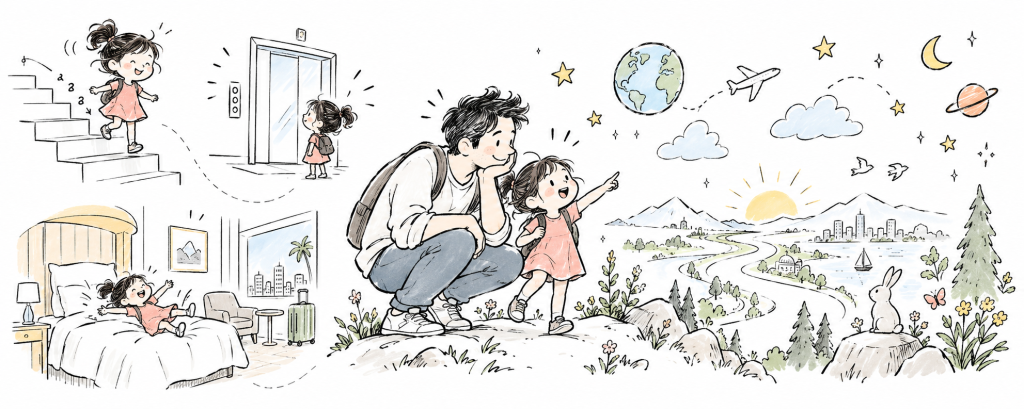
This does not necessarily have to be anything grand. Sometimes it is just walking down a flight of stairs, or staying in a strange hotel.
5. She Found a Paradise in the Hotel
When my daughter was a little over two years old, there was a period when she especially loved walking down stairs. She would go all the way down from more than ten floors up, then take the elevator back up, then walk down again, doing this three to five times a day. Sometimes she would count as she walked.
For adults, stairs are usually just a facility that takes you somewhere; once you reach your destination, that’s the end of it. If taking the elevator is more convenient, then there seems to be no need to take the stairs. But for her, walking down the stairs itself was already interesting; reaching the ground floor did not mean the goal had been achieved. On the contrary, she could take the elevator back up and do it again.
The same staircase, in our eyes a passage we traverse again and again, was for her something she had only just learned to do and had not yet had enough of. We have walked it countless times, but she has only just begun.
When she was four, we took her to Legoland, and we had a similar experience. She loved the trip, but what most attracted her was not the rides in the park, but the hotel itself. She even mistook “Legoland” for the hotel. The novelty of the beds and furniture was already interesting enough; why should joy only properly begin once one enters some amusement ride?
In the adults’ arrangement, the hotel is for lodging, while the theme park is the destination for fun. But she had no obligation to distribute her happiness according to that arrangement. Since the hotel itself was already fun, what problem was there in treating it as a paradise?
Children’s happiness really is simple. Learning to walk down stairs, seeing a new elevator, staying in a room different from home—all of these can be exciting. But this simplicity does not mean her world is impoverished. On the contrary, many things that have already lost their freshness in our eyes are still full of discoverable content for her.
My knowing how to use the stairs does not mean she has already experienced them; my knowing what an elevator is does not mean she has no need to look at it, or ride it, again. A world already familiar to one person cannot be lived through on behalf of another.
The joy of raising children, then, is not merely teaching them what one already knows. Children will bring certain questions back before their parents: why must the hotel be treated as merely a transition to the theme park? Why must walking down stairs always serve some other purpose? Why, once something has been repeated a few times, should it be considered no longer interesting?
Parents bring children to know the world, and children also enable parents to know the world anew. This is not to say that she needs to offer any astonishing insights, or shoulder the task of restoring adults to childhood innocence. It is simply that by living with such a newcomer, the order of life we take for granted is no longer quite so self-evident. A staircase can become something one looks forward to every day; the pleasures of travel can appear in places not especially marked on the itinerary.
6. Welcoming a Person Is Not Preordering Her Entire Life
And unknowns are not only in the world; they also include the child herself.
What will she be interested in? What sort of people will she like? How will she understand what I treasure? What kind of judgments will she form in the future? None of these things can be known in advance. But not knowing does not necessarily produce anxiety; it can also produce anticipation. Since I cherish the richness and unknowns of the world, there is no reason why I should uniquely require that the child become someone who fully matches my expectations.
Therefore, respecting a child’s independence is not only a moral boundary parents must observe; it is also related to the meaning of reproduction itself. What I welcome is a new life, not a project whose goals have already been fixed and which merely awaits execution step by step. If her whole life is only the continuation of my plan, then the new possibilities she brings are, in fact, canceled by me myself.
Of course, “new possibilities” should not become yet another demand for achievement. One cannot simply replace “you must continue my career” with “you must bring innovation to the world” and think that means one has already respected the child. She does not need to prove she is worthy of being born through some great accomplishment. An interest that belongs to her, a friendship she builds, a kind of life delight she discovers on her own—all of these can be meaningful without first being converted into contributions to the family or society.
This also helps me understand anew why childbearing requires planning, and why it can never be fully planned.
Parents should of course prepare carefully, considering whether they have the capacity to care for a child, whether they can provide her with a sense of security, and whether they can shoulder the responsibilities of raising her. But being ready to welcome a person does not mean being ready for that person’s entire life. Parents can arrange material conditions and provide experience and help, but they cannot also decide for her what she should like, or why she should be happy.
Just like taking a child to Legoland: transportation, lodging, and safety all require adult arrangements, but where she will actually find joy need not, and should not, be prescribed by adults. Serious preparation and acceptance of the unknown are not contradictory. Preparation can precisely be for the sake of allowing her to explore more securely, rather than to ensure that she experiences things according to our expectations.
7. Meaning Need Not Wait Until the Child Grows Up
In this sense, the meaning of raising children does not hang suspended in some distant future, waiting for proof in the form of a result after the child grows up. The days spent walking stairs, the few days at the Legoland hotel, the shared discovery of something interesting—these experiences already have meaning in themselves. She does not need to achieve something twenty years later in order to make the happiness of age two worth having.
The traces we leave behind do not all have to be achievements that can be preserved, displayed, and quantified. A life experienced together has already changed the people who participated in it. It may leave behind no conspicuous work, yet it becomes something that truly happened in each other’s lives.
So I am willing to let the child come into this world, not because I have already found for her some task that must be completed, but because there are still many things in this world worth experiencing firsthand. I am willing to introduce to her the good things I know, and I am also willing to follow her in discovering those goods I originally had not noticed.
I thought I was taking her to a paradise, but it turned out she found a paradise in the hotel first. Such surprises are already part of the answer.
Translated from the Chinese original with AI assistance. The original text is authoritative.