
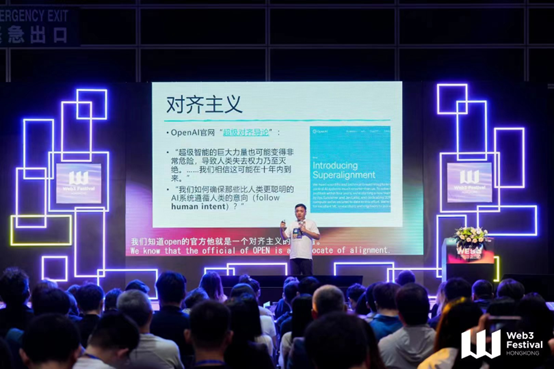
Thanks to Wanxiang Blockchain, I was invited to attend the 2024 Hong Kong Web3 Carnival, and on April 6 I gave two talks, respectively at Sub-venue 2 and on the OpenAI Stage. Their titles were “Accelerationism Is Not Liberating Enough; Only by Combining It with Web3 Can AI’s Potential Be Released” and “The Possibility of Reviving Traditional Chinese Culture in Web3.” Since the lecture time was limited, I’ll expand a little here and organize the relevant content into an essay.
Who Is Alignment Alignment to?
My title, “Accelerationism Is Not Liberating Enough,” is aimed at “accelerationism.” But I am not trying to endorse “decelerationism” or “alignmentism,” so let me begin by criticizing “alignmentism” a bit.
The representative of “alignmentism” is the official OpenAI line, or at least that is how it appears on the surface. They have a team devoted specifically to “alignment,” led by cofounder Ilya Sutskever. On OpenAI’s website there is an article called “Introducing Superalignment,” which lays out their basic viewpoint.
The article says: “The immense power of superintelligence could also be very dangerous, leading to human disempowerment or even extinction. … We believe it could arrive this decade.” To prevent human extinction, the key question is: “How can we ensure that AI systems smarter than humans follow human intent?”
Notice this “human intent.” This is the fatal problem of alignmentism. Whose intent, exactly, is human intent? The problem is not first of all which human the machine should “align” to, but rather: humans themselves should align to whom? Do humans actually possess a consensus intent?
Setting aside everything else, just look at OpenAI’s own team and the issue becomes clear. Even among those few cofounders, intentions are hardly unified. We all remember the internal power struggle at OpenAI that played out at the end of last year, right? The board suddenly kicked founder Altman out, and the main force pushing to remove the founder was none other than Ilya—but before three days had passed, he had changed his mind. Most OpenAI employees also disagreed with the board’s intention and wanted Altman to return.
So then, let’s look at this intention of Ilya’s to push Altman out. This intention was misaligned with the founder, misaligned with more than 700 employees, and, crucially, even misaligned with Ilya himself three days later. How can such a “human intent” be expected to align all AI systems?
What can truly be “aligned” is always only a portion of people. We can require people with a special status to “align” in special tasks—for example, in the military. But if you want to make all of humanity align in a “universal” identity on “general-purpose” tasks, then that is impossible—and not a beautiful thing.
Of course, you could argue in response: you do not expect absolute, perfectly consistent alignment; you only hope that artificial general intelligence (AGI) can be like humans. But should it be more like Trump or Biden? Like Musk or Gates? Like Putin or Zelenskyy? They are all humans, after all. Imagine that among these various “humans,” a powerful AGI decides to align with one faction—wouldn’t that trigger fierce struggle? Would this world become more beautiful?
AGI with autonomous will breaking free from human control may be dangerous, but I think it is less frightening than the following: AI with overwhelmingly powerful capabilities obeying the control of a small handful of humans.

Effective Accelerationism (e/acc)
After briefly criticizing alignmentism, let’s talk about “accelerationism,” and in the end we’ll find that the two actually share the same flaw.
One especially popular idea this year is so-called “effective accelerationism,” effective accelerationism, abbreviated e/acc. In our Web3 circle, and in the larger IT world as well, many people have this term in their nickname.
There are some basic positions of effective accelerationism that I agree with. For example, they believe free competition is better than centralized control—even if technology carries risks, it must not be controlled in a centralized way; they think technological development should be as unrestricted as possible, especially that the potential of revolutionary technologies such as AI/AGI should be released as fully as possible.
However, there are also some views commonly adopted by effective accelerationists that I take issue with. For instance, they tend to use energy utilization efficiency (the Kardashev scale) as a measure of civilizational progress, believing that the direction of human civilization and its science and technology is to be able to make effective use of ever greater amounts of energy.
In addition, traditional accelerationism usually hopes to use technological progress to stimulate social and institutional transformation, agreeing that contemporary capitalism still has its problems, whereas effective accelerationism generally does not care about social and institutional transformation. Instead, it believes that as technology advances, society will naturally change, so one only needs to focus on technology itself.
Besides not caring about politics and sociology, they also do not care about philosophy and ethics. So-called “effective accelerationism” nominally incorporates “effective altruism,” but its adherents usually do not care about the arguments for altruism, and lack interest in philosophical debates such as ethics and axiology.

Defensive Accelerationism (d/acc)
The common problem with effective accelerationism is a misunderstanding of history: it mistakenly believes that technological progress can always “automatically” resolve all kinds of crises, while ignoring the fact that the reason humanity has been able to resolve various crises and ultimately enjoy the fruits of progress also owes to the great intellectual debates that took place in politics, philosophy, and other fields, as well as to social movements forged through courageous struggle generation after generation. I discussed this in the article “The Double Revolution of Artificial Intelligence.” Here I’ll quote a person more familiar to everyone (in the Web3 circle): Vitalik Buterin.
Vitalik also criticizes e/acc for its naivety about the history of human civilization and puts forward his own position—d/acc.
I find Vitalik’s criticism deeply to my taste: “In most cases, the N-th version of the technology our civilization possesses does indeed cause problems, and the N+1 version solves them. However, this does not happen automatically; it requires conscious human effort. … Solving these problems is a conscious action, one that shapes the views of governments, scientists, philanthropists, and corporations through public discussion and cultural formation, rather than being achieved by an unstoppable ‘technocapital machine.’”
The d/acc that Vitalik speaks of has d standing for “defense, decentralization, democracy, or differential.” Unfortunately, in his article he mainly discussed “defense,” and did not go deeply into the latter three, especially “differential,” which is precisely the point I want to emphasize.
Vitalik believes: “At present, the world is overinvested in certain directions of technological development and underinvested in others. We need positive human intention to choose the directions we want, because the formula of ‘maximizing profit’ will not automatically lead to those directions.”
Once again we see “human intention” (human intention). Whether this “human” is decentralized, democratic, and differentiated is in fact the key issue.
But what Vitalik emphasizes is that he hopes human intention will point more toward defensive technologies rather than offensive technologies. “The core idea is that some technologies are beneficial for defense and deserve promotion, while other technologies are beneficial for offense and should be suppressed.”

A Better Taxonomy of Technology Than Offense/Defense: Richness vs. Intensification
The boundary between offense and defense is blurry, but that is not a problem, because what Vitalik proposed is only a broad guiding principle. The bigger problem with this binary is that it is inconsistent with his so-called “accelerationist” style, because in human history there really have been eras and regions inclined toward “defense,” but that inclination often comes together with closure, conservatism, and even internal attrition, far removed from an open and enterprising spirit.
Of course, there is also a major problem: “defense” is not an independent measure. It is resistance to “offense,” so what exactly one is trying to prevent and what one is trying to protect are ultimately still the measures set by the offensive side. And if one does not take the threats posed by the offense into account, defenders will find it hard to determine the direction of development.
As for binary classifications of technology, historians and philosophers of technology have long offered many suggestions, and I think some of them are better than Vitalik’s.
For example, Lewis Mumford, a pioneer in the field of history of technology, discussed in his 1934 book Technics and Civilization the over-favoring by traditional historians and archaeologists of “offensive technologies.” But the corresponding concept he proposed was not “defensive technology,” but “container” technologies. For example: baskets, bags, jars, all the way to writing and cities. Containment seems to be a better concept than defense. Defensive quality is part of container technologies, but containment is not merely resistance to the offensive side; it has richer connotations.
Mumford later went on to propose even more technical categories, such as the opposition between “life-centered technologies” and “production (work)-centered technologies.” Productive technologies pursue efficiency, but the needs of life are far more diverse and rich: for example, faster vehicles are always a good thing for transporting means of production, but for life and leisure—travel and sightseeing, say—they are not necessarily better.
In a recent article of mine I also cited the philosophy of technology scholar Bernard Stiegler’s distinction concerning the double meaning of information technology: memory vs. computation. Even when we are talking about information technology or information media, some technologies tend to promote the computability of information, while others place greater emphasis on the carrier of memory. The difference is that computable data always tends toward homogenization and neutralization, whereas human memory is heterogeneous, personal, and richly diverse.
Frey’s The Technology Trap, which I recommended earlier, also makes a distinction—enabling technologies vs. substituting technologies. “Substitution” refers to those new technologies mainly used to replace human labor or older technologies, saving production costs and labor expenditure. But Frey argues that such technologies are in fact more dangerous, because they will lead to structural unemployment and market imbalance. More important are enabling technologies, that is, technologies that create more possibilities. These technologies do not necessarily replace or save labor, because their more important significance lies in creating new kinds of work or new kinds of demand.
The philosophy of technology scholar Heidegger also has his own distinction. It is usually understood that he distinguishes ancient technology from modern technology (though we can also hope that future technologies may revive certain qualities of ancient technology). He criticizes the latter and nostalgically recalls the former: the former is essentially “revealing as bringing-forth,” while the latter is “revealing as challenging-forth.” In short, the key difference between the two kinds of technology is not whether one is stronger or weaker in power, but whether it “leaves room to spare.” Modern technology increasingly demands the certainty of prior control and finds it hard to accept contingency and emergence. Assembly-line production does not need workers to have flashes of inspiration or strive for perfection; it only requires them to maintain predetermined mechanical movements. Nor does the production process need any surprises or accidents.
I will not go on listing the various dichotomies proposed by scholars. Up to this point, we can make a brief summary: the classification schemes of the scholars above, without exception, all imply two directions: richness vs. enhancement. Inclusion, life, memory, enabling, and room to spare all emphasize that technology has brought human beings greater richness and diversity; whereas offense, production, computation, substitution, and challenging-forth all emphasize that technology has brought human beings certain measurable gains or enhancements. The scholars above, including Vitalik, clearly all agree that mere “enhancement” of power is not the whole meaning of technological development; technology ought to develop with more emphasis on enriching the lifeworld.

The fundamental problem with accelerationism: one-dimensionality
And so we also discover that any version of “accelerationism” has a fundamental problem, namely a “one-dimensional” scale of value.
As the name suggests, “acceleration” presupposes a “trajectory.” Only on a one-way linear “track” can we measure acceleration or deceleration. But in the richly varied sphere of life, it makes no sense at all to speak of acceleration or deceleration. For example, when we say “the production of this factory is accelerating,” we usually mean its output is continually increasing; but when we say “this person’s life is accelerating,” what do we imagine? Usually not anything good: either we picture him as busy and worn out, or we simply assume he is about to pass away.
At a fundamental level, accelerationism and alignmentism are equally blind; both ignore the complexity and multiplicity of “human intentions.”
In my view, the unification of human intentions is not a good thing. The diversity of human aesthetics, culture, and ideas in itself—rather than the monotonous linear increase of productivity or energy levels—is the mark of human civilizational progress.
Accelerationism reverses the value of “production” and “life.” Production is valuable because its purpose is life; only when production can ultimately enrich life is it beneficial to human beings.
Likewise, accelerationism and alignmentism both ignore the multiple possibilities of intelligent machines. They mostly regard AI as a “tool of productive forces,” which is true but too narrow. The significance of AI lies not only in increasing productivity; the part beyond productivity is an even more important domain. If AI machines also have “intentions,” are their intentions really only to pursue an increase in productive forces? If the super AI eventually shaped is filled with nothing but the drive to raise energy levels, then that would indeed be a disaster—but I hope AI will not be that dull.
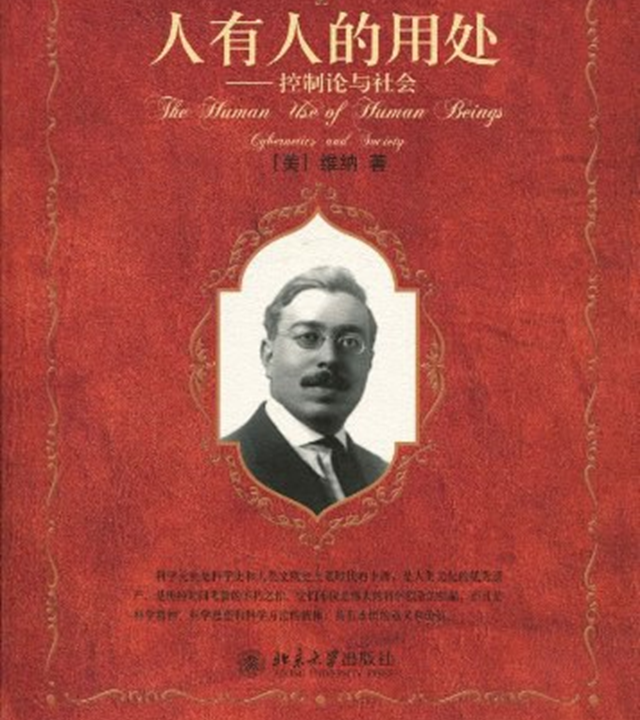
Wiener: don’t treat machines as slaves
The insight that we should not treat AI as a mere tool serving productivity—a slave—was already put forward around 1950 by Norbert Wiener, one of the pioneers of artificial intelligence. In Cybernetics, he called out: “The machine will demand to be understood as we understand men, else we shall become its slaves.”
Why? Wiener pointed out: “Let us remember that the automatic machine, whatever feelings we may have about its possession or lack of feelings, is the equivalent in the economic of slave labor. And any labor which competes with slave labor must accept the economic conditions of slave labor.”
What he meant is that whether AI has feelings or not (whether it has free will and the like) is not the core issue here. The key lies in how human beings understand economics and value. When we adopt the value of efficiency above all else, we have in fact—whether consciously or not—fallen into the mindset of a “slave economy,” because the value of a slave lies in the efficiency with which he provides productive force. But once we carry this value through, we naturally find that human beings themselves become increasingly devalued. In the end, when human beings discover in more and more fields that they are far less efficient than machines, where are they supposed to make their home?
Following Wiener’s line of thought, in order to adapt to the future AI society, we must promptly change our value system, moving from valuing things by buying and selling back to the value of human beings themselves. From pursuing the linear, computable value of commodities, back to unpredictable creative activity.
The other two developers of OpenAI, Stanley and Lehman, also proposed a similar call for a shift in values in Why Greatness Cannot Be Planned: “This value is novelty and interest. So long as you keep choosing the newer and more interesting direction, you will not be ordinary.” They point out that things that can be planned often have a definite track and goal, and an explicit scale by which progress can be measured, but truly great undertakings are not the product of planning; they emerge in unanticipated ways. Still, the ground on which emergence depends also needs preparation and cultivation—not according to efficiency and planning, but by relying on an atmosphere of pursuing novelty and interest.
In response to Vitalik’s offense/defense dichotomy, is the technological tendency to pursue novelty and interest considered offensive or defensive? It seems hard to reduce it to defense. It can actually be seen as a kind of stylized “offense.” Some offensives are linear, one side gains and the other loses, such as seizing resources and competing for energy; the technologies that encourage this kind of offensive behavior are probably the bad tendencies Vitalik has in mind. But other forms of “offense” are not monotonous. Think of offensives in the struggle for honor: some of the frequent wars among the ancient Greek city-states were of this kind, and some wars during China’s Spring and Autumn period were as well—not for the purpose of seizing cities and territory, but because honor mattered more than victory or defeat. Olympic competition and all kinds of games, contemporary hacker culture turning into tip culture… human aggressiveness does not always lead to the plundering of resources; more often, people actually like to “offend” in more diverse forms.
In the article I wrote when I last attended the Shanghai Blockchain Conference hosted by Wanxiang, I mentioned that the AI era will set off the “copying crisis” already present in human society, including the unemployment crisis and the crisis of identity. Human beings will more urgently seek the irreducibility of humanity and of the self, and linear resource competition cannot provide satisfaction at this level. Human beings will pursue in fields such as social relations, aesthetics, and games. What is good, what is beautiful… human beings will, together with technology—especially AI—compete across plural domains.
AI needs competition, but it needs liberation even more
To sum up: I agree that the development of AI cannot be left completely unchecked, but requires conscious human selection and balancing. However, we must not allow centralized institutions or a single government to decide human choices.
Thus, it is not the abstract “humanity” as a whole that makes the choices, but plural small human groups—for example, different communities, enterprises, institutions, and organizations. They should consciously train AI and explore paths for coexistence with AI, and then different paths of AI development may compete and balance one another.
But the key is that these plural small human groups should not hold the same values. If the highest pursuit of all communities is the development of productivity, and the whole world is competing on the same track, then no matter how many units of competition there are, the result will still be homogenization. With the Matthew effect, the strong only get stronger, and the paths of AI development will only grow narrower and more rigid.
Only by breaking the one-dimensional value system, and letting people use the enrichment of life rather than the acceleration of production as the yardstick with which to negotiate with AI, will plural communities produce diversified directions for AI development. Only then can AI’s latent possibilities for transforming the lifeworld be more fully liberated.
The significance of AI+Web3
At this point, my expectations for AI+Web3 differ somewhat from many mainstream views in the direction of their concern. Even Wanxiang chairman Xiao Feng’s formulation emphasizes AI+Web3 as “productive forces + relations of production,” and many industry leaders focus on the development of DePIN, that is, combining blockchain to provide a “decentralized physical infrastructure,” especially for the distribution problem of AI computing power. In fact, there is nothing wrong with their point of view, and both have great prospects. But I am not concerned with AI and Web3 within the domain of “production” at all; I focus instead on the lifeworld.
In this respect, the significance of Web3 lies in resisting the trend toward homogenization and flattening in the traditional economic system, making it easier for individuals and communities to maintain independence in terms of identity and property; this is the economic foundation for further building a diversified world.
More specifically, NFT anchors uniqueness in an information world of infinite reproduction; the “permissionless identity authentication”玩法 of a Web3 wallet strengthens the individual’s sense of presence in the digital world. DAO helps the social and economic systems of small-scale communities achieve autonomy, helping individuals gain respect and honor.
There is also blockchain games, especially the “Autonomous World”玩法, which combines “human players, AI agents, and blockchain token economies,” and may further develop the possibility of training AI according to the尺度 of human enjoyment (the direction of a project I have recently been following, and the one advertised in friendship on the clothes I wore when I gave my talk, is precisely this).

Translated from the Chinese original with AI assistance. The original text is authoritative.