
Stage-by-Stage Reflections on Online Teaching
The most unusual semester in years has already passed its halfway point in the blink of an eye. I have finished eight lectures of my course on the history of technology, and of course it has always been online. The reading group I host has naturally also shifted to an online mode; during winter break we had already launched a “cloud reading group,” meeting once before the semester began and then resuming once a week after classes started.
The reading group is held through Zoom cloud video conferencing, while Tsinghua’s large lecture course (history of technology) is livestreamed simultaneously via Rain Classroom and Zoom cloud video conferencing.
Although I count as relatively forward-looking when it comes to embracing new technologies, I had never before had the chance to run this kind of online teaching activity. Since I finally got some firsthand experience this time, I might as well write down a few impressions here.
Philosophy of technology was not studied in vain; in my reflections, I consciously apply some ideas from philosophy of technology and media philosophy. Of course, this is only an inspirational use of them, and may not be all that profound.
First, I tried hard to suspend my preconceptions about what “teaching ought to be,” because when we discuss what advantages and disadvantages online teaching has, we often presuppose what “perfect teaching” should look like. Yet this kind of “perfect teaching” has never existed. Every form of teaching relies on some kind of media environment; there is no such thing as “media-free teaching.” And media itself is not a neutral conduit for transmitting information, but something that determines the basic form of information as information. The medium of teaching constructs the teaching activity itself; different media have different biases, but one cannot say that any particular bias is “closest to neutrality.”
Second, of course, we still need to talk about certain “biases,” such as what is strengthened and what is weakened in campus-based education compared with face-to-face education. But let us try to focus our attention on the environment rather than the content. At moments of media innovation, changes in “content” may lag behind. For example, the earliest printed books transmitted the Bible; the manuscript books before them also transmitted the Bible, and their contents looked more or less the same. Only after printing gradually became widespread did more “new content” that had originally been transmitted only rarely begin to appear in printed books (such as laboratory reports). But even when the same Bible is being transmitted, the “effect” of the printed book is different: the way a reader comes to possess a printed Bible, and the attitude with which he reads it, both change.
In short, what I am trying to reflect on is how the “atmosphere” of teaching changes in online education.
“Atmosphere”
“Atmosphere” is the thing we most directly feel when entering a new media environment. The teacher is still the same teacher, the courseware is still the same courseware, the content has not changed, the participants have not changed, but the “atmosphere” has changed. “Atmosphere” is sensory, but it is not necessarily arbitrary or elusive; “arbitrary,” “elusive,” and “rigorous and objective,” like each other, can themselves be said to be emotions created within a certain atmosphere. The technological environment of a scientific laboratory constructs an atmosphere of rigor and objectivity, while a carnival amusement park creates an atmosphere of unrestrained spontaneity; experimental activity and festive revelry belong to different atmospheres, rather than one being “without atmosphere” and the other “irrational.”
Whether wild or rigid, “atmosphere” is something that can be grasped and savored afterward. A painter can depict atmosphere with brush and ink, a novelist can render atmosphere in language, and literary theorists can then analyze the painter’s composition and the novelist’s language. Philosophers, of course, can also reflect on “atmosphere.” Different modes of transformation will certainly deconstruct and reconstruct atmosphere in different ways, but these transformations also help us understand atmosphere and its significance.
The Atmosphere of the Reading Group and Its Game Segment
Before discussing the atmosphere of online education, let me talk a bit more about the atmosphere of our earlier face-to-face interactions.
Let us start with the reading group. Our reading group began back in 2014, initially proposed and launched by AK and others, who were then undergraduates at Peking University (AK is now my master’s student, nearing graduation, and the only founding member of the reading group who has persisted to this day). At first, we met weekly by renting a conference room in the Department of Philosophy at Peking University. After I joined Tsinghua in 2017, the meetings became fixed in the transitional housing Tsinghua provided me.
The Department of Philosophy at Peking University had good conditions, and the conference room could usually be borrowed. The room centered on a rectangular conference table around which more than a dozen people could sit. Back then, the reading group had the atmosphere of a normal seminar course; of course, since I was in the role of senior student, and everyone came to read entirely out of spontaneous interest, it was much more relaxed than an actual class.
After moving to Tsinghua, my transitional apartment was not very large, and half of the room was occupied by all kinds of miscellaneous things. We would usually read around a rectangular dining table. Two people on each long side and one on each short side was fairly comfortable, though if we squeezed a bit, three people could sit on a long side and two on a short side. In fact, some students preferred to sit on the sofa at the back and read, and when there were more people, we would add a few small round stools. When there were few people, there would be five or six; when there were many, there would be more than ten. Naturally, the seating was much tighter than in a conference room.
At Tsinghua the reading group added two major segments. We would generally start reading at 3 p.m., then around 6 p.m. we would gather for dinner (usually mainly takeout, though occasionally we made hotpot ourselves), and after dinner came game time: VR games, computer games, Switch games, and tabletop games. Usually any newcomer had a chance to try VR, though we did not play VR often (it is not suited to large groups). We played baba is you, Overcooked, and the like for fairly long stretches, and various tabletop games were also regular items.
Reading, eating, gaming: each reading group session took up the entire second half of a Saturday or Sunday, from the afternoon into the evening. Of course, one could also join in stages; some new students often skipped the gaming segment altogether (which is not good), while some old friends who were not present for the reading could still come by for dinner.
Although the dinner and gaming segments came later in time, they also played a role in shaping the atmosphere during the reading itself.
First of all, of course, there is the creation of a social atmosphere. Dining together has long been an important form of social interaction, and a family-style meal can bring participants closer together. One student remarked that the group dinner had quite a “fellowship” feel, and that house churches likewise use such an atmosphere to deepen intimacy among believers.
Likewise, gaming is also an important social activity, and in my case it has something of the status of “drinking.”
Drinking and singing are part of many academic activities. I myself do not adapt well to activities that do not involve drinking or singing, but I can understand their significance. In academic exchange, although in theory one always discusses issues rather than persons, in practice it is hard to separate ideas from the individuals discussing them; a person’s opinions are always the opinions of a person, and criticizing an opinion as absurd implicitly suggests that the person who holds it is not very bright. Of course, scholars with sound minds do not really hold grudges, but in verbal sparring there is inevitably some injury to feelings. That is where drinking becomes especially meaningful: after heated disputes over academic questions, one sits down at the wine table and continues to flush red-faced while toasting one another, which has a rather “laughing away old enmities” feeling to it. In argument, neither side gives an inch, but at the wine table each yields to the other; from adversaries in debate you become drinking companions, and in an instant “dealing with the matter” and “dealing with the person” are separated.
So, from what I have observed, it is precisely people who have relatively good interpersonal relationships and who often sit together to eat and drink that end up criticizing one another most sharply on the academic stage. There is no need even to mention Wu Laoshi and his drinking companions; to give an example from a senior student, last time I went to Guangxi for a conference, Donglin shixiong’s first criticism of Jin Shixiang was: “I treated you to such expensive wine, and this is what you show me?” This shows that drinking may not necessarily produce good papers, but it can ensure that dissatisfaction is expressed with far fewer scruples.
Of course, after all that, I actually do not approve of using drinking as a social add-on to academic activities, because although drinking certainly has its advantages, it has plenty of drawbacks too. It can become addictive and it takes up time; these two points are the same as with gaming. But drinking harms the body, delays matters (you are not in good shape the next day), and costs money (one good bottle of wine would be enough to play games for half a year), so the drawbacks are many.
By comparison, the main drawback of gaming is that there are too many limiting conditions; it is not universal enough. But once it can be organized, the effect should be even better than drinking.
Like drinking, gaming is egalitarian, pleasurable, and competitive. Though it lacks the intoxicating effect, it additionally provides a kind of “lucid-dream” self-loss, namely the suspension of one’s actual identity in order to project oneself into some virtual identity. Compared with the loss of control that comes with drunkenness, the gaming state is a kind of frenzy from which one can withdraw at any moment. In the gaming state, “reality” is truly “suspended,” rather than simply set aside. We neither leave reality nor remain entirely in it, but at the same time enter a super-real world; this multidimensional experience is something other activities struggle to achieve. Or rather, in a certain sense, perhaps “game” itself can be defined as: an activity that allows one to suspend the real world. There is a stone in front of us—this is real existence—but when we regard it as a chess piece in a game, the stone as stone is suspended; it becomes a knight, a king, a city, or gold.
Of course, we quickly notice: is not “mathematics,” and indeed theoretical science in general, precisely such an activity? Mathematicians manipulate counting rods, abacuses, or the ink on paper, treating them as something super-real. In my view, in this sense, mathematics is also a kind of game. Or rather, first they are games, and only afterward do they become science.
There is room to expand on the related issues another time. In short, gaming not only has a social significance similar to drinking, but also a certain “theoretical significance.”
Of course, in fact there is no need to make it too complicated: the most basic meaning of gaming is simply that it is fun. And by putting these two activities, reading and gaming, together, I am also allowing their atmospheres to permeate one another, so that participants feel that reading is also an interesting activity.
The online reading group lacks these two segments, eating and gaming, which is a great pity. We also tried organizing an online gaming segment and ran one script-killing session. But before, reading and gaming took place successively in the same location—everyone would arrive in the afternoon, read around the table, then eat around the table, and finally play tabletop games around the table in the evening. This continuity and sense of wholeness guaranteed by a physical venue allowed the different activities to merge into one another, and naturally their atmospheres could infect one another. Online activities are hard to organize in this way. We read in a cloud video session on Zoom, then switch to WeChat to organize a game, and then go to a gaming platform to start playing. The scene changes in between are hard to ignore. In fact, even if the two activities remain connected in time, the split in space and setting is still hard to bridge. In the same place, emotions and bodies are continuous—“Since we’re already here, let’s finish reading and play a while before leaving,” or “Let’s come read a bit first so we can get some food and some fun.” But when organized online, just like our daily fragmented internet life, even if we switch seamlessly, it is hard to feel that reading and gaming are “the same event.”
So I basically gave up on the gaming segment of the reading group; if we are going to organize entertainment activities, they would have to be organized separately, rather than being an intrinsic part of the reading group.
Instant Interaction in the Classroom
Let me now talk about my feelings about teaching. This semester I happened to have few classes, only one undergraduate general-education course (history of technology). It is a large lecture course centered on the teacher’s talk, with not much interaction. But even for such a course, the difference between in-person and online experience is drastic.
In the information age, online resources are abundant. It is easy to find many public lecture videos from top universities, whether free or paid, and many foreign courses even come with bilingual subtitles. If one is willing, one can stay at home and listen to countless excellent courses. So what meaning is there left in universities opening a course every semester? Or to put it another way, if I just teach it once and record the video, why not simply play that video every time afterward?
To be fair, I think recording at least part of the teaching content as video is indeed a trend, especially for some primary and secondary school courses. They can really adopt a mirror-classroom approach, distributing videos so that more people have the chance to access the very best courses. The criminal law exam prep course by the recently internet-famous Luo Laoshi is another example: information technology can help excellent courses break through the limits of classroom seating.
As the saying goes, “In teaching there should be no discrimination” (有教无类), and our courses have always welcomed auditors, so wouldn’t it be better to record them as videos and allow more auditors? Not necessarily. After all, alongside “in teaching there should be no discrimination,” there is also the saying “teach according to the student’s aptitude” and “learning and teaching complement each other.”
What classroom teaching cannot be replaced by recorded video, first and foremost, is the interaction between teacher and students. In this respect, it is important in primary and secondary school classes as well, not to mention university courses.
From the teacher’s point of view, students’ real-time feedback is a very important atmosphere. Leaving aside the question-and-answer sessions after class and the free-speaking segments, even in the process of a teacher’s all-out monologue, students’ feedback is still important. What kind of feedback? — eye contact and whispered conversations.
I myself have had the opportunity to give a number of talks off campus. Although, on the whole, they all felt pretty good, I could still sense the effect of the audience’s quality. Faced with a good audience, I can receive just the right sort of feedback: I feel that when I reach a brilliant passage, the students naturally focus their attention more closely; where I think something is amusing, laughter in the hall will break out at the proper moment. Even more often, at places worth poking fun at, a bold student will directly interject a question, and I can immediately say, “Yes, that’s exactly what I’m going to talk about next,” and then the two sides are in tacit accord. Of course, if it is a question I have not prepared for, that is even better.
But the performance of poor students is not necessarily that they are not listening; rather, although they are listening too, they do not feel involved. They are like wooden stakes, with very little immediate feedback, and in that case the teacher just gets more and more discouraged the longer he talks.
In recent online meetings, this sort of scene has happened many times: one person delivers a long speech (though it may not even be all that long—just a few minutes), and then, as he speaks, he becomes more and more powerless, and suddenly asks, “Can everyone hear me?” This is because when a person gives a speech facing a conference room or classroom, even if the room is silent as death, there is still real-time feedback, eye contact. But when one speaks to a computer, silence as death really is utterly motionless, and it becomes a purely self-conversing experience.
Whispering or a Sense of Closeness
Besides students giving real-time feedback to teachers, from the students’ point of view there is another kind of communication that is hard to simulate online: whispered conversation among students. In the classroom, classmates who know one another often sit together, and in meetings too, the distance between people varies. Aside from the one person speaking loudly, people sitting next to one another often frequently “speak in whispers.”
Speaking in whispers and whispering to one another is not merely a negative behavior; on the contrary, for creating atmosphere it is indispensable. Of course, just as immediate teacher-student communication relies mainly on eye contact, with occasional interjections, the scenes in which the audience actually opens their mouths and speaks cannot be too many, or it really does become a din. But a little interaction, even if it is only sensing the nods and shakes of the classmates around you, is meaningful. Especially in settings like discussion classes and seminars, it is originally a platform for interpersonal relations among everyone and everyone, not merely a one-way relation from everyone to a single speaker. Communication between listener and listener can share useful information, help one another understand, and also confirm each person’s own gains and confusions.
Take a reading group as an example. From past experience, some classmates are relatively active in speaking, while others are a bit shy and do not speak much; but that does not mean there is no communication. More or less, during reading or breaks, they will always chat a few words with classmates they know well. In a video conference, however, the distance among everyone is equal; there is no distinction between far and near, and no notion of adjacency. Whispered conversation becomes impossible—of course, there is also the function of privately messaging a few people or opening a small side meeting on purpose, but that seems too affected, and is utterly different from low-key whispering. This means that some classmates who do not like to speak publicly really end up feeling no sense of participation at all.
In classroom teaching, in addition to the fact that students and students have a relation of adjacency and closeness in position, the distance between students and teachers is also a very crucial thing. Especially in the university classroom, where students choose their own seats, where a student sits is a kind of silent utterance to the teacher. Students sitting in the front row are often those who are very interested in the course. Of course, energetic students are not necessarily always in the front row; they often also have a relatively preferred seat. After a few weeks of interaction, I can quickly remember a number of students who speak actively. Although I may not match their names to their faces, I can leave myself a visual impression of them. A relatively fixed seat is also a kind of incentive for students: once they have left an impression on the teacher, it becomes easier to feel embarrassed when they have to be absent.
In some other overcrowded classes, active students may not even be able to grab a seat. Those students crowded by the door, sitting on the windowsill, or standing in the corridor are often the most enthusiastic. Online courses may guarantee unlimited seats, with no spatial limit, but at the same time, that atmosphere in which people stand there and still want to listen to the lecture can no longer be felt. Internet users all know that, many times, saving something is equivalent to reading it; many articles, videos, or games that one is interested in, after being purchased or archived, no longer feel urgent enough to be enjoyed right away. It is hard for the atmosphere of eager pursuit of knowledge—of standing outside the door and still wanting to listen to the lecture—to be recreated in them. When I was an undergraduate, the classes I listened to most seriously were either those where I sat in the front row, or those where I sat on the windowsill. Limited, anisotropic positions in real space are a key link in the atmosphere of listening to a class.
These feelings of interaction, participation, and position not only help the audience become more engaged, but can also help the presenter improve. In academic conferences, the presenter always hopes to improve with the help of colleagues; in classroom teaching, teachers also hope to improve with the help of students.
Incompleteness or a Sense of Participation
Here too lies a major difference between real-time classes (including real-time online meetings and offline classrooms) and recorded video. That is, courses conducted in real time are often, and should be, “unfinished,” whereas a video that has already been recorded presents itself as a finished product.
An unfinished course, on the one hand, can be jointly advanced in the classroom according to students’ real-time feedback; on the other hand, before and after class, the teacher will also continually add content based on new research, new materials, and new ideas of his own, while at the same time making revisions and deletions in light of students’ feedback.
If a course were truly perfected, then there would not be much point in taking it. An imperfect state is the positive state of a course; it means that students have room to participate, and teachers also have room to improve. Only in this way can teaching and learning stimulate each other.
I once sat in on a demonstration class for a teaching competition, and it left me very disappointed. This sort of demonstration class is completely a flawless “finished product.” It is said that every slide of the ppt has been polished and rehearsed countless times, until in the end the time for each slide can be controlled precisely down to the second. If there is an interactive segment, students also need to be arranged in advance to carry out a scripted question-and-answer exchange.
But if it is not for a competition, who would be willing to polish a course in this way? This is not merely a question of whether one is willing to put in the effort; it is also a question of how one understands a course. When a teacher treats a course as a product that has been precisely controlled in advance, he often also treats students as machines waiting to be filled with knowledge. Such a course is indeed suitable for being recorded as a video. Once the teacher has carefully polished it, it can be provided to students once and for all.
But not all knowledge is suitable to be taught in this way. Some courses with fixed content may be suitable, but in general, most courses at first-rate universities are not. Because courses at first-rate universities, including general education courses, should have sufficient frontier character and interactivity. Frontier character means that the teacher also needs to keep learning new knowledge and broadening his thinking in order to keep the course lively. If I am going to spend the same amount of effort polishing a course, rather than repeatedly rehearsing with a stopwatch in hand, I might as well use all that time to continue reading the relevant literature.
The Counter-Discipline of the Product upon the Production Process
But once it is recorded as video, the classroom is forced into a state of completion. The tolerance of listeners toward incompleteness in a real-time class and toward incompleteness in a video is completely different. In a real-time class, if students feel that the teacher has said something deficient, they can immediately communicate, and the teacher can supplement it on the spot or shortly after class. Sometimes it is the teacher’s omission; sometimes it is a misunderstanding caused by differences in students’ knowledge backgrounds, but in real-time communication it can all be supplemented at any time. Even if the student sits there without asking a question, he knows that he “can ask questions,” and thus bears a small share of responsibility for any gaps in the class. A conscientious student, even if he does not ask in time, still has opportunities to communicate with the teacher in after-class reading and assignments. I once said that what teachers hope to see in students’ homework is precisely some kind of constructive challenge. Students can challenge the teacher both in class and in homework, and the teacher has the opportunity to respond.
But when facing a video course that has long since been recorded, its defects will be magnified, and constructive supplementation is no longer possible. Some listeners who like to nitpick will not only discover ordinary omissions, but may also take things out of context, extracting a few isolated words to attack. This happens frequently in the current online environment.
Oral presentations have many vivid parts: sometimes one tells a joke, sometimes one deliberately speaks in an extreme way to attract attention, or puts forward a target for thought or discussion. But if these words are stripped of their context, they may seem extremely absurd or stupid, and are easy to attack.
Even without considering the specific national context, when a person wants to publish a public discourse product, he needs to carry out certain additional forms of self-censorship. What is meant by a discourse product is not merely public speech (for example, giving a speech in a public place to an unspecified audience), but also fixing one’s discourse on some kind of medium beyond immediate speech, so that it may circulate widely outside one’s own field of vision. When we know full well that we are making this kind of fixed product, we will, to a greater or lesser extent, carry out certain kinds of self-discipline. It is like how many people feel awkward in front of a camera and simply cannot produce a natural expression, while others are more inclined to perform before the camera; few people can completely ignore the camera’s presence.
When a kind of discourse becomes more and more fixed and widely circulated, then when one returns to the real-time scene, even if the “camera” is taken away, the gradually sedimented self-discipline will still affect people’s experience. Something analogous to this is that some scholars have pointed out that the development of the phonograph record has made classical-music listeners increasingly unable to tolerate wrong notes from performers. Listeners accustomed to records become more exacting about flaws in performance, and performers under the new atmosphere may also repeatedly practice established motions more often in order to avoid mistakes, while improvising less.
The media environment will in turn affect the attitude of the speaker; this is also why I then deliberately had the consideration of refusing to activate the recorder in the discussion class on philosophy of technology. But, turning the matter around once more, the existence of the basic communicative environment of immediate oral exchange also has its own inertia, and it will also permeate into other media in turn. For example, when producing a class recording, locking the teacher alone in a little dark room to speak, and actually creating a classroom environment where the teacher speaks in the presence of an audience, will definitely produce different effects—even if these listeners do not ultimately “appear on camera” in the recorded product, their presence has already changed the recorded product.
So, even if video recordings will play an increasingly important role in teaching activities, they can hardly completely replace the real-time classroom.
New Characteristics of Online Education
Of course, online classrooms also have many new features that traditional classrooms find hard to achieve. I have always emphasized one point: that a “technological revolution” can be directly understood by borrowing Kuhn’s notion of a “paradigm revolution.” From the classroom to the network, these two “technical environments” for teaching are incommensurable. Standing on the standpoint of the traditional classroom, we can certainly point out all the aspects that online classrooms cannot provide; but standing on the standpoint of the online classroom, we can of course also point out a series of revolutionary new things.
First is the breaking of old inequalities. As mentioned earlier, traditional classrooms have limited capacity and differences in seating position; students who cannot squeeze into the classroom are inevitably excluded at the door. But the positions in an online classroom are isotropic, and capacity can be expanded almost without limit, which can accommodate more students’ participation. Even if you did not get into Tsinghua, even if you cannot reside in Beijing, you still have the chance to participate in the course on an equal footing with other students. Of course, I have also said before that new technologies often always replace old inequalities with some new inequality. Nor do we need to exaggerate the emancipatory significance of network technology. Many times, excessive egalitarianism is not a good thing. Especially in the field of education, where tailoring teaching to the student is valued, establishing some kind of “graduated” order is necessary in many situations. Students’ motivation and ability to learn differ enormously. To put highly motivated and capable students together on the same level with students who neither like to study nor can learn effectively is, one might say, unfair to both sides. But even so, compared with the classroom, which necessarily has a threshold and cannot expand without limit, online courses can have no threshold, though they can also set thresholds and distinctions. Broadly speaking, new technologies still open up more possibilities. But this richness of possibilities must be brought into bloom through our grasp of and guidance over the characteristics of new technologies.
Second, although online platforms have almost eliminated eye contact altogether (perhaps in the future VR technology can reintroduce it), and have also greatly suppressed oral communication (such as the space for whispering), they have also increased new ways of communication. For example, “danmu,” in my view, is a very important new mode of communication.
I’ve said before that “interactive text,” represented by danmu, may well be the key link in online education. Compared with the whispered side conversations and passed notes of a traditional classroom, danmu is obviously much more public. But unlike students openly butting into a live class, this kind of public speech simultaneously has a background quality. It does not foreground itself, nor does it seize the stage and replace the lecturer; yet at the same time, like the lecturer, it is publicly displayed to the same audience. This is a new dimension, a mode of communication unimaginable in the traditional classroom.Danmu intervenes in the lecture, but then hands the initiative back to the speaker. The speaker can choose to ignore it or respond.
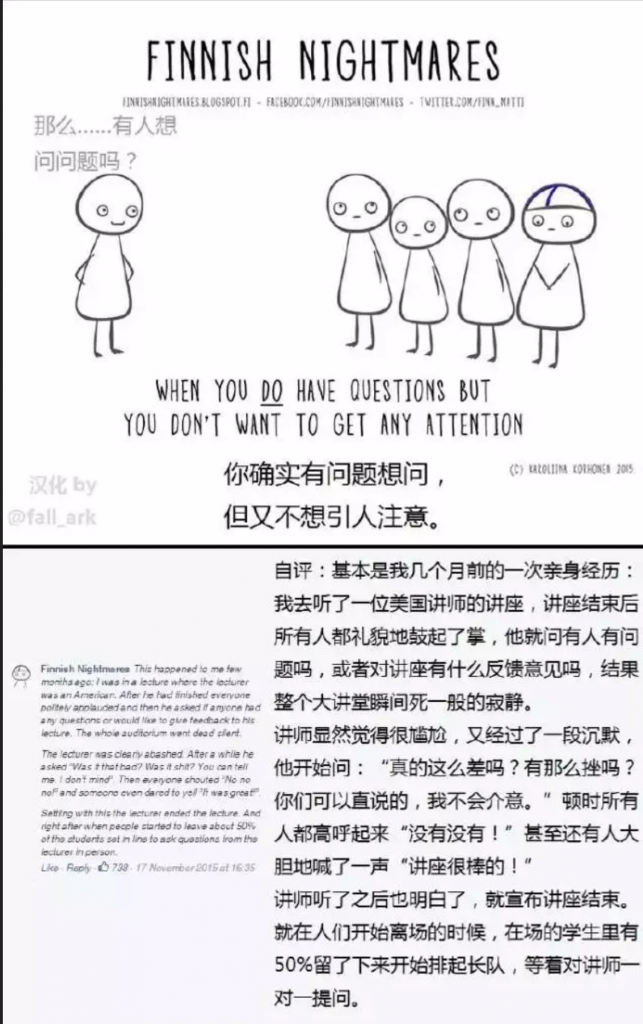
In my experience, in traditional classrooms many students do not like speaking up in public; even during the free question time I deliberately set aside, the room often goes quiet. Yet many people like to come up to the front of the lectern to ask me questions after class. I ask them: if you had questions, why didn’t you ask just now? The answer is: they’re afraid the question is too naive, or that it doesn’t quite hit the point and will waste everyone’s time, and so on. But asking questions at any time in the form of danmu can dispel many students’ concerns, because danmu itself does not waste everyone’s time; whether to respond to it is entirely up to the lecturer. In this way, it is not the questioner who interrupts the class, but the lecturer who interrupts himself only after deciding that the danmu is worth responding to. And even if the speaker does not notice it, danmu can still interact with other danmu. With proper guidance and encouragement, these danmu interactions are extremely constructive.
Even if it is merely an echo or a jeer rather than a well-aimed comment or question, danmu still has meaning. A simple echo, a string of 666, is also a way of expressing oneself to the speaker in a kind of eye-level exchange.
When I teach, I allow and encourage students to speak up by voice at any time, and of course I also encourage danmu and written comments. The result is that almost no one chooses to interrupt by voice, but danmu and instant text are still relatively popular. This shows that young people who grew up in the internet age have their own preferences.
For example, with communication tools like WeChat, the older and younger generations use them very differently. Why are more young people frightened by phone calls, or even long voice messages, while preferring text messages? A major reason is that when replying to text, one can be more composed and more autonomous, and also worry less about whether one is interrupting the other person.
In addition, when students attend online classes, it is easier for them to do other things at the same time; this too is a feature of online courses. That feature is not always a bad thing. For example, in a traditional classroom, eating a jiuzi box while class is in session is of course a thoroughly obnoxious thing to do, but at home, attending a cloud class while taking a bath is perfectly fine. Of course, being able to look things up online at any moment, or even talk and discuss with other people at any moment, is extremely free. This kind of freedom will naturally, in many cases, affect one’s concentration on the lecture, but in some cases it can also help concentration. More importantly, not all courses are better the more concentrated one is. My general education classes, for example, are intended more to inspire students and broaden their horizons, rather than to require them to memorize points of knowledge meticulously. In this sense, listening in a more open posture may not be a bad thing. What’s more, online courses have a much more convenient replay function, so anything missed by momentary distraction can be made up for immediately or after class with ease.
At present, most of our online courses are still designed on the model of traditional courses, including class time, course content, lecture handouts, exam formats, and so on. But online education may not be confined to that. In fact, before the pandemic forced teachers to become “streamers,” many streamers had already, in a certain sense, become “teachers.” People do not always watch live streams merely for entertainment; long ago, people were already consciously or unconsciously “learning” from all kinds of internet streamers. History and culture, life skills, popular science, English, programming, and so on—all of these are streamed and watched. This spontaneously formed teaching and learning may not match the solemn atmosphere of a university, but it is clearly more open and free, and it also makes better use of the characteristics of the new medium.
Universities are not always the most advanced teaching platform. European universities, which led the era in the Middle Ages, gradually took on a conservative and backward-looking appearance during the Renaissance (the age of print), while various scientific societies, correspondence networks, journals, and magazines rose one after another, and cutting-edge academic exchange unfolded more often outside the university. It was only after the Enlightenment, when universities were gradually reformed, that they once again began to move toward the front line. But on the other hand, with the advance of industrialization, the just-revived traditional university again lagged behind in applied research. So starting with Edison, industrial laboratories relying on enterprises rose to provide a supplement to the university. In the new media environment of the information age, the main battleground for educational reform may not necessarily be the university either.
Translated from the Chinese original with AI assistance. The original text is authoritative.