
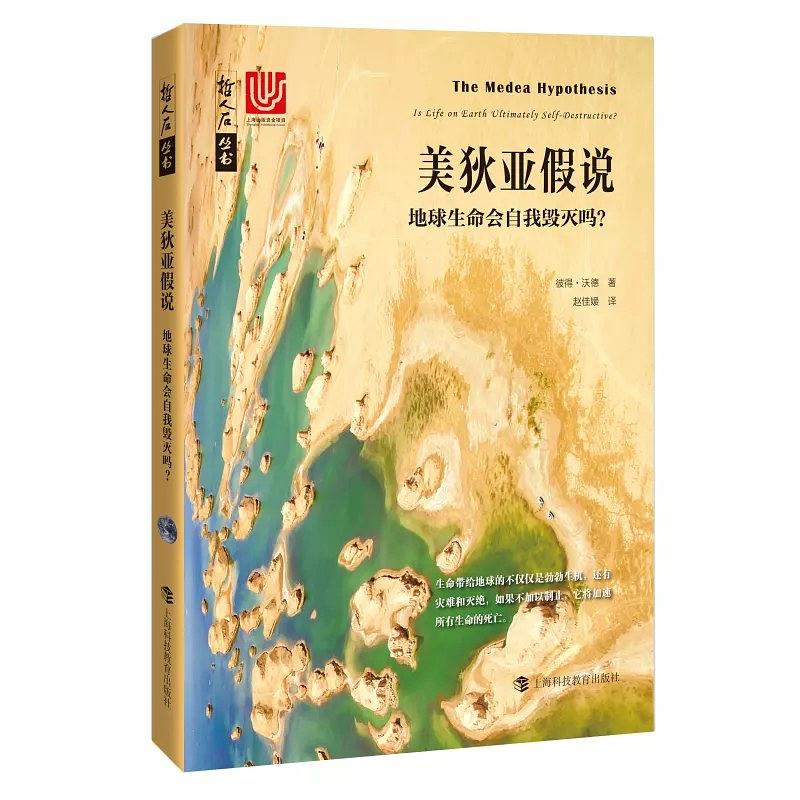
Published in Chinese Science Bulletin (2020-04-16, Book Review, p. 7). The title was mine, but now I’m tempted to change it again and call it: “Will Gaia Die?”
The “Gaia hypothesis” was proposed by the British atmospheric scientist James Lovelock in the 1970s, and, together with the biologist Lynn Margulis, it exerted a huge influence both in science and in the environmental movement; it has remained a matter of controversy to this day.
The inspiration for the Gaia hypothesis came from Lovelock’s participation in the 1965 Mars life-detection project. Lovelock held that the existence of life would be a planetary phenomenon: life would transform an entire planet’s environment, especially its atmosphere. This is why Earth’s atmospheric composition is so different from that of Mars, Venus, and so on. Earth’s atmosphere is not in a chemical equilibrium state (for example, oxygen and methane, which react with each other, coexist). This disequilibrium is sustained by ecological mechanisms such as the carbon cycle and the water cycle in the biosphere. So by observing a planet’s atmosphere as a whole, we can determine whether there are signs of life.
This line of thought also constitutes the most basic insight of the Gaia hypothesis: connecting atmospheric science and biology. Following this line of thought, the new field of “Earth system science” emerged. This science is devoted to studying the mechanisms of interaction between non-living environments such as the atmosphere, hydrosphere, and lithosphere, and the biosphere.
But Lovelock and Margulis were not satisfied with that. They named this “Earth,” regarded as a whole, after the ancient Greek earth mother goddess “Gaia.” A planet with life is different from ordinary planets: it does not merely “contain” life; it itself is also some kind of “life.” In his first book on Gaia, Lovelock said, “To search for Gaia is to try to find the biggest living thing on Earth.” (p. 45).
Of course, this is a “metaphor,” but a metaphor is not necessarily unrelated to science. When the biologist Stephen Jay Gould criticized Gaia as “a metaphor, not a mechanism,” David Abram retorted that “mechanism” itself is a metaphor [1]. Modern scientists use mechanical metaphors to understand nature, seeing the relations among things as external relations among completely passive mechanical parts. But once we regard nature as an organism rather than a machine, we will tend to see the connections among things as relations of coordination among the various tissues and organs inside a living body. The move from “mechanism” to “organism” is not a move from science to metaphor, but from one metaphor to another.
The metaphor of Gaia has given rise to more scientific hypotheses. For example, a direct association is that the whole Gaia, like a single organism, possesses some capacity for “self-regulation.” Just as animals can spontaneously regulate their own body temperature and bodily fluids, Gaia too would, in some way, spontaneously regulate atmospheric temperature and atmospheric composition so as to keep them as stable as possible.
Of course, Gaia’s metaphor also has effects beyond science, and this concept is especially popular with environmentalists. Some environmentalists believe that “Gaia,” true to her mythological identity, is a benevolent mother, while human beings have been constantly defying and harming Mother Earth. In this sense, Gaia represents some kind of standard of the “good”; human beings ought to “follow nature,” bring Gaia’s regulatory capacity into play, and refrain from interfering too much with nature.
The author of this book, Peter Ward, supports the most basic implication of the Gaia hypothesis: viewing the Earth as some kind of organic whole. But he strongly opposes the inferences made at the latter two levels. First, on the scientific level, he rejects the idea that Gaia possesses a “self-regulating” capacity oriented toward stability. He believes the truth is exactly the opposite: life is not maintaining environmental suitability and stability, but rather is always ruining the environment and continuously carrying out self-destruction. Second, in a moral sense, the author also rejects the attitude that “human beings should follow Gaia,” and instead argues that only by going against nature can we, through technology and engineering, break out of the destiny of “self-destruction.”
In this way, the name “Gaia,” that benevolent mother goddess, becomes out of date. The author proposes replacing the “Gaia hypothesis” with the “Medea hypothesis.” In Greek mythology, Medea is the evil mother who kills her own children.
In order to argue for his hypothesis, the author reexamines the history of life on Earth, along with the corresponding trends in oxygen and carbon dioxide, and points out that in terms of total biomass and biodiversity, the broad trend is always one of deterioration: “Medea” washes over Earth’s life with one “mass extinction” after another. Especially today, “Earth is not a place where biodiversity and biomass are continually increasing, but a planet that is entering old age, with biodiversity and biomass both declining.” (p. 128).
Why is self-destruction the destiny of life? I feel the author’s argument is not clear. Instead, the “trash heap Gaia” theory that the author cites (pp. 49–50) but does not comment on much can provide a succinct explanation. Tyler Volk proposes that if metabolism is the essence of life, then producing waste is the destiny of life, and waste is always something the life that produced it hates. Yet these wastes will inevitably continue to accumulate in the environment, eventually reaching a level that the life in question cannot tolerate, leading to mass extinction, while at the same time other forms of life that can make use of these wastes rise up. For example, oxygen was originally waste from life activities; the increase in atmospheric oxygen promoted the rise of new organisms, but for anaerobic old organisms it was undoubtedly a disaster.
In a food chain, the waste of one kind of organism may be digested by other organisms, but can we expect that, overall, all waste will just happen to be processed in time? Obviously not. If the whole “Gaia” is an organism, then her “metabolism” on a planetary scale will not be a process tending toward equilibrium, but will always be in a deteriorating state in which “there is more and more garbage.” Every life form is always sparing no effort to mess up its own environment; this is the destructive nature of “Medea.”
The author’s argument is persuasive, but I myself remain unconvinced. In my view, the author’s reasoning deliberately or inadvertently muddles different time scales.
Take a living organism, such as you or me: on the scale of minutes, it has certain self-regulating mechanisms—for instance, when it is cold, we shiver; when it is hot, we sweat. On the scale of a day, there are also self-regulating mechanisms—for example, if you eat too much at noon, you cannot eat much at night; if you eat too much yesterday, you will poop more today; and so on. But on the scale of decades, we are always in an irreversible process of decline—aging until death. Even without external oppression, we are always aging continuously until we die. So of course we can regard this unavoidable process of aging as the “natural nature” of organisms, but at the same time, this conclusion does not negate self-regulation on shorter time scales. A relatively balanced steady state and irreversible self-destruction are not contradictory, because they belong to different time scales.
The author strings together one “Medea event” after another on the scale of hundreds of millions of years, but this trend toward imbalance on a large scale cannot prove that there is no “equilibrium” on the scale of centuries to ten-thousands of years.
The scale-jumping in the second half of the book is the most dizzying. First he looks ahead to the future five hundred million to one billion years from now, pointing out that within one billion years “the plants we are familiar with will no longer exist.” But very quickly the author returns to the scale of “50 years” and discusses what humanity should do under the unavoidable trend of global warming.
The author’s arguments about Medea’s self-destructive tendency, mass extinction, and the Great Purge are all framed on the scale of hundreds of millions of years, but the conclusion he ultimately tries to draw is what human beings should do on a 50-year timescale. This is utter confusion. It is like saying: because death is natural, you do not want to die, so you must go against nature, so you should resist your own natural tendencies—when you are hungry, do not eat; when you are thirsty, do not drink. Isn’t that absurd?
The “following nature” emphasized by environmentalists generally refers to matters on a century scale. Since the Industrial Revolution, humanity’s impact on “Gaia” has far exceeded Gaia’s rhythms—for example, eating three days’ worth of food within one hour will inevitably bring the organism close to collapse. Environmentalists therefore hope to find Gaia’s original rhythm and advocate that people keep in step with it as much as possible. But the author of this book stands up and says: if you live according to the rhythm of nature, your organism will inevitably tend toward collapse fifty years later, so you must oppose nature.
He is not wrong: if you want to live forever, shouldn’t you indeed fast and cultivate immortality? But such a strategy is utterly meaningless in the present.
So, on the scale of science fiction, I support the Medea hypothesis—that is to say, any relatively balanced steady state of Earth’s biosphere cannot last forever; any equilibrium is relative and temporary. But on the scale of reality, I still side with “Gaia.” We should strive to explore and adapt to Gaia’s rhythms, and try not to depart too quickly from Gaia’s self-regulating capacity.
Whether human beings can survive five hundred million years from now obviously depends entirely on the development of technology and engineering. But whether human beings can still prosper and remain stable fifty years from now still depends on whether we conform to Gaia. The author conflates two vastly different scales, and so his conclusion naturally becomes dubious and ambiguous.
Of course, the greatest difference between human beings and other organisms is probably some kind of planning of “being-toward-death.” Death that may only arrive decades later will also affect a person’s choices about immediate affairs. In this sense, a vision extending over hundreds of millions of years is not necessarily irrelevant to humanity’s present fate. In that sense, the Medea hypothesis can indeed provoke thought.
[1] Abram, D. (1988) “The Mechanical and the Organic: On the Impact of Metaphor in Science” in Scientists on Gaia, edited by Stephen Schneider and Penelope Boston, Cambridge, Massachusetts: MIT Press, 1991 reprinted from https://en.wikipedia.org/wiki/Gaia_hypothesis
Translated from the Chinese original with AI assistance. The original text is authoritative.