
This article was published in the April 2020 issue of Book City
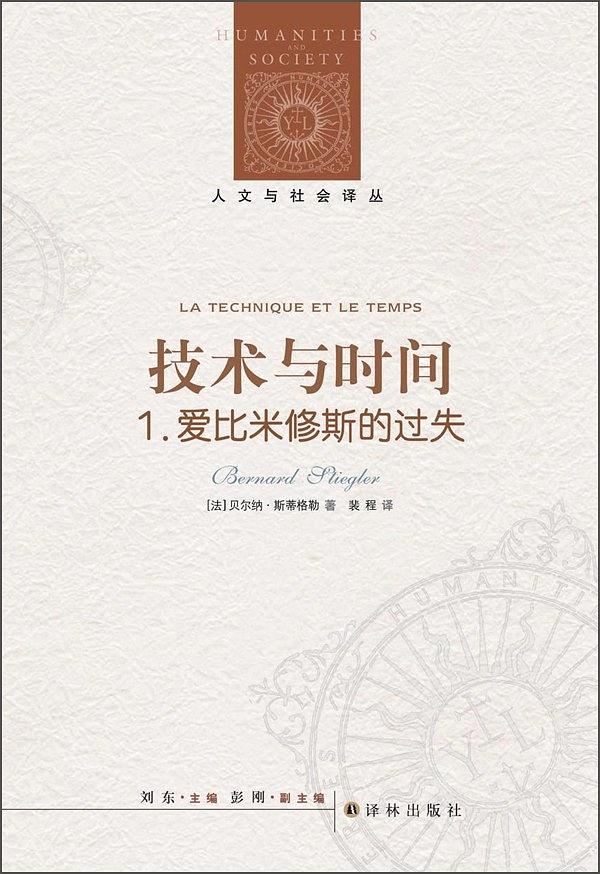
Bernard Stiegler is one of the most influential living philosophers in the field of philosophy of technology, and in recent years he has also had a considerable impact in China. He himself often comes to China to give lectures and teach courses. The lecture notes from a course he taught in the Department of Philosophy at Nanjing University in 2016 have recently been published in collected form (Nanjing Lectures: Reading Marx and Engels in the Anthropocene—From The German Ideology to Dialectics of Nature). And the Chinese translation of the work that made his name in his early years, Technics and Time 1. The Fault of Epimetheus, has finally appeared again in a new edition after being out of stock for many years.
Technics and Time emerged from the doctoral dissertation Stiegler completed under Derrida’s supervision, and he indeed inherited much of his mentor’s style: profound and obscure, difficult to read and to translate. Relatively speaking, the Chinese translation of the third volume seems more careful, while the translation of the first volume has more problems. Fortunately, this new edition has been slightly revised, correcting the core Heideggerian pair “ready-to-hand / present-at-hand.” In earlier translations, the translator, quite contrary to the customary practice of the Chinese scholarly world, rendered what is usually called “ready-to-hand” as “present-at-hand,” and “present-at-hand” as “under hand,” which reads very awkwardly.
But the revisions in the new translation are very limited; here and there the changes are awkwardly made, or have not yet been made at all (for example, on page 207: “…human beings no longer possess any present-at-hand ready-made things” should mean “…no longer possess anything that has come into one’s hands”). In addition, some terms and personal names do not follow the names commonly used in academic circles.
Still, I do not want to be too harsh on the translator. In fact, to translate a difficult work like this in a basically fluent and readable way is quite remarkable. Some terms, though not rendered according to the scholarly standard, are not really a serious problem. In fact, when Stiegler himself explicates Heidegger’s concepts of “ready-to-hand” and “present-at-hand,” he does not strictly follow Heidegger’s original meaning either, but appropriates them creatively for his own use. If we insist on interpreting these concepts strictly in Heidegger’s sense, we may in fact obstruct our understanding of Stiegler’s line of thought.
Heidegger discusses ready-to-hand and present-at-hand in the context of human practical involvement. When one picks up a hammer and drives a nail with it, the hammer is “ready-to-hand,” as if it were part of the body. In Stiegler’s case, “ready-to-hand” likewise refers to this state of treating technical objects as part of the body, but he speaks of it more in the context of technology history or human history. For Stiegler, a certain primordial “ready-to-hand state” is a mythical construction, an idealization of human origins—what is called the “golden age.” Because “primitive people” have “everything at hand,” “gather all things within themselves,” they therefore “lack nothing” and “do not depend on the external world” (p. 125). And once “externalization” begins, once one begins to seek “present things” outside oneself, that is the origin of humanity or of technology.
In Stiegler’s sense, understanding “what has come into one’s hands” as “present” is indeed not without reason. In Heidegger, “present-at-hand” refers to a kind of “externality” opposed to what is “as if an extension of one’s arm,” “something one can handle with perfect ease.” What is ready-to-hand is put to living use as part of the body; what is present-at-hand seems more rigid, fixed, and objectively placed outside the human being. But in Stiegler, it is precisely things that “remain held in exteriority” that come alive; death and temporality are opened up through this kind of “loss.” And the “primitive people” who have “everything at hand” are not yet truly living beings (that is, mortal beings). They have no lack, no forgetting, and therefore no “time.” So in a certain sense, what has come into one’s hands is actually more “present-at-hand,” whereas things that are in hand, or things “lost outside,” are precisely not “present and fixed,” but instead possess a certain self-propelling logic, or rather the dynamic of history—“technological logic” or “technological tendency.”
It is of course a good thing that the translator can follow the scholarly mainstream and revise these terms into the standard academic renderings; this makes it easier for us to notice Stiegler’s relation of inheritance to Heidegger and other philosophical traditions. But I do not think we need to take these “terms” too seriously. Heidegger himself liked to creatively use all kinds of everyday expressions in a playful way with words; he regarded words as “guides” or “signposts.” The meaning of a term is to provide a certain direction, to guide readers gradually out of everyday thinking and toward a contemplative path. But once one goes deeper, everyone will encounter their own road, and should no longer linger beneath any single signpost, refusing to move on. If many people gather beneath one signpost, pointing and talking and lingering there, it may well mean that the signpost is not a good one.
Many philosophy workers laboring over the classics do what amounts to taking the “signposts” set up by philosophers off the road of thought and placing them in a specimen room to be repeatedly admired and displayed. They try to fix the meaning of terms, monopolizing the authoritative, professional right of interpretation for themselves, and most love to accuse others of misuse, overuse, or mistranslation… This way of doing things is completely wrong, at least when applied to continental philosophy traditions represented by phenomenology; or rather, it is the study of phenomenology in an anti-phenomenological way.
The key question is: why do we read these obscure philosophical works at all? If we are merely participating in some sort of “competition,” vying over who can more accurately and comprehensively grasp the author’s “original intention,” then we really do need to weigh every word and clause and strive for precision. But if our aim is to use these thinkers to inspire and guide our own thinking, to help us gain a broader horizon or deeper insight, and ultimately to respond to our own times and our own problems, then perhaps we should not demand too much precision.
Like Derrida, Stiegler likes to cite widely and borrow concepts from all kinds of famous thinkers, but if one examines closely, his quotations are often not necessarily accurate. The key point is that his dissertation is not aimed at interpreting Heidegger or interpreting Plato or the like; what his writing seeks to interpret is our own age, the problems of this “technological age.”
So, although this book is obscure and difficult to read, readers do not necessarily need to have prior knowledge of Husserl, Heidegger, Derrida, and so on; one does not have to be an experienced specialist in philosophy in order to read it. Anyone who is concerned about the technological age and the destiny of humanity may well gain inspiration from this book,
In recent years Stiegler has used the concept of the “Anthropocene” more often, but in Technics and Time I he had not yet taken notice of this concept; instead, he uses “technological age” to designate this similar historical situation—“In the technological age in which we find ourselves today, the power of technology has the danger of destroying all humanity” (p. 95).
The starting point of Stiegler’s discussion is precisely this age-bound common concern. Whether one is an optimist or a pessimist, the power of technology has already reached an unprecedented height, such that it can destroy all humanity at any moment. Thus, the question of whether such powerful force can be reasonably “limited” has become a major difficulty—“Contemporary technology is one of the major problems we face… The substance of the problem is to ascertain whether or not we are able to anticipate and guide the evolution of technology—that is to say, the power of technology” (p. 23).
There are of course many who are troubled by this age-old situation, and one could even say that it has become the background color of the age. “Although resistance to technology has existed since ancient times, this phenomenon has now become a global and common problem” (p. 42). Housewives, too, resist “technology,” pursuing so-called “all-natural” foods, cosmetics, or routines of daily life.
Technological developments such as gene editing have also aroused widespread vigilance. Stiegler was already pointing to this aspect at the time—“The manipulation of genetics… affects humanity’s ‘most natural’ substance and nature” (p. 94).
From the world’s top laboratories and the stage of international politics down to the kitchens of ordinary households, fierce struggles between “technology and nature” are being staged at every moment.
But Stiegler does not remain within anxiety, nor does he simply hope to “promote the humanities and resist technology”; still less does he simply “pick a side.” What he is thinking about is: when we talk about technology and when we talk about nature, what exactly are we talking about?
Gene editing may deviate from human nature, or it may not; but the key point is that Stiegler asks: “What is nature?”
He notices that the distinctive condition of the technological age has already “fundamentally touched the very way of posing questions such as ‘what is human nature’” (p. 94).
Stiegler begins from there, beginning with the most popular concerns of the technological age,
So what exactly is special about this age? Ordinary people can also say a thing or two about this: nothing more than that science and technology are “changing with each passing day, developing at breakneck speed.” Stiegler also mentions that “the specificity of modern technology lies essentially in the speed of its evolution” (p. 25). But this seemingly simple conclusion also contains profound questions. First of all, what is “speed”? The question of speed is first and foremost a question of time: “This obliges us to consider the problem of technics and the problem of time together” (p. 25).
And what exactly is the “place” (space) of the speed we are talking about? When we say Liu Xiang is fast, we mean that he runs fast in the 110-meter hurdles, but his swimming speed may not be fast, and his speed at eating may not be fast either. To speak of “speed” always requires some kind of scale, some kind of “track” as a point of reference. So when we say “the speed of technological evolution is fast,” what is its “track”?
Finally, what exactly is the “technology” we are talking about? Liu Xiang is a person, a shell is a ball; they are all individuals with clear boundaries, but what kind of “being” is “technology” exactly? Where are its boundaries? In what form does it move?
Drawing on the thought of Simondon and others, Stiegler introduces concepts such as “technical system” and “technical tendency” to understand what is meant by “technological development at breakneck speed”—that is, “what—where—toward what direction” is moving. And the problem of “time” is the most complex one. In the end, Stiegler wants to reveal that “rather than saying technology is in time, it would be better to say that it constructs time” (p. 30).
In short, behind the ordinary statement “modern technology is developing at breakneck speed” lies a major question concerning basic philosophical concepts such as “nature,” “human nature,” “time,” “space,” and “being.” Starting from the common concerns of the technological age, Stiegler quickly enters the deepest and most complex problems in the history of philosophy.
Stiegler’s references to the history of philosophy are very much in the mode of “using the classics to explain myself”; he does not get bogged down in detailed distinctions among philosophical terms. His main discursive style is a reinterpretation of ancient Greek myth. As the subtitle of Technics and Time I, “The Fault of Epimetheus,” suggests, the discussions revolving around this mythic metaphor are the theme of the book.
This metaphorical style is of course not easy to understand, but Stiegler’s use of myth and allegory is precisely meant to crack open a certain deeply rooted myth about human nature.
Stiegler believes that whether one is anthropocentric or technocentric, whether one thinks human nature controls technology or technology controls human nature, all such views presuppose some fixed thing as “nature” (nature/essence) and as a universal principle. Stiegler thinks this anthropologist’s notion of “human nature” is questionable—“We no longer assume, as anthropologists do, that human beings have a fixed nature (or origin)” (p. 100).
This fixed view of humanity is represented by Rousseau. In the famous Discourse on the Origin and Foundations of Inequality Among Men, Rousseau constructs a “perfect primitive man.” He believed that science, art, and technology are all things “added on” atop a fundamentally pure, simple, and uncorrupted natural humanity; these “added-on” things gave rise to “inequality,” whereas human beings are equal by nature. Thinkers such as Locke and Hobbes, although differing from Rousseau in many specific ideas, also set up in their own ways an ideal human nature as a universal principle. Their thoughts still profoundly influence political discourse today.
This is a kind of “modern myth,” one that lays down the fundamental opposition between “nature” and “technology” in our age. In this sense, the romantics and the techno-supremacists are of a piece; the only difference is that the former hope that, along the “nature—human—technology” genealogy, human beings should move closer to the nature end, whereas the latter think they should move closer to the technology end.
This myth is not a conclusion of science. Genetics and paleoanthropology may be able to trace when ape-men began to walk upright, but they will not tell us what “human nature” is. On the contrary, many popular science texts are permeated by all kinds of “mythic stories,” such as the so-called “liberation of the hands,” “transforming nature,” and so on. The difference between human beings and animals, the opposition between human beings and nature, is often taken as a state beyond dispute.
Compared with the “anthropological myth” that imperceptibly governs the whole of modernity, Stiegler’s deployment of Greek myth looks all the more justifiable. As the saying goes, use medicine to counter medicine, use poison to counter poison: here Stiegler is trying to break myth with myth.
The human species is of course unique, but not because it has some fixed essence. If there is something distinctive about human beings in comparison with other animals, it is better to say that this distinctiveness lies in “lack,” in “having no essence.” Stiegler uses the mythic fable of Epimetheus and Prometheus to explain this uniqueness—other animals may have fangs or claws; their survival depends entirely on “organs” fixed in advance by nature. But human beings alone are born weak and deficient, and relying only on inborn organs gives them no capacity for survival; therefore they must sustain life through acquired organs. These acquired organs, namely technical artifacts, are named by Stiegler as “prostheses” (or, alternatively, “orthopedic appendages”).
In this perspective, technical artifacts are the human being’s “external organs.” Stiegler reinterprets the word “organ,” arguing that it simultaneously “denotes a part of the body or an instrument as a technical device” (p. 50). This perspective, which analyzes technology as “organized inorganic matter,” had already been opened up by Marx. Developing Marx’s thought, Stiegler examines human history and technological history together.
These external organs are very different from the organs inside a biological body. They can not only be “ready-to-hand,” but also “present-at-hand” as something that has been left to hand; a tool that has been “put down” can be “picked back up” again. Through externalization, human beings can forget and remember. An organism’s internal organs dissipate with its demise; according to Darwin’s theory of evolution, no amount of acquired effort can transmit to offspring an animal’s modifications to its internal organs. But external organs are different. Like DNA, they are also a kind of “hereditary material” that can be “put down” by predecessors and “picked up” by descendants, passed down from generation to generation. And these “heritable objects,” too, like DNA, determine the human way of life.
That is to say, human beings are profoundly different from ordinary living beings: they possess “inheritance” on two different scales, and thus also have an evolutionary history in two dimensions. Stiegler names this dimension of evolution “epiphylogenesis,” or perhaps we may also call it “post-species origination.”
By retelling the myth of “human origins,” Stiegler links human nature (humanity) and human artifacts (technology) in an originary sense. “Technology invents human beings, and human beings in turn invent technology; the two are mutually subject and object.” (p. 148)
“We shape our tools and thereafter our tools shape us”—this maxim comes from Churchill and was popularized by McLuhan; the insight itself is not especially unusual. But Stiegler’s contribution lies in placing this simple notion—that “technology shapes human beings”—against the backdrop of the entire history of Western philosophy. He then goes on to say: “This hypothesis completely overturns the traditional conception of technology since Plato…” (p. 148)
What Stiegler overturns is not merely the conception of technology since Plato; in fact, what is overturned is the conception of “knowledge” since Plato.
Earlier I mentioned that technical tools can be left outside and then picked back up again, but technology is not a capacity human beings are born knowing; it has to be “learned.” But how is learning possible?
Stiegler believes this question originates in the challenge presented by Plato in the Meno, and that “trying to answer this question is itself the driving force behind all thought in the history of philosophy, especially modern thought.” But since Plato, this question has been deliberately or inadvertently evaded. From the perspective of technology, Stiegler reinterprets this most central problem in the history of philosophy (this part is more fully developed in Technics and Time 3).
Of course, for the ordinary reader, there is no need to delve deeply into the details of the history of philosophy and follow Stiegler into disputes with Plato, Kant, and Husserl. But as the saying goes, if one learns the best, one gets the middle as well: even if we do not seek complete understanding of many obscure points, we can still gain inspiration and shock from the reading, prompting us, in this age of technology, to rethink what “human beings” are.
Translated from the Chinese original with AI assistance. The original text is authoritative.