
This article was published in Science and Technology Daily (2024-02-02, p. 3, Book Reviews), and retitled “Memory Is More Important Than Function; Richness Is More Important Than Efficiency”
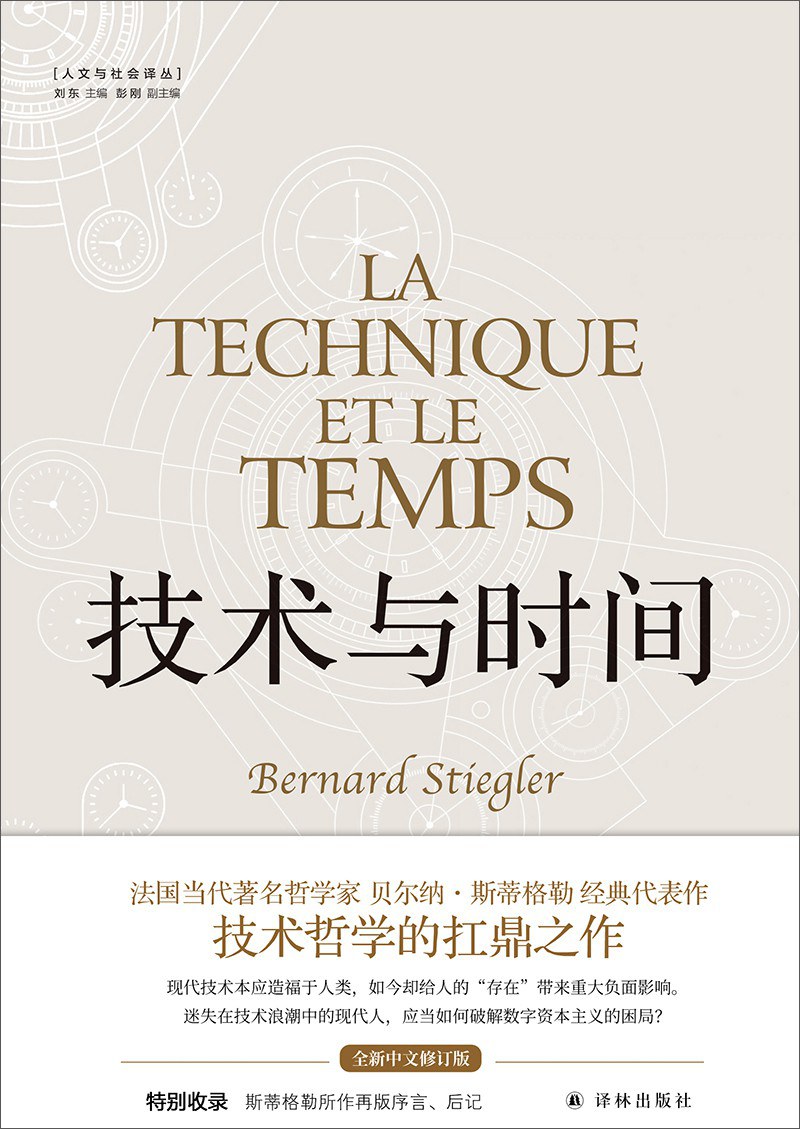
Bernard Stiegler was one of the most important philosophers of technology from the late twentieth century to the early twenty-first; in my view, one could even dispense with both “technology” and “one of.” His magnum opus is the three-volume Technics and Time, which has long been translated into Chinese, and Yilin Press has recently published a collected edition.
The collected edition improves upon the old translation, especially by resolving inconsistent renderings of individual terms and by providing a unified index, making it more suitable for scholarly reference. On the other hand, the collected edition also adds Stiegler’s 2018 preface to the new edition, as well as the 2017 postscript to the third volume.
In the preface, Stiegler sketches the complete seven-volume plan of Technics and Time. Unfortunately, because he committed suicide in 2020, this plan obviously could not be completed. Still, many of his ideas have already been disclosed in other works published over the years, as well as in various interviews and lectures. In the newly added postscript, Stiegler also incorporates the contents of the follow-up chapters he envisioned.
Of course, the foundation of Stiegler’s entire edifice of thought was already laid in the three-volume Technics and Time. In these three volumes, Stiegler brought together the thought of philosophical giants from Plato, Kant, Marx, Husserl, Heidegger, and Derrida to the present, and integrated it with anthropology and the history of technology, forming a highly distinctive intellectual system. Its most central insight is to understand technology as humanity’s “external organs,” organs that bear human external memory (tertiary retention). On this basis, Stiegler elaborated the historical relationship between humans and technology, and in particular criticized the deprivation of knowledge in the age of capitalism, especially in the age of the culture industry and the information age, which leads human beings to be “proletarianized” and to lose their way.
In the newly added postscript, “The New Conflict Between Capability and Function in the Anthropocene,” Stiegler directs his fire squarely at the information age, especially the development of big data and artificial intelligence. Stiegler believes that the information age brings new conflicts to humankind, and that we must seek a new “economy” to replace the traditional capitalist market-economy model.
The postscript opens by quoting a sentence from Norbert Wiener, a pioneer of information science: “Cybernetics is a double-edged sword; sooner or later it will deeply hurt you.” In fact, Wiener had profound anxieties about the fate of humanity in the information age. He believed that future automatic machines would cause a social crisis of mass unemployment; moreover, if human beings only wanted machines to be slaves, they themselves would instead become slaves of the machines.
The solution Wiener proposed was likewise to establish a new economic order: “The answer is, of course, to demand a society based on human values rather than on buying and selling.” (Preface to Cybernetics). Wiener believed that the American value system, which assumed that everything had a calculable price, was bound to become obsolete. Wiener wrote: “In the American environment the problems of information are all evaluated according to the standard American view: a thing has value insofar as it comes to the open market as a commodity.” (The Human Use of Human Beings)
In the postscript (including his later work after the three-volume set), Stiegler likewise turns to the concept of “entropy.” He says, “In what are called other places of the ‘entropy epoch’—where capitalism has become despotic and mad, establishing a kind of self-styled intelligent and gentle totalitarianism—the elimination of detours and the shortening of deadlines have become the law of the world. This world has neither faith nor law; it is only busy breaking through the barriers of time.”
“Time” is obviously the keyword of Technics and Time. Without reading the whole work thoroughly, it would probably be hard to adjust to Stiegler’s distinctive language. So here I borrow Wiener’s thought and try to give a more accessible explanation:
In short, the American value system Wiener opposed, and the capitalism targeted by Stiegler, are both efficiency-above-all-else doctrines. Their way of measuring the value of things is based on a faith in “computability”; all value is computable—nothing more than a cost-benefit analysis. And so-called benefit is nothing other than the efficiency of “shortening time.”
But this view has two major problems. First, it is anti-human, because to be human should mean being complex and diverse. If I want to get to a destination, then of course the transportation I choose should be as fast as possible (saving time); but if I want to travel and relax, then a slow cruise ship may be better than high-speed rail or an airplane. The reason the open market is beneficial to people is less that it saves transaction time and improves transaction efficiency than that, crucially, it gives people more varied choices and richer lives. If one pursues efficiency excessively while ignoring human complexity, one is putting the cart before the horse.
Second, it is relatively suited to the industrial age, but not to the information age. Wiener emphasized: “Neither information nor entropy is conserved, and both are equally unsuitable as commodities.”
A loaf of bread, a car: these are all “conserved.” If one person buys it, it is a loaf of bread; if two people buy it, it is still a loaf of bread, so the two people must either have one person who gets none, or each can only get half. In such cases, all kinds of commodities can easily be assigned an objective value (market price) according to market supply and demand.
But Wiener believed that information is clearly not like this. For example, Leonardo da Vinci painted the Mona Lisa. There is only one physical painting, but its value lies not in the material entity, but in the information it provides. In this respect, if one person comes to view it, he sees a complete picture; if two people come to view it, they too each see a complete picture. The value each person gains from the picture does not diminish as the number of sharers increases. This is a situation wholly different from that of material goods.
Stiegler further distinguishes between two kinds of information, or rather the difference between “information” and “knowledge.”
“Information” does not retain its value in the sharing activity described above; on the contrary, information dissipates and “dissolves.” For example, the information “the eggs on sale at the supermarket are discounted” has value because it helps me buy eggs at lower cost or with greater efficiency. But if this piece of information is shared by tens of thousands of aunties, then I’m probably out of luck; by the time I get there, the eggs will already have been snatched up, and the information will have lost its value. By tomorrow or the day after, this outdated information is nothing but trash with no value at all.
This is because we regard information from the standpoint of “function,” and thereby construct a kind of “virtual economy”: “an economy constituted by computability; it is an economy in the capitalist sense: a market economy. In this economy, I can transform any use value into exchange value, and thus into a computation: I can monetize all things through the computability of information, carry out calculations. The computability of information establishes competition theory, supply-and-demand theory, and so on. Among them, everything can be reduced and dissolved, and thus become ‘virtual’ in the contemporary (and hollow) sense of the word.”
In this virtualized world, memory or knowledge is “transformed into information through large-scale automation.” The cult of “innovation without end” means, at the same time, the devaluation of memory and the forgetting of knowledge, because nothing old is deemed worthy of retention.
Stiegler questions these supposedly self-evident ideas: “Is the value of information really always computable? Can all of its value be reduced to computation? The answer is obviously no: only when those who compute the value of information belong to a distributed space … can the value of information be computed.”
This is the problem of “anti-humanity” I mentioned earlier. Human “capabilities” are not always some “function” whose cost and benefit can be computed; the purpose of human life is not to improve productivity or drive technological innovation. On the contrary, productivity and technology are valuable precisely because they can enrich human life. And if we return to the standpoint of each person’s lived experience, then the value of information is also plural. Even an outdated piece of information like “the supermarket had discounted eggs yesterday” may be beneficial for me to know or remember. Perhaps it helps me understand my parents’ actions; perhaps it helps me reflect on my own gains and losses; perhaps I simply want to write a local gazetteer, and these trivial materials will become sources for historical writing…
At this point, the value of “information” becomes heterogeneous—“this kind of document does not derive its value from the homogenized information market, but from local inner exploration, from intrinsically heterogeneous knowledge; this knowledge possesses a richer diversity of mental comprehension, and its functions divide it into various disciplines, serving certain kinds of knowledge—historical, archival, paleographic, genealogical, archaeological, amateur, and so on.”
Humanistic knowledge is under heavy suspicion in the contemporary era precisely because people always prioritize calculating the value of things from the standpoint of “function.” Some people think the humanities are worthless; some think they have value, but then they must exhaust every possible means to find some function for them—for example, that history can enhance national identity and social cohesion, can provide lessons from experience in order to promote development… As if the ultimate goal were always to promote development and innovation, and only those things that are “old” deserve meaning. So humanistic knowledge, too, has become a series of specialized disciplines according to its different functions.
But let us return to personal experience and think the matter through: are the memories you cherish really valuable only because they can improve your work efficiency? Are the hobbies and fixations you are passionate about really things you are reluctant to give up only because they can enhance your innovative capacity?
Memory is more important than function; richness is more important than efficiency—this is the shallow conclusion we can draw from Stiegler’s doctrine. By rearticulating the essence of technology, and the essence of technology as external memory, Stiegler calls for a new way of thinking and a new economy that return to “human values” — “beyond the computable, that is, beyond the artificial criteria of selection of the market.” For when we measure the value of “memory,” richness and heterogeneity replace computability and become what we cherish.
Translated from the Chinese original with AI assistance. The original text is authoritative.