
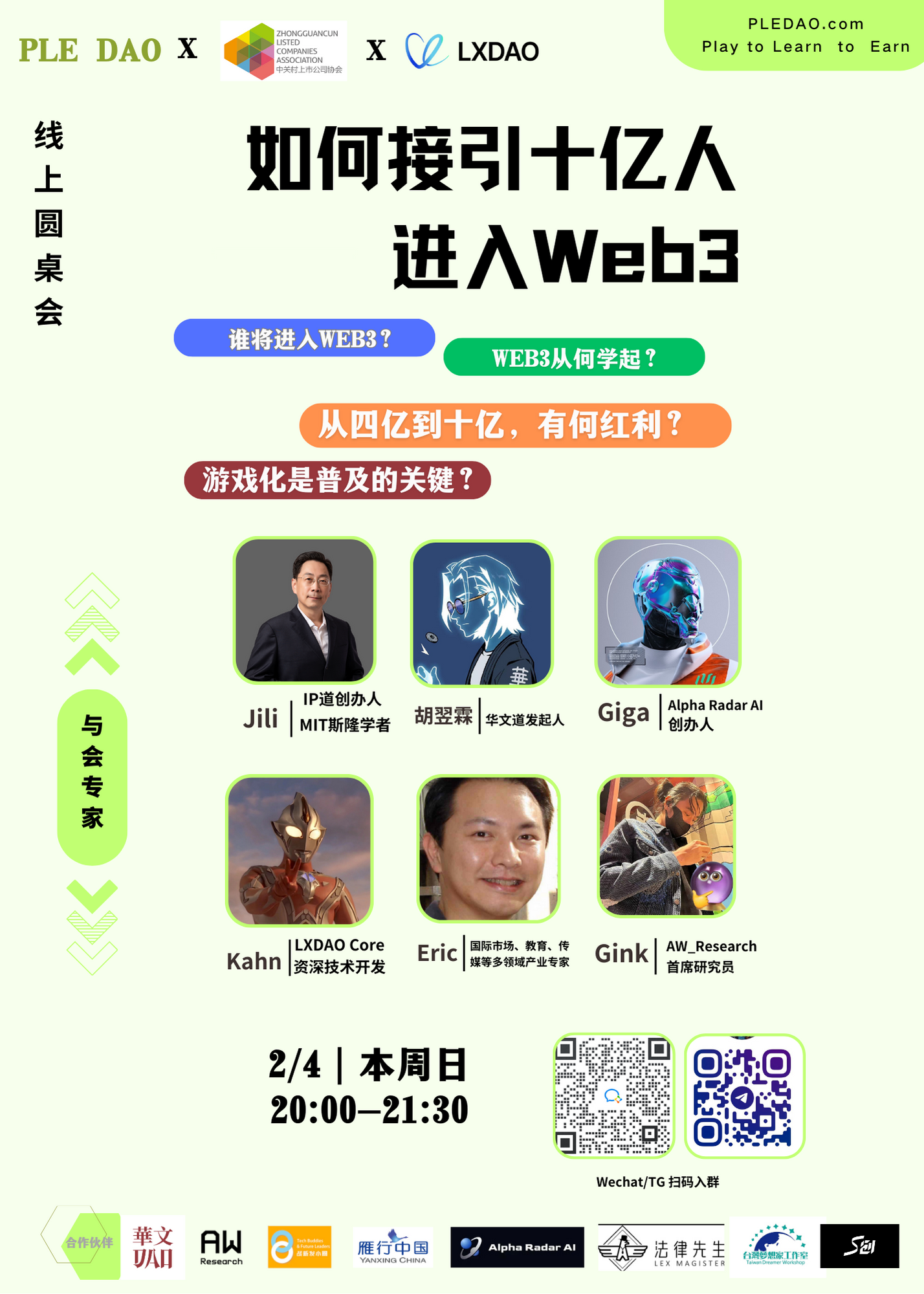
Yesterday, in my capacity as the initiator of Huawendao, I took part in a roundtable discussion titled “How to Lead One Billion People into Web3.” Recently, whenever I’m invited to participate in a program in the name of Huawendao, I’m willing to join for free.
That said, I actually don’t much like the so-called roundtable format, especially when the participants aren’t very familiar with one another and there are more than three people. In practice, everyone is basically just talking past one another, and the time is so tight that the topics can’t really be unfolded in depth. Of course, there are indeed times when some sparks of thought do collide.
I’ve recorded here some of the points I made yesterday, and I’ll expand on them another time if there’s a chance:
- Web3 is both a technological revolution and a social revolution. The reason it has to be a revolution is that the old system has all kinds of problems. If the old system had no problems and everyone loved it to bits, then there would be no need to force a revolution. If the old system has problems, then what Web3 pioneers need to do is open up a new world and wait for those disappointed with the old world to come over.
- The earlier wave of “New World” pioneers actually did not want to bring too many people along. That’s because the New World was full of gold and wild disorder; it was precisely the period for staking out territory and building a new order. The fewer competitors there were, the easier it was for me to seize the initiative and grow wildly. If we were to enter the new world all at once with a billion people, then it would be hard for us not to become ordinary and indistinct. So the only early pioneers who actually had no confidence in the New World, and only wanted to make a quick run and leave, were the ones who hoped the more people came along the better. People who truly have confidence and dare to break new ground and act boldly actually don’t have that much motivation to popularize things: come if you want, don’t come if you don’t; anyway, let me first get my fill of the adventure before we talk about anything else.
- However, taking the approval of the Bitcoin ETF as a marker, the historical process of these past two years may actually already have entered the next stage. Wall Street’s old money, the vested interests of the old system, have also begun entering the new world. Of course they have forces that want reform, but they also have a great deal of energy devoted to pacification—to bringing the new world into the old order. So at this point, we pioneers who long for a new world really do need to band together, to bring more ordinary people from the old world in, rather than letting vested interests from the old world join in and cluster together to build things, thereby countering the force that wants to turn the new continent into Wall Street’s subsidiary mining district.
- In this respect, Chinese people actually have an advantage. That’s because ordinary Chinese people are the ones who can most keenly feel the problems of the old world. For example, the vast ranks of A-share leeks can more deeply understand what it looks like when the financial market is controlled from above and is not open and transparent enough; Chinese social media users can better appreciate how awful it is when a social identity you’ve maintained for years suddenly gets banned for no reason at all; and Chinese game players can better understand what kind of environment it is when the rights to list a game, to charge for it, and even the details of its content are all strictly controlled from above. In fact, these problems also exist in Western societies: financial markets, social environments, and gaming platforms all operate under centralized rules. It’s just that there the market mechanism still exerts some influence, and those in power are relatively more rule-bound, so many contradictions have not been intensified. Thus, at this stage, Chinese people have a stronger motivation to throw themselves into the new world, whereas many Westerners may more easily get the chance to try it out, but lack the resolve to burn their boats and start over. We are less attached to the old system, and therefore are more likely to devote ourselves wholeheartedly to building the new world.
- The first slogan of Huawendao is “Chinese-style waves are the top waves.” We Chinese Web3 players are indeed at the forefront of this technological and social revolution. We should stand up straight and walk forward openly and confidently, letting others follow our trend, instead of insisting on finding some Westerner, or some vested interest under the old system (capital side, institutional side), and then sneaking behind them to eat a few scraps. So many communities are clearly made up of Chinese leeks, yet they refuse to band together or respect one another; instead, they prop up some foreigners as their façade, or bring in some capital or other as backing. This is the kind of atmosphere that Huawendao hopes to change. We begin by confidently writing Chinese characters, and from there strengthen the cohesion of Chinese culture.
- The development of the new world is always “adventure.” In the Age of Exploration, the New World was full of gold, but also full of danger; at sea, you might encounter privateers at any time, and on the Wild West frontier you might run into bandits and swindlers at any moment. So pioneers need courage. If you want “safety,” then go back and play A-shares. Of course, the reason Web3 is not “safe” is that it hands the absolute responsibility for fund security completely back to each user. If the user themselves is not deceived or makes no mistaken operation, then in fact you are more “safe” than anyone else; your digital wealth and property will absolutely not be infringed by anyone. But if what you want is not absolute security but relative shelter, then you will experience insecurity in Web3.
- In response to a question raised by an audience member involved in children’s education, I said that Web3 ought to be “not suitable for minors,” and that Web3 pioneers have no need to specially cater to child users. One major problem with Web2 social platforms and gaming platforms is that they have to “serve” children. Various speech controls and content controls are all carried out under the banner of child safety. Stupification is also a byproduct, because all media want to cater to children’s comprehension in order to get more traffic, so the content naturally becomes more and more childish. Social accounts cannot publish sharp or extreme statements, and game applications cannot include explosive or stimulating content, all for the sake of child users. Thus, the existence of centralized control mechanisms also gains a certain legitimacy. I think Web3 ought to reverse this social trend toward infantilization; we are simply an adult’s game, and at least for the moment there is no need at all to consider how to cater to children. Of course, once Web3 has taken shape, there will be no need to worry about children’s learning ability either. Children’s capacity to accept new things and children’s courage to break old rules are actually beyond what adults can match.
- As for Web3 games, I have always believed that if you want to compete with traditional games on dimensions such as user interface, sensory experience, and silky smoothness, then you are doomed to fail. Web3’s greatest advantage is decentralization and the financial freedom it guarantees. Web3 games are about being able to play with money freely, and that is the killer feature. Take card games, mahjong, and the like: being fun to play is one thing, and adding a little gambling to increase the excitement is another; the audiovisual experience of the game itself is actually the least important part. You don’t need to make mahjong tiles all fancy and dazzling. The way to win with Web3 games is a well-designed set of rules, plus free social functions and financial functions.
- Play to Earn is part of financial freedom, but freedom is not only about being free to earn money; the freedom to spend money is also a pain point. Playing games itself is an activity of spending money and consuming, but I always hope that I spend my money on something worthwhile. For example, I like watching game streamers. Game streamers are basically doing Play to Earn there, and watching them makes me happy; I want to tip the streamer. But when I know that perhaps only a tenth or a fifth of my tip eventually reaches the streamer’s hands, I may no longer be willing to spend. Web3 reduces platform monopoly and makes the flow of funds transparent, allowing me to freely decide, and at any time trace, where my tips go. That solves the pain point of wanting to spend money but not being able to spend it properly. Or take another example: I admire the art in this game, and I want to unlock more provocative card art, to have them draw something a bit more erotic for me; I’m willing to whale and splash out for that. But the problem is that in order to be listed on Apple or to pass content review, the game company has to indulge children and must adapt to all-ages standards, so even if I want to spend money, there’s nothing to be had. Or again: the cards I painstakingly collected, the skills I arduously honed, may all get nerfed by a balance patch from the game company. Perhaps the company will refund you some in-game currency, but I would rather continue spending money than see my game assets altered. Yet there is nothing I can do about it (this was also one of the origins of Ethereum founder Vitalik’s investment in blockchain back then). The decentralized mechanism of Web3 games can allow players to participate in co-construction, and can even let them launch forked versions at any time. As long as people recognize them, both the old rules and the new rules can continue to be played, no longer depending on a single development team or regulator’s say-so. Finally, for example, traditional games may shut down their servers at any time; Chinese Blizzard players experienced exactly this. For some unknown reason the developer and the agent fell out, and as a result Blizzard players across all of China lost everything in the game. Although they could get refunds, I still wanted to keep topping up and playing, but had no way to do so… In short, “play while you earn” and “freedom to spend money” are both experiences that traditional games struggle to provide, and they are precisely the pain points that Web3 games can solve.
- As for how ordinary people can participate in the Web3 cause, my suggestion is to treat the entire Web3 world (the metaverse, the New World) as a game. Don’t calculate gains and losses too instrumentally; instead, go “break new ground” in the Web3 new world the way you would explore a new map in a game. In human history, experiences of freely developing and infinitely creating in a wild new world have been very rare, and they are often accompanied by danger to life. And when we adventure in Web3, we don’t need to sacrifice our lives; at worst, we only lose some money. With such a small risk, to be able to open up and create in a world even more exciting than a game, to guide the future direction of human civilization, and incidentally to have the chance to make a fortune—doesn’t that sound like a very interesting experience?
Translated from the Chinese original with AI assistance. The original text is authoritative.