
This is a topic I have wanted to write about for some time now, including “blockchain philosophy of time” and “metaverse philosophy of space.” These fields can bring into play my own intellectual grounding in Heidegger + McLuhan, and also form a continuous thread from classical philosophy all the way to cyberpunk. It is a very big topic, and for the moment I find it hard to produce an answer that satisfies even myself. But this year’s phenomenology and philosophy of technology conference is about to be held, and I hope to speak on it, so I have hastily put together some words to turn in as an initial stopgap.
Some of the following ideas come from recent exchanges on Seedao, and some were already mentioned in last year’s summary of the introductory course on philosophy of technology. There is not much that is new, so I will first post them here as an opening.
The Cartesian objective “space” is a concept of modernity; such space is not an objectively existing entity that precedes us, but rather something brutally constructed out of modern science. The more originary “spatial phenomenon” is obscured by modern science, but it has not disappeared entirely; it remains preserved especially in concepts related to space such as place, location, site, position, situation, and so on.
In Heidegger’s terms, human beings (Dasein) are spatial; this spatiality is manifested in the activities of making distance and orientation. Cartesian coordinate positioning is only an extreme form of making distance and orientation; more commonly, one is busy among tools and others, and different “spaces” unfold different “stages,” bringing things onstage in different ways. In McLuhan’s terms, space is the media environment in which messages are able to appear, and the medium is the message: space does not passively and neutrally present things, but itself also conveys a certain form or tendency, determining the “room for maneuver” that people and various things have in space.
The “terrain” of the natural world can provide all sorts of “spaces,” but in the human lifeworld, “space” more often than not is largely surrounded by artifacts. Human beings continually cut up and reconstruct space through artifacts, driven by the tendency to “seek nearness.” And in the electronic age this tendency has become mechanized. Heidegger lived in the early electronic age, but he had already foreseen something of the electronic media’s destruction of space. He said: “In Dasein there is an essential tendency toward nearness. Today we are all more or less compelled to accelerate together, and every mode of acceleration is aimed at overcoming remoteness. For example, the advent of radio has made Dasein now take a big step forward on the path of expanding and destroying the everyday surrounding world; what all this means for Dasein’s being so far from the ‘world’ is still not something that can be grasped at a glance.”
The “everyday surrounding world” here is precisely the place where making distance and orientation take place. In this everyday surrounding world, the “distance” of things is estimated through the activity of making distance; Heidegger immediately goes on to speak of things like “a stone’s throw away,” “about as long as it takes to smoke a pipe,” and so on. “From a computational point of view, such estimates may not be accurate, may be shifting and uncertain, but in Dasein’s everyday life they have their own completely intelligible certainty.” The so-called “lifeworld of everyday life” or “everyday surrounding world” stands opposed to “the world of science”; in the world of science, estimates of near and far made through the activity of making distance of course seem “inaccurate, shifting and uncertain,” but in everyday life they have “intelligible certainty.”
Following this line of thought, it becomes easy to understand how “radio” “expands and destroys” the everyday surrounding world. First of all, “making distance” is always carried out through technology or tools—for example, “a stone’s throw,” “a pipe’s worth of time,” “next door,” “across the hall,” “right under one’s nose,” “a couple of intersections away,” “just around the corner,” “a ten-minute drive,” and so on. People always estimate nearness and distance by referring to certain tools that are “ready-to-hand” (including bodily skills).
Thus, when telecommunication technologies—from radio to mobile phones—become increasingly embedded in daily life and turn into everyday ready-to-hand tools, they likewise assume the role of making distance and orientation. Once “on the radio,” “on the other end of the microphone,” “across the screen,” “online friends,” and so forth become as everyday and familiar as “in the room,” “at the other end of the street,” “across the window,” “the neighbors around us,” the human “surroundings” are undoubtedly expanded enormously. A person thousands of miles away can be right before one’s eyes.
But expansion also means “destruction,” and what is destroyed is precisely “intelligible certainty.” Human beings certainly have a tendency to “seek nearness,” but if everything no longer needs to be sought and instead all comes forcibly pressing in, such a situation may no longer be comfortable.
The new situation is full of uncertainty and indifference. Things like “a stone’s throw away” and “about as long as it takes to smoke a pipe” are suitable for measuring space or time, for measuring “the distance between near and far,” because these technological activities themselves possess “certainty” and constitute a stable “normal state.” Bows and arrows can roughly shoot this far; a pipe can roughly burn this long. But if today a bow and arrow can shoot 200 meters, tomorrow 500 meters, and next month 20,000 meters, then we would no longer use “a stone’s throw” to measure space. If a road is one kilometer long today, ten kilometers long tomorrow, and demolished next month, then we will also increasingly lose track of where exactly “the other end of the road” is.
And this unsettling turbulence really does occur in the technological age: the whole world is in “rapid development,” and all technologies are changing at speed. Just as people have only just become familiar with some tool and its scale, that tool may already have gone through many rounds of upgrading and replacement, or even become obsolete and eliminated. Take “radio,” for instance: a few decades ago it was a cutting-edge novelty, but today playing at “radio boys” has already become retro nostalgia.
In the technological age, “everyday life” changes from day to day and loses the sense of certainty that makes the everyday everyday—its “ordinariness,” “familiarity,” and so on. And telecommunication technologies are the fastest-developing and most directly disruptive among all technologies, pushing speed and distance to their limit (the speed of light).
In the technological age, people instead become even more accustomed to measuring the world with the spatiotemporal scales of exact science, which is also easy to understand. For compared with the restless instability of the various technological tools in the everyday lifeworld, the measuring technologies of modern science sometimes instead appear more ordinary and familiar.
But the scientific world cannot truly replace the lifeworld, because the scientific world is “de-centered”; distance in the scientific world can be measured precisely, but human beings cannot find their own “position” within it.
McLuhan likewise prophesied the destruction of space by electronic media. What he called the “global village” was not some utopian wish for a better world, but rather referred to “retribalization”: the implosion of space may cause humanity to return to a barbaric age.
McLuhan’s intellectual great-grandson Joshua Meyrowitz wrote the famous book No Sense of Place: The Impact of Electronic Media on Social Behavior. Place here means place, and Meyrowitz argued that “place” is a different stage for interpersonal activity; such place is not purely natural, but is constructed with the participation of various media technologies. Yet in the age of electronic media, the new “stages” created by electronic media have absorbed or blurred the boundaries of various traditional spaces, leading to the “disappearance of place”—which in substance means the “disappearance of distinctions” or the “disappearance of boundaries,” and the result is the “loss of diversity.”
Technological artifacts were originally human efforts to establish distinctions and boundaries, with fire, city walls, and buildings being typical examples. Various media that can “open up” different spaces have also not leveled distinctions; rather, they have enriched human space of activity and strengthened the richness of the world. But when things reach their limit they reverse: from the standardization of industrial production to the global integration of the electronic age, the boundaries of space are ultimately dissolved, and human beings increasingly live in a pictorialized, one-dimensional world. As Heidegger said, in the age of the world picture, the whole world becomes “at a glance” clear, with no secret shadows, no ambiguous boundaries, only a centralized position (Gestell).
This trend toward the dissolution of space reached its peak in the Web 2.0 era. Social media such as Twitter and Douyin have completely flattened public space; the distinctions and depth of space have disappeared, and the digital world provides a flat stage that connects the globe.
But have we once again reached a point where “things, when pushed too far, reverse”? The concept of Web 3.0, along with the often-promoted “metaverse,” seems to be the ultimate result of “digital space.” Yet on the other hand, we see that digital worlds have become so extremely rich as to no longer be graspable at a glance; “depth” has reappeared. On the other hand, technologies such as cryptography and blockchain provide the possibility of establishing boundaries within the digital world.
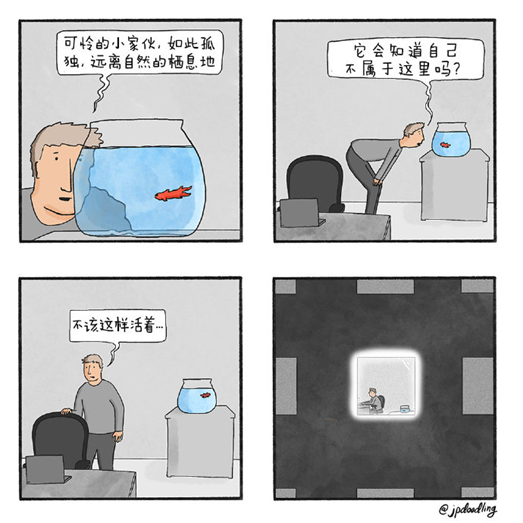
The “metaverse” does not merely represent humanity’s desire to escape reality. In fact, “metaverse” often reflects people’s dissatisfaction with reality and their desire to transform and reconstruct reality. What many people call the real world actually refers to “offline space,” but that space has already disappeared long ago: buildings no longer serve as providers of “space,” but merely function mechanically to house bodies. Human beings become resources, and buildings become warehouses. Offline space has to a large extent already deteriorated into Cartesian space, becoming the “grids” on the “Gestell,” thereby precisely losing the original meaning of space. By contrast, digital space on the one hand has the potential to push Gestell to the extreme, but at the same time it also provides the possibility of stepping outside Gestell. As the saying goes, “Where there is danger, there salvation also grows.” The plasticity of digital space makes the dissolution of space easier, but on the other hand it also makes efforts to rebuild space from below harder to stamp out.
We have already seen that, from the various interest-based communities of the early internet to the DAOs and “digital nomads” of the Web 3.0 era, new forms of association have emerged. In particular, “digital nomads” represent the counterattack of digital space against offline space—they are often not satisfied with socializing in digital space; instead, they pay special attention to face-to-face communication, to local offline connections, and to various practical activities of living together offline. They are simply not bound to staying in a particular region, but instead often fly around to meet online friends all over the world, and this is precisely because they value embodied presence and diversity.
Web 3.0 is not a one-way escape into the digital world, but the digital world’s counterattack against traditional space. It is precisely traditional space that has been dissolved or alienated, while the new digital generation is striving to bring real space back to our side from the metaverse.
Translated from the Chinese original with AI assistance. The original text is authoritative.