

This article was originally the topic of a talk I gave when I took part in a PTADAO sharing session as a friend. After the talk, I organized the text myself, and it was almost as if I reworked the whole line of thought from scratch, forming a more complete article. After it was published on “Yuaibo Sanguan,” it was retitled On Fully On-Chain Games: Reality Is Not Unreal, Virtuality Is Not False, Greatness Does Not Rely on Planning. This article can be counted as a “small synthesis” of my recent thinking. I’m posting the original here.
1 The game of innovation: the only way to achieve great innovation is to chase novelty and fun
Recently two scientists from OpenAI published a book called Why Greatness Cannot Be Planned, trying to argue that great technological innovation is often not the result of advance planning.
Since coming to Tsinghua, I have been researching and teaching the history of technology, so I am thoroughly familiar with this conclusion. There are simply too many cases in the history of technology: the Agricultural Revolution, the Industrial Revolution, the electrical revolution—all of them were like this.
First of all, the question “why greatness cannot be planned” is, in a certain sense, a kind of begging the question: the definition of the concept already presupposes the answer. “Planning” refers to steps or schemes specified in advance toward a particular outcome, and formulating a plan necessarily requires sufficient estimates of both the result and the path; but “greatness” often refers to major transformations that go beyond expectation. Since they are hard to estimate, naturally they are hard to plan.
That said, the proposition is not merely a tautology; it does have some heuristic value. It prompts us to reflect on the conditions under which “planning” is possible. The existing technological system is often precisely the background condition one must consult in order to make a plan. For example, if I plan to build a bridge, I need to examine the technological equipment available in the current market: what materials are available, what kinds of construction machinery exist, what transport tools there are, and so on. Once I have integrated my understanding of the existing technological system, I can formulate a plan effectively: can the bridge be built, and if so, roughly how long would it take and how much would it cost…
Building a bridge where there was no bridge before is, of course, a kind of “innovation” too, but it is not the “great innovation” that the book is talking about, or what is traditionally called “disruptive innovation” or “creative destruction.” The hallmark of disruptive innovation is that it does not merely make use of the existing technological system; it also destroys and reconstructs that system.
For a new technology to grow from an inconspicuous sprout into something that can form a new system takes a very long time, and during that period, rather than increasing productivity, the new technology often looks more like a waste of time and energy, a distraction from the serious business at hand.
In hindsight, disruptive innovation is certainly very “useful” in the end, but in its nascent stage that is not necessarily the case. For example, within a system crisscrossed by highways and gas stations, cars are certainly more useful than horse-drawn carriages; but in a system of dirt roads and relay stations, the primitive automobile was no more useful than a carriage.
Before Edison, electric light had already been studied for 80 years, and there were more than 20 inventors of the incandescent lamp alone; before the Wright brothers, there had also been nearly a century of research and practice on airplanes, and if one traces back to Leonardo da Vinci’s fanciful ideas, the history is even four or five hundred years long; before the earliest crops were domesticated, there were no full ears of grain, and only continuous centuries of artificial selection could complete domestication (regarding the motivations for early domestication, some archaeologists have proposed the garden hypothesis)…
If the goal is merely to improve lighting, then people in 1800 should have focused on oil lamps; if the goal is merely to fly into the sky, then people in 1800 should have focused on hot-air balloons. If everyone focused only on planable undertakings, then disruptive innovation would have no soil in which to take root and germinate.
In short, merely looking at the practical purpose visible before our eyes is not enough to become the driving force for those investors and inventors. But clearly they are not simply messing around aimlessly, banging here and striking there, or blindly following trends without the sustained accumulation needed for anything lasting; otherwise it would also be hard to accomplish great undertakings.
So what on earth is the driving force that pushes countless inventors and investors to pour their energy and material resources persistently into those new technologies that have not yet revealed any practical value, or are even still difficult to imagine as practical at all? On this point, the two OpenAI scientists give an answer: “Please note, this does not mean that life should be aimless and drift with the current. Novelty-seeking algorithms do not presuppose a specific goal, but they are guided by values, and that value is novelty and fun. So long as each time you choose the newer and more interesting direction, you will not be ordinary.”
“Novelty and fun” is not exactly the pursuit of “games”? We might as well call it a “game attitude,” in order to distinguish it from a “practical attitude.” A “game attitude” is an indispensable force driving great innovation.
It is worth noting that “games” stand opposed to “utility,” but not in contradiction with “making money.” So long as there is a cultural foundation that pursues novelty and fun, new inventions that are not yet practical can also become profitable as toys or entertainment products. These game projects, on the one hand, provide the masses with play and entertainment; on the other hand, they also provide inventors and investors with inspiration and feedback.
For example, beyond becoming a necessity for the AI industry, Nvidia’s graphics cards have long been supported by the gaming industry; what first brought OpenAI into the spotlight was creating AI players in the game DOTA2.
Before improving the steam engine, Watt had once started a business selling toys and musical instruments; Bolton, Watt’s partner who helped bring the steam engine into production, got his start making toys (not children’s toys, but various gaudy silver and gold tableware and vessels).
What inspired the Wright brothers was first the helicopter toy their father bought them in childhood. Later they began making toys themselves and selling them to friends; during the process they discovered that if the toy’s size was increased, it became difficult to get it off the ground, and this spurred them to study the principles of flight. The Wright brothers’ parents bought and made many toys, and even allowed the brothers to skip school on occasion in order to research and modify them.
The theoretical basis of the steam engine was the vacuum pump, and this invention originally came from the problem of pumping water for garden fountains. Later, both the Magdeburg hemispheres and Boyle’s vacuum pump were used extensively in public demonstrations…


The small gilt objects from which Bolton made his fortune

The Wright brothers’ childhood helicopter toy (reconstruction)


“Electric kiss,” an early application of electricity. The host would spin a wheel to generate static electricity by friction, allowing young couples to experience the feeling of being “shocked.” Before batteries and electric motors, static electricity had very few practical uses and was mainly employed for all sorts of novelty demonstrations.
2 The game of freedom: enjoying freedom is the purpose of civilization
We have already interpreted the meaning of “games” as “the original driving force of innovation.” Isn’t that overrating “games”? Not at all. In a certain sense, this is actually underestimating “games,” because this explanation merely sees games as a “tool” that benefits some other undertaking.
In Homo Ludens, Huizinga discusses many “explanations” of games, and finally comments: “All these explanations have this in common that they all start from the assumption that play must serve something that is not play… To every one of these explanations one can make the same objection: ‘Yes, but what is the fun of play?’”
The view that “games are beneficial to innovation” is hardly any wiser than the vulgar view of games. The common view holds that the meaning of games lies in “balancing work and rest” — “moderate play helps relax the nerves, so that one can better devote oneself to labor.”
No matter what games serve, we can continue to ask: where does the meaning of that purpose lie? For example: what are technological innovation for? What are people’s hard labors for?
Technology and labor are the truly instrumental things. Don’t people always say that technology has no good or bad in itself: a knife can kill people or cut vegetables, and the value of technology depends on how people use it? This neutralist view is somewhat naive, but those who support technological neutrality often only bring out this line when technology is under attack; yet when technology is being idolized, they pretend to have forgotten the view that technology is merely a tool. If one really insists that technology is merely a tool, neither good nor bad, then why think that developing technology is always a good thing?
The development of technology itself is not a good thing; in the final analysis, only when technological development promotes a good human life is it a good thing. But many advocates of technological neutrality do not really regard technology as a tool that is neither good nor bad; instead, consciously or unconsciously, they take technology to be the ultimate end. For example, many people see that “XX is conducive to innovation” and assume that XX has thereby been justified, no longer thinking to ask: what, exactly, is that “innovation” conducive to?
If games are beneficial to innovation, then games have legitimacy; so if, under certain conditions, enslavement is beneficial to innovation, does enslavement also gain legitimacy? Plunder, exploitation, theft, brainwashing… if they are beneficial to innovation, do they all become good things? Some people defend the primitive accumulation of capital; others defend the 996 system and the suffering of those at the bottom. They all believe that, for the sake of promoting technological progress, the suffering and sacrifice of an entire class or an entire generation are worthwhile. The problem is that technological progress has no end: if this generation should sacrifice its own happy life to accelerate technological progress, then the next generation can simply sit back and enjoy happiness? But if they keep sacrificing, they can keep accelerating technological progress! If humanity should sacrifice happiness for technological progress, then given that technological progress is endless, the conclusion is that humanity should endlessly sacrifice, endlessly suffer and toil?
If labor is not suffering, but rather a kind of life that is “better” than games, then the way we benefit future generations is to try every possible means to make future generations play less and work more? Is this really the direction in which human civilization is supposed to develop? Some ant enthusiasts may truly think so; in their eyes, the ideal social form should be an ant society, with the queen ant single-mindedly producing offspring, and the worker ants laboring together with one heart. But I obviously do not long for such a society. Freedom is human nature; a life that becomes ever freer and more at ease is what is worth longing for.
When praising arguments like “labor is the happiest thing,” one needs to distinguish between intrinsic and extrinsic happiness. For example, although labor itself is painful, one feels happy at the thought that labor can benefit others (one’s retired self, one’s descendants, or all humankind). This is extrinsic happiness. As I said above, if the meaning of this “benefit” is “bringing others more labor,” then this “happiness” is still empty and groundless, or else self-deceptive. Only when one thing can provide intrinsic happiness can we escape infinite regress and find an anchor point for meaning. So what would labor that intrinsically provides happiness look like? It is nothing other than labor like “games.”
So technology and labor themselves have no meaning; they are instrumental means in the pursuit of meaning. Only when they ultimately serve games, or themselves become games, are they meaningful.
Rather than saying that games are meaningful because they serve other serious matters, it is better to say that nothing has meaning until it finally becomes a game. Human civilization once achieved, in limited localities, this state in which everything was treated as a game. The most典型 example is the ancient Greek city-state. Hippolyte Taine, in his famous work The Philosophy of Art, said: “‘Oh, Greeks! Greeks! You are all children!’ Indeed, they took life as a game, all the serious matters of life as a game, religion and the gods as a game, politics and the state as a game, philosophy and truth as a game.”
The gymnasium and the theater were the cultural core of the Greek city-state, and in the marketplace and the town hall, the Greeks also conducted speech and debate as though engaged in an equal game of competition. In the academic temple, the Greeks likewise took pride in “curiosity,” enjoying the delight of knowledge itself, and were ashamed to seek practical purposes for knowledge. Legend has it that when a student asked Euclid what use geometry was, Euclid threw him three coins and angrily scolded him: “Now you have gotten your benefit; get lost.” This was the cultural trait of the Greeks. Olympia, drama, democracy, and mathematics, among other different aspects, can all be summed up as the Greek “spirit of play.”
Of course, the life of Greek free men depended on the support of slavery, but for modern people, even if one is involuntarily constrained at work, it is still possible to live as a free person in the eight hours after work, isn’t it? If one cannot even secure these eight hours of free life, then what meaning is there in eight hours of work?
The tragedy is that this eight-hour free life is on the one hand continually threatened by involution and overtime culture, and on the other hand always occupied by an entertainment industry that numbs and intoxicates people. But fortunately we still have games; games can still provide a liberating force. In my earlier article “Games and Their Mission,” I said: “Although the game industry is likewise undergoing modernization, and likewise experiencing alienation, if games are to be fun, they must always leave room for human ‘freedom.’ The mission of modern games is not only to fill people’s leisure time; more importantly, games can briefly lift people out of the cycle of utility, allowing them to experience once again the possibility of freedom.”

3 Games and Liberation: A Breakthrough Point for Breaking Free of the Shackles of Modernity
Modern society has liberated slaves, which of course is a major advance of human civilization. But if we become complacent with “progress” and lose the resolve and ability to further transform society, allowing the history of civilization to end here, that may not be such a wonderful thing either. In One-Dimensional Man, his classic work, Marcuse systematically criticized the predicament of “advanced industrial society”: humanity has lost its critical dimension and is left with only one dimension—submission to the industrial-technological system.
Marcuse said: “The liberating force of technology—the instrumentalization of things—turns into a fetter of liberation; it instrumentalizes man too.”
Industrial technology can of course be beneficial to humankind, helping to liberate human beings from servitude and pursue happiness. But in saying this, one cannot omit the “human” as the goal and instead reduce it to “industrial technology is beneficial,” while turning human beings into tools that are beneficial to industrial technology. That would invert means and ends.
We have already discussed the inversion of means and ends above—technological progress was originally supposed to be a means of benefiting human beings, but many modern people instead take it as the end that humanity ought to pursue. Marcuse goes further and points out that in advanced industrial society, this inversion of values has been institutionalized and solidified. The modern political system is no longer founded on goals such as the pursuit of freedom, equality, or human happiness; instead, the legitimacy of the modern political system is built upon “developing the productive forces.” It seems that the struggle among various “isms” is all empty talk, while improving productivity is what is real and tangible. Yet the problem is that to improve productivity, one must adapt to the industrial-technological system. The result is that the system best able to adapt to and develop the industrial-technological system becomes the best system. Thus, on the scale of the entire civilized society, humanity inverts means and ends, taking the maintenance of industrial technological development as the highest end.
In modern society, if people still want to continue talking about freedom, justice, happiness, and other grand concepts, they are very likely to be accused of being “impractical”: what you say sounds nice enough, but exactly what should be done? The “pragmatic” person demands that you present a feasible “plan”: what to do in the first step, what to do in the second step, and so on. After all, one cannot travel a thousand miles without accumulating small steps. But as I said earlier, great innovation cannot be planned. In this technological age that praises disruptive innovation, the entire social system itself has in fact completely refused disruptive innovation.
But has our social system really already attained perfection? Or does it only need incremental patching and repair to become eternal and indestructible? Over the past few decades, we have not seen everything steadily getting better and better without a hitch; on the contrary, problems such as cultural conflict, social polarization, class solidification, and the widening gap between rich and poor have only grown more and more severe. With the development of technology, some people’s lives have indeed become richer and richer, but humanity’s capacity to bring about catastrophe and self-destruction has also been increasing day by day. Even Fukuyama, who proposed the “end of history” thesis, no longer believes that humanity has found the final answer to social organization.
If we still expect great transformations to continue occurring in human society, how could that possibly happen? Must we wait until the existing system collapses before there is an opportunity to rebuild from the ruins? But with the rise of technological power, the collapse of modern civilization and the toppling-and-rebuilding of ancient civilizations are not in the same league. The disasters caused by ancient civilizations were all localized, whereas the cost of rebuilding modern civilization may be irreversible civilizational and ecological catastrophe.
So is it possible to explore a more gentle kind of disruptive social transformation? Marcuse’s student Feenberg, in Alternative Modernity, put forward some ideas for going beyond “instrumental rationality” and seeking plural rationalities. He did not mention games, but the typical case he offered for “another kind of rationality” was East Asian Go competitions. He pointed out that in Go, the emphasis on ritual propriety and respect goes beyond mere calculation aimed solely at achieving ends. In fact, this is precisely the characteristic of “games”: many games have certain goals, but no game is ever one in which “the end justifies the means.” The true aim of a game is always the pleasure intrinsic to the game itself, including various forms of enjoyment such as novelty, a sense of achievement, and friendship.
Beyond the spirit of play that transcends instrumental rationality, a carefully designed game is even more likely to directly become an experimental stage for some ideal social system. People can first explore in games the possibilities of all kinds of radical social transformations, without having to endure war in reality, and then put them into practice once they are relatively mature.

Whether turning left or turning right, all of it is just working for technological development
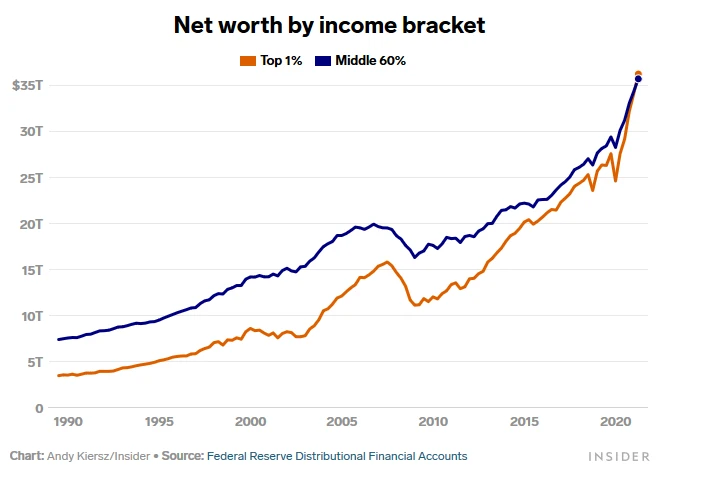
Income inequality in the United States is increasing day by day; the wealth of the top 1% of the rich already exceeds the combined wealth of more than 60% of the middle class
4 Real Games: Reality Is Not Real, the Virtual Is Not Virtual
Earlier we discussed two views of games. One is instrumentalist: it sees games as tools that are beneficial for other things—balancing work and rest is beneficial to work, or beneficial to promoting technological innovation, and so on. The other is existentialist: it sees games themselves as having intrinsic legitimacy and as not needing another thing to defend them—the intrinsic meaning of games includes various kinds of pleasure, novelty, a sense of achievement, a sense of excellence, and so on.
Note that what is meant here are two views of games, not two kinds of games. Different views may also exist regarding the same game. For example, with the same sport, some people see it as a profession for making a living, some see it as a means of exercising the body, and some enjoy its intrinsic happiness. Even within the same person, multiple views may be mixed together at once.
In addition to one’s view of games themselves, what also determines how people view games is their view of the real world.
There is a Japanese term, “genjū,” referring to people who live full lives in the real world. ACG (anime and games) enthusiasts believe themselves to stand in opposition to “genjū,” because people whose real lives are too full are usually unable to understand the world of anime and game enthusiasts.
This is of course reasonable. Reality, like any game, can draw people into immersion; only, compared with many games, most people’s “gaming experience” in the real world is not very good, so they are willing to seek supplementation in virtual worlds. Of course, some people merely hope to use games to escape reality, while others still persist in the hope of changing reality.
Regrettably, the real world is not always more “full” than virtual games. It is only a matter of a few people, or a few moments, that can feel full in the real world. For more ordinary toiling people, what is experienced in real life is only “toil and drudgery,” not fullness.
An assembly-line worker sits stiffly at his station, unscrewing bolts all day long, then drags his exhausted body onto a crowded bus and back to a tiny cubicle in the concrete forest. Only on the commute and while scrolling his phone before sleep does he feel a bit of relaxation. In such a life, the most fulfilling experiences are probably those provided by the virtual world inside the phone. Hard labor can make a person forget to think, but it cannot fill the spiritual world; otherwise, the slave who works like an ox or horse would be the most fulfilled of all.
In the industrial world, people become wage slaves, mineral resources, consumables, human resources… They exist as means of production, but as human lives, they are anything but real.
What does a person’s sense of reality depend on? In many literary and artistic works, it is often portrayed like this: when someone has traveled through time and space or fallen into a dream, and begins to doubt the reality of the world, the first thing he may do upon opening his eyes is look for a mirror, or look at his own hand (while moving his hand), or pinch his face. These actions are not a one-way reception of information, but an attempt to do something, and to see the “feedback” of these actions in this world. If I smile but the image in the mirror does not smile, if my finger moves but the hand I see does not move, if I touch my face but feel no change in sensation, then this world is unreal.
Seeing oneself in the external world is the way to confirm that the world and the self truly exist. In fact, Marx believed that this was the fundamental meaning of “labor”: “The object which labor produces — labor’s product — confronts it as something alien, as a power independent of the producer. The product of labor is labor which has been embodied in an object, which has become material: it is the objectification of labor. The realization of labor is its objectification. In the framework of political economy, this realization of labor appears as the loss of realization for the workers, objectification as loss of the object and bondage to it, appropriation as estrangement, as alienation.” (Economic and Philosophic Manuscripts of 1844)
After toiling hard and then seeing the harvest, after painstaking refinement and then seeing a mature work, after active action and then seeing others’ recognition… when the actions I can see leave a mark in the world instead of vanishing into thin air, I find it easy to feel fulfilled.
But Marx also noticed that this kind of behavior of “intuiting oneself” became “alienated” in the industrial age: “Labor is external to the worker, i.e., it does not belong to his intrinsic nature; that in his work, therefore, he does not affirm himself but denies himself… he feels at home when he is not working, and when he is working he does not feel at home,” (Economic and Philosophic Manuscripts of 1844)
Why is this so? First of all, it is caused by the new mode of industrial production. Assembly-line production is the culmination of industrialization. An assembly-line worker is quite different from a traditional artisan. When a traditional artisan is making something, his skill, his eye, his taste, his creativity, his will, all can be directly reflected in the finished work. When his skill improves, the work becomes more refined; when his creativity is distinctive, the work becomes more unique; when he does a sloppy job, the work becomes shoddy too… But none of this happens in the experience of an assembly-line worker. The assembly line does not require him to improve his skill or deliberate over creativity; he only needs to complete the prescribed motions as required, and these pre-set motions do not express his own will. In fact, an assembly-line worker may very likely never have seen what the thing he helped produce finally looks like. An employee on an iPhone production line may never have played with an iPhone, and would not feel proud of the iPhone’s brilliant design either.
The only feedback a laborer can see is the paycheck. But money is a completely neutral thing; there is nothing on it that shows your personality. In fact, you do not receive your wages as the unique you, but merely as the provider of “human resources,” receiving the sale price of a certain amount of labor power. What one can intuit directly from a salary is only the reality of a beast of burden, not the reality of a human being. No wonder Marx said: “The animal becomes human and the human becomes animal.”
Beyond physical labor, public action has also become increasingly hollow. In ancient times, when someone did a good deed, people within ten li or eight villages would praise it in one voice; when someone did something bad, neighbors might point fingers and whisper. But a modern person living in a cubicle in the concrete forest may live there for ten years and still not know his neighbors. In the real world, spaces where one can present oneself and receive feedback have almost ceased to exist. Instead, only in virtual spaces like Weibo and WeChat Moments do some room for action remain, however reluctantly. Yet many people with greater influence—stars and idols, and even politicians—have increasingly lost their real selves and become “personas” tailored by the entertainment industry.
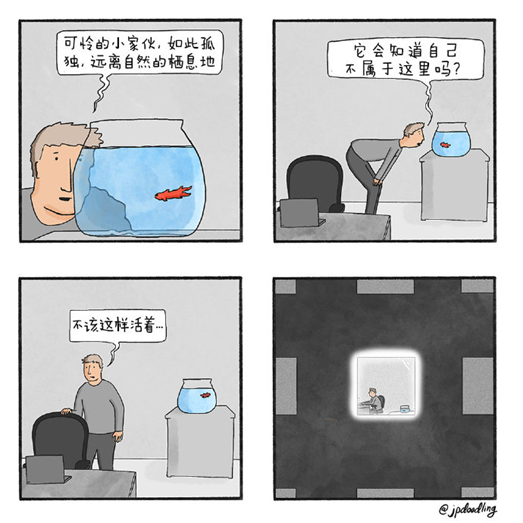

“Intuiting oneself in the world one has created” can also happen in digital worlds and virtual spaces. Rather, in this one-dimensional industrial society, virtual space has become a place of salvation for recovering a sense of reality.
The salvation offered by the digital world takes two forms: one is via hallucinatory anesthesia, using various sensory stimulations and frequent operations to plunge people into it, like drowning sorrows with wine, allowing them to escape a bad reality; the other is to provide more concrete “feedback,” giving people’s labor and actions a chance to leave more direct traces.
Even single-player games often involve collection systems, decoration systems, achievement systems, and so on, allowing players to see the fruits of their efforts at any time. In a typical gacha mobile game, do players play the game and collect cards because they are drawn to the exquisite card art? Not entirely. Because all that exquisite card art can be found online; just right-click and save as, and you can look at it as long as you want. But players’ desire is not merely to look at the cards; they also want to “own” them.
Is this “ownership” illusory? Not necessarily, because I really can activate it, operate it, and cultivate it—not merely stare at it, but see through it the feedback of my actions.
Moreover, the digital world is not only about single-player games; it also offers rich opportunities for interpersonal interaction, and within these interactions, various online communities form around shared interests. People’s actions can truly create echoes there, and they can gain tangible feelings of recognition, participation, and interaction.
In the online world, we can see many subtitle teams, mod creators, strategy sharers, wiki compilers, speedrun challengers, and so on. They are not doing it for money, but are selflessly sharing or displaying their creations. Because after sharing, they can see the world’s response and see positive feedback.
Within these “virtual worlds,” what people weave and create can not only gain resonance inside the virtual world itself, but may even feed back into our real world.
In a certain sense, the characteristic of human culture is nothing more than continuously constructing meaning in virtual worlds and, in turn, leading social development. This is not some off-the-cuff claim of mine, but a consensus among many historians and cultural scholars. The core point of Harari’s hugely popular Sapiens is precisely this; he sums it up himself: “The best way to describe Homo sapiens is as a story-driven animal. We created fictional stories about gods, nations, and corporations, and these stories became the foundation of our society and the source of the meaning of our lives.”
From the earliest cave paintings to epics, drama, and literature, and then to comics, film, and video games… the carriers through which human beings construct “virtual worlds” have kept growing richer, while the real power of virtual worlds has never diminished. What people have always pursued in virtual worlds are real things, even things more real than the real: that is, the power to dominate and lead reality.
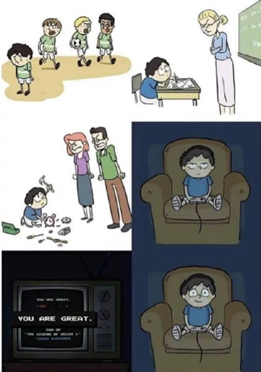

Even single-player games have a visible sense of achievement
5. Cooler Games: What Does a Truly “Revolutionary” Game Need?
Every game contains, to a greater or lesser extent, a spirit of freedom and a force of liberation, and this is true even of the kitschy games produced by the entertainment industry. For as long as it is a game, it always more or less requires the player’s personal participation and active interaction; a “player” who maintains autonomy and interactivity is always a bit freer than a mere “audience.”
McLuhan is the most famous media thinker. He pointed out that “the medium is the message,” meaning that in terms of the effects they have on people, the form of the medium itself is often more important than the content the medium conveys. Specifically with games, we can also say that the form of gameplay is at least as important as the game’s specific content.
McLuhan also proposed the distinction between cool media and hot media to differentiate between different tendencies of media. Cool media have lower definition and more blank space, requiring greater participation from people to complete them; hot media have higher definition and less blank space, requiring only simple reception of information.
Applying the language of cool and hot media, “games” are always somewhat “cool,” because the point of a game is always “play,” that is, active participation by human beings.
McLuhan’s use of the concept of “definition” can easily lead people to misunderstand. In fact, media’s “coolness” and “hotness” are not scientific concepts that can be precisely measured. In fact, McLuhan did not borrow the words “cool” and “hot” from the natural sciences; rather, he borrowed them from slang. Perhaps “cool media” and “spicy media” would be a better translation?
We say things like: “That cool girl is wearing hot pants,” or “That hot girl’s top is really cool.” Cool and hot often intertwine. McLuhan noticed the ambiguity of the concepts of cool and hot in slang, and he did not reject this ambiguity; on the contrary, it was precisely under this fuzzy popular semantics that he borrowed the two words.
Evidently, McLuhan prefers “cool.” When we say “That’s not cool at all,” we are not expressing any notion of temperature; more likely, we are saying that the matter is “boring,” or that it is “irresponsible, embarrassing, undignified,” and so on. McLuhan said: “Cool in slang also carries many other meanings. It signifies taking over the job, living the thing as a committed participant, one whose being is wrapped up in the process.”
It should be noted that McLuhan’s phrase “one whose being is wrapped up in the process” does not mean that the content of the medium contains all the senses; rather, it means that the “blank space” provided by the medium contains the possibility of total participation. If the medium itself is “high-definition” and provides sensory content that is too rich, it will in turn suppress people’s initiative and interactivity.
Human ability is limited. To focus on a particular action, one must simplify and block out sensory information that is too abundant. As the saying goes, only by shutting out the world can one concentrate on reading the sages’ books. If someone is always shouting in your ear, if your nose is always catching the smell of food, if the table keeps vibrating and spraying water, then let alone reading—you won’t be able to focus on anything at all.
LEGO bricks are an example of a “low-resolution” toy. Why not make the pieces smaller and the color schemes more dazzling? Then the resulting bricks might have finer “resolution,” but players would find it harder to manipulate and build with them freely. Of course, if the result looks too crude, that is no good either, because then the “sense of accomplishment” gained through personal participation becomes weaker.
Board games are another example of “low-resolution” games. Players do not need lifelike pieces or overly abundant sensory stimulation, such as furry “horses,” booming “cannons,” or “soldiers” that bleed. Richer sensory content would instead damage the game as a whole. Go, by contrast, is almost the epitome of “low-resolution”: its board and stones are the simplest and most austere, yet they provide the richest space for strategic contest.
VR games seem like the典型的“high-resolution” games, because they try to provide overly abundant, “all-sensory” content. But that is not entirely so. From my own experience, what is most exciting in VR games is not the high-resolution realism of the images, nor the high-fidelity surround sound, but rather the stronger sense of participation—“I can intuitively see the movements of my own hands.” Although my body in the VR world is a fictional digital avatar, every move I make can indeed receive direct feedback. Of course, any traditional game can also show feedback from one’s actions, but the room for action is extremely limited: I can only output “actions” through keys such as WASD. The reason some VR games feel more interactive and more real is that the room for my actions has been widened, because “all my faculties are drawn into it,” rather than because “all my faculties are stimulated.”
If a game’s sole purpose is to satisfy the sofa-potato “audience” in their time-killing needs, then of course it is worth developing toward “high resolution” and “all-sensory content.” But if what we want is a game that leans more toward “innovation,” “freedom,” “liberation,” and “reality”—a game of revolutionary significance—then high-definition content is not so important. What matters more is what is “cool,” the art of leaving blank space, so as to ensure realism and interactivity.
In my view, the truly revolutionary game is not an “all-sensory game,” but more likely an “all-on-chain game.”
6. All-on-chain games: what can blockchain provide for games
What is meant by an “all-on-chain game” refers to “putting all in-game behavioral interactions and target states on-chain, so that the core game logic and asset economic model are all handled through the blockchain, using the blockchain as the game’s server, while all player operations are completed through interaction with smart contracts, and even the game’s narrative and governance are decentralized in the form of a DAO, thereby realizing a truly decentralized game.” I also borrowed more of the technical principles from PTADAO; I won’t explain them in detail here.
Blockchain can provide decentralization and an immutable historical record. I have discussed these features at length on my blog as well, so I won’t belabor them here. Here I want to focus instead on what significance blockchain specifically has for a game.
- A sense of accomplishment from work
The immutability of blockchain records provides a visible and solid sense of accomplishment: the fruits of one’s actions are all engraved on the blockchain, and will not be tampered with by the game operator, nor vanish into thin air when the game shuts down.
- The authenticity of interests
Blockchain comes with its own currency system that can be freely traded across the globe, making it possible to bring real-money contest into the game. It is like adding some stakes to a card game, which better motivates players to invest their body and mind. In addition, the existence of actual interests can make all kinds of experimental social explorations more real; moreover, blockchain’s decentralization and ledger transparency make various interest relations more fair and transparent.
- The self-organization of communities
Richer communities of shared interest can also spontaneously form around traditional games, but social platforms are relatively flat, and the interactions among community members depend on various social platforms; identities on each platform and identities in the game often do not correspond to one another. By contrast, organizational forms based on blockchain, such as DAOs, can on the one hand also form spontaneous, bottom-up community organizations, and on the other hand allow these communities to have identity and social relations controlled entirely by the players themselves, unconstrained by any platform or service provider.
- The transparency of rules
Blockchain smart contracts can execute game rules in a completely fair and transparent form, including all kinds of experimental and radical rules.
- Transcending space
Transcending the limitations of traditional regions and national borders, joining the game requires no permission.
- Transcending time
The game may continue to operate spontaneously; as long as players remain, it can go on indefinitely, with no risk of being shut down.
- Incentivizing innovation
Although all-on-chain games are inevitably “low-resolution,” they leave more blank space, which is more conducive to generating content from the bottom up.
- Exploring revolution
Players can conceal their real-world identities and carry out utopian experiments in a safe and low-cost way.
I have recently been happy to tout PTADAO for free, precisely because of their understanding of all-on-chain games. Of course, I dare not guarantee that they will certainly produce the kind of revolutionary game I have in mind. Perhaps the successful one will be some other all-on-chain game; perhaps a half-on-chain game also has a future—who knows? But I have always believed that new forms of games combined with blockchain will be revolutionary, not only in terms of gameplay, but also in terms of how to overcome the various predicaments of modern industrial society.

Translated from the Chinese original with AI assistance. The original text is authoritative.