
What did I say? Why have I “not kept up closely with the new things in the crypto world in recent years”? Because it takes too much mental energy: there are too many opportunities, and before you know it you’re getting fomo. I played with NFT for a few days recently, and I felt that familiar sensation again. You really can’t linger in this circle for long; I’d better pull out early and get back to writing papers……
But I’ll still write down the second idea I came up with that night when I couldn’t sleep. At the time I actually mainly thought of three projects: one was 《Pantheon》, the second was 《World of Ideas》, and the third was 《Lyceum》, an elite academic publishing platform, something like a combination of arxiv/doi/sci-hub/CNKI. I’ve thought about the latter two only very preliminarily, but I don’t feel like pondering them further; I’ll just lay out the rough ideas for now.
《Lyceum》: A Decentralized Academic Platform
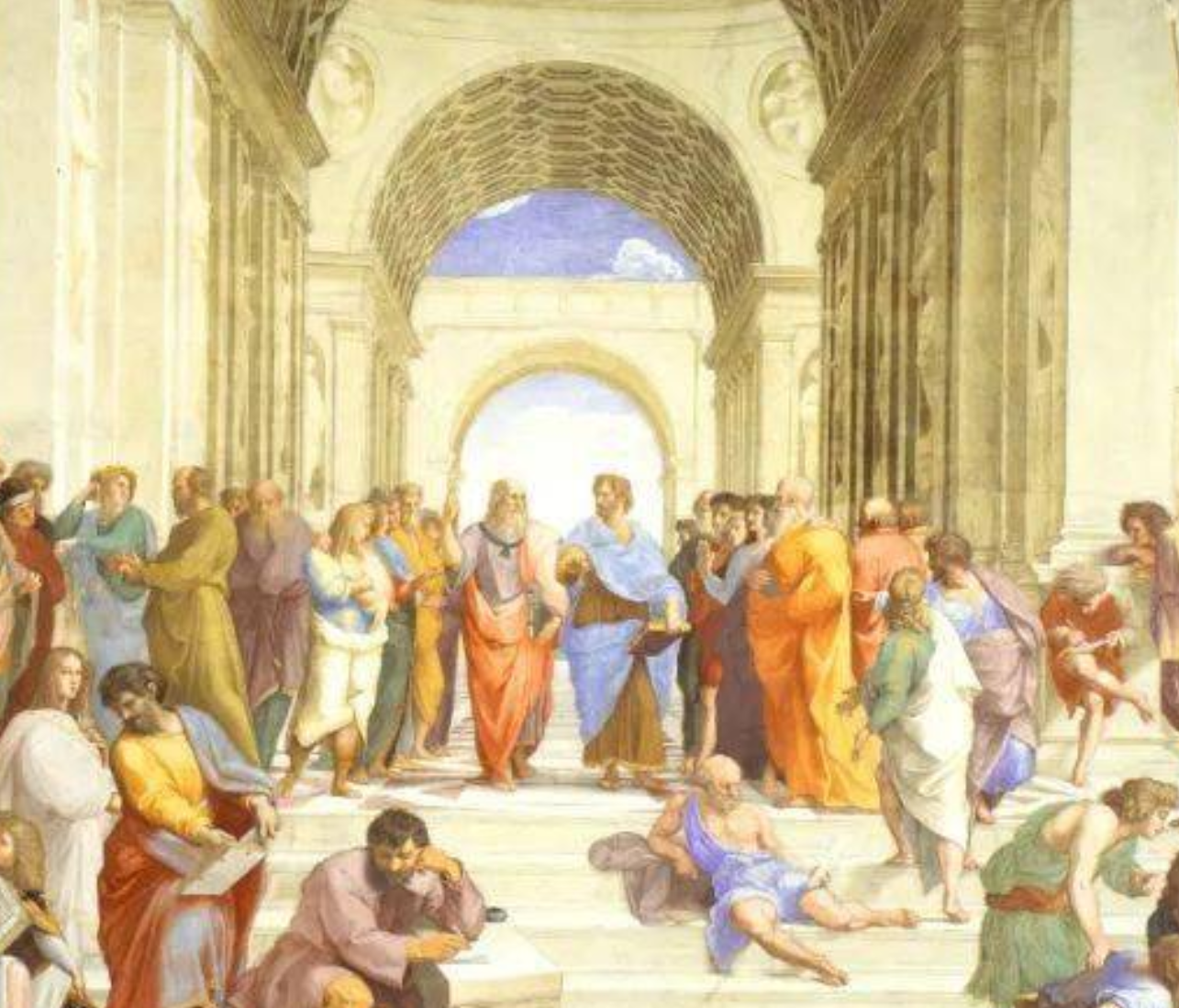
Let me start with the third. It could actually also be called 《Academy》, but academy itself has already become the common word for “academic,” so it’s better to call it 《Lyceum》. The Lyceum is both a continuation of and a rebellion against the academy, and its alternate name, the Peripatetic school, sounds a bit more decentralized.
There are already many decentralized text communities and text NFT platforms, such as mirror.xyz, BBS, and so on. But I feel their positioning is aimed at the mass market, whereas mass social interaction in fact has no very high requirement for decentralization at all. Turning likes into rewards, auctioning posts, and so on—these things can all be done on a centralized platform, and for ordinary participants there’s no real difference. If it’s a mass social platform, I’m more optimistic about what Twitter is rumored to be doing: built-in support for NFT avatars. Even functions that let users mint articles or posts as NFTs can be embedded and supported by existing large platforms like Twitter, Facebook, wordpress, and the like. Starting from scratch would make it very hard to compete with these mass platforms.
So I’m more optimistic about demand in elite fields, such as publishing papers. Some time ago, an old professor’s lawsuit against CNKI sparked a wave of discussion, and people discovered that CNKI is pretty bad—but in fact the academic platforms overseas aren’t much better. The platform charges the journal house (in substance, this is often charging the author), and then it also charges the reader, taking money from both sides, and the fees are all quite high. But the money paid by readers doesn’t reach the author, and the money spent by the author often doesn’t have the intended effect either (for example, helping to promote one’s own paper).
So “decentralization” has actually long since become a genuine need in academic circles. Ordinary people don’t care at all whether Twitter or WeChat is centralized or decentralized, but scholars all like decentralized platforms. I’m ignorant and unsophisticated, but I haven’t seen a single scholar who dislikes sci-hub. Yet although sci-hub is a pirate platform and has won the favor of scholars around the world, as long as it has a physical existence it can be blocked, sued, and then it will stop updating or even have its site shut down. So a decentralized sci-hub built with web3 and DAO is genuinely meaningful.
The paper NFT platform I imagine would require authors to pay in order to publish papers—this is a necessary threshold, and in fact paper authors are usually willing to pay page fees for a work they are proud of. Readers, however, would be able to read for free—that is also a necessary openness. But citations would require payment—this is included in the cost of publishing the paper, but it is not an extra fee. Papers with many citations and papers with few citations should pay the same publishing fee, so as to prevent authors from deliberately reducing citations in order to save money. If a published paper cites papers already on the platform, the cited authors will benefit. This would ensure that authors with greater influence earn more. Even things like SCI impact factors would be replaced.
Of course, journal editors would still have a role to play. In an environment of information explosion, editors take on the work of treasure hunters: they can proactively get in touch with paper authors whose names are not yet prominent, help them polish, collect, and promote their work, and thus collect remuneration from both authors and readers, with the difference that the author’s position is more free.
I don’t plan to sell this idea; whichever big shot wants to make it can go ahead and do it, and I’m even willing to donate money. First, because I believe other people can also think of it; at present there aren’t many serious scholars participating in the NFT craze, but if there were more serious scholars, this kind of demand should be something everyone could think of. Second, because I believe knowledge sharing is priceless.
《World of Ideas》: A Top-Down Crowdsourcing Platform
The second idea is still a game, but perhaps in a broader sense. This idea is the vaguest, so I’ll just speak casually about it.
“World of Ideas” is Plato’s philosophical term. Plato thought that the world of ideas stands above the real world: the former is the world of the knowable, the latter the world of the perceivable, and the real world is a “mimesis” of the world of ideas. For example, in the real world there are various “circles,” but all real circles are imperfect. Yet the “archetype of the circle” that makes them all circles is perfect, and that perfection exists in the world of ideas.
The world of ideas is motionless and eternal. In reality there is birth, aging, sickness, and death, and everything is inevitably subject to decay, but the existence of the world of ideas is forever perfect, so it does not change.
When I talked about the metaverse earlier, I said that the metaverse is not virtual reality but hyperreality, reality above reality. This “world of ideas” is taking that meaning. The eternally unchanging image of NFT also fits the mood very well. (Let me state again: this is a game design. I’m not saying that I accept Plato’s doctrine, nor am I saying that I think NFT is truly an eternal thing.)
So what is in the world of ideas? Eidos—that’s Plato’s term, usually translated into English as idea or form. In Chinese it can be translated as 理念, 形式, or 理型. In fact, for scholarly discussion, 理型 may be better, but for popular understanding, “理念” may be smoother.
Of course, the NFT of 《World of Ideas》 could also be named “universals” or “archetypes.”
The very notion of “archetype” here is itself also an “archetype”; it can be extended into many more specific game designs.
The core of my thinking is actually consistent with what I’ve repeatedly expressed before: NFT is elite, or at least NFT on decentralized blockchains is elite. Don’t expect mass participants to each have several NFTs before they can play a game.
The division between the world of ideas and the real world distinguishes the boundary between NFT holders and community participants. The community can be barrier-free and organized around various centralized platforms. NFT holders, as the center of various centralized platforms, function as “meta-centers.” Just as the world of ideas is motionless and eternal, holders of ideational NFTs do not need to operate frequently; they only need to remain still, or to play their role in a “emanative” way (the Neoplatonist term).
For example, in the 《Pantheon》 I designed earlier, if the holders of the major-god cards are set up as “archetypes,” then in the actual game platform they can have countless “mimicries” or “avatars” (the original meaning of avatar). These avatars do not have to be NFTs.
Of course, you don’t have to use a divine system; you could instead switch to a gacha game that requires heavy spending (such as FGO). In this game, NFT cards can serve as “archetype cards,” or “mother cards.” Each heroic spirit corresponds to an “archetype,” but in fact when players whale on gacha pulls, what they draw is not the NFT card as archetype, but unlimited imitation cards as replicas. This is actually the setup of FGO: heroic spirits exist in the eternal Throne of Heroes, and summoning (pulling gacha) is really just drawing a version of the heroic spirit (a copy). In fact, games like FGO are already very popular now; people don’t care whether the cards they draw are NFTs, and everyone happily pulls away. So what use is a mother card? A mother card is not meant to actually enter the game field; it takes effect when people spend money. For example, when a player chooses a certain mother card and whaling is directed toward it, the drop rate of that card can be increased, or when a player uses spending to cultivate a certain card, the corresponding mother card can receive the corresponding spending. Simply put, mass-market games do not need NFTs to participate directly; ordinary people can also play for free. It is only in the spending phase that they come into contact with NFT cardholders. Even this need not be mandatory: players can still spend RMB and the like through the operator, and blockchain spending is only one option among others.
So what are the benefits of blockchain spending? First, it bypasses extra payment fees like the Apple tax; second, it creates a public and transparent ranking list (during the ranking period, the cardholder’s access to the fund pool must be frozen); third, the gacha mechanism becomes public (drop rates and random numbers can all be made into on-chain programs running openly), ensuring fairness while also allowing people to show off. Fourth, it is a way of community interaction: although in principle NFT mother-card holders can remain still and do nothing, in order to attract gacha players they can take more active actions, such as subsidizing artists to make better card art or costumes, and so on.
Of course, the “archetype cards” discussed above are still quite far from archetypes in the Platonic sense. What is closer to Plato’s “ideas” may be “words.” There is already a crowdsourced NFT game based on a set of words—Loot. Each NFT has only 8 words, representing a set of equipment. Then the community designs games based on these equipment cards.
Eight words is still a bit too many. Why not make it so that one word corresponds to one NFT? In fact, there aren’t that many commonly used English words; a vocabulary of a few thousand words is enough for everyday communication, and more complex meanings can be formed by combining multiple basic words. Or we could also consider making Chinese character NFTs; in fact, there are only about 3,000 Chinese characters commonly used in daily life, so one Chinese character could be one NFT.
On the basis of basic concepts, the community could develop all kinds of gameplay, such as making cards for each concept and combining multiple concepts to form new secondary ideas, and so on. I haven’t worked this part out yet.
The relationship of “archetype—copy” can also be applied to the construction system of virtual worlds of the “Minecraft” type. We first provide the most basic “bricks,” and then builders can freely choose all basic components to construct a more complex unit, such as a “bed,” a “door,” and so on. Basic bricks can be copied and used freely without limit. But a builder can register one of the composite structures they have assembled as an NFT; at that point they need to pay a certain tax to all the components used by that structure. NFT is unique: each fixed structure can only be registered once. New NFTs can also become new components, which can be copied and used freely without limit by other builders. But if other builders want to register a more complex structure they have built as an NFT again (such as a house, a block, and so on), then they also need to pay tax on all the original and derived components they used.
The benefit of this is still the same: players can start playing for free and create freely; only when they need to fix their own work as an NFT do they need to pay money (and at the same time, they also gain the possibility of earning money).
This time I tried minting an NFT on mirror.xyz
Translated from the Chinese original with AI assistance. The original text is authoritative.