
This was a lecture program I recorded at Super Star half a year ago; a cut version can be found here https://www.bilibili.com/video/BV1W34y1z7QD?from=search&seid=5300241720853418317&spm_id_from=333.337.0.0. The full version is probably on Super Star.
The transcript of this lecture was handed to Li Shi for revision and enrichment, and was rewritten into a book review published in issue 10 of Chinese Media Technology in 2021, titled “Embracing McLuhan in Fragments—A New Perspective on Reading Understanding Media.”
Here I’m posting the original spoken version of the script.
McLuhan is an oddity in the history of scholarship: it is hard to categorize what sort of “-ist” he actually was. Naturally, when that happens, we generally just call him a philosopher. He certainly had a great deal of knowledge of philosophy, especially continental existentialist philosophy; he also knew contemporary art very well, and had wide-ranging interests in history, anthropology, psychology, social criticism, and more. His horizons were remarkably broad. But if we ask what his formal academic training was, it was actually English literature.
McLuhan was born in Canada in 1911, and his academic career was active in Canada and the United States. He studied English literature for both his bachelor’s and master’s degrees and also for his doctorate. He began as a professor of literature, and only after becoming famous did he found an interdisciplinary institution such as the Centre for Culture and Technology.
McLuhan’s debut work was The Mechanical Bride, published in 1951. This book still largely belonged to the field of literary studies. Its objects of analysis were mass media such as newspapers, posters, and film, with a special focus on the “advertisements” within them. The writing style was rather unconventional; one might call it a “clipping” style: he would extract a case and then comment on it, with dozens of scattered cases in total. After its publication, the book did not cause much of a stir.
The 1960s were McLuhan’s creative peak. The Gutenberg Galaxy, published in 1962, was the work that made him famous; the Chinese translation is titled Gu 登堡星汉璀璨. The “galaxy” here, in fact, is also McLuhan’s style: when you look at it locally, it seems to be nothing but a shattered mess of individual stars—short pieces that appear independent—but only when you look at it as a whole can you see that there may be a systematic structure present.
Although The Gutenberg Galaxy, like The Mechanical Bride, also has a mosaic-like, fragmented style, on the one hand ten years had passed and McLuhan’s thought had indeed become much weightier and deeper; on the other hand, it may also have had something to do with the rise of the so-called “Beat Generation” in the 1960s and the beginnings of the hippie movement. Young people who grew up after the Second World War were more inclined to rebel against the mainstream and resist order, and McLuhan’s style and thought could more easily strike a chord with them. In any case, The Gutenberg Galaxy received a good response.
Two years later, Understanding Media, published in 1964, further propelled McLuhan to great fame. This is also the magnum opus that brings together the whole of McLuhan’s thinking on media. Stylistically it is still wildly imaginative, but compared with his other works it is actually already much more “proper.”
After these two books, and until the early 1970s, McLuhan was not exactly known to every woman and child, but he was certainly a celebrity figure in North America. If young people did not throw out a couple of lines about McLuhan, they would seem uncultured. He even made a cameo appearance as himself in a famous film starring Woody Allen.
But like any wave of popular culture, McLuhan rose quickly and cooled off just as fast. By the mid-1970s, McLuhan had begun to “go out of fashion.” Around the time of his death in 1980, his thought was not exactly ignored, but it did lack successors.
It was not until the 1990s, with the advent of the internet, that McLuhan became hot again. In the inaugural issue of Wired, founded by Kevin Kelly, McLuhan was mentioned and hailed as a “prophet” of the internet age; many of his statements, the magazine argued, had been “fulfilled” in the internet era. This wave of enthusiasm was not especially feverish, but it did not fade away easily either. More and more philosophers, cultural critics, and communication scholars began to take McLuhan’s theories seriously.
Over the past ten years, McLuhan seems to have entered a third spring of sorts, because we have moved into the era of so-called “social media.” His notions of the “global village” and the like have become increasingly easy to accept, and the word “media” itself has also become more and more important.
We can see that in the latest Chinese translation of Understanding Media, celebrities such as Ma Huateng and Luo Zhenyu have also joined the list of recommendations, and it is said that one can read “internet thinking” out of this book.
The fact that any scholar or any book has been popular for a few years does not in itself prove much. But if it has been popular again and again for more than fifty years, continuously attracting admiration, then the book is certainly worth reading—even if only to understand why it has been so admired, which is itself quite meaningful, because the history of its reception reflects the cultural changes and transformations of the times, from the television era to the internet era. Whether one can in fact read “internet thinking” out of it, however, is still a matter on which opinions differ. McLuhan’s own thought is extremely open; rather than saying that his ideas already contain some particular “thinking,” it is better to say that his arguments are highly inspiring and can stimulate readers in different eras to think for themselves.
Of course, McLuhan’s style and thought are highly distinctive. If you are not used to his manner, it is very likely that you will not be able to get into his rhythm, will fail to resonate with it, and may even finish the book only to sneer: what on earth is all this? So in my discussion that follows, I will focus on the opening section of Understanding Media in order to help everyone adapt to McLuhan’s basic style and line of thought, so that you can then continue reading on your own smoothly. I do not hope to provide a comprehensive summary of every chapter in the book. Such a summary might be condensed into some neat “views” or “conclusions,” but this method of “refined conclusions” is not suitable for reading McLuhan or any philosopher with a broad horizon and keen thinking, because the value of these works does not lie in specific conclusions, but in the inspiration brought by their unique perspective and mode of thought. My guide is meant to lead you into your own reading, not to replace it.
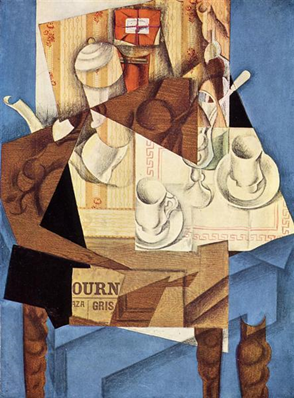
Let us now focus again on McLuhan’s writing style. As just mentioned, McLuhan’s style is sometimes clipping-style, sometimes galaxy-style, sometimes aphoristic, sometimes mosaic-like… in short, fragmented.
You may be wondering: is this style caused by McLuhan’s background in literature? A literary youth, with withered vines, old trees, crows at dusk, small bridges, flowing water, and people’s homes—doesn’t that just mean speaking in terms of mood rather than logic? Indeed, McLuhan’s media theory is truly related to his literary background, but it is not the case that the literary style of his youth simply carried over unchanged. On the contrary, McLuhan’s new style was consciously constructed when he turned to media studies.
When he was still a literature student in his early years, he was actually rather conventional. His master’s thesis studied a 19th-century English poet, and it was written in a proper, standard style, with orderly argumentation—completely different from the freewheeling style of his later years.
The reason McLuhan consciously established this distinctive style was precisely bound up with his media thinking. He kept his ideas and attitude consistent throughout, expressing them not only through content but also through form.
In simple terms, McLuhan opposed mechanical, linear, detached modes of thinking—precisely the things emphasized by mainstream academic papers. He advocated an integrated, Cubist, sensory-immersive mode of thought, and he applied this method in practice.
McLuhan often mentions “Cubism.” “Cubism” is, of course, the term for that school of painting; even if you are aesthetically illiterate, you must at least have heard of Picasso, who for a time was the representative figure of Cubism.
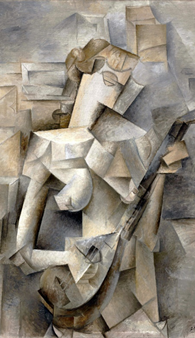
Cubism is a milestone in contemporary art. Earlier Impressionism was already somewhat anti-traditional, but even laypeople could still make some sense of it. By the time of Cubism, however, laypeople could no longer take it: what on earth is this stuff?
Why can’t laypeople understand Cubist painting? McLuhan hits the nail on the head. He says—by the way, the quotations here are all McLuhan’s own words from Understanding Media—“Because people always like to ask what content a painting represents.”
McLuhan often said that artists are usually ahead of their time, and contemporary art had already silently expressed the new philosophy of media. Since the Renaissance, or rather since the print age, the basic characteristics of Western art have been mechanical, linear, and detached. The viewer stands in front of the painting, the object presented by the painting is on the other side, and both the viewer and the object are outside the frame; the painting itself is a medium that is “seen through.” Aside from conveying content vividly and realistically, this medium has no meaning of its own.
So for those accustomed to the print-age mode of thought, when they see a painting, the criterion by which they judge it is whether it “looks like” the thing. A painting that looks vivid and lifelike, “just like the real thing,” is a good painting. An even better painting might depict something more beautiful than the real object. But in any case, the object—or the thing itself—as the content of painting, is the basic standard by which a painting is judged; the degree to which it approaches or surpasses the real thing becomes the measure of the painting’s quality.
Contemporary art, however, no longer regards painting as a transparent medium. Artists believe that painting itself can open up an independent space of meaning; the meaning of a painting lies on the canvas itself, rather than being defined by some object behind the canvas. Of course, Cubism still does not completely sever itself from the “object”; it still tries to express the object, only now it seeks to present all the different aspects of the object on a single canvas. But the standard supplied by the object has already begun to take a secondary position, while the space of meaning endowed by the art of painting itself has grown. After Cubism, the various contemporary art movements moved even further beyond these restraints, but I will not go into that here.
Spending so much time discussing contemporary art is extremely helpful for understanding McLuhan’s thought. We will see that McLuhan’s central insight, the so-called “the medium is the message,” is completely consistent with the ideas of contemporary art. The transformation from classical art to contemporary art is nothing more than a shift from “conveying a message through the painting” to “the painting is the message.”

“The medium is the message” is McLuhan’s most widely quoted, and also one of his most electrifying, maxims. In the very first paragraph of the main text of Understanding Media, McLuhan states this maxim in no uncertain terms. He says:
“In a culture like ours, long accustomed to splitting and dividing all things as a means of control, it is sometimes a bit of a shock to be reminded that, in operational and practical fact, the medium is the message. … any medium or extension of ourselves, . . . introduces a new scale into our affairs.”
Earlier we said that McLuhan consciously rejected mechanical analysis and linear, logic-based writing, adopting instead a distinctive mode of writing. The first paragraph of the main text serves as a perfect gloss on this practice. The analytical mode of writing is precisely what is meant by “splitting and dividing”; this writing style is regarded as a mere “means,” and the standard by which this means is judged lies in its “control” over “things.”
Just as in the mechanical age the standard for judging painting was whether it “looked like” its subject, in the mechanical age the standard for judging writing was nothing more than whether it was “correct.” Writing was nothing but the expression of some “content,” and the techniques, style, form, rhetoric, and so on of writing were nothing but means for presenting that “content” more clearly and transparently—for example, opinions, positions, information, or conclusions. There are only differences of efficiency and precision in writing technique: efficiency means expressing content more concisely, while precision means approximating the “original meaning” of the content as closely as possible.
But “the medium is the message” means that “writing,” as a medium for conveying messages, is itself also a “message”; the standard by which writing is measured is not determined solely by the degree to which it approaches “content,” but writing itself also furnishes its own “standard.” This standard is even more important, because how “content” is to be measured in turn still has to be assessed according to the standard of the form of writing.
McLuhan put his own view into practice, and it can be said that if you understand the form of McLuhan’s works, then you can understand the core ideas they seek to express, and vice versa.

Beyond artists, the idea that “the medium is the message” had already been expressed in different ways by many earlier thinkers, including Harold Innis, McLuhan’s mentor and friend, with his “bias of communication” theory, and also earlier philosophers of technology such as Mumford and Heidegger, and it can even be traced back to Marx.
Put simply, all these thinkers acknowledge that “the intermediary is not neutral.” Whether means, tools, media, or technology—anyhow, those things ordinarily regarded as merely “intermediate links” are not simply neutral parties.
McLuhan also began by criticizing the neutralists. For example: “The products of modern science are neither good nor bad in themselves; it is the way they are used that determines their value.” “Firearms are neither good nor bad in themselves; it is the way firearms are used that determines their value.” These are all typical neutralist views; the expression more familiar to us Chinese is the notion of a “double-edged sword.” But McLuhan believed that these statements “ignore the nature of the medium.”
How should the value of firearms be measured? Neutralists understand them entirely from the standpoint of the object toward which this means is directed—firearms can blast good people or blast bad people; blasting good people is a bad thing, blasting bad people is a good thing, and that’s all there is to it. This is not wrong, but it is too superficial, because besides the standard supplied by the object, firearms themselves also supply a new standard.
Marx once said that “gunpowder blew the knightly class to pieces,” but gunpowder can of course kill knights, peasants, workers, and capitalists alike—so why did gunpowder specifically shatter the knightly class? This is very hard to explain with neutralist thinking. In fact, the key is that firearms supplied many new standards.
For instance, in terms of sheer lethality, early muskets were not necessarily more powerful than bows and crossbows, but training a batch of musketeers was much easier than training a batch of longbowmen or mounted archers. Military organization therefore had to change, in recruitment and training and so on, according to the standards of firearms. Again, the impressions produced by warfare with firearms and warfare with cold weapons are very different for participants and spectators alike; individual valor and knightly glory were greatly diminished before muskets. Again, musket production was more compatible with standardized industrial production, which also promoted the comprehensive war form of total mobilization centered on the state machine.
Exactly what new standards gunpowder supplied can of course still be studied and debated, but in any case, these standards are supplied by gunpowder itself; along with the spread of gunpowder, these new standards push forward changes in people’s ideas and in society.

The railway is another example, and McLuhan was especially fond of citing it. The role of the railway as a transportation medium is nothing more than transporting people or goods, but if you only keep your eyes fixed on cargo, it is hard to understand the role the railway has played in human society as a whole.
McLuhan said: “The railway did not introduce movement or transportation or wheel or roads into human society, but it accelerated and enlarged the scale of previous human functions, creating totally new kinds of cities and new kinds of work and leisure.” “Such changes had nothing to do with the goods or content of the railway medium.”
No one would deny the railway’s impact on human society, but how to understand that impact is a matter on which different people, starting from different disciplinary perspectives, will have different insights. For example, there was a econometrician named Robert Fogel, who received the 1993 Memorial Nobel Prize in Economic Sciences. He had a much-debated study whose conclusion was that “the railroad’s impact on the nineteenth century American economy was almost negligible.” How did he arrive at this conclusion? First he tallied the various kinds of transport carried out by rail, then assumed that they were replaced by other modes of transport and calculated the changes in cost-benefit; in the end he found that if there had been no railroads, America’s GNP in 1890 would have fallen by only 1.7 percent.
His method was to stare at the railway’s “content,” but we know that the railway exerted a very broad influence on American society in the second half of the nineteenth century. It can be said that America’s so-called westward expansion movement as a whole depended on the transportation network formed jointly by railways and inland steamboats; the cowboy culture we now commonly see in American Westerns also has as its real background the linkage established by rail between the eastern and western United States. America’s becoming an agricultural power was also related to the railways. In these respects, what the railways provided was not higher transport efficiency, but many new standards that previously did not exist. For example, without railways, getting live cattle all the way from Texas to major cities in the eastern United States would not at all have been a matter of cost being high or low, but a matter of whether it was possible or impossible. Without railways, many trade routes simply would not exist. And the calculation of cost-benefit, so-called, always presupposes the existence of the corresponding trade in the first place. Railways stimulated the formation of new trade routes, and only then did there emerge cost-benefit measurements based on those trades.
8.

Whether it is the example of firearms or the example of the railway, we can see that neutralists analyze them as isolated fragments that can be split off from the whole social operating system, whereas McLuhan’s vision is cubist and holistic. In other words, these new things are less individual new components than they are what together built an entirely new “environment.” Firearms, rather than changing the means of warfare, changed the military environment; railways, rather than changing the means of transportation, changed the trade environment.
McLuhan himself adds: “The meaning of ‘the medium is the message’ is that a totally new environment was created.”
The visual illusion on the right vividly displays the role of “environment” in perception. Which of the circles in the middle is larger? To us, the right one clearly looks larger, but in fact they are the same size. Why does it look so different? That is the effect of “environment.” If such a simple environment can play tricks on our senses like this, then how much more impact must the changes in the objects of daily life—things that are visible wherever we look and that we live with day and night—have on our perceptual world?
Even if we still regard media as mere “tools,” passive things whose use is entirely under human control, that still does not mean that the dispositions and attitudes of “human beings” can remain unchanged in the face of these tools.
McLuhan quotes a passage from the psychologist Jung: “Every Roman lived surrounded by slaves. Slaves and their mentality ran wild in ancient Italy, and unconsciously every Roman became, psychologically, a slave. Because they lived constantly in the atmosphere of slaves, they were also infected through the unconscious by a slave mentality. No one can protect himself from such an influence.” Put simply, if masters grow accustomed to enjoying an environment composed of slaves, then their thinking will revolve around slaves; whenever they think about anything, they will always evaluate it under the standards supplied by slavery. How to drive slaves, how to use slaves—these slave-centered questions become the basis of all his thinking.
9.

At this point, we finally see the importance of the title Understanding Media. This is not an ordinary phrase; it does not simply mean “on media.” “Understanding” does not mean “analyzing,” much less “using” or “exploiting.” The word itself calls for a cubist, holistic perspective.
McLuhan said: “Our conventional response to all media, namely, that it is how they are used that counts, is the numb stance of the technological idiot.”
At this point, I think everyone will no longer ask questions like these: What use is Understanding Media to me? What specific problems does Understanding Media solve? Of course, this is not to say that there is no “content,” no “conclusion,” and no “use” in Understanding Media; rather, it is to say that these are not the key points. Gutenberg’s printing press certainly also printed a great deal of content, but asking exactly which books Gutenberg printed is not the key to understanding the significance of the printing press. In the same way, the mode of understanding displayed by the book Understanding Media itself is more important.
In the book, McLuhan examines more than twenty kinds of “media,” including speech, print, clothing, money, clocks, weapons, and so on. But more importantly, these lines of thought can also be borrowed by us, inspiring us to understand the various media around us. How, for example, are we to understand WeChat? If we merely focus on how the text transmitted by WeChat differs from the text transmitted on a postcard, then we may be missing the point by miles. Clearly, what all kinds of social media bring us is not just content.
In this age of media proliferation, it is easier for us to resonate with McLuhan, because the shocks brought by media change are becoming ever more intense and frequent. A thousand-year upheaval like the one from handwritten books to printed books may today occur once every few years. That is also why McLuhan has once again drawn attention.
10
Having come this far, we have probably at last finished reading the guide to the first subchapter of Understanding Media. This guide is extremely important. We need to carry out a kind of “paradigm shift,” adjusting our reading attitude and reading purpose, and trying to shift the focus from content to environment, from use to understanding. If this shift cannot be made, then the more you read, the more awkward and the more averse you may become, until in the end you toss off a “that’s all?” and call it a day. But if this shift is accomplished, then we can continue reading along McLuhan’s line of thought, and whether we broaden our horizons by taking in the general sweep or draw inspiration from the details, I believe we will not come away empty-handed.
The second chapter is called “Hot and Cool Media.” This chapter is also notorious as a chapter that sends readers running for the exits, because readers may discover that when McLuhan introduces this pair of key concepts, he always seems muddled and vague, and may even appear self-contradictory. Many scholars who admire McLuhan also have reservations about this passage and think it can be skipped over.
But I feel that if we can carry through the paradigm shift accomplished in Chapter 1 and then return to Chapter 2, we may arrive at a different understanding.
Let us review the first sentence of Chapter 1: “Our culture, long accustomed to splitting and dividing all things as a means of control … to introduce a new scale into our affairs.”
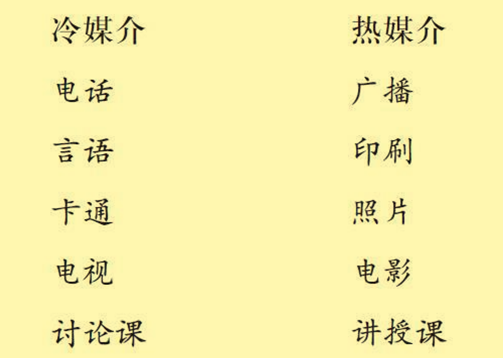
In the preface to the revised and annotated edition, Gordon made a table, including telephone (cool) / radio (hot); speech (cool) / print (hot); cartoon (cool) / photograph (hot); television (cool) / film (hot); seminar (cool) / lecture (hot). There is nothing wrong with this table, but if it is taken as an important result of hot-and-cool-media theory, then it may be somewhat misleading, because tables of this sort easily steer our thinking toward the so-called “splitting and dividing,” turning the concepts of hot and cool media into a way of labeling various media with precision.
Hot and cool media are not an either-or binary label. Rather, this is a new scale McLuhan offers for “how to understand media.” And this scale is not like a ruler or a thermometer, a precise linear scale from 0 to 100.
11.

McLuhan did not borrow the words “cool” and “hot” from the natural sciences. In fact, he borrowed them from slang. Perhaps a better translation would be “cool media” and “spicy media”?
We say things like, “That cool girl is wearing hot pants,” or “That hot girl’s top is really cool.” Cool and hot often intertwine. McLuhan noticed the ambiguity of the concepts of cool and hot in slang; he did not reject this ambiguity, but rather borrowed these two words precisely under the popular, ambiguous meanings they already had.
Clearly, McLuhan prefers “cool.” When we say, “This thing is not cool at all,” we are not expressing any temperature concept; more likely, we mean that it is “flat and boring,” or that it is “irresponsible, embarrassing, undignified,” and so on. McLuhan says: “The use of ‘cool’ in slang also has many other meanings. It means to bear a responsibility, to be personally involved, to engage all of one’s faculties.”
McLuhan says that a medium is “cool,” which is somewhat ambiguous, but clearly no more ambiguous than when people say that a person or a thing is “cool.” Ambiguous though it may be, the “cool” of slang is still substantial; it can still become a scale for measuring things. This scale is by no means scientifically precise, but it is more intuitive and sensory.
Of course, hot-and-cool-media theory is often misunderstood, and McLuhan himself bears some responsibility for that; he really did offer a set of “definitions” that are easy to misunderstand. He says:
Here is a basic principle. Hot media extend only one sense, and possess “high definition.” High definition is a state of being filled with data. Visually, photographs have high definition, while cartoons have only “low definition.” The reason is simple: they provide very little information. The telephone is a cool medium, or a low-definition medium, because it provides the ear with rather scant information. Speech is a low-definition cool medium because it provides pitifully little information; much of the information must be filled in by the listener. By contrast, hot media do not leave so many blanks for the receiver to fill in or complete. Therefore, hot media demand less participation; cool media demand more participation and require the receiver to supply more information. Naturally, the effects of a hot medium like radio on the user are very different from the effects of a cool medium like the telephone.
“High definition,” “filled with data,” “information-poor” — these terms easily tempt us to understand things from the perspective of information science, where “amount of information” is an objective value that can be measured precisely, and we may then easily come to think that hot and cool media are also a precise classification.
But judging from McLuhan’s consistent style, what he is discussing here in terms of information is the degree of “blank space.” The difference between hot and cool media lies mainly in whether their extension of the senses is monotonous or all-around, and whether the user’s degree of participation is rich or meager; in short, the key lies in the way the user is affected.
Simply put, in terms of transmission, hot media are more powerful, but for that very reason you can be lazier, handing everything over to the medium and not needing to take responsibility yourself. Conversely, cool media provide information that is more limited in itself, but they encourage you to participate more actively.
Returning to the analogy at the end of Chapter 1, hot media are like a group of capable slaves, around whom the master need only lie flat and enjoy. Cool media are like employees each doing their own job; they can help you get things done, but they will slouch off and skip work whenever they can, so you must keep your wits about you and coordinate and mobilize them actively in order to make the whole environment function in harmony. The difference between these two environments is not only a matter of work efficiency; more importantly, it lies in the subtle influence they exert on you over time. Whether you become a landowning old master with oil dripping from every inch of you, or a shrewd and capable entrepreneur, has much to do with the environment on which your growth depends.
Likewise, different media environments will bring different effects to people. McLuhan believed that media can influence people by changing their pattern of perception. In Chapter 1 he already said: “The effect of technology does not occur at the level of opinions and concepts, but rather it steadfastly and irresistibly changes the ratios among the senses and the patterns of perception.”
What is meant by “ratios among the senses”? This is again a seemingly scientific concept, but here McLuhan is still borrowing this kind of mathematical concept to make an intuitive analogy; he is not really trying to calculate results such as a visual ratio of 86.7%.
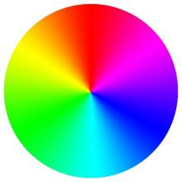
McLuhan compares the senses to color. He says, “Sensation is a 100% constant, and color is a 100% constant.”
A color is a harmony of multiple primary colors, but its total is always 100%. For example, yellow is 50% red and 50% green, but adding more red to yellow will not turn it into some 120% state of 70% red plus 50% green; what we always see is still some 100% color. When the proportion of red increases, green is suppressed, even diluted or obscured.
Human “perception” is similar. Vision, hearing, touch, and the like are like several “primary colors,” and the human perceptual world is composed of combinations of various senses. But McLuhan believes that human perceptual capacity is also limited: people can always perceive only a 100% world. Thus when one kind of sensation becomes especially intense, the background of the other senses will become blurred, dulled, and even numb or shut down.

When McLuhan says that “hot media extend only one sense,” he does not mean that such a medium requires only one sense to be used. For example, when watching a film, hearing is also required; indeed, from the standpoint of sensory use, film seems no different from television, since both use the eyes and ears simultaneously. Yet McLuhan places film and television in opposition, with the former hot and the latter cool. Why is that? The key lies in the way the senses are limited and suppressed.
When we read books, we very clearly feel the requirement that other senses be suppressed. In a library, the proper posture is to sit quietly and read; people consciously demand silence, and of course do not fidget or touch things indiscriminately, but instead tend to close off the senses other than vision. To be precise, this is a characteristic of the print age. In the era of handwritten books, “silent reading” was not mainstream; the character for “reading” includes the speech radical, and reading meant reading aloud. Nodding and swaying, voices ringing out in unison — that was the mainstream mode of engaging with handwritten books. So printed books are not only hot relative to speech; they are also hot relative to handwritten books. Although the question of why this is so still needs to be discussed, at least phenomenologically, the environment created by printed books tends to make people emphasize vision while suppressing the other senses.
Suppressing a sense does not necessarily mean shutting it off; it can also mean numbing it with high-intensity stimulation. Film works in this way. What people feel in a movie theater is not quiet, but strong auditory stimulation. The sound in a movie theater is often louder than anything in everyday life, flooding the audience’s ears and preventing them from hearing everything at once. Whether through utter silence or deafening noise, the “space” of hearing is greatly compressed, and a person’s “participation” on the auditory dimension is greatly constrained.
By contrast, although watching television also engages sight and hearing, it does not usually require the sensory world to be closed off. In fact, the typical scene of watching TV is the whole family sitting around the dining table, picking at dishes, eating, chatting, and watching television at the same time. Only for part of the time do we focus all our vision on the TV; for much of the time, we even leave it on as background sound and listen casually. In a scene like this, not only are sight and hearing free, but smell and taste are open as well. Of course, some people do watch television the way they watch a movie: locking the door, turning off the lights, sitting motionless and concentrating for two hours. But if we speak only of the typical, ordinary mode of interaction, the way the senses are mobilized and stimulated in watching a movie and watching television is vastly different. Let us set aside for the moment exactly how to interpret these differences. At the very least, we can see that under McLuhan’s measure, such differences are brought into relief. If you keep analyzing everything in terms of “content,” it will be very hard to notice the differences in modes of perception between handwritten books and printed books, or between film and television.
Translated from the Chinese original with AI assistance. The original text is authoritative.