
As usual, every course needs a closing summary. This time, the summary of A General History of Technology will be in two parts: for now I’m posting the commentary on the final exam, and in the next post I’ll summarize the student questionnaire and think through possible plans for improving the course in the future.
Note:
This was an online open-book exam, two hours long, with books and computers allowed, and with internet access for searching materials.
The exam consisted of 7 open-ended essay questions. Each examinee chose any 3 to answer, with 100 points for each question, and the final exam score was the average of the three questions.
For each question, the instructor selected one of the most outstanding or most exemplary answer scripts to display and comment on (with authorization already obtained from the relevant student).
The answer scripts were first graded by teaching assistant Wu Yueheng, and then reviewed and adjusted by me. I went through every assignment and made a small number of major adjustments (around 10 points) and countless minor ones.
The teaching assistant’s grading rules are attached after each question. The cases in which I made major adjustments were mainly these: 1. if a student showed critical thinking and questioned or criticized the assumptions of the question or what I said in class, then as long as it was not mere obstructionism, extra points were awarded even if the logic or key points were somewhat lacking; 2. if a student seemed as though they had never attended class at all, and treated clearly covered class content and slides as if they had never heard of them, then points were deducted accordingly.
In general, an excellent answer should have the following elements: 1. it reflects attentive listening in class; 2. it shows independent thinking; 3. it cites reference materials beyond the slides; 4. it is coherent and logically clear.
Question 1: Many scholars believe that the rise of agriculture had adverse effects on the health and lifespan of early settlers. So why might agriculture have emerged and ultimately come to dominate? Please discuss this issue briefly. (90 students chose this question, average score 82.5)
TA grading standards: To answer both the emergence of agriculture and the survival of agriculture, with at least two reasons and reasonable, substantive content, merits 80 points. Bonus points include comprehensive key points, rich content, and citation of literature. Given that many students focused more on why agriculture came to dominate, and since some of the reasons for its dominance overlap with the reasons for its emergence, if a student only answered why it came to dominate, but did so with many key points or by citing reading materials, the highest score still given was 80.
Instructor commentary:
The “many scholars” in the question include Diamond and Harari; Guns, Germs, and Steel and Sapiens are, one might say, classic readings of humanistic general education for two generations. I also talked in class about Mumford, as well as A Brief History of Prehistoric Humanity; it is good to draw on these books. Of course, it is also possible to question the premise, which requires citing other materials. Accepting the premise for the sake of argument, what remains is to discuss why agriculture emerged and why it eventually prevailed. The emergence of agriculture may have had climatic backgrounds, such as the beginning of the Holocene and the Younger Dryas event, and it also had cultural and technological accumulations from the late Paleolithic as its background, such as the emergence of seasonal settlements and the development of symbolic art and primitive religion. Mumford’s garden hypothesis can also be mentioned. Of course, one may also say that part of it was accidental. As for how agriculture prevailed, it was nothing more than the collective defeating the individual: although it was not necessarily superior at the individual level, it was stronger in collective power. On the one hand, population density was higher in space, making social organization easier to establish; on the other hand, over time it was more conducive to the transmission of culture and technology.
I did not feel that this question had any especially outstanding answer script. The one below was judged by the teaching assistant to be good, and in my view it is also relatively satisfying and somewhat original; for example, “it is not an either-or relationship” and “it has a greater impetus for expansion” are comparatively distinctive insights.
Excellent answer script (Zhang Hantian):
The adverse impact of agriculture on settlers’ health and lifespan lies in this: the labor required for grain production is greater than that of hunting and gathering; grain production often leads to dietary monotony, and lower protein intake is not conducive to health; grain production is often accompanied by settlement, and settlement provides convenient conditions for the spread of infectious diseases and parasites; moreover, agricultural production is relatively weak in resisting natural disasters. Hunter-gatherers can reduce the harm of natural disasters by migration and dietary diversity, whereas settled grain producers face too high a cost in migrating.
First, it needs to be stated that agriculture and hunting-gathering are not an either-or relationship. Within many tribes that developed agriculture, the emergence of agriculture often accompanied hunting and gathering. At this point, agriculture was usually a supplement to hunting and gathering: during hunting and gathering, seeds were collected along the way and brought back to the settlement for planting, so that they could be used to stave off hunger when hunting and gathering yielded little. Our ancestors did everything they could to fill their stomachs, and the rise of agriculture came from this; it was almost unconscious and natural.
As for why agriculture was able to dominate, the direct reason was that compared with hunting and gathering, it could fill one’s stomach better. Jared Diamond listed four reasons in Guns, Germs, and Steel: the chance of obtaining wild food decreased, and hunting and gathering became increasingly unable to meet the needs of tribes; for example, many large mammals went extinct because of climate or overhunting, forcing tribes to shift their focus to agricultural production; there were more wild plants that could be domesticated, which was also favorable to agricultural production; for example, climate changes in the Fertile Crescent increased the amount of land available for cultivation; the techniques of planting, processing, and storing grain also gradually matured with the development of agriculture; and the energy yielded by grain production per unit area was much higher than that of hunting and gathering, which meant that on land of the same size, grain production could feed more people. (Chapter 6, To Farm or Not to Farm) All these factors led to the rise of agriculture.
Another point is that the development of agriculture usually went together with settlement, and although settlement brought various disadvantages, it first made possible the development and transmission of various technologies, and second, the grain storage that accompanied settlement changed the social division of labor, forming more complex social relations and improving the overall productive capacity and mobilization ability. I think a more crucial point is that grain production gave settlers a stronger impetus to expand (Zhihu, Yuanfang Qingmu https://www.zhihu.com/question/431627014/answer/2194696425). Because the total area that tribes living by hunting and gathering could control was limited: on the one hand, hunting and gathering could support only a limited number of people; on the other hand, frequent migration was required. Both of these made it difficult for large-scale hunter-gatherer tribes to emerge. For them, the more common pattern was to move from one settlement area to another. For grain producers, however, they could feed more people, and settlement meant they had more offspring. This made grain producers urgently need more land, and more land brought more population. Complex social relations could sustain a large grain-producing tribe. So grain producers had more incentive to expand and annex the tribes of other groups. Even if the people in hunter-gatherer societies were healthier, they still could not withstand agricultural societies, which had higher productivity, greater technical capacity, and greater social mobilization capacity. The new germs brought by grain producers were also a devastating disaster for hunter-gatherer populations with no resistance. So hunting societies were either swallowed up or gradually moved toward agricultural society.
In sum, even though the rise of agriculture had many adverse effects on settlers’ health, it still ultimately came to dominate.
Question 2: Briefly explain the meanings and relationship of “nature” and “mechanical” in ancient Greece. (24 students chose this question, average score 76)
TA grading standards: Being able to mention that nature is internal, mechanical is external and anti-nature, and that the two are opposed yet also share common ground, with all key points covered and substantial content, basically merits 80. If the relationship is only emphasized as opposition, and the explanation is fairly earnest, then 80 was also given. More accurate and comprehensive citation and explanation received higher scores. Cases of mistaken understanding—for example, taking nature to mean the external environment—or answers that were thin and lacked cited materials generally received 70 or 75.
Instructor commentary: The key point of this question is actually quite simple; it was mentioned in the slides: the difference between inwardness and outwardness. If the cause of motion and change lies within the thing itself, that is nature; if the cause lies outside, that is mechanical. And “mechanical” also has the senses of contrivance and trickery. In the end, the two were linked through mathematics… But to answer well, besides merely copying the slides, one must definitely add something else. Once many students added their own understanding, they went off track; for example, some took nature and mechanical to mean the opposition between motion and rest. More advanced answers require outside materials in order to be done well. For example, one can criticize or parse the premise of the question: so-called “ancient Greece” was not really a monolith; popular understandings and philosophers’ understandings were not necessarily the same, and there were subtle differences among different philosophers as well. For example, the following excellent paper distinguished the subtle differences between Plato and Aristotle.
Excellent answer script (Huang Zongbei):
The concept of “nature” can be said to appear in the works of all major ancient Greek philosophers, but setting aside the purely “natural philosophical” inquiries of the pre-Socratics, the discussions that can speak about the relationship between “mechanical” and “nature” are, in my view, mainly found in Plato and Aristotle.
In Plato, what we can see is nature as the “natural world,” and more discussion of “technique” rather than “mechanical” in the strict sense. The cave allegory proposed in Book VII of The Republic devalues the epistemological status of the sensible world (that is, the natural world), making “nature” to a large extent merely a poor imitation of “forms.” Yet on the other hand, the master craftsman in Timaeus creates nature by means of technique; “technique” has a very high status in Plato.
Aristotle, by contrast, is more directly related to this issue. According to Book II of Physics, “nature is a source or cause of being moved and being at rest in that to which it belongs primarily and in virtue of itself, not incidentally”[1]; that is to say, “nature” is an internal, thing-specific “self,” and the causes of all motion and change are internal to the thing itself. When Aristotle discusses “nature” here, he explicitly sets it in opposition to “artificial things.” And the pseudo-Aristotelian Mechanical Problems says: “When we have to do something contrary to nature, due to the difficulty we become perplexed, and so must use technique. Therefore we call that part of technique which helps us deal with this kind of perplexity ‘mechane’ (mechanical).”[2] Here “mēkhanē” in Greek means tool, machine, trick, and contrivance.
Thus, if in Plato “nature” and “technique” still maintain some kind of kinship (the cosmos is created by technique, and therefore can still be said to contain a certain rational order, which in turn needs to be understood through “techniques” such as geometry), then in Aristotle “nature” and “mechanical” are more often split apart and opposed. “Nature” is self-natured, free, original, self-fulfilling; “mechanical” is constrained, unfree, deceptive, and low in status.
But through Aristotle’s works, we can still see a layer of relationship that even he himself did not realize: both nature and mechanical can be treated mathematically. Aristotle himself had no hesitation in applying mathematics to physical objects, for example in his analysis of the motion of bodies (including natural motion)[3], and in the Posterior Analytics he also says that “the propositions of optics are subordinate to geometry”[4]. And in the Mechanical Problems, we can see an approach that reduces complex machines to levers, then further reduces them to circles, and handles mechanical problems mathematically. Therefore, starting from Aristotle, “nature” and “mechanical” already possess a hidden connection in a kind of “shared mathematization,” and we will be able to see in the Scientific Revolution that the mathematization of nature ultimately brought about the formation of a mechanical universe, with “nature” understood according to “mechanics.”
Question 3: During the Age of Geographic Discovery, what scientific background was needed for the activity of Western navigators, and what impact did it have on science? (101 students chose this question, average score 79)
TA grading criteria: Most students mixed up science and technology, so after looking through a number of answers, I settled on the following grading standard: anyone who mentioned the development of geographical cartography, longitude and latitude, astronomical planispheres, progress in celestial navigation, and other matters connected with astronomy and geography, and who could list at least two ways in which the Great Discoveries affected science and explain them, would get 80 points. Since the geoid theory, and related astronomy, were not mentioned by the vast majority, these became bonus items: if they were mentioned, the score could reach 85, provided the other parts were not perfunctory. If the effects were clearly stated and the listing was comprehensive or the explanation was rich, points were added upward depending on the specific case. If the content was sparse and the explanation not comprehensive enough, points were deducted downward.
Teacher’s comments: I planted a trick in this question. Although this is a course on the history of technology, what I was mainly asking about was the “scientific background” and the effects on “science.” Unfortunately, only one student spotted this ploy; almost everyone else failed to distinguish science from technology, or even talked only about technology. In my view, the scientific background here is mainly astronomy and geography, including related knowledge of geometry. Of course, it is also fine to discuss science and technology together, but then there are actually quite a lot of items, and some students simply copied the slides, listed a few keywords, and called it a day. But this is an essay question! To answer well, you certainly need to expand on each item and explain it. Apart from being tricky, I precisely asked only about “science” because I considered that explaining each item might make the answer too long. Many people did not have even a single additional sentence beyond what was in the slides, and then their scores naturally became very low. Another thing: when listing technology, one must actually pay attention to the timeline. The era of the Great Geographical Discoveries in the prompt generally refers to the 15th to 17th centuries, whereas navigational technologies such as the sextant and marine chronometer were invented only later, and should not be called the “background” of the Great Discoveries. By contrast, geoid theory and the like were precisely the scientific background of the navigators (Columbus of course believed in the geoid theory, which is why he set out on his voyage), and of course one can also say that navigators verified the geoid theory, but one cannot simply put geoid theory in the section on effects and omit it from the background.
Excellent answer (Huang Zongbei):
(I)Scientific background:
I think the scientific background can mainly be divided into two broad aspects: first, astronomy, including astronomical theory, star catalog compilation, celestial observation, and so on; second, geography and cartography, including geographical knowledge and the mathematical methods used in cartographic projection. Since this question asks about “scientific background” rather than “scientific and technological background,” I am taking a relatively narrow interpretation, focusing mainly on scientific theory and related practice. In fact, long-distance oceanic navigation also depended on other conditions that are more “technological” in nature, such as the development and improvement of surveying instruments (from the cross-staff, backstaff, mariner’s astrolabe, all used in the Middle Ages, to the early modern octant, reflecting circle, sextant, and so on), shipbuilding techniques (the caravel), timekeeping technology (from the hourglass to the marine chronometer), and the compass; but I will not discuss these aspects below.
Astronomy is related to navigation because of the problem of positioning, since oceanic navigation differs from the close-to-shore sailing of the Middle Ages in the Mediterranean and along the coasts of Europe, and requires reliance on absolute coordinates such as latitude and longitude. Latitude is a relatively easy problem to solve: one only needs to observe the altitude of celestial bodies (the noon sun’s altitude, or a bright star at night). The problem of longitude, however, was the main difficulty that plagued early modern oceanic navigation.
In 1514, Peter Apian described in his Cosmographia a method for calculating longitude by “lunar distance” (the lunar distance method was not Apian’s invention; it can already be found in Ptolemy’s works, but Apian’s discussion became very popular). In essence, it uses the deviation observed when different locations view the moon against the background of the fixed stars. But sailors could not perform such complex astronomical calculations at sea, so all this data had to be “prepared in advance” for them in the form of compiled astronomical tables and nautical ephemerides. Thus, relying on the development of mathematical astronomy, precisely calculating celestial positions and compiling star catalogs became a scientific precondition for solving the longitude problem in navigation. In fact, even into the eighteenth century many sailors still used the sextant to calculate longitude, using the Nautical Almanac, published annually from 1767 onward, to calculate the time difference between local time and Greenwich Mean Time and thus convert it into a longitude difference[5]; the publication of the almanac itself depended on astronomical activity. As for specific observation, Galileo’s invention of the telescope in the sixteenth century improved observational accuracy and was applied to the sextant (one important improvement from the octant to the sextant was replacing the traditional sighting vane with a telescope).
As for geography and cartography, Ptolemy’s Geography was translated into Europe in the fifteenth century and printed, providing Europeans with a perceptual image of the “earth.” One important piece of information was that Ptolemy did not adopt Eratosthenes’ measurement of the earth’s circumference in the Geography (252,000 stadia), but instead used a smaller value calculated by the Stoic Posidonius (180,000 stadia). Columbus used this to calculate the distance between Spain and the Indies, and thus believed that the distance between the two places was much shorter than it actually was, which helped bring about his voyage[6]. In addition, the Geography also introduced projection methods, promoting the development of Renaissance cartography and giving sailors maps that were more precise and mathematically quantitative than the medieval mappaemundi. An early representative example was the Portolan charts of the thirteenth century, which used triangulation, and in 1569 there appeared a world map drawn with the Mercator projection.
(II)Effects on science:
The era of the Great Geographical Discoveries had three main effects on science: at the level of “scientific culture,” or more precisely the “metaphysical foundation of science,” it gave rise to the concept of “discovery”; in geography, it confirmed knowledge about the earth; and in natural history, it encouraged the rise of a European culture of collecting and curiosity, driving the development and spread of early modern natural historical knowledge, as well as the establishment of certain institutions, organizations, and communication networks.
According to David Wootton, in Latin, which was then the scholarly language, there was no word corresponding to “discovery,” and in 1492 this concept had not yet been established. But after Columbus used the Portuguese word “discobrir” to describe his discovery of the New World, figurative uses of a word meaning “discovery” were rapidly adopted in all the major European languages to describe voyages of discovery. Eventually, “it was the voyages of discovery that enabled ‘discovery’ in the broad sense to mean ‘finding out’ to emerge.”[7]
In terms of geographical knowledge, although Europeans had already established the concept of the “earth” from antiquity through the Middle Ages (the earth is round), there were disputes over the earth’s actual size, the proportion of ocean, and the relationship between the positions of land (the element earth) and sea (the element water). The New World and circumnavigation falsified the hypothesis of a “water sphere.”
In natural history, large quantities of curiosities and specimens of new species brought from the New World, India, and elsewhere were continuously sent back to Europe, giving rise to the so-called culture of “curiosity,” and the “cabinets of curiosity” were born as predecessors of modern natural history museums. In addition, these new specimens from outside Europe also challenged the long-established authoritative natural history texts, making natural historians realize that merely collating texts was insufficient for obtaining precise knowledge; one had to observe specimens and record descriptions. This in turn promoted the emergence of a kind of early modern natural history that shifted from “text” to “observation and description”[8].
Question 4: Henry Adams believed that there was a consistent commonality between the generator of modern America and the Madonna statues of medieval Europe, and that the rise of modern technology had a cultural background traceable to the Middle Ages or even earlier. How do you view this idea? Is the industrial age a product of Western culture? State your view and briefly discuss it in relation to the history of technology. (Number of students choosing this question: 7, average score: 80.7)
TA grading criteria: Very few people answered this. My basis came from a summary of what Teacher Wang Zheran said, and the key points include: a center of aggregation; becoming a symbol of a certain order and meaning, and being able to赋予 people’s activities with specific meaning; and the transformation and opposition between spiritual belief and material production. Anyone who could roughly mention these points could get 80, and a complete discussion could reach 90. Those who deviated from this interpretation but could still make a coherent case could also reach 80–90. This question is actually very easy to score on: by reviewing Wang Zheran’s lecture on the spot and searching for supplementary material, one can get to a passing score.
Teacher’s comments: This semester I invited my colleague Wang Zheran to give a lecture on “The Technological Revolution of Medieval Europe,” and this question came from his slides. In fact, my wording was not very good, because the proposition of “the Madonna and the generator” was actually first reintroduced by the technology historian Lynn White; what Adams noticed was only a surface-level commonality, while Lynn White tried to elucidate a deeper commonality. Some students thought that Adams was merely a literary figure and not worth taking seriously, which means they either did not listen carefully in class or did not study the slides and were misled by the wording of the question, failing to notice that Lynn White was the main representative of this topic. Of course, this question was extremely hard to answer, so almost no one chose it. In fact, setting aside the few who were just trying to muddle through, those who did choose it generally received relatively high scores. This question was quite open-ended, and it is difficult to summarize the key points; you can refer to the following excellent answer.
Excellent answer (Huang Zongbei):
The commonality Adams found between the generator and the Madonna was a kind of symbol of “infinite power”: “That forty-foot generator was a moral force, much like the feeling early Christians had when they saw the cross. The planet itself seemed rather insignificant… far less so than this huge wheel, which spun at a dazzling speed within arm’s reach, making almost no humming noise; it was merely giving off a faint warning that could just barely be heard, reminding people to further respect power, and at the same time it would not wake even a baby sleeping right beside the frame.”[9]
Judging only from Adams’s own discussion, however, I would actually think that the “infinite” and “power” symbolized by the generator is precisely one point in which modern technology and medieval technology are fundamentally different in their symbolic meaning. It is true that, as the medieval technology historian Lynn White said, the late medieval use of various water- and wind-powered technologies made Europeans familiar with a civilization “based primarily on nonhuman power”; and the mechanical clock, which spread from monasteries after the invention of the escapement in the fourteenth century, also provided a metaphor for early modern natural theology, which understood the “universe” as a self-operating, precise machine. But by comparison, the power of these ancient technologies was still only a “transmission” of forces already present in nature, unlike the steam engine and later the generator, which seem to “create” power from within themselves. In the preface to the 2014 American edition of Journey by Rail, Schivelbusch also noted that the reason the steam engine became a crucial step was that it was no longer transmitting an already existing force in nature (wind, water, animals—such transmission could never exceed a 1:1 ratio), but in some way accomplished the “creation of force.” Heidegger also revealed in “The Question Concerning Technology” that the characteristic of modern technology is precisely “that way of revealing which challenges forth nature and humans”; ancient technology was also a mode of revealing, but it never challenged nature as forcefully as modern technology, ordering everything into “standing-reserve” (interestingly, the example Heidegger uses to illustrate modern technology is precisely a hydroelectric station, which forms a sharp contrast with the waterwheel as a representative of medieval technology). So the rise of modern technology may indeed have a certain cultural background traceable to the Middle Ages—a familiarity with “technology” and “machines”—but I think this continuity is relatively weak and cannot obscure the far greater rupture between the two.
If one wishes to argue for a connection between the industrial age and Western culture, I think one could instead make the case from the perspective of the “Scientific Revolution.” For the Industrial Revolution can be said to have had to occur only after the Scientific Revolution had exerted its cultural and spiritual influence, and if we further assume that the “Scientific Revolution” itself was a product of Western culture, then a loose inference would lead to the conclusion that the industrial age is a product of Western culture. James Watt, a banner figure of the Industrial Revolution, improved the steam engine in a way that embodied the truly revolutionary idea of the Industrial Revolution: the pursuit of “efficiency” itself, and the improvement of technology through “quantitative experimentation”[10]. Watt’s improvements were based on condensate experiments with a quantitative awareness of water vapor (whether the results were in fact precise or not), and he would use experimental verification at patent hearings to demonstrate that efficiency had improved. This kind of mathematically oriented thinking—quantitative control and cumulative progress—shared the same spiritual and cultural foundations as the experimental science, or Baconian science, that emerged after the Scientific Revolution.
Question 5: What is the hallmark of the modern machine tool? Please briefly describe the historical context in which the modern machine tool was invented, and discuss its historical significance. (Number of students choosing this question: 53, average score: 80.8)
TA grading criteria: Most people took the all-metal screw-cutting lathe designed by Maudslay in 1797 as the hallmark of the emergence of the modern machine tool, which served as the general standard. A very small number of people did not understand “hallmark” as a sign of emergence, but instead understood it as a characteristic feature; points were assigned according to how reasonable their interpretation was. In terms of background and effects, mentioning the manufacturing needs after the Industrial Revolution, and giving two or three points of significance with reasonable explanation, earned 80. More comprehensive and clearer explanations were scored upward based on content.
Teacher’s comments: This question really comes down to three points: sign, background, significance. The sign is very clear: Maudslay’s 1797 invention. Students who attended class or looked at the slides should not get this wrong; a tiny number answered “CNC machine tools,” which obviously means they neither listened to the lecture nor looked at the slides, and also did not read the question carefully or do any searching. As for the later historical background and significance, basically one just had to answer by revolving around the Industrial Revolution. In fact, one more layer could have been added for the historical background: the development of precision measurement technologies, such as Ramsden’s dividing engine, used to manufacture standardized measuring instruments. This layer was discussed in the course group, and Huang Zongbei provided background information. Unfortunately, each person could answer only three questions; otherwise, the excellent answer to this question would probably also have been Huang Zongbei’s. But since it was a public discussion, the other students should also have paid attention to these materials, and in the end not a single student connected them, which I found rather disappointing. As for significance, the answers that did well were generally able to connect it with interchangeable parts, standardized mass production, and the predicament of modern workers. The answer below is, on the whole, concise and to the point, and its connection to Mumford’s “megamachine” is also a highlight.
Excellent answer (Shi Qingyu):
The hallmark of the modern machine tool is the all-metal screw-cutting lathe designed by Maudslay in 1797.
The birth of the modern machine tool depended to a large extent on the development of traditional machine tools. Traditional machine tools represent the precision mechanical manufacturing techniques that have developed since the Middle Ages. With the help of machine tools, artisans were able effectively to improve manufacturing precision, thereby meeting the needs of fields such as clocks and watches, nautical instruments, astronomical instruments, and scientific instruments. The emergence of the modern machine tool came slightly later than the steam engine (compare Watt’s steam engine of 1765), and the early machine tools (improved boring machines) also greatly facilitated the production of steam engines; the two were mutually beneficial and symbiotic. It can be said that the Industrial Revolution demanded higher precision and output in production, and, drawing on the achievements of precision mechanical manufacturing, gave rise to the emergence of the modern machine tool.
An important difference between the machine tool and the steam engine is that the steam engine appeared in the role of an “energy converter,” whereas the machine tool appeared in the role of an “operator.” Therefore, the important significance of the modern machine tool lies in the fact that, while further improving processing precision, it greatly reduced the demands placed on skilled workers.
Higher processing precision made standardized production possible. People could produce parts according to specific standards and assemble them into machines, without having to build an entire machine from scratch as before. And the idea of standardization was a key factor in the further expansion of production scale: parts produced by one department could be used everywhere and could be replaced at any time; different factories could also form a more definite division of labor and a more coordinated pattern of collaboration. This created the conditions for improving and utilizing the productive forces of society as a whole.
There was also a transformation in the demands placed on technical workers: from highly craft-dependent artisans or skilled workers to people who could produce simply by operating according to rules. Factories could therefore hire more workers, which made it possible to further increase productivity. Of course, this was also a key step in Mumford’s so-called “megamachine”: when workers carried out production, they only needed to mechanically repeat certain operations (such as adjusting the position of the machine, turning a handle, and so on) and put in time; they no longer needed to invest their humanity and thought as artisans used to do. They became more like a part in the social machine, becoming one of the problems running through the Industrial Revolution and beyond.
Question 6: How should we regard the Luddites who smashed machines during the Industrial Revolution? Today, with the development of technologies such as artificial intelligence, the problem of unemployment caused by technological change still exists. What lessons can we draw from history in this regard? Discuss your views around the relevant themes. (90 students chose this question, average score 82.6)
Tutor’s grading criteria: Most people mentioned sympathy and understanding, saying that the root lay in labor-capital conflict, social concern, or immature compensation mechanisms, and then moved on to broad, generalized solutions. These points basically all show the social dimension of technology, and if the thinking is clear, the language fluent, and the content substantial, the score is 80. Scores are higher if a student offers a novel perspective, or supports a viewpoint with specific factual material.
Teacher’s comments: This question does not really have many objective points to answer; it mainly tests humanistic concern. In fact, from the Agricultural Revolution (such as in Question 1) to the Industrial Revolution to the AI revolution, I have been highlighting a certain tension: the same technological innovation produces very different feelings when viewed from the standpoint of humanity as a group versus from the standpoint of the individual. Many individuals often become victims of the tide of the times. But as individuals with humanistic concern, we cannot truly step outside the world and turn a blind eye to real suffering. Yet how should we care for the victims? There is no definitive answer, but judging from the wording of the question and the overall requirements of the course, I hoped to see students draw inspiration from “historical experience.”
Excellent answer (Gu Ziyan):
The Luddites refer to workers during the Industrial Revolution whose jobs were displaced by the use of machines, leading to unemployment. For example, after the automation of spinning and the invention of the steam engine, some workers whose living conditions worsened as a result smashed machines in resistance to the movement of automated industrial production. In fact, this was also dissatisfaction with the dissolution of self-worth in the process: crafts that they had once been proud of and had relied on for their livelihood were replaced by machines that did not require long apprenticeships and skilled hands, making them hard to pass on. In the intellectual realm they lost their right to speak, and were simply regarded as inefficient tools and discarded outright. Meanwhile, workers who had not yet been laid off were in fact threatened by the existence of machines in regard to their original positions, making their working conditions and treatment worse and depriving them of the joy of work[11]. Their work also became mechanized, and, like the protagonist of the film Modern Times, they became rigid and the whole person grew depressed.
Although resisting in this violent and direct way was certainly inappropriate, if we consider the level of education and scientific understanding of most workers at the time, not to mention their relatively low social status and relatively limited actual influence, this seems to have been one of the few choices available to them. We cannot simply criticize this with an “anti-intellectual” mindset. In my view, from the perspective of the Luddites, it was understandable that they would hate the machines that caused them to lose their jobs and thus their means of livelihood, and that they would take extreme actions; behind this also lay the contradiction in the Industrial Revolution between rapid technological development and relatively lagging humanistic awareness. Technology will ultimately be used by human beings; this is respect for and care toward people, and it is also the preciousness of humanity itself, something that cannot be obscured by utilitarianism.
The Luddites were only a miniature version of this intensified contradiction; the underlying social-relations problem reflects the strong impact of technological development on society. Although the Luddites of the Industrial Revolution became a term in the history of technology and do not appear in the present day, in the age of artificial intelligence there still exists another kind of “Luddite”: modern people worry incessantly that their jobs may be replaced by AI and thus instinctively reject the existence of machines, even “conspiracize” the existence of machines. Although the method may differ from the Luddites’ direct violence, the essence is not different. It is still closely tied to technological updates and the social effects brought by such updates. It is also about ordinary people’s concern for the development of technology and their own living conditions, as well as the gap between the pursuits of social elites and the wealthy on the one hand and the needs of ordinary people on the other.
In a certain sense, technological updates are not necessarily directly beneficial to wage laborers; rather, they are more like placing a shackle on them. As the cartoon shown in class vividly demonstrated, capitalists use technology to further monitor workers. When technology develops to a certain stage, some repetitive jobs may be replaced by technology, and workers are also needed to act like “shepherds,” watching over machines or repairing machines and promoting their normal operation. But no matter how one explains it, it still carries the color of enslavement and coercion, still carries the exploitation of surplus value and the disregard of workers’ individual value. Reflecting on unemployment caused by technological updates has to do with the creativity of human individuals. If the sole goal is merely production efficiency and higher returns, if standardized assembly-line production across all dimensions and processes is made the only goal, if all participants are turned into symbols, then workers and machines are in fact no different in the eyes of capitalists. Indeed, because machines are more efficient and do not tire, they may completely replace workers. In this way, resistance from wage laborers is bound to arise. From a practical standpoint, the development of science and technology here is proactive, but the experience of it may not directly bring benefits. Although this can further force workers in relatively repetitive occupations to learn new, non-replaceable skills, and can also increase market consumption power[12], considering the average standard of living and condition in society, this social problem still cannot be ignored. The emergence of scientific management[13], which considers managers training workers and producing together with workers according to scientific principles, is one way we can choose to solve this problem. They should be given the minimum safeguards, attention should be paid to emotional needs in the workplace, and they should be guided to bring into play the awareness that only humans can bring to work. At the same time, before all this is solved, it is also appropriate to retain certain kinds of work temporarily in order to ease social contradictions. One may draw an analogy with new technological theories of automation and human-computer interaction, whose core ideas concern control, feedback, and the close relationship between humans and machines, extending human capacities and meaning further through machines[14].
Considering the fate of the Luddites, in fact, contemporary society did not stagnate in technological development after the Industrial Revolution, nor did it produce greater social-ideological fragmentation. Rather, along with industrial transformation and upgrading, other jobs requiring labor emerged, stabilizing social order. One can see that the sharpest contradictions only existed within a certain stage. But if handled poorly, the harm is far-reaching. What is at issue, then, is the balance struck by those in power between technological production efficiency and the degree to which workers are actually respected and their own value satisfied. This does not mean asking people to regress technically and return to a primitive or natural state, but rather how to break out of the narrowness of one’s own perspective and, from the standpoint of humanity’s future development, neither worship machines blindly nor use machines to seize people’s own creative meaning and the morality different from machines, thereby normalizing consumption and socializing creativity[15], becoming the true masters of machines rather than simply enjoying the conveniences of modern mechanization and intelligence while ignoring negative social existence. The annihilation of this utilitarianism is what we can do in the future, and the experience we can draw from history is to use a system that accords with the direction of human development, starting from the standpoint of the spiritual world, to create a new civilizational conception that coexists with the mechanical system. In the form of a “technological-social ensemble,” let the two evolve together[16].
Human beings and technology are certainly in a relationship of coexistence, but how not to be alienated by technology, how to detach oneself from technology, is another key factor, and requires a developmental process. Just as after the emergence of machines and even artificial intelligence technology, people often first go through a phase of rushing toward them in great numbers. Then problems are discovered, and the solutions built on that basis always further promote development; the Industrial Revolution happens to confirm this point. Beyond the technology of making things, there also exists a humanistic condition. Under the impact, I believe that in the future artificial intelligence can also, in this process, make up for its shortcomings and gradually develop, effectively adapting to the actual level of civilization development in society. This is the answer to the questioning of the history of technology.
Question 7: When discussing production lines, the teacher drew a nine-square diagram. In imitation of this form, choose another technology or concept covered this semester (such as experiments, the steam engine, the computer, the Industrial Revolution, the metaverse, etc.), draw a nine-square diagram (no need for an actual image; a clear textual description will do), and, in combination with the history of technology, provide brief annotations (at least explain the thinking behind the selection of the vertical and horizontal axes and the historical background of three or four important examples in it). (21 students chose this question, average score 87.8)
Tutor’s grading criteria: Since thinking up a table for this question is still rather brain-consuming, the scores were generally quite high. Basically, a complete and reasonably made table got 90 points; if there seemed to be flaws, I generally gave 85 or 88. But this question involves some blind spots in my own knowledge, so the teacher may still need to check it.
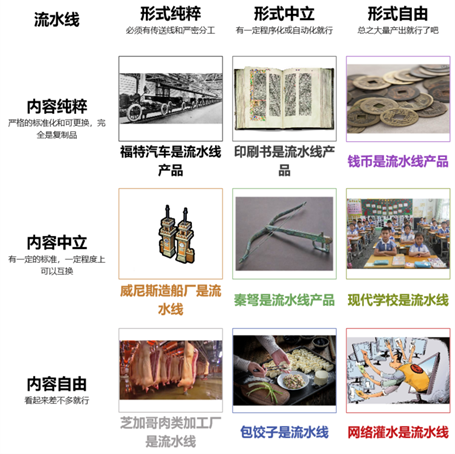
Teacher’s comments: This question is relatively interesting, but very difficult to answer. It is basically a trap question; doing well on it takes a lot of brainpower and a lot of time, and may affect the overall timing of the exam. Looking at the results, those who chose this question scored relatively high, but their overall exam totals were not among the very top. I’ll first append the self-made nine-grid “production line” I displayed in class.
Although the nine-square format is playful, the history of technology involved in it is serious. I also mentioned in class that, in my understanding, the three squares in the lower right corner of the nine-square diagram are meant as jokes, but the other six squares should be taken quite seriously. Regarding the nine-square diagram of X, the first issue concerns conceptual definition, namely, “What is X?” The upper-left square should be the most “pure” definition, that is, the thing generally regarded as the most typical X. The vertical and horizontal dimensions then express X’s basic characteristics: for example, in my understanding, the feature of the production line, in terms of form or method, is a strict division-of-labor system arranged around a conveyor belt; in terms of product or effect, it is the output of standardized replicas. So I chose these two aspects of the feature to serve as the vertical and horizontal axes, and then selected historical cases to fill them in. The historical cases selected are often the ones that truly reveal the origin of X. No technological invention appears out of thin air; there are many “precursors,” and these precursors approach X along some dimensions but do not yet reach X along others. So we still regard Ford’s production line as the most typical (the most pure) “sign” of the production line. Therefore, apart from one typical case in the upper-left corner and three playful cases in the lower-right corner, the other five cases in principle should precede X historically and constitute the historical forerunners of X.
Of course, my nine-square grid is not necessarily perfect, but using it as an example, I hope the X nine-square grids the students come up with can likewise reveal both X’s conceptual definition and its historical roots. Unfortunately, most students did not grasp these intentions. They often just forced together a nine-square grid for the sake of having one, without caring about the historical relationships involved—for example, listing the steam engine and putting the electric motor afterward, without considering the various precursors to the steam engine discussed in class (Hero’s aeolipile, da Vinci’s steam cannon, Papin’s pressure cooker, and so on). But overall the TAs graded this question very generously, and I was not going to play the villain either, so probably as long as the grid was filled in neatly there was no deduction. But for some entries with serious flaws, or those that simply were not filled out, I deducted extra harshly. For example, one student who chose “experimental science” used the horizontal and vertical dimensions of theory from simple to profound and practice from simple to complex, which completely fails to reflect “what experimental science is,” let alone its historical roots. What is profound and what is simple are in fact highly relative. The theory of free fall may seem simple today, but in Galileo’s era of experimentation it was by no means necessarily simple. The horizontal and vertical axes should be meaningful in revealing what experimentation actually is. For instance, the method of controlling variables is a basic requirement of experiments, so the dimensions could be designed as: “strict control of variables, some environmental control, anything goes”; moreover, mathematical and quantitative calculation is a feature of modern experiments, so the dimensions could include “precise quantitative measurement, some measurement, completely qualitative observation.” These two threads can reveal a developmental history of experimental science from qualitative to quantitative, from casual observation to prearranged control. And that student’s nine-square grid was not even filled in, and had absolutely no explanatory power.
Although this question generally received high scores, there were no perfect submissions. The following are relatively excellent answers; at least the chosen horizontal and vertical axes help reveal the two fundamental characteristics of “what a computer is”: (automatic) control and (data) computation.
| What is an assembly line? (text version, modified from the course slides in the lower-right corner) | Formally pure: there must be a conveyor line and a strict division of labor | Formally neutral: some degree of proceduralization or automation is enough | Formally free: anyway, as long as it produces in large quantities |
| Content pure: strict standardization and interchangeability, entirely duplicates | Ford automobiles are assembly-line products | Printed books are assembly-line products | Coins are assembly-line products |
| Content neutral: some standards, to some extent interchangeable | The Venetian shipyard is an assembly line | Qin crossbows are assembly-line products | Modern schools are assembly lines |
| Content free: as long as they look roughly the same | The Chicago meatpacking plant is an assembly line | Making dumplings is an assembly line | Talking in circles is an assembly line |
Excellent answer (Peng Sijin):
| Computer nine-square grid | Since it is a machine, it should be fully automatic, right? | It’s only fair to have a bit more manual operation to help out | Why must a machine exist in the world at all? |
| A computer should be able to handle all data in an all-encompassing way | Electronic computer | Analytical engine | Turing machine |
| Being able to perform only numerical calculations is also acceptable | Electronic calculator | Napier’s bones | Calculus |
| Why should computation be limited to mathematics? | Antikythera mechanism | Sextant | Yijing |
The choice of horizontal axis is especially reflected in the computer’s nature as a “machine”; what the last column seeks to express is that “it does not exist in the world as a machine, but as a cognitive model, allowing the human brain to carry out operations along this cognitive model,” which is somewhat similar to letting the brain itself become a machine. The vertical axis, by contrast, is emphasized in the understanding of “computation”; the last row refers to kinds of computation that are not “arithmetic,” such as fortune-telling, astrological calculation, distance calculation, and so on.
Historical background of the electronic computer: the work of Boole and Shannon made it possible to use circuits to simulate logical operations; wartime demands in World War II (codebreaking, automatic artillery) drove developments in related fields (cybernetics) as well as the invention of the computer; von Neumann proposed the modern computer architecture
Antikythera mechanism: a machine from ancient Greece used to calculate astronomical positions; its specific working structure is still unknown, but its structural complexity was such that similar craft structures did not appear again until astronomical clocks in the fourteenth century (Antikythera mechanism_Baidu Baike (baidu.com))
Sextant: invented around 1731, it uses the angle between the sun and the horizon to quickly calculate one’s current longitude and latitude; first invented by Hooke, but not widely used because it was not convenient enough. It went through an intermediate “octant,” and was finally improved by Bird into the sextant widely used in navigation. (Shi Hongwei: “A Witness to Early Modern Navigation Technology—The Sextant”)
[1] Physics 192b20–25; the translation used here is that of Zhang Zhuming.
[2] Mechanical Problems (also translated as Mechanics) 847a15–20; the translation used here is that of Xu Kailai, see The Complete Works of Aristotle, vol. 6, p. 153, edited by Miao Litian.
[3] Lindberg, The Beginnings of Western Science, p. 400.
[4] Posterior Analytics 75b15.
[5] See James A. Bennett, The Divided Circle: A History of Instruments for Astronomy, Navigation, and Surveying (Oxford: Phaidon-Christie’s, 1987), Chapter 4, Chapter 8.
[6] See Lindberg, The Beginnings of Western Science, trans. Zhang Butian, Hunan Science and Technology Press, 2013, p. 149.
[7] David Wootton, The Invention of Science: A New History of the Scientific Revolution (Vol. 1), trans. Liu Guowei, CITIC Publishing Group, 2018, pp. 65–59.
[8] See Brian W. Ogilvie, The Science of Describing: Natural History in Renaissance Europe, trans. Jiang Che, Peking University Press, 2021, Chapter 5.
[9] Henry Adams, The Education of Henry Adams, trans. Zhou Rongsheng and Yan Ping, China Social Sciences Press, 2003, pp. 405–406.
[10] Hu Yilin, What Is Technology, Hunan Science and Technology Press, 2020, pp. 89–90.
[11] Hu Yilin, The Extension of Man—A General History of Technology
[12] Wolfgang König, Introduction to the Study of the History of Technology
[13] Nakayama Hidetaro, Introduction to the History of Technology
[14] Zhang Xiaoyu, Technology and Civilization: Our Time and the Future
[15] Mumford, Technology and Civilization
[16] Wolfgang König, Introduction to the Study of the History of Technology
Translated from the Chinese original with AI assistance. The original text is authoritative.