
This article was published in China Science Daily (2022-01-21, page 3, Reading); the title was changed to “A Different Kind of Inspiration: Seeing the Suffering of Ordinary People in the History of Technology.” It was also posted on their WeChat public account, under the title “Let’s Talk This Time About the Suffering Brought to Humanity by Technological Progress!” I’m reposting it here.
I teach a general history of technology course at Tsinghua, and over the past few years I have also given quite a few public lectures on special topics in the history of technology. One question such courses or lectures often face is this: what guiding significance does the history you are talking about have for us? Listeners with an information-technology background especially like to talk about the so-called “Fourth Industrial Revolution,” and when I say I’m going to talk about the age of Watt and Edison, what they care about is: you’ll probably talk about the inspiration that the first few Industrial Revolutions offer for today’s technological innovation, right?
I do indeed hope to draw inspiration from the history of technology for understanding the present, and that is one of the original reasons I studied the history of technology. But what I mean by “inspiration” is not quite what many listeners expect. Listeners often focus on “innovation”; in their view, the history of technology is nothing other than the history of innovation, or rather, the meaningful part of technological history consists only in the one thing of continual innovation. In their view, the problems we face today in connection with technological development are mainly problems of how to promote innovation. Of course I also care about “innovation,” and I have even given a reading of the history of changing patterns of innovation, but that is not actually what I care about most.
In fact, what we can read from history goes far beyond successful experience; there are also memories of suffering and lessons of failure. As the saying goes, “When the dynasty rises, the common people suffer; when it falls, the common people suffer” (兴,百姓苦;亡,百姓苦). Even those grand milestones that seem to be “successes,” when opened up and examined, often have as their background the suffering of countless ordinary people.
Unfortunately, the history of technology is no exception—it does not consist only of triumphant achievements marching ever forward, with no tragic episodes or suffering whatsoever. If we have not read suffering in the history of technology, it is only because it has been covered over by a glossy surface. It is like the old style of historical narrative, in which only the ultimately victorious emperors and generals were endlessly celebrated, while the suffering of the common people was entirely ignored, or else treated merely as a backdrop to grand achievements.
Innovation is not always something everyone welcomes with open arms, and the so-called Industrial Revolutions are no gentler than political revolutions; beneath upheavals that turn the world upside down, countless sufferings are buried as well. Under the course of technological innovation, those fierce conflicts and heavy costs can also provide us with “inspiration”—not inspiration for how to innovate, but inspiration for how to face innovation.
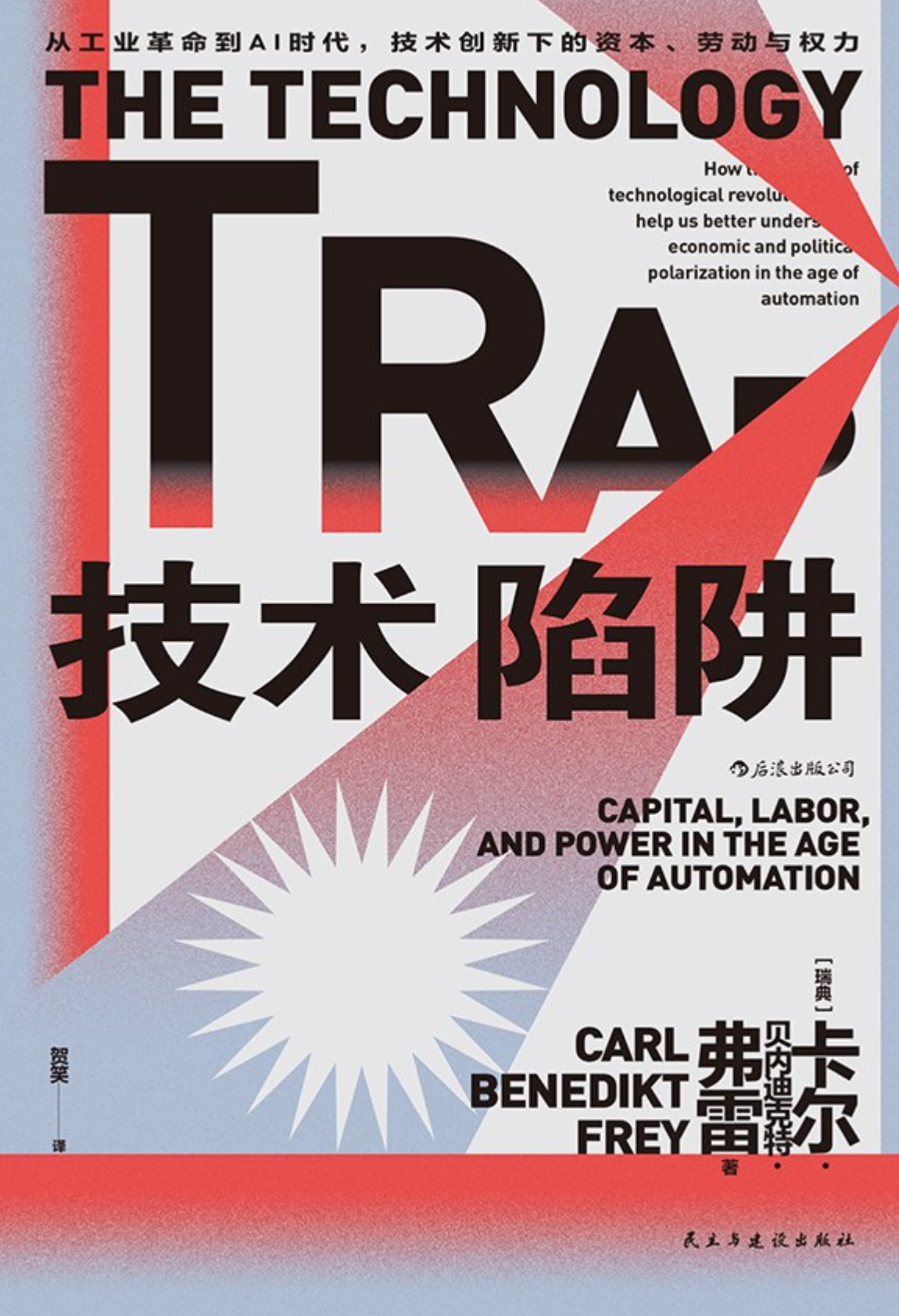
Karl Benedikt Frey’s Technology Trap focuses on the workers crushed beneath the wheels of technological innovation, paying attention to the “losers” in the process of the Industrial Revolution. Its aim is “learning from history,” to help us understand what is happening, or will soon happen, in today’s AI revolution.
This is first and foremost a work of history of technology. The blurb for the Chinese translation calls it “a long-duration analysis spanning 300 years of history,” but in fact Frey crosses an even longer period; he begins with the Agricultural Revolution. Like the Industrial Revolution, the Agricultural Revolution was, in the long view, of course great and beautiful, but for people living at the time, quality of life actually declined. From the Agricultural Revolution to the Industrial Revolution, from automation to artificial intelligence, history moves forward again and again, yet also keeps echoing back.
Frey points out that the hallmark of the Industrial Revolution was the development of “labor-saving technologies.” Such technologies, aimed at replacing workers’ labor rather than augmenting workers’ capabilities, were not welcomed in ancient times. Labor-saving technologies would cause workers to lose their jobs, but there are in fact two types: “substitution technologies” and “enabling technologies.” “Substitution technologies render work and skills obsolete. By contrast, enabling technologies help people carry out existing tasks more efficiently or create entirely new work opportunities for laborers.” (p. 14) Writing, mechanical clocks, and printing are all典型 “enabling technologies”; rather than saying that they reduced labor, one might say they opened up more room for labor, making more and richer kinds of work possible. Pure substitution technologies, designed solely to reduce labor, were not welcome; only under the distinctive political and cultural environment of eighteenth-century Britain did the development of substitution technologies gain sufficient support.
And the full development of substitution technologies did indeed bring suffering to society. As Engels observed, in the early Industrial Revolution, industrialists “grew rich by sucking the misery of the masses” (p. 134). In the first forty years of the nineteenth century, wages for workers rose slowly compared with the steadily increasing productivity; taking into account their labor intensity and the worsening quality of life, workers did not benefit from industrialization. But after 1840, things began to improve, and real wages grew faster than productivity. Frey believes this was due, on the one hand, to the gradual emergence of the “enabling” effects of new factories, and on the other hand to the spread of education, which ultimately enabled people who had learned more skills to find more jobs. Of course, those who suffered in the early nineteenth century did not enjoy these new opportunities.
Workers who could exchange high-intensity labor for low wages may not have been the most suffering; in the eyes of people at the time, a child from a poor family being able to find a job in a textile mill working eighteen hours a day might even have counted as a kind of “blessing.” Some inventors even defended the unemployment of skilled workers caused by machines by appealing to the fact that they were “creating jobs for women and children” (p. 104). Meanwhile, many more adult workers lost their jobs; they could find no means of livelihood and saw no hope. Even if they could foresee the prosperity of the industrial age fifty years later, so what? Not to mention that they saw no hope at all in the progress of machines.
When I teach the Industrial Revolution in my general history of technology course, I always mention the proliferation of child labor and the rise of Luddism. In the early Industrial Revolution, more and more craftsmen’s work was replaced by machines, while the work of tending machines required only a small number of people, who also did not need skilled training, so children could do it. The result was that large numbers of prime-age workers faced unemployment; some of them turned their anger toward the machines that had taken their jobs, and this became the machine-smashing “Luddite movement.”
After I finished this section, a student asked: where did those unemployed people end up? That is a good question. Because after reading this part of history, many people simply stop caring about the fate of these individuals; they are treated as the pains of revolution and glossed over. In grand narratives, industrialization very quickly brought unprecedented prosperity to human society. But if we return to the context of the time, the so-called “short-term pain” could, for an individual, mean a lifetime or even generations. Of course, new technologies were also constantly creating new jobs, but on the one hand they might not live to see those jobs appear, and on the other hand they lacked, compared with younger generations, the skills needed to adapt to the new positions. And often they had long since lost their land in the countryside, so the destination of unemployment was scavenging or wandering, living out their final years in destitution—though usually they did not live long enough to reach old age.
Frey wrote: “Three generations of British workers saw their lot worsen as technological creativity accelerated. The losers did not live to see the enormous prosperity of today. The Luddites were right, but posterity can still be glad that they did not get their way.” (p. iv)
Why should we care about these sacrifices? First, of course, out of sympathy—these people themselves did nothing wrong; they worked diligently and yet suddenly lost everything, with no hope of turning their fate around. We should of course sympathize with them, and we ourselves may at any moment become such victims. Second, we should place humanity above technology—when we praise progress and innovation, it is because technology can bring welfare to humankind. If the more technology advances, the more humankind suffers, then what reason do we have to support innovation unconditionally?
The reasons above may perhaps be only some “big principles,” and cold-blooded politicians may not care for them. But even politicians cannot ignore the political force of the Luddites. If the grievances of the sacrifices of technological progress are never resolved, they may side with more radical options. For example, Frey points out that in Germany in 1933, with unemployment high, one of the promises that helped the Nazi Party win votes was restricting machines: “There will be no more cases of workers being replaced by machines” (p. 13). In addition, Frey argues that the increasingly evident political polarization of recent years, the rise of populism, Trump’s support among the white working class (p. 285), and even resistance to globalization and hostility toward China are all phenomena related to the development of automation technology. The predicament we contemporary people face is actually similar to that of the Luddites, except that because the history of the Industrial Revolution has already provided a warrant for the meaning of technology, people today no longer direct their resentment at machines themselves; instead, they have to set up other targets—American workers think globalization or China has stolen their jobs, while Chinese workers may direct their hostility toward capitalists or America.
Just as the Luddites ultimately failed, the divisions and conflicts of contemporary society may perhaps also be dissolved sooner or later as technology develops, but the question is: how is that possible? What efforts do we need to make for this? In this respect, we can still seek inspiration from history.
In Frey’s view, the so-called “Second Industrial Revolution,” led by the United States beginning in the second half of the nineteenth century, reversed the face of the First Industrial Revolution: on the one hand, it created large numbers of new jobs for ordinary people; on the other hand, it brought industrial products into thousands of households and improved people’s lives, thereby dissolving people’s hostility toward technology. From the 1870s to the 1970s, especially the first seventy years of the twentieth century, which Frey calls “the most magnificent balancing period” (p. 208), everyone’s income was rising, and the gap between rich and poor was narrowing.
Frey agrees with other economic historians and attributes this “great balance” mainly to “the race between technology and education” (p. 216). Of course, he does not rule out many other factors, such as the development of unions, changes in macro policy, and the development of technology itself, but he believes education is the most important field.
After 1970, however, things reversed again: workers’ wages stagnated and inequality tended to intensify. In the author’s view, an important factor was the development of computer-supported automation technology. Frey stresses that “we must distinguish between the automation age and the mechanization age” (p. 228). “The computer revolution is not a continuation of the mechanization revolution of the twentieth century, but a subversion of it. The computer-controlled machine eliminated precisely the job of machine operator that the second Industrial Revolution had created. Workers who had been pulled into mass-production industries and employed in decent-paying jobs were now pushed out.” (p. 229)
Just as the First Industrial Revolution was eventually balanced by the Second Industrial Revolution (electrification), can the so-called Third Industrial Revolution (automation) also be balanced by the Fourth Industrial Revolution (technologies such as artificial intelligence)? The situation is not necessarily so optimistic; in fact, many AI technologies seem to tend toward “substitution” rather than “enabling.” We cannot sit and wait for rabbits to run into the stump; rather, we need to respond proactively to the challenges of the automation age. Learning from history, Frey offers a number of remedies, including concrete fields such as education, retraining, insurance, and tax policy.
As for Frey’s specific claims and policy recommendations, I do not fully agree with them. For example, I believe that taking the collapse of the Bretton Woods system in 1971 as the marker, the modern credit-money and financial system is the key factor behind the intensification of wealth polarization after the 1970s. Yet Frey mentions the Bretton Woods system not at all, and only gives finance a passing mention, arguing that financial policy can only explain the top 1% of the rich and cannot explain the situation of the middle class (p. 226). But today the wealth of the top 1% in America already exceeds that of the middle class as a whole, so how could this 1% possibly be unrelated to the middle class’s condition?
But in any case, the vision Frey offers is broad and inspiring, and he fully demonstrates the real-world significance of the history of technology.
Translated from the Chinese original with AI assistance. The original text is authoritative.