
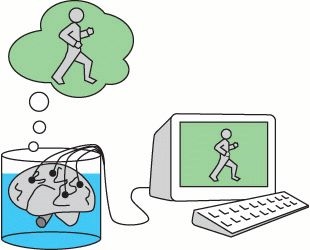
My doctoral student Yao Yu recently gave a presentation in the reading seminar, discussing a phenomenological reconstruction of Putnam’s “brain in a vat” thought experiment. He chose the topic himself, and I thought it could be done, but I was very dissatisfied with what he actually produced. I won’t repeat my criticisms here; I’ll just briefly note here my own understanding of the “brain in a vat.”
First of all, the reason Putnam proposed the thought experiment of the “brain in a vat” was absolutely not to reintroduce some new version of “external-world skepticism.” In the skeptical sense, there is nothing novel about a brain in a vat. I think Kant’s “thing-in-itself” is already enough to respond to skepticism in the ordinary sense, while skepticism in the extreme sense is simply impossible to answer at all and need not be taken seriously.
Putnam’s proposal of the brain in a vat was actually an attempt to provide a kind of reductio ad absurdum: by means of an extreme case, he sought to reveal the contradictions in the theory of reference in the analytic-philosophical tradition, and thereby to refute traditional “external realism” and support Putnam’s own “internal realism.”
So what I mean is that a phenomenological reconsideration of the “brain in a vat” experiment may well be meaningful, but this meaning must never sink to the level of merely bringing skepticism back into view. If it did, it would be a regression even by Putnam’s standards, and all the less worthy of calling itself phenomenology. As an extreme case, the “brain in a vat” is supposed to infinitely magnify the absurdity of some theory or some attitude, thereby refuting that position; that is what makes this kind of thinking meaningful. If an extreme thought experiment cannot reveal any problem that already exists in ordinary cases, then that sort of thinking is more like the ancient Greek sophists, medieval scholastics, and contemporary (some branches of) analytic philosophy: it moves toward the sophistic rhetorician rather than the philosopher.
The brain in a vat is an extreme case; it merely points out problems that have already surfaced in non-extreme cases. Putnam in fact already explicitly indicated non-extreme cases, for example: can someone who has never seen a tree use the word “tree” to refer to a tree? And if everyone has never seen a tree, can the word tree have reference at all? What if everyone has never seen a tree but all think they have seen a tree? And so on.…
If I were to reconstruct it, I could immediately give a “de-extremized” version of the brain in a vat: AR glasses—suppose that from childhood to adulthood a person has always worn AR glasses to look at the world, and has never “directly” looked at the world with the naked eye; then what would be different about the knowledge he forms of the world?
In my private conversations with Yao Yu, I once mentioned the concept of the “egg of VR,” which was actually just a casual remark, but he solemnly took it and rewrote it as “body in a cocoon” for his presentation. In fact, I brought up this concept only to rebut his original line of thought: the attempt to use bodily phenomenology to entirely “cancel out” the problem of the brain in a vat. I think that is rash, and moreover based on a misunderstanding of bodily phenomenology. If so-called bodily phenomenology means that “the brain and the body cannot be separated,” then what if we simply do not separate them? As long as we stipulate that the mad scientist does not directly transmit false sensations to neurons, but instead sets up a VR egg-shell that stuffs both brain and body inside all at once and creates a false world within it, isn’t the effect the same as Putnam’s brain in a vat?
AR glasses are a weakened version of the VR egg-shell. Imagine a person who has worn AR glasses since childhood and sees the world through them, but the glasses are made so light and thin that he never knows he is seeing the world through glasses. Then when he (say, Zhang San) points at the sun and says “ri,” and someone else (say, Li Si) points at the sun and says “ri,” are they referring to the same thing?
On the position of the traditional theory of reference as Putnam recounts it, these two ri are not the same ri. But this is a judgment from the “God’s-eye view,” whereas from Zhang San’s perspective, the ri Li Si says is the very ri he points to, and the same holds from Li Si’s perspective. For instance, suppose the AR glasses invert all reds and blues, so that when Zhang San sees what others call “red,” he actually experiences “blue,” and so on.
The key to this thought experiment is that such distinctions only make sense when spoken of from a God’s-eye view or a transcendent perspective—say, Zhang San after taking off the glasses, or the mad scientist who puts the glasses on Zhang San. When no one has a transcendent perspective, these distinctions have no meaning. Considering that Putnam gradually moved toward pragmatism, his position becomes easier to understand.
What kind of position is phenomenology? Of course, phenomenologists would also acknowledge that Zhang San’s “ri” and Li Si’s “ri” “refer to” the same ri, because that “one” does not exist naturally in the first place. There is no “one sun” in the sense of a God’s-eye view, and then people come to see and speak of it in different ways. Objectivity is the product of intersubjectivity, not something already laid out in advance prior to any subject. To treat anything as “one X” requires “sedimentation,” and the process of sedimentation includes the technical environment and interaction with others.
Phenomenologists do not think that what we first see are fragmented “sense data”; what we see are the “profiles” of things. Whether seen with the naked eye or through a telescope or through AR glasses, what is seen is always a “part” of the thing, compressed or reduced in some way, but through this “part” we see the thing itself. We say, “I saw the sun,” rather than, “I saw half of the sun’s surface”; similarly, we do not say, “I saw the product of sunlight refracted on the lens,” nor do we say, “I saw an image resembling the sun displayed on the lens through electronic signals.” Only when do we see, through some medium, “something that resembles the sun,” rather than “the sun” itself? Precisely when the relevant “sedimentation” has not yet been completed—for example, when learning about the relevant technology has not yet been completed, or when communication with others runs into obstacles.
Phenomenology holds that our consciousness or perception can reach things, but this “reaching” is never straightforward; “reaching” has blockage, structure, thickness. In this sense, the “blocking” of the AR lens and the “blockage” encountered when looking at the sun with the naked eye are not essentially different. We always have to go through certain mediating things—technical artifacts, bodily skills, accumulated knowledge, linguistic habits, and so on—in order to deal with things. Is the sun seen with the naked eye necessarily “more sun” or “less sun” than the sun seen through a filter lens? What is seen through electronic instruments, like what is seen with narrowed eyes, is only a certain “profile” of the sun, a specific mode in which the sun presents itself; but what we are talking about is still the same sun. The fact that this sun is the same is not because there was already a sun standing there waiting for us to look at it. Rather, it is because, through historical sedimentation, through a certain amount of time spent learning and adjusting, this consistency has been formed intersubjectively.
Then what if the mad scientist tampers with the AR lenses so that Zhang San sees a “false” sun? (For example, the sun grows horns.) In fact, there is no need at all for a mad scientist: historically and in reality, different people have very different experiential impressions of certain things, and this is a common situation. The ancient Greeks never saw black spots on the sun, whereas the ancient Chinese could not only see black spots on the sun but also see horns growing on stars. This is due to differences between the two sides in the sedimentation of astronomical theory and stargazing techniques, and so on, which produced the divergence. This divergence is not only theoretical; it permeates observational experience itself. Through cultural integration and the clash of ideas, people gradually reached consensus on many things, but then gradually produced many new divergences as well; there is nothing strange about that. If Zhang San and Li Si differ over the sun, then they can clarify matters through communication (though they may very well fail to reach consensus). But if Zhang San and Li Si have no divergence at all, then of course what they are talking about is the same sun. Even when Zhang San and Li Si do differ, they can still discuss the same sun, because without sameness how could one speak of divergence? But in no case can Zhang San and Li Si discuss that “sun itself” as a “thing-in-itself.” If they are indeed discussing the “sun itself,” then this sign functions more like the “knight” in chess: it has meaning only within a particular, carefully arranged language game, and has no meaning in other language games.
Actually, judged by their conclusions, phenomenology and Putnam are quite close: both oppose the God’s-eye view, both in some sense hold a stance between dogmatism and skepticism, and even both in some sense accept a pragmatist-like attitude (for example, that the meaning of a concept lies in its use). But their lines of argument are very different. Putnam was deeply trapped in the context of analytic philosophy, so trying to pull himself out was extremely difficult. He tried to step outside the God’s-eye view, but he did not step outside the prior assumption of abstract symbols. Phenomenology likewise seeks to break the God’s-eye view and transcend the “natural attitude,” but it should go further, more deeply, and more thoroughly.
If the thought experiment of the “brain in a vat” concerns only the relation between “words” and the “thing-in-itself,” then it is still a bit boring. The “brain in a vat,” besides being an extreme version of AR glasses, can also be said to be an extreme version of any technological “prosthesis.” What it involves is the “substitutability” or “expandability” of the “body.”
From this perspective, the thought experiment of the “brain in a vat” can be used precisely to rebut a narrow understanding of bodily phenomenology, which treats the actual anatomical body as something non-substitutable. The basic feature of phenomenology is its mode of thinking that resists treating things as ready-made. Phenomenology’s discussion of time is first of all not objective time recorded by clocks; phenomenology’s discussion of space is first of all not absolute space defined by Cartesian coordinates; phenomenology’s discussion of the body should likewise not be the body in the biological or anatomical sense. This body in the anatomical sense undoubtedly has “substitutability”; phenomenology cannot deny the substitutability of the anatomical body. On the contrary, phenomenology thinks that such substitution does not have to await future high technology in order to happen; it already happens when human beings use technology—human extensions, prostheses. So in this sense, to “de-extremize” the “brain in a vat” first gives us the human-machine integrated “cyborg,” then stepping back we get “prostheses” and “artificial limbs,” and stepping back again we get the “prosthesis” as extension of the body, that is, technology in the general sense. But this kind of extremization does not seem to be achievable all at once. In ordinary cases, the “substitution” or “extension” of the body requires learning; what is called the “body schema” is not fixed once and for all, but changes and is reconstructed in learning and training. Seen this way, the overly extreme thought experiment of the “brain in a vat” may not be suitable for an exercise in bodily phenomenology; perhaps we would do better to think instead with AR and VR as examples.
Translated from the Chinese original with AI assistance. The original text is authoritative.