
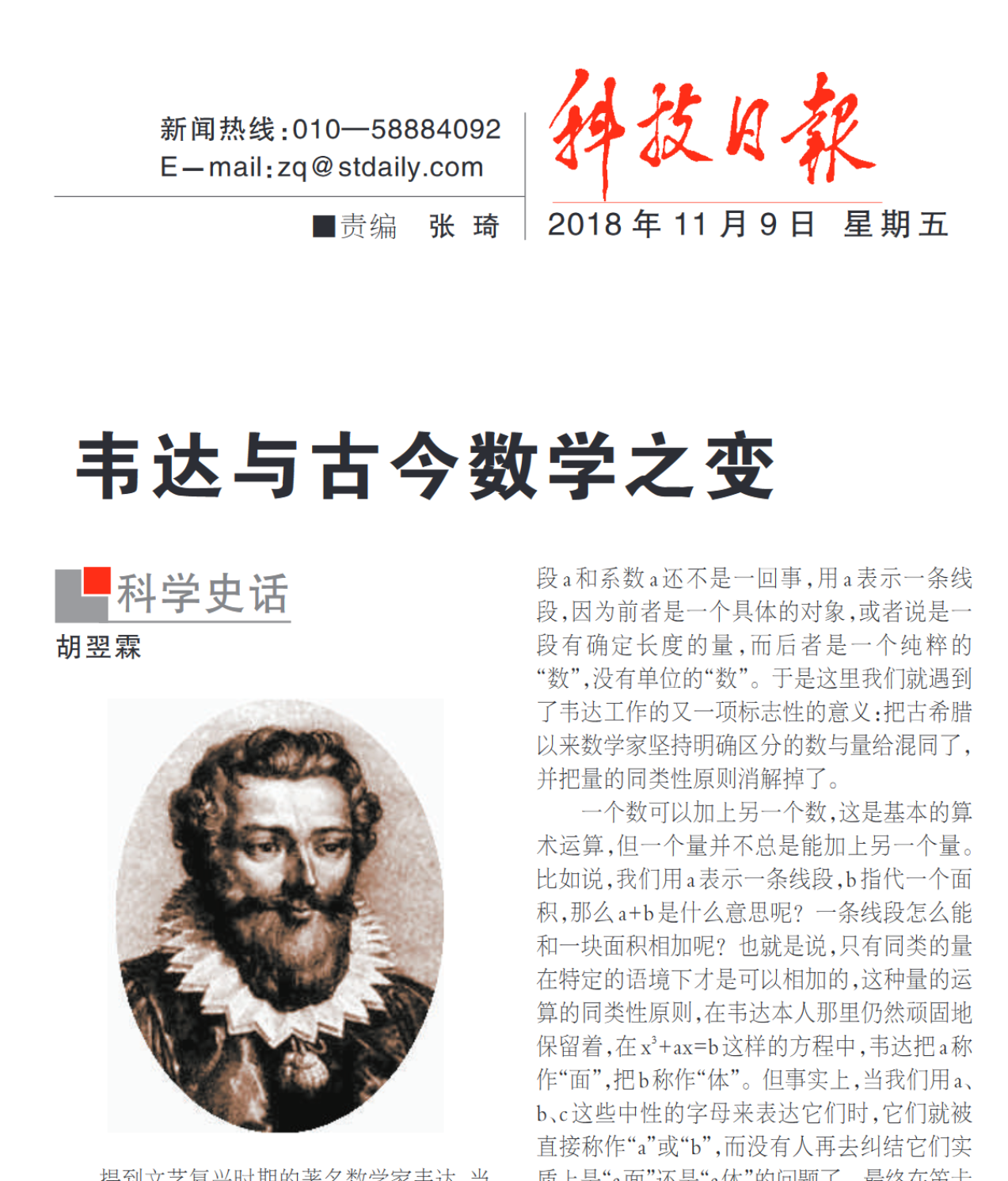
Published in the Chang’e supplement of Science and Technology Daily on November 9; I cobbled this piece together from a general invitation for submissions. Science and Technology Daily has launched a new column, “Stories from the History of Science,” which is rather good. If any students want to submit something, I can make the connection. Of course, the mentality of the traditional media is still rather old-fashioned—for example, they always hope to draw out some kind of scientific spirit…
Viète (François Viète, 1540–1603) was a famous mathematician of the Renaissance. Contemporary middle school students are probably not unfamiliar with his name, because the “formula for finding the roots” of the one-variable quadratic equation so often used in middle school mathematics is called “Viète’s theorem.” Viète’s theorem gives a general formula for the roots of any equation of the form ax2+bx+c=0.
The derivation of Viète’s theorem does not seem difficult. In fact, a middle school student just beginning algebra is already capable of carrying out this derivation—as long as one rewrites the left-hand side of the equation in the form (x-x1)(x-x2)=0, x1 and x2 are the two roots. To put it plainly, it is only a matter of a few arithmetic operations.
But why did such a simple derivation have to wait until the sixteenth century to be completed by Viète? Could ancient mathematicians really not solve equations?
Ancient mathematicians really could not solve Viète’s kind of equation. In fact, Viète is called the father of modern algebra; his greatest contribution was not that he gave the general formula for the roots of equations, but that he gave the general formula for equations themselves. This creation marked the greatest overturning of ancient mathematics by modern mathematics.
Ancient mathematicians of course could “solve equations,” but what they solved were necessarily equations such as 3x2+5x=7, rather than equations such as ax2+bx=c.
For instance, in al-Khwarizmi, the father of algebra, quadratic equations were divided into six types, each of which was discussed separately in terms of its solution. 3x2+5x=7 and 3x2+7=5x are two different kinds of equation, because neither roots nor coefficients can be negative.
But even reading al-Khwarizmi through equations such as 3x2+5x=7 is not accurate enough, because al-Khwarizmi’s algebraic writings were in fact throughout composed of words and figures; he did not use such symbolically expressed formulas, and he even made very little use of the Arabic numerals he himself introduced.
So Viète’s work was also built on the widespread use of abbreviated symbols. On the one hand, this work was based on a reinterpretation of Diophantus’ writings; on the other hand, it also depended on the invention and popularization of various operational symbols in Europe since the Middle Ages, under the merchant tradition. And Viète, as a scientist, unlike merchants, did not merely treat abbreviated symbols as a convenient means; he pursued the scientific goal of universality. Thus he further developed the use of symbols, and completed the final decisive push—using symbols to represent known quantities.
Using symbols to represent unknown quantities had long been common, but using symbols to denote known quantities was somewhat more roundabout. In a broad sense, Euclid already used ab to denote the line segment between point a and point b; among medieval mathematicians, one could sometimes more briefly use b to denote the segment AB.
But a line segment a and a coefficient a are not the same thing. To use a to denote a line segment is one thing, because the former is a concrete object, or at most one may say, a quantity with a determinate length; whereas the latter is a pure “number,” a “number” without units. Here we encounter yet another emblematic significance of Viète’s work: he conflated number and magnitude, which mathematicians since ancient Greece had insisted on clearly distinguishing, and thereby dissolved the principle of homogeneity among magnitudes.
One number can be added to another; that is a basic arithmetical operation. But one magnitude cannot always be added to another magnitude. For example, if we use a to denote a line segment and b to denote an area, what does a+b mean? How can a line segment be added to a patch of area? One meter plus one mu of land yields neither two meters nor two mu. A person 180 centimeters tall and a pig weighing 180 kilograms do not, when added together, produce some 360 of anything. Even a 2-centimeter straight segment and a 1-centimeter circular arc cannot be directly added or subtracted; what would you get if you subtract a circular arc from a straight line?
That is to say, only magnitudes of the same kind can be added in a specific context. This principle of homogeneity in the operations of magnitude remained stubbornly preserved even in Viète himself: in the equation x3+ax=b, Viète called a “area” and b “volume.” But in fact, once we express them with neutral letters such as a, b, and c, they are directly called “a” or “b,” and no one bothers any longer with the question of whether they are really “the area a” or “the volume a.” Eventually, in Descartes, through the introduction of “the unit 1,” the principle of homogeneity was thoroughly broken; but that is another story.
The establishment of Viète’s symbolic algebra was significant not only because it changed the way people solved equations, but more importantly because it changed people’s understanding of the relationship between mathematics and reality. Human beings have long been adept at using all kinds of abstract symbols; writing itself is a kind of abstract symbol. But in antiquity, the meaning of abstract symbols always remained attached to the things abstracted themselves. When people performed operations on abstract symbols, what they had in mind was always the relation among the things abstracted; symbols were merely shorthand tokens convenient for expression. When people carried out mathematical operations, they were in fact, through symbols, solving certain relations among real things. So people were always very cautious about what exactly stood behind the symbols.
For example, what do things like negative numbers, irrational numbers, and imaginary numbers mean? As abstract symbols, what exactly are the real things abstracted by them? These questions were not fully settled even by the twentieth century. Yet under the horizon of symbolic algebra, symbols were no longer always used to denote a specific magnitude, but could denote an “ordinary number” in general. A number itself has no specificity at all; it is completely neutral, without units or dimensions: 1=1, 2=2, a+b=b+a. Thus, people could set aside the question of what real significance some equation might have, and instead focus on the rules governing the operations among symbols.
Only in this way can we understand why a modern elementary school student can easily understand the concept of “negative numbers,” while the greatest mathematicians of antiquity could not. The reason is that the direction of thought is completely different: their starting point was real things and their relations, whereas ours is symbols and the rules governing their operations.
In a certain sense, we may say that Viète marked mathematics as becoming independent from the ancient tradition of natural philosophy and becoming a self-consistent symbolic system. Like “mechanics,” which likewise broke with tradition, modern mathematics replaced the demand for “reasonableness” with “legitimacy” (rule-governed validity).
Translated from the Chinese original with AI assistance. The original text is authoritative.