
This is a commissioned review. My original title was “The Meaning of Philosophy of Science”; when it was published in the China Science Daily, it was changed to “Thinking at the Edge of Science.” I actually didn’t like either title all that much, so I won’t put a title here. In any case, this is just a review of the book. Commissioned reviews always tend to lean a little toward saying nice things; in fact, this book is just so-so, and I’m not particularly recommending it. Still, what I say in the text below about an introduction to philosophy of science positioned as “non-academic” is worth writing about.
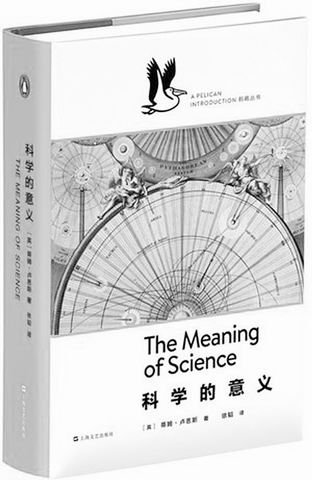
Shanghai Yilin Press has recently published The Meaning of Science, written by Tim Lewens, Professor of Philosophy of Science at the University of Cambridge. The English original of this book was also published quite recently, in 2015; one could say that it is a relatively new introduction to philosophy of science.
Speaking of introductory books on philosophy of science, the best known is probably Chalmers’s What Is This Thing Called Science?, first published in 1976 and then reissued several times in 1982, 1999, and 2013. Both the first and third editions have Chinese translations, and the book has had a major influence in Chinese academic circles.
Compared with a time-tested classic like What Is This Thing Called Science?, this The Meaning of Science undoubtedly looks much more immature. But its positioning is also somewhat different. Introductory works such as What Is This Thing Called Science? are aimed more at beginner students in philosophy of science, or at professionals in other fields who are interested in the relevant academic area. Relatively speaking, they are more systematic and comprehensive in content, covering the key figures and major topics in the development of philosophy of science.
The Meaning of Science, by contrast, is aimed more at a general audience. It belongs to the Pelican series, relaunched by the Penguin Group. In 1935, Penguin launched the paperback revolution, and the long-lived Pelican series that followed was specially designed to provide high-quality serious scholarly works for the general public outside the universities.
Even when a book is a clear and accessible introduction, there are still some stylistic differences between an introductory textbook for professional students and a general-knowledge book for ordinary readers. Academic introductory guides value systematization: they need to sketch for students as complete a bird’s-eye view as possible of the relevant field, so that beginners can understand the full picture of the discipline and thus find the right direction for deeper study. But for the general public, one does not necessarily need to join the academic enterprise step by step, so systematization or comprehensiveness is not quite so important. Instead, guiding and stimulating the reader’s interest becomes more crucial.
This The Meaning of Science is very much a personalized book, and that style is already visible from the table of contents. In the table of contents of What Is This Thing Called Science?, chapter titles such as “Sophisticated Falsificationism, Novel Predictions and the Growth of Science” and “Feyerabend’s Anarchistic Theory of Science” clearly convey the topic of each chapter at a glance, and just reading the contents already outlines the basic issues and main schools of thought in philosophy of science. But the contents of The Meaning of Science? “But is it true?” “Human good will” “Nature—beware!” Just looking at the table of contents, it is a bit like a mystery novel. If this book were to serve as a textbook for graduate students in philosophy of science, it would give them a headache. But for ordinary readers, it may be more vivid.
The whole book is divided into two major parts. The first part is “What science means”; the second is called “What science means to us.” Put simply, these correspond roughly to two academic fields: the former is what is generally called “philosophy of science,” while the latter concerns “philosophical problems of the natural sciences.”
The first part asks about “science” itself: What is science, really? On what grounds can science be distinguished from other activities of inquiry? Where does the basis of science’s reliability lie? The book deals with some classic questions in the traditional field of “philosophy of science,” such as the “demarcation problem” and “scientific realism.” In discussing these issues, the author does not conceal his theoretical leanings; he critically introduces the views of famous scholars such as Popper and Kuhn.
The second part fully displays the author’s personal strengths. It focuses on many issues related to biology, including difficult problems in evolution theory (such as the question of female orgasm) and the ethical implications of evolution theory (such as the selfish gene), as well as neuroscience and its significance (has neuroscience dissolved free will?), and so on. As for physics, astronomy, chemistry, and the like, although there are also many meaningful issues worth discussing, they are not covered in this book.
Frankly speaking, from an academic standpoint, the author’s handling of these topics is not perfect. The overall structure is somewhat haphazard, and the logic of the argument falls well short of being tightly interlocked. Of course, this personalized way of writing also has its advantages. For one thing, from the standpoint of ordinary readers, his arguments are much less pedantic, and he does not use any symbols at all. Analytic philosophers’ discussions, by contrast, often insist on using T0 to denote a theoretical proposition, O1 to denote an observation, and so on. This book has none of those bad habits; the entire text is written in plain, everyday language.
Frequent and vivid “examples” are another major feature of the book. For instance, the 2011 CERN discovery of “faster-than-light neutrinos” is used to discuss the difficulties of falsificationism, and sprinting star Bolt also appears several times, which makes one feel quite at home. There are also many analogical arguments drawn from everyday situations. For example, when discussing communication problems in climate change, the author asks why, when someone asks “Are there nuts in the cake?”, you need to check to different degrees depending on the cost of making a mistake—are they simply someone who doesn’t like nuts, or are they severely allergic to nuts? The response to the same question is completely different in these two cases: in the former, a rough glance at the ingredients of the cake will do, whereas in the latter, you must carefully check the details of every ingredient. Viewed through this kind of analogy, in issues related to climate change, how scientists should respond depends not only on the proposition being asked about itself.
These stylistic features make the book more suitable for general readers who are not philosophy majors. But why should general readers need to understand philosophy of science? In the preface, the author offers a hint: “The value of philosophy of science should not be judged entirely by how much help it gives scientists. It also has cultural importance in a general sense.” The author believes that science is not everything; it does not teach us all the things worth knowing. Outside science, we still need to make “judgment.” For example, in the case mentioned above, checking whether a cake contains nuts may be a scientific question, but how much of our limited energy we should devote to pursuing how deep a verification under this topic is something that cannot be answered entirely from within science. Ecological issues such as climate change, or political and interest-based issues such as how much resource to invest in one scientific field versus another, are not things science itself is sufficient to resolve.
But if science cannot resolve these questions of “trade-offs” and “judgment,” can philosophy of science resolve them? I’m afraid not either. In particular, things over which scientists themselves are divided are also not something a philosopher of science can settle. However, if we do not expect philosophy of science to provide a written, clear, actionable conclusion for every issue—an answer of this kind could also be called a “scientific-style” answer—but instead hope that it, like literature, art, or sports, can provide some kind of “cultivation” or “capacity” that is hard to capture in a clear text, then that is another matter. So what the author hopes to convey to general readers through this book is probably not specific philosophical theories or technical terminology, but rather a kind of sensibility and ability to reflect at the edge of science. Cultivating the ability to reflect is more important than instilling all kinds of ready-made conclusions. In the concrete contexts each person encounters, personalized, local knowledge often matters more than universal knowledge provided by science textbooks.
Translated from the Chinese original with AI assistance. The original text is authoritative.