
Today we are talking about eighteenth-century science.
From the Glorious Revolution in England in 1688 to the French Revolution in 1789, the eighteenth century can be said to have been a century of transformation in history. The Enlightenment and the Industrial Revolution both took place in this century, and the independence of the United States and the rise of Russia also both occurred in this century.
But in terms of the history of science, the eighteenth century seems to have been a relatively uneventful period. The sixteenth and seventeenth centuries before it were the sweeping and magnificent Scientific Revolution; and the nineteenth century is called the century of science, with all kinds of disciplines blossoming in full force: electromagnetism, thermodynamics, atomic theory, evolution theory… But the eighteenth century? Compared with those, it seems rather lacking in memorable achievements.
Some historians of science regard the history of eighteenth-century science as a transitional period of “absorption and digestion” of the Scientific Revolution, and that is correct. But that does not mean the eighteenth century was unimportant in the history of science. Traditional histories of science focus on “results,” on the proposal of new laws and new theories; from that angle, the eighteenth century indeed has few highlights. But if we regard science as a human undertaking situated in a social and cultural context, then the eighteenth century can by no means be called unimportant. For it was precisely in the eighteenth century that science became socialized, and the interaction between scientific development and the cultural environment became especially close.
Before the eighteenth century, scientific research had always been a special activity of a small group of non-mainstream intellectuals, and these intellectuals did not even have a unified affiliation. But after the eighteenth century, science became a common human enterprise, or a universal culture.
Without the eighteenth century, there would be no nineteenth century. That sounds like a truism, but what I want to say is that this transitional period of “absorption and digestion” should not be ignored in retracing the history of science.
Let us place eighteenth-century science in the context of the Enlightenment. We will talk about the Industrial Revolution next time. This is because the First Industrial Revolution, represented by the spinning machine and the steam engine, in fact had no direct relation to the development of theoretical science at the time. It was not until the Second Industrial Revolution in the nineteenth century, represented by the electric motor and the internal combustion engine, that one can really speak of a result driven by science. Theoretical science, experimental science, and industrial technology were only fused together in the nineteenth century, so I will put the Industrial Revolution together with this topic for next time.
The so-called Enlightenment originally meant “illumination.” Enlightenment thinkers of the eighteenth century hoped to use the “light of reason” to dispel darkness, advocating science, democracy, and freedom, and opposing ignorance and despotism. The Chinese translation as qimeng, “enlightenment,” is quite apt: it means to awaken the unenlightened and open up the people’s intelligence.
At the end of the eighteenth century, the great philosopher Kant gave a classic definition of “Enlightenment” in a prize essay. Kant said: “Enlightenment is man’s emergence from his self-incurred immaturity. Immaturity is the inability to use one’s understanding without guidance from another. If the cause of this immaturity is not lack of understanding, but lack of resolution and courage to use it without guidance from another, then the immaturity is self-incurred.” “Have the courage to use your own understanding! This is the motto of Enlightenment.”
Great philosophers always speak in a somewhat roundabout way, but Kant really said it very well. The Enlightenment emphasized using the light of reason to illumine ignorance, but this light of reason does not come from some authority. Rather, everyone has the light of reason in their own heart. The key problem is not a lack of reason, but a lack of courage: always wanting to rely on others, submitting to rulers, obeying authority. That is ignorance. So the Enlightenment manifested itself as a revolt against despotic rule and religious dogma. Enlightenment thinkers valued education, because only through education could the masses come to recognize the power of reason and thus gain the courage to be free. Education, in the eyes of Enlightenment thinkers, was not the inculcation of dogma; the ultimate aim of education was to enable the educated person to free themselves from the educator.
The “courage” of the Enlightenment largely came from the achievements of the Scientific Revolution. The image of Newton, stripped of alchemy and religious elements, was fashioned into an idol of the Enlightenment age. Enlightenment thinkers actively disseminated scientific knowledge represented by Newtonian mechanics, because such knowledge was itself the great achievement of the light of reason. The exploration and dissemination of science were in themselves an Enlightenment cause. In Diderot’s Encyclopedia, the following slogan was put forward: “What you know, spread; what you do not know, explore.” In the engraving below, the goddess of Truth radiates light in the center of the image, while on her right the two goddesses of Philosophy and Reason are drawing back her veil.
This was the Enlightenment’s attitude toward science: science was not merely an activity for the leisure and self-enjoyment of the aristocracy, but also bore the mission of allowing the light of truth to illuminate ignorance. So the eighteenth century can be said to have been a “century of scientific dissemination,” and the socialization and popularization of science were its defining features.

Let us first return to the seventeenth century and talk about the development of science at the level of social institutions. We know that the academic center of Europe was undoubtedly the university at first. But with the unfolding of the Scientific Revolution, universities gradually became places of relatively conservative thought. Although scientists were initially educated mostly through universities, they began to seek their own affiliations outside the university.
Small scientific groups supported by courts or nobles began to appear. A representative example was the Accademia dei Lincei, in which Galileo had participated; it was founded in 1603. Later, Galileo’s disciples founded the Accademia del Cimento in 1657, that is, the Academy of Experiment, which was also highly influential. But these spontaneously formed learned societies were all very unstable, and often disappeared after their patrons left or died.
The first truly stable institutions were the Royal Society of England in 1662 (in English, “Royal” distinguishes king from emperor, so it should be rendered as royal), and the Royal Academy of Sciences of France in 1666 (after the French Revolution there was no more “royal”). These national learned societies were also established on the basis of scholars’ spontaneous organization, but once they were given the royal title, they began to become official institutions. Although they still had patrons, they were no longer dissolved merely because an individual patron departed.
The Royal Society of England and the French Academy of Sciences represent two models. The English Royal Society actually did not have stable royal funding; its finances mainly depended on members’ own contributions, and most members were amateurs. The organization was relatively loose and free. The French Academy of Sciences, by contrast, was closer to a government institution. Academicians generally received salaries from the government, and sometimes had to undertake certain research tasks.
By the eighteenth century, national and regional learned societies modeled on London or Paris had sprung up everywhere, for example:
Berlin 1700, Saint Petersburg 1724, Stockholm 1739; Montpellier 1706, Bordeaux 1712, Bologna 1714, Lyon 1724, Dijon 1725, Uppsala 1728, Copenhagen 1742; Göttingen 1752, Turin 1757, Munich 1759, Mannheim 1763, Barcelona 1764, Brussels 1769, Padua 1779, Edinburgh 1786, Dublin 1785……(78页)Even in far-off America, Franklin founded the American Philosophical Society (1768).
These learned societies replaced the universities and became the centers of exchange for scientists. At the same time, with the help of print technology and increasingly developed communication networks, written communication among scientists became increasingly common. At first, it was centered on certain well-known figures who maintained a correspondence network, through which scholars exchanged the latest ideas and experimental reports by letter. On the basis of these correspondence networks, academic journals appeared.
The Journal des Savants, founded in Paris in 1665, is generally regarded as the earliest academic journal. In the same year, the Royal Society of London also began publishing its own proceedings, namely the Philosophical Transactions. The learned societies that arose later often also established their own proceedings.
At first, the proceedings of learned societies were generally annual or quarterly publications, and there was a considerable delay. For example, the average interval between a paper being read before the French Academy of Sciences and its publication in the academy’s proceedings was three years, and the longest sometimes reached seven years. Such delays became unbearable amid the increasingly rapid development of science, and faster monthly journals and transactions began to appear. By the end of the eighteenth century, journals specialized by discipline began to emerge, such as the Annals of Chemistry (1778), Botanical Magazine (1787), Chemical Annals (1789), Annals of Physics (1799)……


In addition to supporting learned societies, governments in various countries also built national observatories, botanical gardens, and other institutions, serving practical purposes such as navigation, while also maintaining a number of scientists.
Although government-supported scientific institutions were still relatively free in research, compared with traditional universities, the newly emerging scientific organizations paid more attention to practical research. The Royal Society of England in particular strongly encouraged research into “useful knowledge,” including manufacturing, mechanical practice, engineering, and experimental invention, and so on. Newton was actually admitted to the Royal Society not because of pure theoretical research, but because of his improvements to the telescope. The Royal Society’s weekly meetings were almost all experimental reports, and its members followed Francis Bacon’s motto: “Reject empty talk.”
However, many experimental studies at that time had not yet been integrated with the development of theoretical science, and the practical usefulness of science had not yet truly emerged. Although key figures of the Industrial Revolution such as Watt were also members of the Royal Society, their technical inventions still came from the craft tradition of groping, trying, and modifying, rather than from products influenced by theoretical science. From the appearance of Newcomen’s steam engine in the early eighteenth century onward, the steam engine had in fact long been one of the common props for experimental demonstrations. Watt’s understanding of the steam engine and access to materials should also have had something to do with the experimental tradition. But for experimenters, the steam engine always remained merely a performance prop and never received theoretical study. The eighteenth-century theory of heat had even less influence on Watt.
Of course, universities always remained the main channel through which scholars received basic education. At the beginning of the eighteenth century, universities in Catholic regions were still mostly teaching Aristotelian natural philosophy. In Protestant regions, Cartesian mechanical philosophy had generally replaced Aristotelianism, but it was still a speculative, descriptive, causally inquisitive style of natural philosophy, without introducing mathematics and experiment. It was not until the end of the eighteenth century that Newton’s classical mechanics, centered on mathematical analysis, replaced the natural philosophy of Aristotle and Descartes in most places.
The public seemed to accept Newton before the universities did. Voltaire, a representative figure of the French Enlightenment, was stranded in England in 1726, and witnessed Newton’s funeral in 1727. He was deeply moved, and believed that it was precisely because the English respected scholars and valued knowledge that they could be so prosperous and full of good things. By comparison, France at the time was simply a mess. So when he returned home in 1729, he published Letters Concerning the English Nation, recounting what he had seen and heard in England while at the same time attacking the state of France. Later, in 1738, he wrote The Elements of Newton’s Philosophy to introduce Newton’s thought as part of his attack on the French Church, while the philosophy of the Frenchman Descartes was regarded as conservative thought tied to ecclesiastical tradition.
_-001.jpg)
Voltaire’s mistress, the Marquise du Châtelet (1706–1749), was also very important in the dissemination of Newton’s ideas. She was a legendary woman of both literary and martial talent, and of both beauty and intelligence. Her life was notably uninhibited and romantic, especially in her many stories with Voltaire; everyone is welcome to go and gossip about that after class. In addition to helping Voltaire understand Newton’s theory, Mme. du Châtelet eventually translated Newton’s Principia into French (published in 1756 after her death). Below is an illustration from the Principia in her translation: in the sky is Newton, at the desk writing is Voltaire, while Mme. du Châtelet herself is transformed into the Muse.


In the eighteenth century, women played a certain role in scientific activity. Of course, women scholars like Madame du Châtelet were still very rare after all, but ordinary women at least played the role of scientific audience. In France, for example, the salon was a venue for exchanges among many scholars; a salon was, after all, a large sitting room, and social activities were often hosted by the lady of the house, with gentlemen discussing scientific questions in front of ladies.
The French scholar Fontenelle (1657-1757) wrote a best-selling work promoting Descartes’ mechanical philosophy, Conversations on the Plurality of Worlds, whose first edition came out in 1666 and which was revised continuously until 1742. This dialogue takes place between him and a marquise, and natural knowledge becomes a way of banter and amusement between noble men and women.
The Italian Algarotti (1712-1762) wrote a book especially entitled Newtonianism for Ladies (1737); this book swept across Europe and was soon translated into French, English, German, Dutch, and so on.
The English also had many similar pamphlets, such as The Newtonian System of Philosophy, Adapted to the Capacities of Young Gentlemen and Ladies, published in 1761, aimed directly at children and using everyday things to demonstrate Newtonian mechanics—for example, using candles and squash balls to explain the phenomena of solar and lunar eclipses. In eighteenth-century England, this book sold 35,000 copies.
One can say that in the second half of the eighteenth century, Newton’s doctrine was already “known by all, young and old” in Europe. In this regard, Newton’s triumph was not necessarily due to its superiority in mathematical system and precision; to a considerable extent, perhaps it was because Newton, representing England and the new science, was more suitable than Descartes, representing the French tradition, to serve as an idol.
Speaking of the contest between Newton and Descartes, one must mention a large-scale expedition organized by the French Academy of Sciences between 1735 and 1745. According to the law of universal gravitation, Newton believed that the Earth should not be a perfect sphere, because owing to its rotation the equatorial region should bulge out somewhat. The Cartesian school, however, following Descartes’ vortex cosmological model, believed that the equatorial region ought to be somewhat compressed inward. We know that Descartes did not acknowledge action at a distance such as universal gravitation; he recognized only the collision of material particles. Using vortices of ether particles, he explained the motions of celestial bodies and terrestrial gravitation; gravitation was in fact caused by ether particles squeezing inward from the outside. Descartes himself seems not to have stated clearly the shape of the Earth, but his followers believed that the Earth should be lemon-shaped rather than onion-shaped, with the two poles bulging out relatively.
The Newtonians and the Cartesians could not agree, so the French Academy simply organized an expedition, sending two teams: one to Lapland near the Arctic Circle, and one to Peru near the equator in South America. The result of the investigation was that Newton came out on top. Although there is still controversy over this result, in any case Newton’s theory obtained strong support.
 Descartes’ vortex cosmological model
Of course, Newton’s doctrine was also being improved upon. First came the emergence of ideas of cosmic evolution. In Newton, the universe depended on God’s continuous maintenance and existed eternally. But in 1718 Halley reported that the positions of three stars had changed since ancient times, shaking the notion of the eternity of the universe.
By 1755, Kant was the first to propose the nebular hypothesis. He held that planets revolve around stars, while numerous stars gather into the Milky Way; the universe gradually forms order out of a heap of loose sand, evolving from disorder to order. Kant’s nebular hypothesis was developed by Laplace at the end of the eighteenth century.
Laplace wrote the Celestial Mechanics (published 1799-1805), discussing the motions of the planets throughout in the language of calculus, treating perturbation theory and giving special solutions to the three-body problem.
By this time, through the efforts of generations of mathematicians such as the Bernoullis, d’Alembert, and Euler, Newtonian theory had been analyzed into analytic form, marked by Lagrange’s Analytical Mechanics, published in 1788. Analytical mechanics replaced Newton’s laws with more general principles; it replaced forces and momentum and other geometric vectors with scalar functions such as energy and work; it introduced generalized coordinates, transforming Euclidean-geometry problems into purely algebraic ones.
These are developments in theoretical physics; next let us focus in particular on matters in experimental physics. As we have said, in the eighteenth century the traditions of theoretical science and experimental science were basically still separate. For example, if we note that the analytic transformation of Newtonian mechanics had nothing to do with experiments, then what were the experimentalists doing? They were “performing,” of course.
In the eighteenth century, courses under the name of “experiencing nature” were offered in universities, mainly in medical schools, including anatomy, botany, and chemistry; the classroom atmosphere was close to a “performance.” Besides students, there were often laypeople observing. Physics experiments were also introduced into the classroom, likewise demonstrative in nature, and open to the public, including women.
Oxford University introduced experimental courses in 1704, and in 1705 began a series of public lectures accompanied by experimental demonstrations. At Cambridge University, in 1707, William Whiston (1667-1752), the Lucasian Professor of Mathematics after Newton, gave lectures in experimental physics.
Pierre Polinière (1671-1734) of the University of Paris demonstrated Cartesian physics with experiments, holding public lectures that had a great impact; King Louis XV attended one of his lectures in 1722. In the lecture notes Polinière published, the first edition still described experiments as a supplementary method for explaining theoretical principles, but after the third edition they became the only reliable method for reaching true physics. (p. 309)
Although experimentalists kept elevating the status of experiment in scientific research, experiments at the time were still more demonstrative and entertaining in character.
Experimental demonstrations in some cities became must-see attractions for visitors; for example, when the German novelist La Roche (1731-1791) visited London in 1786, her travelogue recorded: “Our evenings were spent at physical experiments, and without doubt these experiments constituted part of worship, revealing to us the inner essence of existence and making a sensitive soul increasingly rational in its awe before its Creator.”
Some performances even became stage plays. For example, in a 1786 pantomime about Captain Cook’s voyage to Tahiti, the “director” Russberg deployed the newly invented hot-air balloon, causing actresses dressed in very little to descend from the sky onto the stage, and finally displaying the magnificent spectacle of Captain Cook as if he were ascending in feathered flight. If we were to look at it now, it would amount to nothing more than a gaudy acrobatic show, but at the time this performance was reviewed by The Times as “a spectacle worthy of contemplation by every rational person—from children to aged philosophers. Such a spectacle most fully displays the wisdom and design of God.”
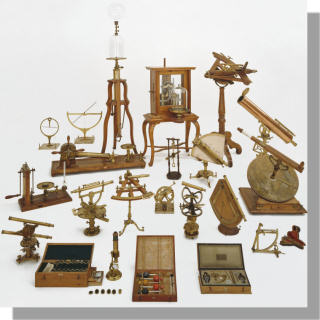
A large number of novel instruments were used to demonstrate science to the public, such as solar-system models, electrostatic generators, air pumps, fountains, hot-air balloons, lightning rods, and so on. These instruments also became best-selling commodities and collector’s items of the time, driving an entire industrial chain from instruments to performances to books.
The demand for performances promoted the production and improvement of scientific instruments, making it easier for scientists to obtain more precise instruments and paving the way for the advancement of experimental science.
The picture below shows some of the scientific instruments made by the German instrument maker Brand (1713-1783), now housed in the Deutsches Museum.

Although instruments such as the air pump were said to be able to demonstrate Newtonian mechanics, one can imagine that in demonstration experiments, the entertaining element was more dominant.
In particular, electricity and magnetism—fields that had not yet been mathematized in the eighteenth century—became all the rage precisely because of their greater entertainment value. For example, at fashionable gatherings of the time, gentlemen and ladies amused one another with small balls or rods electrified by friction, shocking one another and making each other’s hair stand on end.

The University of Leiden in the Netherlands was also a stronghold of experimental physics. F. van der? The University of Leiden’s Boerhaave? Wait—Leiden University’s? no, the text says 福尔德 (1643-1709) visited England in 1674, and then established “demonstrative physics,” beginning to use air pumps and other instruments for classroom demonstrations. The subsequent Willem Jacob ’s Gravesande (1688-1742) continued to advocate the use of experiments to teach natural philosophy.
The famous Leyden jar was also named after Leiden University. Musschenbroek (1692-1761) invented this capacitor in 1745, and it soon swept across Europe, with everyone vying to use Leyden jars to demonstrate discharge phenomena. The most famous performance was organized by the French electrochemist Nollet. He gathered 200 monks in front of a monastery in Paris, arranged them in a large circle, connected them with iron wire, and then discharged a charged Leyden jar; the audience thus witnessed the magnificent spectacle of hundreds of normally solemn monks all screaming in shock together. The French king Louis XV personally came to watch.

Nollet was a major figure in experimental physics; in his book Physics Course he mentioned about 350 demonstration instruments.
He also had theories. For instance, below is his explanation of the rotating-ball electrostatic generator, which also became fashionable in the 1740s and could even produce electric sparks on ice, inspiring particular wonder. Nollet’s explanation of the phenomenon of frictional electrification was:
“While the aroused stream of fiery matter leaves the electrified body, other such streams flow in to replace what has departed. Whether the body is attracted or repelled depends on whether the body is in a position where the inward flow is stronger or the outward flow is stronger. When these subtle currents are concentrated enough, the particles composing them will collide head-on, breaking through the sulfurous envelope surrounding the particles and freeing the active fiery matter within them.” (p. 319) Nollet believed that this theory was based on straightforward facts rather than hypothesis.
Of course Franklin’s explanation of electricity was much more reliable. He proposed the concepts of electric current, positive charge, and negative charge. As is well known, he also proved that lightning in the sky and the electricity collected in a Leyden jar were one and the same, invented the lightning rod, and so on.
In the eighteenth century, theoretical research in electricity thus groped its way forward with great difficulty. It was not until the end of the eighteenth century, with the research of Coulomb and Volta as representatives, that electrical experiments and theory became truly fruitful. Volta discovered that contact between different metals produced different electric potential differences, and designed the electrometer to measure the magnitude of the potential difference. Based on these studies, Volta invented the voltaic pile, which could continuously produce electric current and laid the foundation for later research on current electricity.
Coulomb, meanwhile, proposed the inverse-square law of electric charge interaction and used torsion-balance experiments to determine the force between two charged objects. But the experimental methods of scientists in this period were still rather crude; for example, Coulomb’s torsion-balance experiment provided only three sets of experimental data, and one of them did not conform very well to the inverse-square law.
Research on heat, combustion, gases, and so on also gradually shifted from qualitative observational records to quantitative research in the eighteenth century, ultimately completing the Chemical Revolution.
The maturation of quantitative research depended on the development of experimental instruments. As we just said, partly because of the demand for demonstration experiments, the development of experimental instruments was promoted in the eighteenth century; thermometers, barometers, gas-collection apparatus, more precise balances, and so on—these precise instruments became widespread in the second half of the eighteenth century.
Scottish scholar Joseph Black (1728–1799) used a mercury thermometer to study heat. He discovered that melting ice into water required the application of a fixed amount of heat, yet the thermometer did not change, thereby distinguishing the concepts of temperature and heat. He further discovered that different substances have different capacities for holding heat; that is to say, a given amount of heat raises the temperature of different substances by different amounts. On this basis he proposed the concept of “specific heat.”
So what, exactly, is the “heat” transmitted between substances? Lavoisier and Laplace proposed the “caloric theory,” which held that heat was a weightless fluid substance, and that the transmission of heat was the flow of caloric between bodies. The caloric theory also explained evaporation as the “combination” of the substance being evaporated with caloric.
Although the caloric theory is now seen as mistaken, it reflects the demand for quantitatively theorized research, because a scientific theory of quantitative research does not merely mean measuring one datum after another quantitatively; it must also provide some kind of conservation law to explain the relations among the data. And a conservation law in turn requires positing the existence of some constant thing. “Caloric” is precisely such a constant that remains unchanged amid change; “phlogiston” was another such thing.
The phlogiston theory was proposed by the German chemist Stahl (1660–1734) in 1703 to explain combustion. Stahl is important in the history of chemistry because he clearly distinguished chemistry from physics, holding that physics studied the aggregation of homogeneous material particles, whereas chemistry studied the synthesis and decomposition of heterogeneous substances.
According to the phlogiston theory, combustion is the process by which a body loses phlogiston, and it is exactly the opposite of the theory of oxidation: it holds that combustion is decomposition rather than combination. Air is a kind of combustion-supporting agent; phlogiston separates out from matter and enters the air. If air is cut off—for instance, if a candle is covered by a jar—combustion stops, because the phlogiston in the enclosed air quickly reaches saturation, so the phlogiston cannot escape, and naturally combustion can no longer continue.
The phlogiston theory had great influence in the eighteenth century, not only in chemistry but also in fields such as the life sciences and earth sciences, where it was used to explain many phenomena. But the quantitative formulation of phlogiston theory was not successful, and it was eventually replaced by Lavoisier’s theory of oxidation and reduction.
Before discussing the theory of oxidation and reduction, we should first talk a bit about eighteenth-century research on gases. We mentioned earlier that the alchemist Helmont distinguished air from gas, but he did not have equipment for collecting gases, and thus could not study the properties of various gases in any concrete way. Such gas-collection apparatus appeared in the eighteenth century. In Hales’s 1727 book *Vegetable Statics*, he described a method of collecting gas using a vessel inverted over water. Hales himself did not study these gases; he believed they were the same as air, but the method he provided had far-reaching influence.
Black’s 1756 *Experiment on Magnesia Alba* examined the air produced when magnesia alba was heated; he called it “fixed air.” He found that after this air was released, the weight of the salt decreased and its alkalinity was lost. This air was also different from ordinary air: it could turn limewater cloudy, and it did not support combustion or respiration. Black formally brought the study of gases into the field of chemistry, pointing out that gases are also chemical substances, that they participate in chemical reactions, and that their chemical properties can be investigated.
The English clergyman Priestley (1733–1804) was a master of gas research. He distinguished many kinds of air, including: “fixed air,” “inflammable air,” “nitrous air,” “marine acid air,” “alkaline air,” and “phlogisticated air,” which, translated into modern concepts, are respectively: carbon dioxide, hydrogen, nitrogen oxides, hydrogen chloride, ammonia, and nitrogen.
Priestley believed that the differences among these airs lay in the degree of phlogiston they contained. Since the breathing process is one of discharging harmful phlogiston into the atmosphere, air rich in phlogiston is not fit for breathing. Priestley obtained a kind of air by heating red mercuric calx (mercuric oxide) that could promote combustion and was suitable for breathing, and he named it “dephlogisticated air.” As we said, phlogiston theory held that air saturated with phlogiston would inhibit combustion, so air without phlogiston would naturally promote combustion. We now know that this dephlogisticated air is oxygen.
Somewhat earlier than Priestley, the Swedish chemist Scheele (1742–1786) also independently isolated oxygen, which he named “fire air.” He believed that combustion is the process of phlogiston combining with this fire air.
 Diagram of Priestley’s gas-experiment apparatus (1774)
In the 1770s Lavoisier studied the calcination of metals. Unlike the combustion of ordinary wood and the like, the weight of metals increases during calcination. Chemists before him may also have known this, but they did not attach much importance to it; in Lavoisier’s eyes, however, this was a counterexample that refuted phlogiston theory. Lavoisier held that both combustion and calcination are processes in which air is fixed by solids and releases its heat in the form of light and heat; thus flame is not the sign of phlogiston but the sign of heat.
Of course, supporters of phlogiston theory could still reply. They admitted that in the calcination of metals something was absorbed from the air, but that did not negate the fact that the metal was still releasing phlogiston into the air. But in any case, phlogiston theory remained vague about whether phlogiston had weight, and about what substances, besides phlogiston, were exchanged during combustion. Lavoisier, through further quantitative research, substantiated his own judgment.
Lavoisier believed that the processes of combustion and calcination were reversible. He heated litharge (lead monoxide) together with charcoal and reduced it to lead metal. Traditionally, charcoal was thought to be the source of phlogiston, so this could also explain the reduction. Later Lavoisier heard about Priestley’s experiment of heating red mercuric calx. This reduction reaction did not require charcoal to take part, so in that reaction, who was it that returned phlogiston to the mercury?
Priestley called the gas produced in this reaction dephlogisticated gas, whereas Lavoisier regarded this reaction as a fatal blow to phlogiston theory. Soon afterward, Lavoisier quickly discovered that this so-called “dephlogisticated gas” was exactly the portion that had been absorbed from the air during calcination or combustion. Therefore, the combustion process is precisely the combination of the combustible substance with this air, while the reduction reaction is the separation of this air out of the compound.
Lavoisier mistakenly thought that this air existed in all acids, and therefore named it “oxygen” (oxygen), which is what it is called in Japanese; in Chinese, taking the sense of nourishing life, it was translated as oxygen.
Who exactly deserves credit for the discovery of oxygen is a matter of scientific-historical dispute. In terms of preparing this gas, Scheele should have been first, but his research had no influence; Priestley’s research directly influenced Lavoisier and thus promoted the development of science. But Priestley, based on phlogiston theory, misunderstood the nature of this gas, whereas Lavoisier was the one who truly discovered oxygen as oxygen.
Of course, we do not need to worry over the issue of priority here. In any case, Lavoisier’s contribution was revolutionary. His significance lies far beyond the discovery of oxygen or the proposal of the theory of oxidation and reduction; more crucially, he laid the foundation for the modern research paradigm of chemistry as quantitative, standardized, and experimental.
Lavoisier also collaborated with Laplace on many experimental studies, such as measuring the heat released during combustion with an ice calorimeter, quantitatively studying the decomposition and synthesis of water, and naming hydrogen.
Together with several other chemists, he also proposed *Method of Chemical Nomenclature*, advocating the naming of compounds by the elements composing them, and using different suffixes to indicate the degree of oxidation. For example, sulfate, sulfite, and so on. He also redefined the concept of chemical elements and summarized thirty-three elements. Although many of these were in fact compounds, this nonetheless established the future direction of chemical research.
Lavoisier had once invested in a tax-farming company. Tax-farming companies were regarded as a corrupt product of the Bourbon dynasty, exploiting the people, and hated to the core by the populace. Although Lavoisier himself did not actually participate in the company’s operations, as a shareholder of the tax-farming company he was sentenced to death by the revolutionaries during the French Revolution. Many prominent figures pleaded for him, but perhaps because Lavoisier had offended Marat years earlier, Marat insisted on having him executed, and in the end he went to the guillotine. At the time, the deputy head of the revolutionary tribunal uttered the famous line, “The Republic does not need scholars,” while Lagrange, grief-stricken, said, “It took a moment to chop off his head, but a hundred years will not suffice to grow another like it.”.
 Diagram of Lavoisier’s experimental apparatus
Finally, let us briefly mention reforms in the university system.
We said that in the seventeenth and eighteenth centuries, universities became relatively conservative institutions, and the center of scientific activity shifted to “societies,” but the status of the university eventually returned in the nineteenth century, and reforms of the university had already begun in the eighteenth century.
In France, Enlightenment thinkers in the mid-eighteenth century were already calling for educational reform. For instance, d’Alembert believed that wasting energy during university years on the study of dead Latin was unnecessary, and that the study of physics should be limited to experiment and geometry, and so on.
In 1745, the Hat Party in Sweden proposed reforming the university system, in which mathematics and physics would become independent specialized disciplines, just like medicine, law, and theology had previously been, established as a college of specialized studies after the basic subjects. But this plan was not implemented. The educational reform launched in Poland in 1777 was indeed implemented: Polish universities added faculties of physics, including mathematics and medicine, reduced Latin in preparatory teaching, and increased scientific content. But in 1796 Poland was partitioned by the great powers, and educational reform was consequently halted. Austria also made some attempts at educational reform, but none of them lasted.
At that time the university environment in the German states was relatively good. For example, the regulations of the University of Göttingen in 1737 stipulated the freedom of teachers: as long as they did not teach content contrary to religion, morality, or the state, professors could choose their own textbooks and arrange their own courses. In addition to teaching, professors also devoted themselves to publishing articles, founding societies and journals, and thus formed the prototype of the research university.
Kant was a professor of philosophy at the University of Königsberg, which at the time belonged to Prussia; Königsberg is now the Russian exclave of Kaliningrad. In 1798 Kant wrote *The Contest of the Faculties*, calling on the government to grant the Faculty of Philosophy complete freedom of thought and speech. Kant’s influence was enormous. Later, Wilhelm von Humboldt founded the University of Berlin under Kant’s influence (1810). The faculties of the University of Berlin were still the traditional four faculties of law, medicine, philosophy, and theology, but its educational environment was new: teachers could freely teach and research, and students could also freely choose their courses, making it a model of the modern research university.
Besides the traditional university, many specialized schools emerged in the eighteenth century, such as mining academies, artillery academies, and schools of bridges and roads, and so on.
After the French Revolution, education for common people was given greater attention, and elementary education began to be institutionalized. Napoleon promulgated the “Basic Law on Education” in 1802 to advance educational reform. In fact, Napoleon wanted to restrict educational freedom and attempted to implement a centralized, universal, and standardized model of education to cultivate outstanding citizens who were moral, cultured, and disciplined. Napoleon established the “Imperial University.” The Imperial University was not a specific university, but a system that unified all universities together and administered all teachers and courses.
Within the Imperial University, disciplines in the natural sciences and the humanities began to be distinguished from one another. The system of academic specialization became closer to our own era.
Traditionally, human knowledge was often regarded as a unified system. In the eighteenth century, when the trend toward specialization was becoming increasingly obvious, scholars still tried to sketch a holistic picture of human knowledge. For example, the knowledge map involved in d’Alembert’s compilation of the *Encyclopédie* (below) divided human faculties into memory, reason, and imagination, corresponding respectively to the three major categories of history, philosophy, and poetry, with many branches further subdivided beneath them.
But this effort to depict a map of knowledge was soon abandoned. In the *Encyclopaedia Britannica* published at the end of the eighteenth century, such a knowledge map was no longer included. The same was true for the organization of disciplines: different fields were no longer regarded as belonging to some unified system, and in any case no one person could master all knowledge. Scholars devoted themselves to formulating norms for each specific specialized discipline, no longer concerning themselves with the overall system of knowledge. Science henceforth became increasingly specialized, to the point of becoming, in the literal sense, a “study of divisions into fields.”
 D’Alembert’s knowledge map (p. 227)
Further Reading
Roy Porter: “Eighteenth-Century Science (The Cambridge History of Science)” — This book is very thick and includes many essays; if you are interested, you can pick through it and take a look.
Peter Gay: “The Enlightenment” — My introduction to the background of the Enlightenment here is far too abbreviated; students who are not very familiar with it are advised to find some related historical reading to supplement it.
Supplementary Note:
Regarding the relationship between the steam engine and theoretical science, a student raised doubts in class. Indeed, the statement that “science promotes technology” is quite common; traditionally people took it for granted that Watt’s improvement of the steam engine was the result of applied science, but now it is generally believed that the First Industrial Revolution as a whole was still a product of the artisan tradition and had no direct relation to theoretical science. But if we expand the scope of “science” and count the performative-experiment aspect as well, then Watt’s work did indeed benefit from the broader environment of the instrument industry shaped by the experimental tradition.
In order to refute my remarks, one student found an article for me to read: He Jijiang: “What Did Science and Technology Contribute Separately to the Invention of Watt’s Steam Engine”
We didn’t examine it closely in class, but looking back, this article is actually supportive of my view. Right at the beginning, the author lays out three views on science’s influence on Watt, and acknowledges that more people support the third view, namely the irrelevance thesis. And the conclusion he draws from his analysis of the influence of latent heat theory is also that “latent heat theory did indeed play an inspiring role in Watt’s invention of the steam engine, but one cannot say that Watt’s invention of the steam engine was an application of scientific principles.” This is basically my view as well. So-called “inspiring role” is somewhat nebulous; in substance, there was no direct influence. And when he goes on to mention science’s influence on Watt, he notes that Newcomen’s steam engine had long been used in classroom teaching, but that there was no theoretical research in the scientific community. This is exactly the situation I described: the tradition of experimental physics, centered mainly on demonstration, was detached from theoretical physics. The steam engine was of interest to the scientific community as a demonstration device, but had nothing to do with the development of theoretical science. In the end, the author draws the conclusion, stating plainly that the contribution of scientific theory to the invention of the steam engine was very small.
Translated from the Chinese original with AI assistance. The original text is authoritative.