
Last class I talked about medieval science. We discussed the emergence of the “university,” and the conceptual preconditions that Christian theology may have provided for modern science. But I have not yet given a concrete introduction to the theoretical creativity of medieval scholastic philosophers.
I had originally considered giving a comprehensive account of the specific contents of medieval science in this class as well, but after weighing it up, I decided not to devote a single lecture to it. The main contributions of medieval science were concentrated in natural philosophy and in the clarification of certain concepts; they are relatively speculative in character, and if treated in a separate class they might seem rather cumbersome. As Francis Bacon once said in a maxim: “He who lacks the ability of analytical judgment may study scholastic philosophy, for this discipline values tedious dialectic most highly.”
So I plan to insert the content of medieval science appropriately later, when I lecture on the Scientific Revolution. The next several classes on the Scientific Revolution will mainly be divided into a few threads: the first is astronomy, the second is physics, the third is alchemy, and I may also add a mathematical thread. Medieval science will come up in the course of discussing these threads, and I will introduce it separately then.
Here I can offer a small hint. In astronomy, the main contribution of the Middle Ages lay in imagination concerning cosmology, and it mainly included several questions: whether the universe is eternal or created; whether the universe is finite or infinite; whether a vacuum is possible; whether the sharp division between the heavenly realm and the earthly realm, as well as the notion that the earth stands motionless at the center of the universe, can be broken; and so on. Aristotle held that the universe is finite, perfect, and eternal, and that what is called space is precisely the place occupied by things, so that without things there is no space; he also posited a division between heaven and earth, and each element has its natural place. But in scholastic philosophy, all these notions were challenged, opening up intellectual space for the astronomical revolution later summarized as “from the closed world to the infinite universe.”
In physics, the main contribution of scholastic philosophy lay in discussions of the cause of motion and in the quantification of kinematics. For Aristotle, motion is divided into natural motion and forced motion. Natural motion is the motion of each element toward its natural place—for example, earth falling downward and air rising upward. In natural motion, the cause of motion lies within the thing itself; in forced motion, the cause lies outside the thing, and some mover forces the thing to move. But how to explain the phenomenon of a thing continuing to move after it has left the mover became a problem. In Aristotle, this was explained by the transmission of motion through the air: that is to say, although the thrown object has left the original mover’s “hand,” it is still continuously being pushed by the air.
In medieval scholastic philosophy, partly because of the idea of a vacuum, there were many discussions of the motion of projectiles, and some new modes of explanation emerged. The most representative was the “impetus” theory of the French scholar Jean Buridan (1292–1363). Impetus is also called “impressed force” or “inherent force.” The mover does not transmit force layer by layer through the air to the thrown object; rather, it once and for all impresses a portion of force into the projectile itself. This impetus continues to drive the object onward until it is neutralized by air resistance. This concept of impetus is clearly the prototype of the later concepts of inertia and momentum.
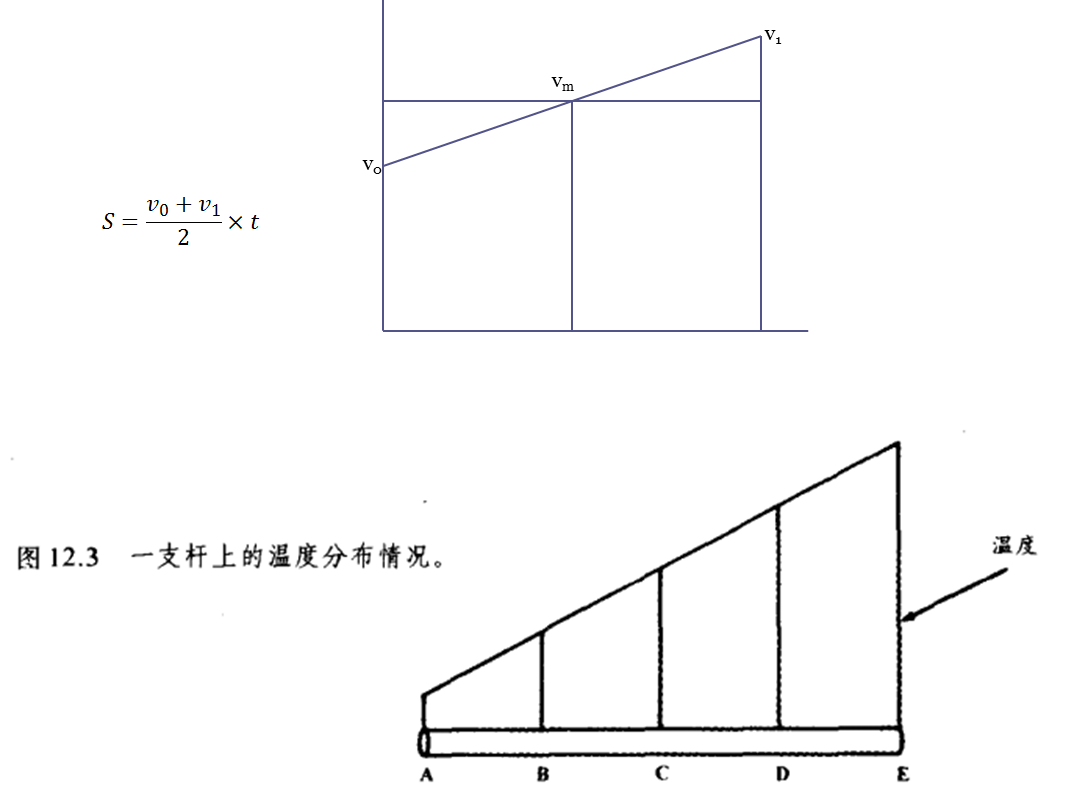
In kinematics, the French scholar Oresme (ca. 1320–1382) defined uniformly accelerated motion and derived its formula, namely that the distance traveled in a certain time equals the product of time and the mean velocity in speed.
What is interesting is that the quantification of kinematics started from the quantification of “qualities”. Oresme’s work benefited from the work of the Merton School at Oxford University, and he geometrized the Merton School’s results. He developed a method of using line segments to represent the measure of qualities. So-called qualities, such as color, hot and cold, are all what things are said to possess as properties. But these properties are not simply present or absent; they have a certain measure—for instance, from light red to deep red, from warm to scalding. The same quality has different degrees. So we can use line segments of different lengths to express the degrees of a quality—for example, the figure below represents the temperature distribution on a rod heated unevenly.
If the magnitude of motion, like the magnitude of heat, is a measurable property, then this kind of diagram naturally can be applied to depicting changes in speed. For example, imagine that the rod is rotating around point A; then these line segments representing temperature can also be understood as representing the magnitudes of motion of different parts of the rod.
Finally, if we change the object of inquiry from the qualities of different parts of an object to the qualities of the same object at different moments in time—for example, the process of heating an object, where a “rectangle of temperature” represents constant temperature—then the diagram for uniformly accelerated motion below comes into view all by itself.
Oresme’s “proof” of the mean-speed theorem seems to be the result of intuition, and he may not have sufficiently considered or excavated the physical meaning behind the diagram. But his contribution to later scientists is beyond doubt. His contribution lies not only in the discovery of the mean-speed theorem, but also in bringing geometric diagrams and mathematical calculation into the study of kinematics and indeed into natural philosophy more generally.
Finally, the Middle Ages introduced Arabic alchemy and developed it further, pursuing the “philosopher’s stone” that could turn stone into gold. In the early Renaissance, Europeans discovered the Hermetic corpus, and in addition, the earlier-rising esoteric religion of Kabbalah converged into a mystical tradition of exploring magic. The influence of this alchemy-magic tradition on the rise of modern science cannot be ignored. Its significance is not limited to nurturing chemistry as a discipline. In fact, many famous early modern scientists, more or less, directly or indirectly, were influenced by Hermeticism—for example Copernicus and Kepler, not to mention religious zealots like Bruno and alchemists of the first rank like Newton. (Bruno was burned not because he defended Copernicus, but because of religious heresy influenced by Hermeticism. Christian belief among intellectuals of the time was itself somewhat heretical, but Bruno’s heresy went too far—he was almost completely denying Jesus Christ and moving toward pantheism. Added to that, his own personality was terrible and he offended too many people; under the historical circumstances of the time, he truly did not die unjustly. As for Newton, his investment and output in alchemy and theology were no less than his work in physics, and he has been called the last magician.)
The rise of the “magician” changed the basic style of the ancient philosopher’s contemplative reflection, emphasizing the manipulation and alteration of natural things. In the hands of the magician, natural objects and artificial objects transform into one another, which is of great significance for the formation of the modern scientific conception of nature.
Later we will also devote a special topic to this alchemical thread.
 The diagram of the Kabbalistic Tree of Life, which appears in anime such as EVA. Kabbalah is a branch of esoteric tradition that arose in medieval Europe.
Before unfolding the several threads of the Scientific Revolution, let us first talk about the technical environment that helped bring the whole Scientific Revolution into being—that is, the impact of printing.
We say that the Middle Ages generally refers to the period from the 5th century to the 15th century. We can take the fall of Byzantium in 1453 as a marker of the end of the Middle Ages, and we may also take Gutenberg’s invention of movable type in the 1440s as a marker.
Of course, we know that movable type had already been invented in China by Bi Sheng several hundred years earlier, but movable type printing had long exerted little influence in China, where woodblock printing remained dominant. Gutenberg’s invention, by contrast, was truly timely and appropriate; from the start it was propelled by the cultural environment’s love of texts, and after its invention it quickly spread throughout Europe, having a major impact on a series of later transformations such as the Renaissance, the Reformation, the Scientific Revolution, and even the Enlightenment.
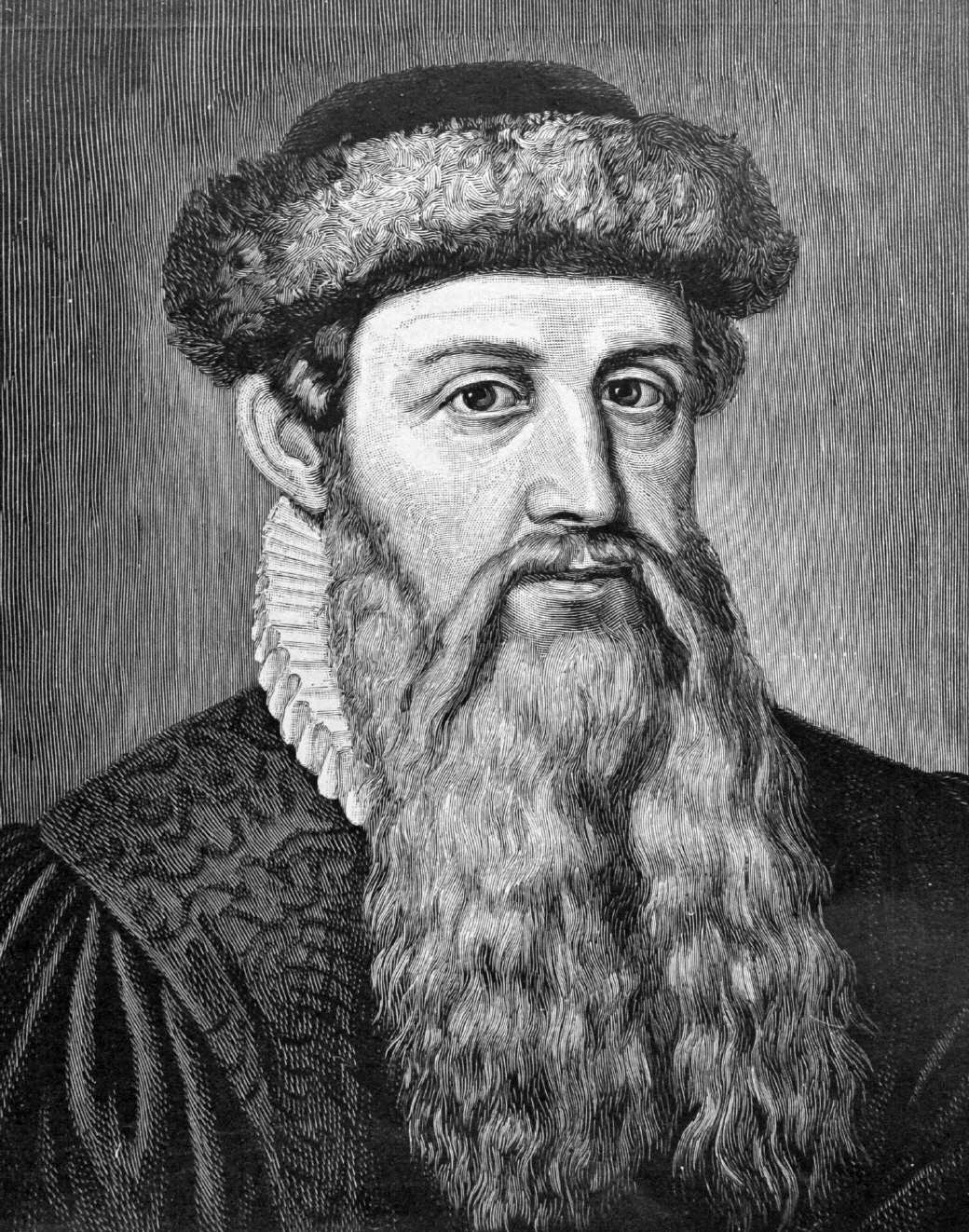 Gutenberg
We can see that, with the spirit of Greece plus the soil of Christianity, the intellectual “raw materials” required by the Scientific Revolution were already basically ready. The rise of the Scientific Revolution was more or less a case of “all is ready except the east wind,” and this “transmitter” was printing.
The Greeks lit the spark of science; the Arabs preserved the spark of Greek science, which finally burst into flame on Christian Europe’s soil. But besides the source of fire and the land, wind is another essential element that people often overlook. Yet without the spread carried by wind, a flame can usually only flash and die out.
Looking back at all the “golden ages” that ever appeared in ancient civilizations, we find a period of contending schools, heroic figures, and intellectual peaks, but their brilliance often lasted only a very short time before giving way to a long decline. Later generations merely kept annotating and repeating the words of the sages, while the occasionally flickering sparks of wisdom were difficult to inherit and develop. Only modern science, beginning in the 16th and 17th centuries, opened up an era of sustained growth and progress; scientific development spread like a prairie fire, once started impossible to stop.
And what we want to say is that printing was precisely the driving force that enabled the scientific tradition to maintain continuous growth.
By “driving force” I do not mean a logically sufficient or necessary condition. To demonstrate a historical condition that is both necessary and sufficient is in the first place not very possible, and I am even less inclined to establish some causal relation between printing and modern science. For printing did not provide modern science with specific raw materials; it provided a medium.
Just as wind can hardly be said to be the cause of a fire, from the perspective of tracing causes and effects, wind is only an aid, like a catalyst—it does not alter the original reaction, merely multiplies the rate at which the reaction occurs. Traditional historians also value the significance of printing, but they generally see its influence as merely multiplying the speed and range of dissemination.
But beyond speed and scale, did printing also exert some influence on the content of modern science? This is also possible. In fact, if we compare historical transformation to a chemical reaction, such a reaction is not a controlled reaction in a laboratory or an engineering setting, where the raw materials can be carefully selected while all other impurities and interferences are excluded. A medium in history is more like introducing a certain specific catalyst into a large mass of raw materials containing all kinds of substances: it can accelerate the reaction of some substances, while others are relatively inhibited. In this way, for the social environment as a whole, what it undergoes is by no means merely a simple process of “acceleration,” but a shift with a distinctive tendency.
For example, in the laboratory, if the raw materials are A and B and the reaction produces C, then whether or not the reaction is accelerated, the final product is still C. But in the real world, besides A and B, the environment may contain many other elements, with countless possible paths of development, such as D + E = F. If one catalyzes one of these directions of development, the result may ultimately be a major transformation of the cultural environment as a whole—for example, a world that changes from being centered on D to being centered on C. And if there were no such catalysis, the result would not necessarily be a slower change into a C-centered world, but perhaps a world centered on F.

Printing reshaped human ways of thinking and habits of life in a certain specific manner, but any new way of life can never descend from nowhere; it can only be a certain transformation of previous ways of life. The new tendencies brought by new media are always able to find “raw materials” in tradition. So we can very likely find the sources of various aspects of modern science in the origins of Greek and Christian culture, but this does not negate the crucial role played by printing in the process.
Therefore, the transformation brought by printing cannot be understood only from the content it disseminated; one must look at the transformation of the entire cultural environment under its impetus.
People generally find it hard to understand the cultural changes caused by new technology—for instance, someone may ask: what is the difference between a theory printed in a book and a theory copied in a manuscript? This is like asking: what is the difference between coal hauled by a train and coal hauled by a horse cart? But such a question already misses the meaning of the new technology.
This is because people are always accustomed to measuring new technology with concepts from the context of old technology: automobiles are seen as self-moving horse carts, telegraphs as faster letters, printed books as more efficient manuscripts. Imagine a person living in the age of horse carts who first comes into contact with an automobile, but who has not yet changed his entire way of life and habits. In the past, however he traveled, now he still travels that way; in the past, however he arranged travel within the rhythm of life, now he still arranges it that way. He merely replaces the old horse cart with the present automobile. Then of course he will find that travel is a bit faster and a bit more convenient, though when the environment and infrastructure are not in place—for example, if roads have not been properly laid—the automobile is actually slower and more troublesome. So taken together, automobiles and horse carts do not differ all that much. Only when the entire environment (context) has changed—when people have rearranged the rhythm of life according to the automobile’s performance, when the whole social structure and public environment have all been reconfigured around the automobile’s characteristics—can the difference between automobile and horse cart truly be revealed. Yet at that point, people who have become accustomed to the automobile environment often have already forgotten the world of the horse cart; they then turn around and use automobile-based notions to understand the horse cart, and are still quite likely to conclude that automobiles and horse carts do not differ all that much.
In fact, what we call science is also a certain intellectual-cultural environment as a whole, and not merely the statements and data that can be simply accumulated in books. That is only the modern impression, and this impression is precisely the result of printing.
Very few people attribute the success of modern science to printing. Many people believe that the reason ancient scholarship could not endure while modern science can accumulate and progress is that modern science finally found the most effective “scientific method,” namely the “induction-experiment” method. But where did this scientific method come from?
Francis Bacon (1561–1626) is regarded as a proponent of the scientific method, and he expounded the new method of modern science—“induction.” But what is the essence of this method? I think it lies precisely in a kind of “historical method,” that is, a completely new attitude toward “textual records.” And this new attitude only became possible after printing.
By the way, what is called “history” (history), in Greek originally meant inquiry or investigation. Such inquiry differs from the contemplation and quiet observation of ideal things in theoretical science, and refers more to investigation and exploration of real things. In a certain sense, “history” was from the very beginning an “empirical science,” except that its objects of study were generally only winds, customs, and human affairs, without establishing a connection with natural philosophy. We often think that “history” has a temporal character, but this is only in terms of its usual objects of study—the perishable human world rather than the eternal world of ideas. As for its method, history does not necessarily contain the meaning of time.
Bacon’s methodology contains at least three steps: “First, we must prepare a natural and experimental history … this is the foundation of everything; … the second step must be to arrange the facts into tables and columns according to some method and order, … the third step must be to use induction.” In simple terms: record—compile—induce. The first two steps are nothing more than the procedures of “historiography” in the general sense, and this is precisely the part on which Bacon devoted most of his effort.
Apart from The New Organon, Bacon’s own practical work was also concentrated on historiography, from his early studies in the history of learning to the unfinished History of Ten Centuries of Nature—Bacon in this book “left behind a large quantity of ‘facts’ he had collected, belonging both to books and to direct observation. … This work, usually printed together with New Atlantis, is the most frequently reprinted of all Bacon’s works.”
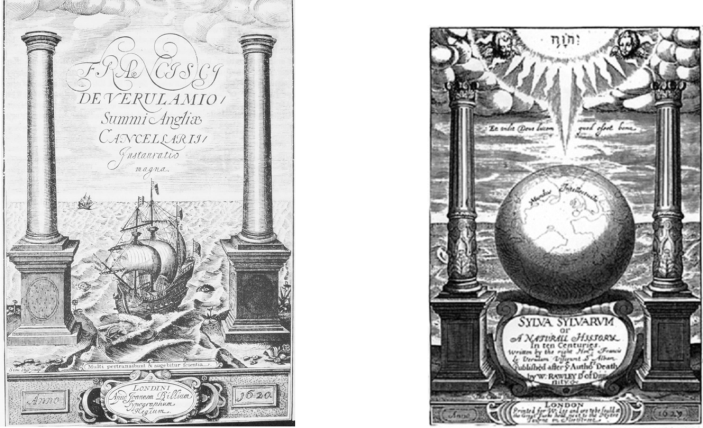
The image on the left is the cover of Bacon’s 1620 New Organon, showing a sailing ship passing through the Pillars of Hercules—the Pillars of Hercules were, in Greek mythology, the westernmost point of the hero Hercules’ journey; New Organon aimed to go beyond the Greeks and enter a new and free world.
The image on the right is Bacon’s posthumous Sylva Sylvarum, published in 1627, also known as the History of Ten Centuries of Nature. At the top of the cover, the sun bears the Hebrew symbol for God; in the middle are the words from the Book of Genesis, “God saw that the light was good”; and below, on the earth, are the words “the world of wisdom.” The book is divided into ten chapters, and each chapter includes 100 recorded “experiments.”
By the way, the concept of Natural History is now usually translated as “natural science,” but earlier I mentioned that this translation may hinder our understanding of the status and significance of the ancient discipline of natural history. Here we will continue to call it “natural history,” which at the same time suggests the tension between the two concepts of nature and history, or rather between the natural world and the textual world.
Of course, from Aristotle to Pliny the Elder, the ancients also achieved much in “natural history.” So why say that only in Bacon’s age did “natural history” become the “new instrument” of scientific research? On the one hand, in antiquity natural history stood far below natural philosophy in status and could not possibly be placed at the foundation of methodology. On the other hand, and more importantly, ancient natural history consisted only of scattered achievements and could not form a tradition capable of cumulative development.
And what enabled “natural history” to flourish in the modern era was precisely the technical conditions brought by printing. Bacon himself was to some extent aware of the significance of recording devices; he said: “Even if … a heap of material of experience is already prepared at hand, if understanding, with no equipment whatsoever and relying only on memory, is to cope with them, then it will still be unable to do so, just as one cannot hope by the power of memory alone to preserve and handle calculations for astronomical almanacs. But hitherto work in invention has always involved more thought than writing, and experience has not yet learned its letters. And we know that the course of invention, unless sustained and steadily advanced by written records, can never be brought to completion. Once written records are widely adopted and experience becomes literate and able to write, then better things may be hoped for.”
What made experience “learn to write” was printing. Before the age of printing, unless there was support from a large and stable institution like the Mouseion of Alexandria, it was practically impossible for anyone to master an entire astronomical almanac and make accurate, accumulative calculations. Although Ptolemy’s works began to be translated into Latin from the twelfth century onward, their preservation and dissemination were extremely difficult. So we see that the achievements of scholastic philosophy in the Middle Ages were mainly in natural philosophy, relying on oral exchange centered on “scholastic disputation.” Thus, although Ptolemaic astronomy was also introduced, beyond its introduction it did not receive any obvious improvement.
In fact, in the age of handwritten books, astronomers seldom could read the complete Almagest. Many scholars spent their entire lives only copying, correcting, making summaries, and so on; but what if the manuscripts they used were already full of errors and omissions to begin with? Accumulation was out of the question, and it was already very difficult merely to ensure that errors did not multiply as they were transmitted. So in antiquity, scholarly decline was the norm, while accumulation was extremely rare. Only within relatively stable research institutions such as the Mouseion of Alexandria or the astronomical observatories of the Arab world was scholarly accumulation possible, and even then only within a particular time and place, inside a certain school or academy.
Bacon complained that the ancients did not preserve records of their experience, so that their research was difficult to inherit and advance. He mentioned: “The ancients, when they first began to think, also had at hand a great abundance of examples and particulars … but inserted only a few instances in a few places to serve as proof and explanation; as for publishing the whole body of notes, annotations, details, and accumulated materials together, the ancients thought that was superficial and also inconvenient. This practice is just like that of construction workers: once a house is finished, the scaffolding and ladders are taken away and disappear.”
In this respect, Bacon was clearly too demanding of the ancients. Even if the ancients did not regard the activity of recording experience in lengthy and cumbersome notes and details as superficial, even if they dutifully recorded them one by one, could such dull and repetitive records possibly have been transmitted to the world? Even if the scribes after them also tirelessly copied these dull records on, would these records not quickly become rife with errors? Even if, on occasion, an accurate version were preserved safely in some filing cabinet, could other scholars freely obtain it so as to advance their own research? And even if other scholars had the chance to obtain a dull record table, would their first task not be to check for possible copying errors in the text they were editing?

This image shows the work of a medieval copying laborer. In the Middle Ages, the professionalized manuscript-copying industry could also achieve the mass reproduction of texts, but this kind of work was time-consuming and labor-intensive, and it was even harder to guarantee correctness. Because the spread of books was so difficult, only famous authoritative texts had the chance to be widely copied, and so some scholars, in order to disseminate their ideas, had to pass them off under famous names.
Only printing made it possible for such records of experience, or experimental reports, often composed of lengthy descriptions, error-prone data, and tedious tables, to enter the scholarly world, where they could be repeated and revised. Even the so-called scholarly world was completely reconstituted: the original circle of scholarly exchange could only be confined to one school within one time and place, and apart from face-to-face exchange, at most it could rely on private correspondence to stay connected. But once these records of experience and experimental reports spread widely with the help of printing, this broke down the traditional boundary between “private” and “public.” Things that had originally belonged to scholars’ personal experience, things that had originally belonged to private exchanges among scholars, suddenly became the basis of public controversy. And the reshaped public sphere ultimately brought about the opening up of the entire “scholarly space”: the traditional circle of academic exchange was often confined to a school or academy at one time and place, whereas the modern scholarly world expanded to the entire community of literati. And this “scholarly circle” created an environment of active competition and cooperation, making science into a common enterprise of “those who follow after and those who come before.”
A public scholarly space requires public debate, and the thing that becomes the common focal point of public debate is, first of all, not so-called “nature,” but precisely reproducible texts. Experience of nature is private; only when experience is written into text does the text become public.
So we can easily understand that what scholars first paid attention to was not finding a universal “order of nature,” but establishing a universal “order of texts.” We notice that the pioneer of “zoology” and “botany” in early modern Europe—the Swiss scholar Conrad Gessner—also happened to deserve the title of “father of bibliography.” Gessner passionately pursued the cataloging and systematization of books; he “devoted himself to compiling the first (and last) truly comprehensive ‘universal bibliography,’ in order to display all Latin, Greek, and Hebrew works published within the first hundred years of printing.” His later Historiae animalium and Historia plantarum were also extensions of this bibliographic interest.
If Gessner is characterized as a “naturalist,” that may create a misunderstanding. In fact, what Gessner cared about was not “things,” but “history”—that is, the cataloging and systematization of texts. In that era, “natural history” was first and foremost a discipline that truly deserved the name of history.


This image shows Gessner’s Historiae animalium, which includes many animals we now consider normal, as well as legendary creatures such as unicorns; the collection of these materials was accomplished only through the collation of other texts.
But textual records contain many errors, and different texts give different accounts. Scholars after Gessner wanted to organize textual materials better, and this gave rise to the need for actual field investigation. In fact, many early field investigations were initiated by publishers, editors, and translators.
For example, the French scholar Pierre Belon (1517–1564) wanted to translate the Greek Hellenistic works on materia medica and botany into French, but he found it hard to determine exactly which plants and animals were being referred to in the ancient books, because the terminology was different. Then he thought he could go and investigate in the East, because the core regions of the Hellenistic world were in Egypt. So, under royal patronage, he traveled to the Middle East to investigate, and eventually produced influential works on zoology and botany. These works were no longer merely translations of ancient texts.
No age lacks travelers who love nature, or adventurers fascinated by novelties; but what drove “the study of nature” to grow and flourish was not only explorers’ curiosity about wild animals, but also historians’ desire to compile and organize historical records, along with publishers’ pursuit of profit.
Simply put, what rose together with printing was first of all the interest in historiography—that is, the need to organize and correct ancient books. And in order to remedy the omissions and errors caused in ancient books by loss and scribal mistakes, people began to seek help from the natural world. Activities such as field investigation and specimen collection were initially not driven by interest in things themselves, but by the need to correct texts.
Early printed books were still riddled with errors, and after publication many errata sheets would often be issued. But the fact that printed books could issue errata sheets “in itself shows the new capacities that printing endowed upon people.”
For the formation of the modern scientific concept of “standardization,” the image of the “errata sheet” is in a certain sense even more important—although the book before my eyes is full of mistakes, it can after all be revised. Behind the various erroneous versions that circulate, there is still one most accurate original version, and the work of revision can, step by step, move toward this “original edition,” eventually restoring a standard version.
Once people begin to view the ancient classics transmitted down to them with this same attitude, the first thing they will think of is to set about “restoring” these classics. And that is exactly what happened: in the early modern period, even when scholars discovered errors in the works of great ancient thinkers, they often attributed them to copying mistakes in the text and then tried to recover the original version.
By the way, dogmatism was precisely just beginning to flourish at this time. In antiquity, even texts such as the Bible, which were carefully preserved and meticulously copied, did not have self-evident authority; rather, their authority was guaranteed by the authority of the Church.
Biblical literalism as fundamentalism is a phenomenon that appeared only after printing. Preaching on the basis of Scripture became popular only in the sixteenth century. The absurd “witch trials” were also a phenomenon that arose only after The Malleus Maleficarum was disseminated by printing.
 An illustration from 1577 depicting a scene of torturing a witch.
Dogmatism is very bad in many cases, but on the other hand, a certain degree of dogmatism is also indispensable to modern science; modern science textbooks specify many relatively firm basic dogmas. We are often more inclined to emphasize the revolutionary nature of science while ignoring its conservative nature. If scientists spent all day questioning fundamental theories, science would also be unable to develop cumulatively.
When the idea of “taking the book as the standard” arose, scientists first did not try to construct a new system of nature out of thin air, but instead did everything possible to revise the classical texts of antiquity. Early scientists believed that the works of ancient philosophers, after long centuries of copying, had accumulated countless errors and omissions. Hence the urgent need to restore them through diligent research.
However, once the work of textual correction began, its effects went far beyond simply rewriting some old book from top to bottom. The key point is that original editions, corrected editions, and rewritten editions of old books would all circulate in the world at the same time. In this sense, it is by no means an exaggeration to say that Ptolemy was a contemporary of Copernicus: Ptolemy became popular only shortly before Copernicus, and continued to circulate for many years after Copernicus.
The different editions of a printed book are utterly unlike the different handwritten manuscripts that circulated simultaneously in the world. The differences among manuscript versions are vague and murky, whereas the different editions of a printed book are clear-cut and distinct, and can be used for comparison and criticism against one another.
In a certain sense, Copernicus’s contribution lay less in finding the “correct” theory than in proposing “another” theory, thereby inspiring later generations to distinguish better theories through further research.
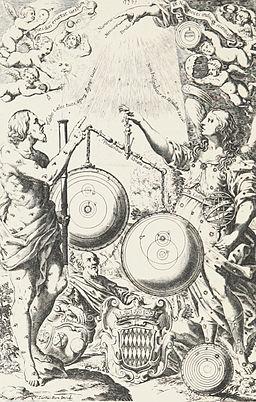
In the frontispiece to the 1651 edition of Riccioli’s *New Almagest*, Copernicus’s diagram and Tycho’s diagram are placed on the two ends of the scales held by the Muse, while Ptolemy’s diagram is placed on the ground. What is striking about this picture is not any final judgment on the three theories, but the fact that it places three mutually conflicting theories side by side at once. In antiquity, obtaining a complete astronomical theory was also extremely difficult, but in modern times scholars step beyond any one particular traditional theory and instead stand at a higher vantage point from which to weigh the theories already in existence. Thus the working method of modern science is no longer to patch up and annotate within a particular textual tradition, but to step outside a specific textual tradition and stand in a so-called objective, neutral, detached position to evaluate texts.
Speaking of the Tychonic system, we can say that Tycho was a typical master of using print. He reached the peak of naked-eye observation of the stars before the telescope, and his astronomical instruments were in truth not much better than those of the Arab observatories, but his use of print was something ancient people did not have. He cross-referenced multiple star catalogs at once, and had his own library, paper mill, and printing shop, ensuring that he could obtain the newest and most complete scholarly materials in a timely manner, and also ensuring that his discoveries could spread promptly. The figure below shows a pamphlet Tycho had printed, marked with the position of a new star. Such material could be disseminated quickly and accurately; in this way, colleagues in the scholarly world could verify the discovery in time. If, as in antiquity, a discovery had to pass from one school to another through decades or even centuries of copying and recopying, the new star in the sky might already have gone dark, and no one would know whether the star had existed all along and was simply omitted in earlier texts or copied out by mistake, or whether the star itself was the result of a copying error. In that case, scholarly discrimination, controversy, and accumulation of new evidence would simply be out of the question.

We said that Tycho had no telescope yet; he relied on the aid of print. But after all, Galileo did have a telescope. It is undeniable that technologies such as clocks and lenses also played crucial roles in the history of the development of modern science. However, the key point is that print also played some kind of decisive role in the development of many other technologies.
Before the advent of print, new discoveries or inventions were often reported orally, and much knowledge was preserved in secret, transmitted only within esoteric traditions. For example, lenses were already widely known in the thirteenth century, but for a long time no one treated lenses as an object of public theoretical study. It was not until the sixteenth and seventeenth centuries, when technical inventions began to be reported in print, that people started competing for priority in invention.
Galileo very likely learned of the Dutch invention of the telescope directly or indirectly through printed materials, and then immediately set about improving it and turning the telescope toward the heavens. Galileo’s improvements to the telescope and his new discoveries in the sky were then quickly spread by means of print.
Print, on the one hand, itemized knowledge, and on the other hand made knowledge public; this promoted the scientization of craft. Skills and secrets that had previously existed only as oral instruction and apprenticeship within artisan traditions were turned into a kind of public scholarly resource that could be accumulated and criticized. After print, the best way to preserve precious materials was to make them public rather than lock them away in a treasure chest. Artisans, too, no longer spoke admiringly of “ancestral secret recipes”; instead, they rushed to publicize their own creations and to compete for priority.
 The Dutch telescope depicted in a book published in 1624. It is generally believed that the telescope was invented by a Dutch spectacle maker in 1608, though other inventors also filed for patents. In any case, news of the telescope quickly spread across Europe, and the following year Galileo, based on rumor, immediately set to work making one.
Before the age of print, not only did technological development always depend on private secret transmission, but the tradition of science had not completely escaped the realm of secrecy either. We have said that in ancient Greece, mathematical proofs and deductions were originally part of the technique of teaching, a practical craft for leading people toward truth, and were to a large extent private in nature; both Pythagoras and Plato had esoteric traditions.
In the early modern period, mathematics still retained many elements of secret technique. For example, mathematicians at the time often took part in all sorts of spontaneous or prize competitions, posing problems to one another and testing their skills, and their own distinctive methods of solving problems were not something they wished to reveal to outsiders.
Take, for instance, the sixteenth-century mathematician Tartaglia (1500–1557). He was a self-taught artisan, and he was the first to translate Euclid into the vernacular, which was one effect of print. But on the other hand, he was unwilling to disclose his own mathematical methods. He could solve cubic equations, and therefore won many of the mathematical contests in which participants posed problems to one another, but he did not want to make his methods public. Later Cardano, making a request on condition of secrecy, asked him for the method; Tartaglia, reluctant to seem stingy, finally passed the solution on to Cardano in the form of an encrypted poem. Cardano, together with his students, eventually managed to decipher Tartaglia’s solution, and generalized it to arbitrary cubic and quartic equations; after remaining secret for several years, it was ultimately published, which caused Tartaglia intense dissatisfaction. Today the solution of cubic equations is called Cardano’s formula.
Tartaglia was indeed rather miserable, but from our modern point of view what was most miserable about him was that he failed to secure priority: the formula ended up bearing Cardano’s name. For Tartaglia himself, however, the very fact that the solution was made public was unacceptable. From Tartaglia to Cardano, we can discern the turning point by which the mathematical tradition moved from secrecy toward publicity.
Another example is the transformation of alchemy: as Rutherford said, in the shift from alchemy to chemistry, the most important transformation was not so much whether one’s attitude toward nature was superstition or reason, but rather the turning point from secrecy to publicity.
In the modern age, the concept of “knowledge” as we understand it has itself already acquired a public character, and so the meanings originally contained within “knowledge”—practical knowledge, manufacturing knowledge, and so on—have gradually been forgotten. For example, I know how to swim; that too is a kind of bodily knowledge. This is less because modern people neglect practical technique than because print recently endowed the concept of “knowledge” with a requirement of publicity: knowledge ought to appear as something set down in black and white, something that can be publicly circulated and read, and should not be anything obscure that cannot be printed. What can be known is almost the same as what can be printed.
 Tartaglia
The world of “textual knowledge” builds a curtain before “nature,” and from then on “knowledge” loses its immediacy (of course, that original immediacy may itself have been nothing but an illusion). “Direct” experience of nature is private and sensory, whereas natural knowledge constructed through texts is public, rational, and “scientific.”
In fact, the slogan “believe what you observe with your own eyes rather than books” did not just arise in modern times; rather, it became obsolete in modern times precisely because of the emergence of print. Ancient authorities warned people not to rely on words and images but to observe with their own eyes, and this is easy to understand, because books transmitted over long periods are always unreliable. Thus Galen in the Hellenistic period said, “The patient is the doctor’s medical book.” But in the age of print, scientists were finally able to trust books and images, and to trust the descriptive records of other scholars, thereby freeing themselves from having to travel in person and allowing themselves to sit back down in the study to conduct research. So our modern medicine actually trusts data more than it trusts personal observation: for instance, we may personally experience catching a cold as a result of getting chilled, but through double-blind experiments and big-data analysis, science tells you that colds have nothing to do with getting chilled.
So in a certain sense one can say that the attitude of modern science is to keep away from nature rather than to approach nature, and that is precisely the revolutionary character of modern science. In fact, when we say “nature,” what we often mean is a series of texts. For example, when we argue about a scientific problem, you cannot say, “Because nature is just like this,” or “Because I personally saw that it is just like this”; rather, you need to cite all kinds of literature, charts, and data, and behind the data there are also texts that support it, and behind the texts there are still data to corroborate them… Only at the end of layer upon layer of texts might there be some person’s direct observation. And the more texts you can cite, and the thicker they are, the more reliable your conclusion becomes; the closer you are to the so-called “nature,” the less “scientific” what you say becomes.
In modern science, distance opens up between human beings and nature, and thus an “objective,” “objectifying” attitude emerges. As Foucault said, “natural history finds itself in the interval now opened between things and words,” and this interval-spaces is precisely the “array” composed of texts and yet more texts, made possible and opened up by print. Mumford also observed that print “promoted a mode of thought that separated and analyzed,” that “printed matter left a deeper impression on people than what actually happened in reality,” and that therefore “to exist meant to exist in print, and to learn meant to learn from books, so the authority of books was vastly extended. … The gulf between reading printed matter and firsthand experience has grown ever wider.”
Further Reading
Eisenstein: “The Printing Press as an Agent of Change”
Mumford: “Technics and Civilization”
Hu Yilin: “A Brief History of Scientific Culture” — most of this lecture and the previous one comes directly from this book of mine, which is relatively more complete. I list it here only to make the point that, for this course, reading the lecture notes is enough; there is no need to read my book, and for the book report you also may not choose my book to write about.
Translated from the Chinese original with AI assistance. The original text is authoritative.