
After finishing with the Arabs and China, let us return to the West and talk about medieval science.
As for the Middle Ages, I was wondering whether I should spend two classes on them, because traditionally this period has been rather neglected; people probably know very little about it, yet in fact it is extremely important. To discuss why modern science did not arise in the Arab world or in China, on the one hand we have to talk about what was lacking in Arab and Chinese civilization, and on the other hand we must also make clear what medieval Europe actually had.
In this lecture we will mainly talk about medieval universities and about certain conceptual preconditions that Christianity provided for modern science. We do not have time to go into the specific doctrines of medieval scholastic philosophers in detail, especially their contributions in mechanics and kinematics. I may add something on that next time, but those contents are relatively specialized and we may also simply skip them; let us leave that for the next lecture.
The concept of the “Middle Ages” itself emerged only after the Renaissance. Europeans of that time “rediscovered” the great cultures of ancient Greece and Rome, and by comparison, the thousand years since Rome’s fall looked to them like utter darkness; only after the Renaissance did Europe begin to enter a new age, that is, “modernity.” Thus modern people claimed the status of the “modern,” took the classical age as their ideal, and drew a clear line separating themselves from the “Middle Ages” in between.
So from the very beginning, the Middle Ages were a pejorative term; some people even called them the “Dark Ages” outright. After the Enlightenment, the Middle Ages were depicted even more as a period of ignorance and superstition, not only making no constructive contribution to modern science, but serving as a stumbling block to it. Modern science seemed to have had to force its way through, overcoming the oppression of the Middle Ages bit by bit, before it could suddenly appear on the stage. In particular, medieval religious belief was portrayed as a demon wildly suppressing progressive science, while modern scientists were all cast as heroes and fighters.
We already said in the first lecture that this is a typical Whiggish history: the good is assigned to science, the bad to the devil; such history is in many respects one-sided wishfulness.
In China, we have been deeply influenced by this Whiggish view of history. Even today, many textbooks and popular books, and even some professional scholars, are still promoting a “negative-energy” Middle Ages and the utterly evil Christianity. But in the Western history of science, the importance of the Middle Ages for the history of science has long been a matter of consensus.
The scholar who first rediscovered the scientific achievements of the Middle Ages was Pierre Duhem (Pierre Duhem 1861-1916), a French physicist, philosopher of science, and historian of science. His views in philosophy of science were also quite influential; Lenin once singled him out for criticism. His work in the history of science was also pioneering, especially his excavation of medieval science, which had a major impact. In Duhem’s account, many so-called revolutions of Copernicus, Galileo, Kepler, and even Newton were in fact nothing more than the sorting out and supplementation of the achievements of fourteenth-century scholastic philosophers.
Duhem’s history of science was also strongly biased. He himself was a religious believer and also a Frenchman, so he often overraised the contribution of medieval scholastic philosophy, especially that of the University of Paris. Although there is some element of overcorrection here, Duhem did in fact uncover a great deal of evidence, enabling scholarship to realize that the Middle Ages were by no means all darkness; on the contrary, the Middle Ages, especially the late Middle Ages, possessed extremely rich scientific achievements. Moreover, Christianity was by no means simply obstructive to modern science.
Of course, this is not to say that the Middle Ages were not dark at all, or that Christianity had no negative effects on science whatsoever; but at the very least it is quite clear that the Middle Ages and Christianity were not purely negative factors, and that they played certain positive, constructive roles in modern science.
Starting with Duhem, some historians of science have adopted a continuity view of the history of science, holding that Greek science, Arab science, medieval science, and modern science in fact form a continuous spectrum. Others still insist that the rise of modern science remained a disruptive revolution. Some have also proposed a theory of “two revolutions”: that is, before the modern scientific revolution of the sixteenth and seventeenth centuries, medieval scholastics also completed a revolution of comparable significance.
Whether there was or was not, or how many, scientific revolutions there were is not the crucial issue. In fact, it depends on the perspective from which we observe history. On the one hand, no thought ever appears completely out of thin air; any new idea has the soil in which it was nurtured, and careful historical investigation can always discover the predecessors of revolutionaries. On the other hand, every scientific discovery can be seen as a revolution, large or small, because it is not merely a simple accumulation, but will also set in motion transformations in various other related ideas and habits. When we later discuss the Copernican revolution, we will also specifically discuss the concept of scientific revolution.
 Duhem
Duhem
The Middle Ages generally refer to the nearly thousand-year span from roughly the fifth century to the fifteenth century. The period before about the year 1000 is generally called the Early Middle Ages, 1000-1200 the transitional period, and 1200-1450 the High Middle Ages.
In the Early Middle Ages, the whole of Latin Western Europe was indeed relatively dark, because the regions occupying Europe at that time were all some kind of barbarian states. The Germanic barbarians had not been separated from clan society for very long, their level of civilization was relatively low, and the population was very small. The whole of Latin Europe was basically a cultural desert, with only some Christian churches preserving a bit of literacy tradition.
The Early Middle Ages saw only one brief scholarly revival at the end of the eighth century. At that time, Charlemagne (Charlemagne 742–814) inherited the Frankish kingdom and campaigned across Europe, expanding his territory to almost the entire western European continent (except for today’s Britain and Spain). This is known as the Carolingian dynasty, the first unified empire established in Europe after the Roman Empire.
But as the saying goes, founding a realm is easier than preserving it; after Charlemagne conquered the world, he discovered that the people governing the state, himself included, were a bunch of illiterates. This was really intolerable, so he vigorously promoted education and culture, spread the “seven liberal arts,” and organized the collection and copying of大量 classical texts. This is known as the Carolingian Renaissance.
Although its main purpose was simply to eradicate illiteracy and improve literacy, with no real innovations in science, the key point is that many ancient texts were preserved and disseminated, and the scholarly tradition of Latin was maintained, providing a foundation for later scholarly revival.

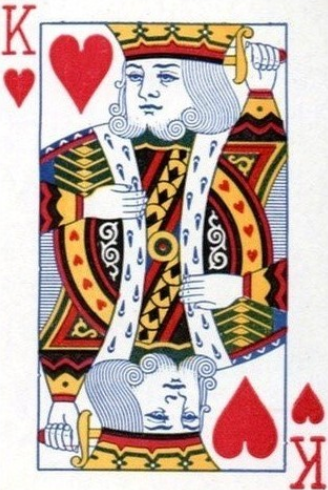 Charlemagne (the prototype of the King of Hearts)
Early medieval Europe was also sparsely populated and vast in territory, which had certain advantages. Because of the shortage of labor, and with no large numbers of slaves available, this may in another respect have promoted the spread of technology. In particular, the use of mechanical technology drawing on water power and wind power became increasingly common in Europe. In the late Middle Ages, machines such as mills, waterwheels, and windmills had already become commonplace in the life-world of medieval people.
The historian of medieval technology Lynn White pointed out: “The most glorious thing about the later Middle Ages is not the cathedral, nor the epic, nor scholastic philosophy, but the first construction in history of a complex civilization. This civilization was built not on the backs of laboring slaves or of beasts of burden, but chiefly on nonhuman power.” (Wu laoshi lecture notes)
The clock that appeared around the thirteenth century was also an important machine. Clocks first appeared in monasteries because monks required a strict daily routine. As clocks became popular, the monastic rhythm of life gradually spread throughout society, and in a sense the rhythm of our modern lives has already been held hostage by the clock. Therefore the American scholar Mumford believed that the key machine of the Industrial Revolution was the clock rather than the steam engine. Before industrial life driven by the steam engine became possible, concepts such as organized living, punctuality, efficiency, and standardization had already been disseminated along with the mechanical clock.
In addition, the metaphor of a “clockmaker God” was very popular during the Scientific Revolution; people imagined the universe as a self-operating mechanical clock. This too is inseparable from the popularity of clocks in the Middle Ages. Later we will say more about the relationship between the concept of the “clockmaker God” and Christianity, and between it and modern science.
The image on the left is a fourteenth-century illustration depicting the abbot of St Albans Abbey in England, pointing to a mechanical clock that he had built for the monastery. The image on the right is a crane from a fifteenth-century manuscript, and below it is the double-revolving crane drawn by Leonardo da Vinci.

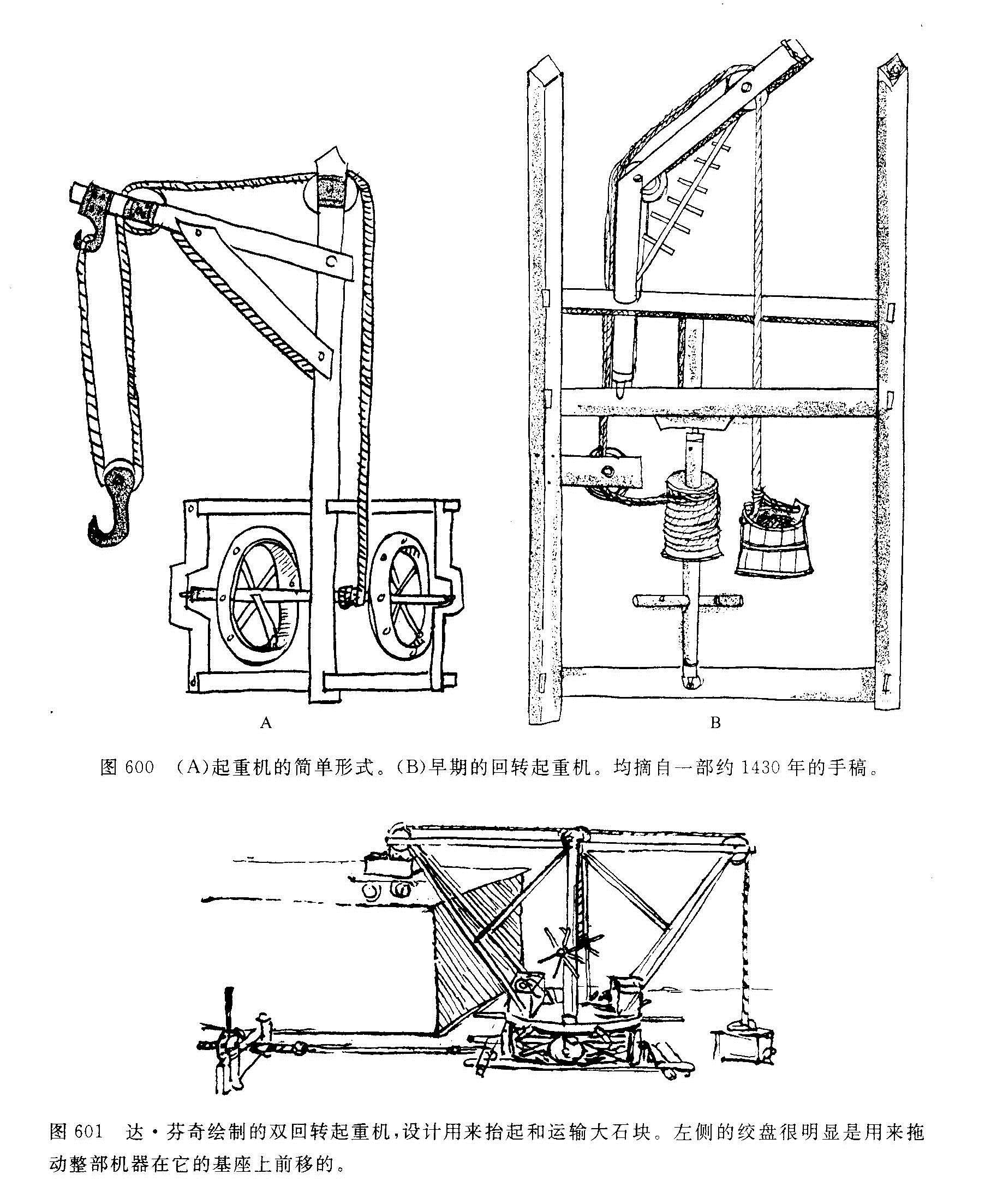 (Wu laoshi lecture notes)
By the eleventh and twelfth centuries, Latin Europe once again experienced a scholarly revival, known as the Twelfth-Century Renaissance. During this period, a large number of classical scholarly works were introduced into Europe through the Arabs, and Europe’s population and degree of urbanization also reached a peak; scholarship began to flourish.
The impetus for this revival may have been the disintegration of the Umayyad dynasty. We mentioned earlier that after the Arabs’ first dynasty, the Umayyad dynasty, was overthrown by the Abbasid dynasty, one branch fled to the Iberian Peninsula, that is, today’s Spain, and then remained entrenched there, also known as the later Umayyads. The Umayyad dynasty reached its peak in the tenth century; its capital Córdoba was the largest city in Europe at the time, and on a world scale it could absolutely be compared with Kaifeng and Baghdad of the same period.
But after the year 1000 the Umayyad dynasty rapidly declined, splitting into several kingdoms and gradually being “reconquered” by the Christians. From the Christian point of view this is what is called the “Reconquista.” Although it was not until 1492 that Christians controlled the entire Iberian Peninsula, from the eleventh century onward Latin Western Europe was able to import Arab texts comprehensively. The earliest translation center was Toledo in Spain, where many Spaniards knew both Latin and Arabic, and Greek scholarship such as Aristotle and Ptolemy began to be translated into Latin.
One often sees people say that Aristotle and such “reactionary scholarly authorities” shackled people’s minds for thousands of years, only to be overthrown in the end by brave and fearless modern scientists. But in fact, before the twelfth century Europeans knew almost nothing about Aristotle; Aristotle’s so-called authoritative status was formed only gradually in the thirteenth and fourteenth centuries, and at most he was respected as the philosopher with a capital P. There was never really a time when people believed his words were beyond question.

With the revival of scholarship, one of the most important scholarly institutions in history, without any qualification, appeared in the twelfth and thirteenth centuries: the “university.”
The university is a European specialty. The historian of science Grant said: “Humanity has experienced the rise and fall of countless urban civilizations, but none of them produced anything like the European university… It arose from the special conditions of the West in the twelfth century.”
Universities began to appear in the middle of the twelfth century, first the University of Bologna in Italy in 1150, followed by Paris, Oxford, Cambridge, and finally they spread throughout Western Europe.
It is hard for us to determine precisely the date on which a university was founded, because on the one hand universities often had predecessors such as church schools before their establishment, and on the other hand after their establishment they often had no fixed location and no clearly defined statutes. For example, the University of Paris already had an organization in the 1160s, but it was not until 1200 that its teachers obtained a clearly defined status; that is, the organization was finally recognized by the king.
1150, University of Bologna, Italy
1160/1200, University of Paris
1167/1220, University of Oxford
1209/1225, University of Cambridge
The greatness of a university was not originally a reference to large buildings, such as the Musaeum; nor was it a reference to particular masters, such as the Platonic school and the like. Rather, it meant the greatness of the “all-in-all.”
We know that “university” is university, and clearly this word is related to universe. Indeed it is: the word university comes from the Latin universitas, which originally meant “the whole, the totality.”
In the 12th century, as commerce flourished in European cities, people in different trades began to organize, of their own accord, various associations and guilds. Members received protection within the guild, and the guild was able to gather up dispersed forces, maintaining internal discipline and preventing vicious competition, while externally defending and seeking its own rights and interests. In the cracks between church and monarchy, within civil society, guilds formed an independent sphere of self-government.
This tradition continued into today’s Western democracies. The so-called trade unions, student unions, and other associations in the West are not chiefly intended to provide services for their members; rather, their purpose is to unite strength so as to fight for the rights and interests of the whole. So when we see Western professional associations, their main activity is basically organizing protest actions all day long. This is not because they have nothing better to do, but because that is precisely the basic mission of the guild.
Since guilds can be regarded as representatives of an entire trade, they were also called universitas, that is, the whole or the totality. And the guild of teachers and students was perhaps the most influential and the most vigorous among them, so this word eventually became the proper name for this kind of educational organization.
So the earliest universities were merely unions of teachers’ guilds and students’ associations. Some universities were organized mainly on the basis of student guilds, such as the University of Bologna; others were organized mainly on the basis of teachers’ guilds, such as the University of Paris. When the identity of these guild organizations was recognized by the government, that marked the formal establishment of the university. Early universities did not necessarily possess immovable property; on the contrary, “we can leave this city at any time” was often one of the trump cards teachers used in making demands of the government. Like other guilds, European universities from the very beginning possessed a sharply defined autonomy.
 Professor Wu’s handout
In terms of teaching content, European universities also inherited the Greek tradition of liberal scholarship. The rise of the university was a consequence of the 12th-century translation movement that introduced Greek learning through the Arabs. The appearance of the university first of all satisfied people’s pursuit of knowledge, rather than serving to transmit practical skills.
These universities were mainly divided into four faculties: the Faculty of Arts, the Faculty of Theology, the Faculty of Medicine, and the Faculty of Law. Among them, the Faculty of Arts was the most foundational; most students entering the other three faculties would first pass through study in the Faculty of Arts. Broadly speaking, the other three faculties aimed to train specialized talents in their respective fields, while the Faculty of Arts provided an education in basic cultural literacy.
And the main content taught in the Faculty of Arts was precisely the “seven liberal arts,” sometimes replaced by Aristotle’s three philosophies, namely natural philosophy, moral philosophy, and metaphysics. By the Renaissance, subjects such as history and poetry were gradually added. But in any case, education in the Faculty of Arts was always “non-utilitarian.” Training in practical skills more closely aligned with social needs was never included.

A university classroom depicted in the 14th century
University teaching initially centered on commenting on classical texts, mainly Aristotle, and by the late 13th century the form of “scholastic disputation” became dominant. In such disputations, the teacher first提出 a “question,” and the other participants are divided into pro and con sides for a public debate. The “doctoral defense” required for graduation from university is essentially a demand that the student preside over a disputation, guide the debate as it unfolds, and finally render a judgment.
But one can imagine that the final adjudication of the answer to the question was not the most eye-catching part; the intense process of argument was the most charming aspect of this teaching model. The question could concern anything, including claims that conflicted with authoritative theological interpretation, all of which could be introduced into debate. Perhaps in the final ruling the teachers would try their best to remain consistent with religious dogma, but all kinds of novel heresies could be imagined by the disputants.
Since the purpose of university education was not to master practical knowledge, but rather more a kind of free intellectual exercise, the contribution of the medieval university did not lie in establishing any definite assertions, but in the space of thought opened up by these free debates.
 Scholastic disputation
There were many contradictions between Aristotle’s natural philosophy and the Bible’s account of creation, and in a sense these tensions further stimulated the liveliness of medieval scholars’ thought. Aristotle was on the one hand a highly respected authority, but on the other hand any of his doctrines could also be questioned.
Before the 12th century, what Latin Western Europe knew of Aristotle was basically just a logician; but beginning in the 13th century, Aristotle’s works on physics, metaphysics, ethics, and so on were introduced in their entirety, and scholars marveled at his grand philosophical system, referring to Aristotle as “the Philosopher” with a capital P, and to the Arab commentator Averroes as “the Commentator” with a capital C. But people immediately discovered that there were many contradictions between Aristotle’s natural philosophy and the Bible’s account of creation.
In 1210, the University of Paris prohibited the teaching of Aristotle’s Physics and Metaphysics; later the Roman Curia also reviewed the relevant prohibitions several times. But in fact these bans were basically ineffective. Other universities were still openly teaching Aristotle; for example, when the University of Toulouse recruited students, it explicitly said that Aristotle was prohibited in Paris, but that everyone was welcome to come study him with them. Even the University of Paris itself still listed Aristotle among the required readings.
If the prohibition had truly been effective, there would have been no Thomas Aquinas (c. 1225–1274). Aquinas and his teacher Albertus Magnus systematically sorted out all of Aristotle’s doctrines and tried to integrate philosophy with theology and to harmonize reason with faith. Aquinas’s Summa Theologica became the crowning achievement of scholastic philosophy.
Later Aquinas was canonized by the Roman Curia, and so he was also called Saint Thomas, but in his own time his doctrines were also highly controversial. Not long after Aquinas’s death, the Curia launched a “Great Condemnation” against Aristotle. Clearly drawing on Aquinas’s systematization, the Curia finally listed 219 erroneous Aristotelian propositions for condemnation, forbidding scholars from adhering to these views.
But, as we said, in the scholastic tradition of disputation, not holding a certain view does not mean one cannot discuss it. The Great Condemnation actually provided scholars with a debate outline, and through the dissemination of this list, perhaps these related philosophical issues were instead discussed more widely and more fully.
These discussions were obviously helpful in breaking many of the stereotypes within Aristotle’s philosophical system. Because of God’s omnipotence, the Curia rebutted many of the limits Aristotle had imagined. For example, Aristotle could not imagine a vacuum, could not imagine infinite space, could not imagine what would happen if earthly things crossed over to the lunar heavens; but once the concept of an omnipotent God was introduced, all these implausible situations became imaginable—does God have the power to create an infinite void? If so, how would objects in that space move?
Unfortunately, medieval scholars often did not take their imagined scenarios “seriously”; they imagined these ideal or extreme things only in order to enrich their debating game. But their idle speculation did in fact prepare the conceptual ground for modern science. They distinguished kinematics from dynamics, distinguished temperature from heat, and defined important terms such as impetus, accelerated motion, and instantaneous velocity.
The example modern people often cite when mocking medieval scholastic scholars is this: they were so absurd as to chatter endlessly over how many angels could stand on the head of a pin. Of course, this is deliberate modern sarcasm, but perhaps medieval scholars really did debate similar questions. Does that mean they were ignorant? Quite the opposite: the very possibility of such questions surely reflects the scholastic philosophers’ extreme commitment to rational inquiry and conceptual discrimination—of course the actual topics were not so superficial; they may have discussed questions about the substantiality of angels and the nature of space, which were meaningful for breaking through Aristotle’s concepts of matter and space.
For comparison, Archimedes could ask: give me a lever and I can move the earth; Newton could say: in an infinite space with nothing else in it, a body will forever maintain uniform straight-line motion; Einstein could imagine: what would I see if I ran as fast as light? …All these imaginings are built on unrealistic, even to ordinary people absurd, premises—how could there be such a fulcrum? Where could there be such space? These are all theoretical speculations using hypothetical things that do not exist in reality. And the scholastic philosophers merely happened to develop their speculations with angels or God as their premises—on what grounds can one say they were stupid?
 Thomas Aquinas
What I said earlier about the tensions between Aristotle’s natural philosophy and the Bible stimulating medieval scholars to develop Greek natural philosophy in a more flexible way, and about how, by introducing the existence of God, some new conceptual spaces were opened up—this is to say that even if modern science ultimately abandoned the hypothesis of God, God at least played the role of a catalytic medium. It is somewhat like the absolute space and time in Newtonian mechanics: although they were ultimately proven to be unnecessary, even erroneous assumptions, in the initial theoretical construction they may still have played certain positive roles. Below, let us talk about what positive effects Christian creationism may have had on the rise of modern science.
The discussion below is mainly speculative. This is a way of doing intellectual history: first mentally reconstructing the logical premises of certain ideas, and then seeking confirmation in actual history.
Below I will discuss this from two aspects: first, the logical premises of the mechanistic view of nature; second, the legitimacy of empirical research.
First, the ancients regarded the universe as an organism: it had a center and boundaries, heaven and earth were divided, and it was anisotropic; modern people, by contrast, regard the universe as a machine, with matter lacking any inner vitality, everything being externally related to everything else. The origins and development of the mechanistic view of nature involve many issues, which we will discuss again later when we talk about Newton. Here, let us first talk about how the mechanistic view of nature was logically possible.
Simply put, if the world is created, and God is not a created being, then God is absolutely external to the entire world. This absolute externality solves the logical difficulty of the mechanistic view of nature. Without this conceptual transition, and thus without a complete reconstruction of the concept of “nature,” the mechanistic view of nature would remain a completely absurd concept.
We have already mentioned that ancient Greek science originated in the “discovery of nature,” that is to say, people began to ask about the inner “nature/essence” of things, rather than understanding natural things from the standpoint of external intervention (divine power or human will). Nature stands opposed to the artificial; natural motion stands opposed to forced motion; natural things stand opposed to technical artifacts. The motion of natural things originates in themselves. Aristotle even defined what a natural object is by explaining the cause of artifacts in reverse—non-externality.
A machine is precisely a typical technical artifact. It has no inwardness; its source and purpose are both external to it. Of course, we can also speak of certain properties “of the machine itself,” study its combinatory structure and operating mechanism, but the machine’s “formal cause” has long since existed in the designer’s mind or on the drawing board; moreover, the formal cause is always still merely the “appearance,” not really inside the machine. By contrast, when a seed grows into a large tree, its cause is contained within the seed itself.
Thus, the machine represents pure externality: it has only appearance, not content; the reasons for its operation are all external—the designer (formal cause), the maker (efficient cause), and the operator (final cause).
So when we say “nature becomes a machine,” this is actually a paradoxical proposition, equivalent to saying that the realm of inwardness has become the representative of externality. This suggests that modern science, in essence, from the very beginning broke down the boundary the ancient Greeks had established between the realm of inwardness and the realm of externality, dissolving the opposition between knowledge and making.
The universe of utmost vastness, “with nothing outside it,” was originally impossible to think of as external, but once an absolutely external being—namely God—was posited, God could assume the role of the external cause of this cosmic machine: that is, the designer, maker, and operator of this machine.
By the way, the “divine craftsman” mentioned by Plato in the *Timaeus* can also, to some extent, play the role of this absolute outsider—but only in the sense of “maker.” The design and operation of the world, however, are not the task of the divine craftsman. In other words, he is unable to bear and carry away the final cause. By contrast, the omnipotent God of Christianity is at once the designer, maker, and operator of the universe, and even the provider of matter itself (the material cause). Aristotle’s four causes all went to their grave with God; what remained in the mechanical world, and could still be pursued by modern science, was not, in Aristotle’s sense, the efficient cause or the formal cause, but something that could not possibly be questioned in Aristotle’s framework at all—“the internal cause of the machine,” or, in other words, “mechanistic natural philosophy.”
Although modern science eventually discarded the concept of God as well, what it discarded together with it was in fact the pursuit of causes, especially the pursuit of the final cause. For us moderns, this world-picture may not seem strange at all, but for those familiar with Aristotle’s natural philosophy, without the mediation of “God,” it would probably be very hard to accept the concept of a mechanically natural world existing independently and self-subsistent.
We will return to these problems when we get to Newton, so I will not say more here.
Second, let us talk about the concepts of God and natural law.
Christian creationism believes that God’s authority is higher than that of the world; that is to say, God’s creation does not need to depend on any higher law. On the contrary, God lays down laws for the world. This so-called “authority” is not sheer arbitrary play, but the governance of the world’s order through legislation. God is the “Lord,” the covenant-maker; the Old and New Testaments are precisely the two covenants between God and humanity, and the books of the law are even more foundational among them. The God of Christianity is not a capricious and fickle tyrant, but a monarch who speaks in terms of law. Therefore, although God’s creation of the world is free, it is at the same time rational. In theory, the omnipotent God can at any moment do anything whatsoever, but Christians also believe that God keeps promises and speaks in terms of law.
Here, too, two levels are involved: first, the contingency of the world brought about by God’s free will; second, the regularity of the world brought about by God’s law. That is to say, God established laws that nature must obey (natural laws), but the design of these rules was not determined according to any necessary rational principle; rather, it was decided according to free will. Because human beings cannot directly grasp God’s will, we can only indirectly infer the order of the world through empirical study.
Indeed, the beliefs of the Greeks—whether polytheism, pantheism, or the doctrines of Plato or Aristotle—could not provide sensory experience with a solid epistemological status. What one obtains from sensory experience is either merely appearance, or else only an obstacle to knowing. To know truth, one could directly conceive it from the “Idea.” The world of Ideas or forms is perfect and eternal, whereas the real world is defective and uncertain. To pursue eternal knowledge, one must strive to free oneself from the various illusions of the real world and use the mind’s eye to see the things of Ideas. Even the divine craftsman in the *Timaeus* merely makes according to form, rather than creates according to free will; any contingency that might appear in the product is at most a flaw in the work of making, with no positive cognitive significance.

But we cannot simply understand this as Greek science valuing mathematics alone, while only modern science values empirical research. In fact, the Greeks likewise paid attention to empirical observation; conversely, modern science in a certain sense values mathematics even more.
At least in Aristotle, the accumulation of sensory experience did indeed have a positive significance for knowledge. In Aristotle’s system of knowledge, empirical research and even the knowledge of craftsmen had a place, though their status was not as high as theoretical knowledge. However, within the system of modern science, all kinds of knowledge are still stratified. Mathematical knowledge, which modern people regard as occupying the most fundamental position, is still considered purely rational, dependent neither on the accumulation of experience nor on experiment. The modern system of knowledge takes mathematics and theoretical physics as its core, while the more “peripheral” a discipline is, the more it depends on experience. Compared with Aristotle’s system of knowledge, this situation is not all that different.
And yet, the modern system of knowledge and Aristotle’s system of knowledge do, after all, have certain major differences. The difference lies in the fact that the system of modern science is reductionist: although core and peripheral disciplines have become increasingly differentiated institutionally, they are ontologically unified. That is to say, the mathematical symbols that theoretical physics deduces conceptually, and the actual phenomena grasped by experimental science through experience, point to the “same beings.” This homogeneity of the realm of beings is what distinguishes modern science from ancient Greek science. Ancient Greek science, although it also contained both deductive and empirical methods of inquiry, did not identify the world of Ideas with the real world. The real circle is an imitation of the circle of the Idea; even if drawing the real circle helps evoke a “recollection” of the circle of the Idea, theoretical knowledge and empirical knowledge ultimately point to things on different levels.
For the Greeks, theoretical science was either a tool for studying the real world, as in Ptolemy; or theoretical science itself was independent knowledge beyond the real world, as in Plato. In any case, there was no reason for theoretical science to maintain exact correspondence with reality. But for Christians, God’s word and the real world are one and the same thing: God said, “Let there be light,” and there was light. The real world ought to obey the command of the omnipotent God scrupulously—that is, the natural laws he promulgates.
Therefore, Plato could accept a qualitative description of planetary orbits, because his model described a higher world of Ideas, and some quantitative deviation in the actual motion of the planets was perfectly normal; Ptolemy, likewise, could accept an “equant” introduced merely as a mathematical device, along with layers upon layers of crystalline spheres, without caring whether such things really existed in the actual universe. But by the time we reach the modern period, Kepler could not accept the eight-minute discrepancy between theoretical deduction and empirical observation, because he believed that what he calculated in theory and what he observed in experience were completely the same thing.
 A mid-13th-century image, with God as geometer, using a compass to create the world
In addition, in *Genesis*, almost every act of creation is followed by the phrase “God saw that it was good.” Clearly, the God of Christianity takes a positive view of his works. Christians therefore are more inclined to believe that the study of creation will inspire people to appreciate God’s greatness and benevolence; the vast majority of scientists in the Scientific Revolution regarded this as a source of glory. This sense of honor may well have fostered a free spirit in scientific research.
Of course, ancient Greek science already possessed a very strong non-utilitarian character; scholars pursued learning entirely out of a desire for knowledge rather than out of practical interest. Yet the freedom of Greek science can be felt precisely only in pure theoretical contemplation that transcends concrete real things. What intrinsic pleasure could there be in empirical research on the perishable, disorderly, and imperfect material world? But modern Christian scientists did not need to confine their research objects to pure ideal beings; instead, when studying specific things in the real world, they could already obtain intrinsic meaning. Empirical research itself, the observation of creation itself, is praise of God, and is therefore meaningful, regardless of the actual results of the research.
This contribution of Christianity was achieved through correcting the Greek spirit. The material world, which had been极度 devalued in Greek science, was restored to honor, while the spirit of free inquiry could still continue.
Most scientists in the Scientific Revolution would mention phrases praising God in their research. Of course, some might say that such praise was nothing more than a matter of etiquette, or even rhetoric spoken against one’s true feelings. As for the extent to which belief in God actually inspired their zeal for research, it is indeed hard for us to determine. But whether their praise was sincere or insincere, the more crucial question is that “praising God” did in fact provide scientific activity at the time with an internal legitimacy, making it possible for empirical research itself to deserve social support without needing to consider its effects or output.

An early-15th-century French illustration depicting a group of clerics studying astronomy and geometry.
Further Reading
Grant: “The Foundations of Modern Science in the Middle Ages”
Lindberg: “The Beginnings of Western Science (2nd ed.)”
McGrath: “An Introduction to Science and Religion”
Translated from the Chinese original with AI assistance. The original text is authoritative.