
This time we are treating the history of Chinese science as a special topic. This subject does not lie within the lineage of Western science, so it is relatively difficult to discuss: there is a great deal of material on the history of Chinese science, but it is itself very scattered, and it is hard to summarize or to筛选 out what counts as core content. So this class may also be relatively free-ranging; what I mainly select are some points that can be set in contrast with the formation of Western science.
We know that ancient China achieved a great many scientific accomplishments. Our primary and secondary education, as well as general science popularization, especially emphasize the brilliant achievements of ancient Chinese science, and when introducing these achievements people often have to mention that they were “N hundreds of years earlier than the West.”
In broad terms, that is indeed correct. Chinese history is long and continuous; its cultural tradition is relatively uninterrupted; and geographically it was relatively isolated, so it followed a comparatively independent path of development for science and technology civilization.
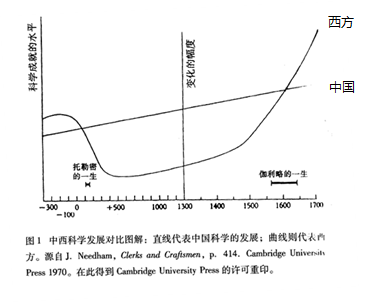
Roughly speaking, China’s Han dynasty corresponds to the Hellenistic period. In the mathematical and scientific fields, of course, it was not as brilliant as the Greeks, but it had its own distinct strengths. By the Tang and Song periods, Chinese scientific and technological civilization had reached its peak, while the West happened to be in the Dark Ages, and it was only after the Scientific Revolution of the 16th and 17th centuries that it burst forth. Therefore many of the scientific achievements of ancient China were several hundred years earlier than those of the West, and that is a very natural thing.
But if one keeps stressing that ancient Chinese scientific achievements came several hundred years earlier than those of the West, on the surface this seems to boost national self-confidence, yet on reflection something always feels a bit off, rather like an exam failure boasting to the top scorer: “When I was in primary school I was always first in the class, I won who knows how many little red flowers, and back then you were lagging behind me in this way and that by so much.” Such boasting is not so much self-respect or self-confidence as a sign of psychological imbalance. No matter how impressive you were back then, why are you lagging behind now?
This is precisely the famously well-known “Needham question” in academic circles. The *Science and Civilization in China* edited by the British scientist Joseph Needham (1900–1995) (the Chinese translation is called *History of Science and Technology in China*) is the most authoritative source on the history of Chinese science in the world history of science community. From the first volume published in 1954 to the second part of volume 7 in 2004, 7 volumes in 27 books have appeared, of which Chinese translations of 14 books have been published. This monumental work is not only the starting point for Western scholars to understand the history of Chinese science, but also something Chinese historians of science can hardly bypass.
With abundant evidence, Needham showed the world the astonishing achievements reached by ancient Chinese science and technology, and showed that before the Scientific Revolution of early modern Europe, Chinese science had long occupied a world-leading position. So the question arises. Needham asked: why did modern science not arise in China?
In domestic and international circles of the history of science, there has been much debate over this question. Even before Needham, many Chinese scholars had already asked why China failed to develop modern science. Needham is merely the most representative figure. Some scholars have tried to seek the causes in intellectual tendencies, social systems, and so on; others have questioned the very premises of the Needham question itself.
For example, Shenwen, one of Needham’s successors, interpreted the Needham question as a pseudo-question, equivalent to asking, “Why does my name not appear in today’s newspaper?” Shenwen believed that the rise of modern science is like a person’s name appearing in the newspaper: it is a rare event. We can investigate why a person gets into the newspaper, but cannot answer why a person does not. But this explanation seems to evade the core of the Needham question. It reveals that ancient China had highly developed scientific achievements, and therefore China ought to have been “in the newspaper” all the more; it is like saying that someone used to be on the front page of the newspaper every day, but suddenly from some day onward can no longer be found, and this still needs explaining.
There are also scholars who question the premise of the Needham question from another angle, namely that ancient Chinese science had a period in which it was far ahead of the West. But this is questionable, because ancient Chinese science itself had an entirely different logic of development; so even if one says that China was outstanding in certain details, as a whole scientific enterprise China was never superior to the West, or rather, there was no basis for comparison in the first place. It is like asking why a willow tree, though it plainly once grew faster than a peach tree, ended up with the peach tree bearing fruit first?
I personally incline toward this explanation. In other words, the differences between Chinese science and Western science arose already at the germinal stage. Although there were many similarities in the course of growth, they have never been fully measurable by the same standard.
Of course, this does not completely dissolve the Needham question. Even if we acknowledge that Chinese and Western science differed from the outset in their basic logic of development, that does not mean the two are utterly incomparable. In what sense they can be compared is still something that needs sorting out.
In addition, there is another aspect that Needham did not sufficiently notice: according to the development of Chinese science itself, it does not seem to have simply advanced by continuous accumulation from ancient times to the present. Compared with the Song dynasty, Chinese science seems to have experienced a certain decline in the Ming dynasty. Many Ming mathematicians could no longer understand Song texts. If such a decline existed, then what was the reason? Of course, the Mongols’ destruction may have been a major factor in the decline of science under the Song, but on the other hand, through the Mongols as intermediaries, Chinese people actually had the opportunity to come into contact with scientific literature from the Arabic world; in fact, Greek learning such as *Elements* and Ptolemaic astronomy was indeed introduced into China, but it did not elicit a response until it was reintroduced by Western missionaries in the late Ming and early Qing. And when the first missionaries introduced Western learning, the West was in the midst of the height of the Scientific Revolution. If China had been able to respond in time, it would still have had the chance to “get in line with the international standards,” yet it still missed the opportunity. These two “missed opportunities” probably cannot be blamed on the Mongols either.
In any case, the significance of the Needham question does not lie in providing a definite answer, but in the reflections it provokes on what science is and on the relationship between science and civilization. My course also does not attempt to provide a ready-made answer; students can take the question and think about it independently.
 China’s Science and the Scientific Revolution
Before introducing the concrete achievements of ancient Chinese science, let us first discuss China’s unique intellectual and cultural background.
China’s writing system is very distinctive. We know that almost all modern Western countries use alphabetic scripts, whereas only China and Japan use square-character writing.
Compared with alphabetic scripts, Chinese characters are obviously more concrete, their mode of expression is more implicit and contextualized, and their grammatical structure is looser; thus, relative to Western writing, they seem less adept at abstract and logical ways of thinking. This makes sense, though we cannot wholly attribute the backwardness of Chinese science to Chinese characters. On the other hand, the Chinese character system, being relatively independent of pronunciation and relatively stable, makes communication across eras and across regions easier. Yet in terms of speech, the differences among China’s major dialects today are almost comparable to the differences among Europe’s various languages, but through Chinese characters communication is very easy. Although many Westerners take it for granted that complex Chinese characters are hard to learn, in fact we know that learning Chinese characters is not as difficult as imagined, and basic literacy training can basically be completed in the lower grades of primary school. In ancient China, the literacy rate among ordinary people was also, by world standards, very advanced.
We know that the basic form of Chinese characters had already been largely established by the Shang dynasty oracle-bone script from more than 1,000 BCE. The Shang oracle bones unearthed by archaeology record various divinatory inscriptions spanning 270 years, from the migration of Pan Geng to Yin all the way to King Zhou. From climate, war, disease, and childbirth to all kinds of large and small affairs, divination was required. The Shang people used cracks in oracle bones to forecast auspicious and inauspicious outcomes in advance, and then after the event they recorded on the oracle bones the matters that had been confirmed. Thus oracle-bone script is also a primitive historical record.
The ecology of this script seems from the very beginning not quite the same as that of Western scripts. The earliest cuneiform writing we have found was mostly used for bookkeeping, and the Phoenician alphabet also originated among merchants. Although the Chinese word “merchant” (shāngrén) derives from the Shang people, this is precisely because after the fall of the Shang dynasty the Zhou people used it as a pejorative term for merchants. Chinese culture seems from the outset not to have placed much emphasis on commerce, but instead to have been characterized by the tradition of shamans and historians.
“Shaman-historians” combined the functions of divination, sacrifice, ritual, record-keeping, and so on; this can be glimpsed from the role played by oracle-bone script. China’s later political culture and scholarly tradition also originated here.

If one does not understand China’s “historiographical culture,” it is difficult to understand China’s unique intellectual and cultural tradition. We know that China’s *Twenty-Four Histories* are continuous and unbroken; why did Chinese people value the compilation of history so much? In a certain sense, historiography is the Chinese people’s “theology.” When Sima Qian said that he was “examining the boundaries between Heaven and humanity” (究天人之际), he was not speaking casually; this was precisely the duty of ancient Chinese historians. From the oracle-bone script onward, the recording of history carried a certain sacred significance, and the historian was the medium connecting Heaven and humanity.
Ordinary Chinese people do not have an exclusive religious faith like Western Christianity. They worship bodhisattvas, they also worship the Jade Emperor, and it seems very pluralistic. Yet there is one thing that cannot be worshiped casually, and that is one’s ancestors. Compared with Western people’s heaven and eternal life, continuing the ancestral line and bringing honor to the family name is the Chinese people’s aspiration to transcend this life.
Modern China has lost the continuous historiographical culture, as well as the related traditions of ritual, ethics, and belief, and thus it is difficult to understand the important place the historiographical tradition occupied in ancient Chinese culture. If the core of ancient Western scholarship was philosophy, the core of ancient Chinese scholarship was historiography.
“Shi” was originally an official title. It is said that there were historians already in the Xia dynasty. In the pre-Qin period, historians were responsible for recording the words and deeds of emperors, kings, and generals, drafting documents, as well as astronomy, calendrics, and the management of sacrifices. In the Qin dynasty they were called the Grand Historian’s Clerk (Taishi Ling), and in the Western Han they were the Grand Historian (Taishi Gong). Sima Qian was the most famous of the Grand Historians; the records he compiled were called *The Records of the Grand Historian* (*Taishi Gong Ji*), and only later were they called *Records of the Historian* (*Shiji*). But the meaning of “shi” as an official position far exceeds the scope of historical record-keeping.
During the Wei and Jin periods, the historian as recorder and editor of words and deeds was separated out from the Grand Historian’s Clerk; in the end, the “Grand Historian” mainly took charge of astronomy and calendrics. From the Tang dynasty onward it was sometimes called the Directorate of the Celestial Office (Sitianjian), and sometimes still the Grand Historian’s Office (Taishiyuan), until the Ming and Qing dynasties, when it was called the Imperial Astronomical Bureau (Qintianjian).
So we see that the so-called astronomers of ancient China were actually all historians: Zhang Heng was a historian, Shen Kuo was a historian, and Guo Shoujing was also a historian. Thus the astronomical tradition of ancient China displayed characteristics entirely different from those of the West. Western astronomers were often independent scholars detached from the political system, whereas China’s scholars of Heaven were all within the official system.
In ancient China, the astronomy pursued by historians was not the Greek “saving the phenomena,” but “examining the boundaries between Heaven and humanity.” It carried the sacred mission of mediating the relationship between Heaven and humanity. We mentioned earlier that the “discovery of nature” was a Greek specialty; ancient China did not discover an independent, self-subsistent “natural world” opposed to humanity. The Chinese “Heaven” has always corresponded to human beings. Therefore observing and studying Heaven meant studying human affairs, especially the fortunes of the dynasty.
So ancient Chinese astronomy was monopolized by the imperial court. If commoners privately studied astronomy, they would be regarded as intending rebellion; and rebels often did indeed have to cite some astronomical phenomenon in order to show that their rebellion was ordained by Heaven and therefore legitimate. The imperial monopoly on astronomy also meant that astronomers were often hereditary families. On the one hand, this ensured continuity in the astronomical tradition; on the other hand, it clearly also made astronomical research prone to stagnation and lack of vitality.
Ancient Chinese people did not have the Greek belief that the heavens were eternally unchanging. On the contrary, the heavens were of course full of change, and thus closely bound up with changes in worldly fortunes.
Therefore ancient Chinese astronomy placed great emphasis on observation. The imperial court would generally set up multiple observation platforms, with specialized officials responsible for uninterrupted daily observation of the sky. One person would watch the north, another would be in charge of the south, another of the zenith, and so on. Some records of celestial phenomena required cross-checking between two observatories before they could be reported, making the process very rigorous.
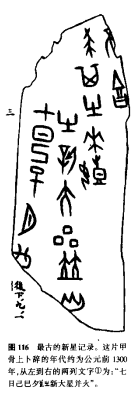
Thus ancient China left the world the most complete records of celestial phenomena, especially records of solar and lunar eclipses, novas, comets, meteors, and sunspots. Research on Shang oracle-bone inscriptions has confirmed multiple lunar eclipse records and one solar eclipse record from that time, the earliest dating to 1361 BCE. An oracle bone from around 1300 BCE records a nova, which is regarded as the earliest extant record of a nova. A supernova explosion in 1054 created what is now the Crab Nebula, and this supernova can almost only be found in Chinese documents, which also accurately record its position, brightness, and duration.
Compared with the calculations of modern astronomers, ancient Chinese records of solar and lunar eclipses, comets, and other celestial phenomena are very accurate, but there are also many omissions. These gaps may not necessarily have been caused by the observers’ negligence, because many celestial phenomena signified “Heavenly admonitions,” warnings or reproofs given by Heaven to the imperial house. The court then needed to respond and promptly carry out the corresponding rituals of appeasement. The emperor would issue a self-criticism edict or dismiss ministers, and so on. But if the Grand Historian judged that the emperor did not need admonition at that moment, he could simply not report it, and if the emperor did not carry out the corresponding ritual, that celestial phenomenon might never be recorded in the historical books.
 A History of Chinese Scientific Civilization
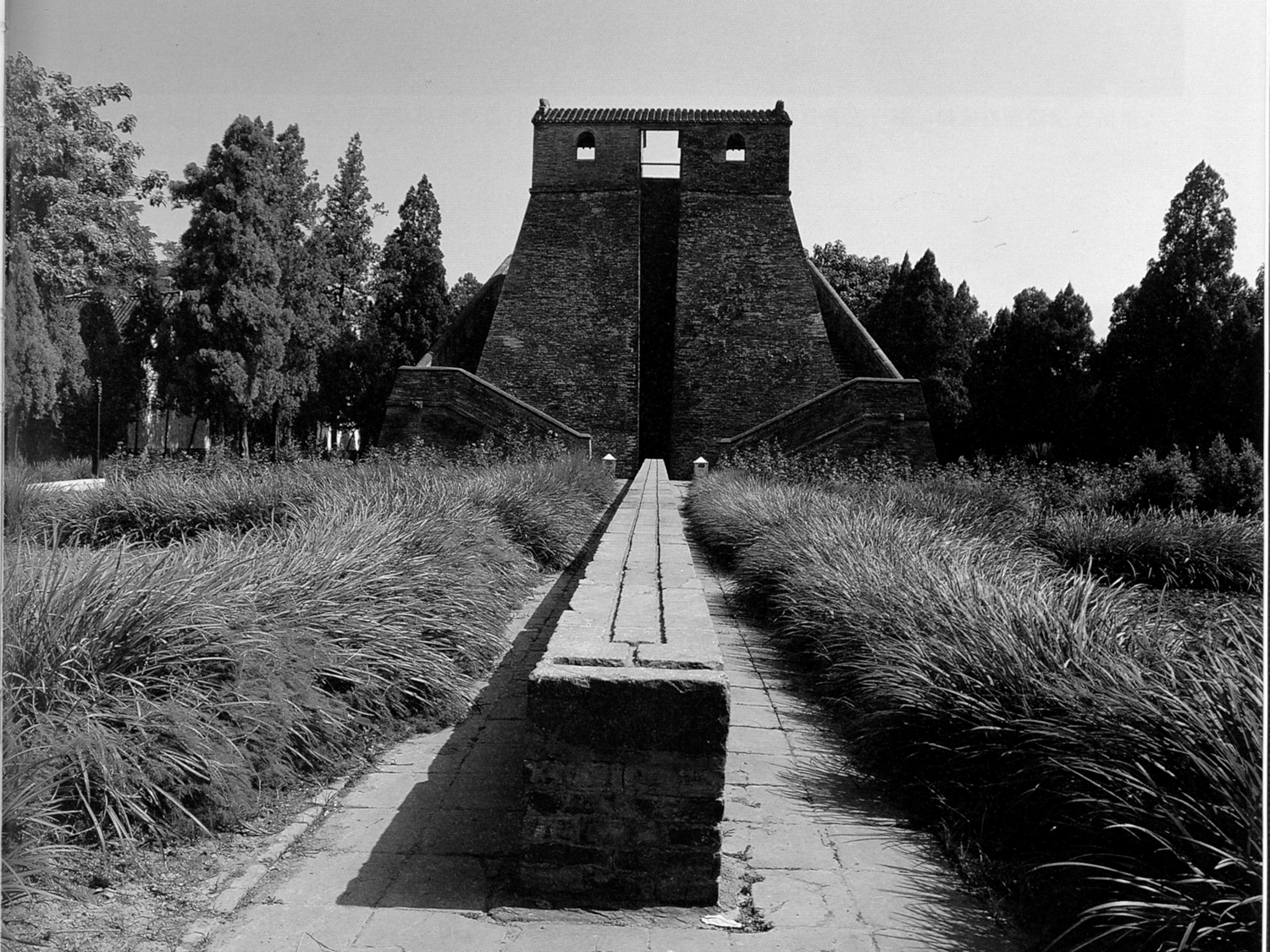 The Duke of Zhou’s shadow-measuring platform, built by Guo Shoujing in 1276 and rebuilt in the Ming dynasty. Image from Teacher Wu’s handout
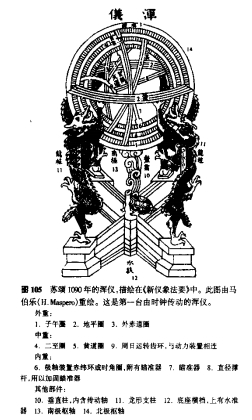
China’s astronomical observation instruments were also highly developed. For example, there was the “armillary sphere” (hunyi), already fairly complete at least from Zhang Heng in the Han dynasty, consisting of circles marking the equator, ecliptic, and so on, used to determine the positions of celestial bodies. The armillary sphere, together with the celestial globe used to demonstrate the positions of heavenly bodies, was called the armillary astronomical instrument. The making of the armillary instrument reached a peak in the Song dynasty. The “water-powered astronomical clock tower” (Shuiyun Yixiangtai) begun by Su Song in 1086 is a major landmark. It combined observation, demonstration, timekeeping, and time announcement in one; the escapement mechanism inside was a key component of mechanical clocks.
After the fall of the Northern Song, the water-powered astronomical clock tower was moved by the Jurchens to Yanjing, where it was eventually abandoned. During the Southern Song, people tried to reconstruct the instrument according to Su Song’s manuscript, but because the description in the manuscript was not detailed enough, they were unsuccessful, and it was thus lost. It was only after the founding of the People’s Republic that Wang Zhenduo reconstructed the machine based on the manuscript and some imaginative filling-in. But whether this reconstruction was successful is actually controversial, because if one really reconstructed it at original scale, the instrument would be very hard to keep running continuously. Therefore some modern reconstructions are directly driven by electric motors for demonstration purposes. There may be two reasons for this: first, the documentary descriptions are not precise, and modern people have not yet found the best way to reconstruct it; second, Su Song’s instrument in its own time was not meant to run for long periods either, because in many cases ancient Chinese astronomical activity was actually ritual and sacrificial activity. Some large demonstrative devices only needed to run briefly during important ceremonies and were not practical in everyday use.
Later, some mechanical devices introduced from the West were in fact mostly treated by the Chinese imperial court as objects of appreciation, and their practical value was not particularly emphasized.
 The History of Chinese Scientific Civilization
 Illustration of Su Song’s water-powered armillary tower
By the way, let me mention Wang Zhenduo (1911–1992). In fact, among the great marvels of ancient China, it was he who reconstructed most of them. Besides the water-powered armillary tower, there were also the south-pointing chariot, the distance-recording drum carriage, the seismoscope, and the sinan.
Among these, the reconstruction of the distance-recording drum carriage is relatively credible. There are already several schemes for the south-pointing chariot, but we do not know which mechanism the ancients actually used. As for the seismoscope and the sinan, they are relatively questionable. The seismoscope may have been similar to the water-powered armillary tower—that is, it was not truly practical even in its own day, and may merely have served as some kind of ritual vessel. The sinan is even more likely to be a wholly fabricated imagination. In modern reconstructions, if natural lodestone is used, then no matter how the bronze platform is polished, one cannot make the magnetic spoon overcome friction and rotate by itself. In ancient texts, “sinan” very likely referred only to the south-pointing chariot, and was not a magnetic spoon at all. (See Jiang Xiaoyuan: http://blog.sina.com.cn/s/blog_485f2bc801017l4f.html )
Similar misunderstandings often arise in the reconstruction of ancient Chinese scientific and technological achievements, because ancient accounts are often ambiguous, and modern people, by filling in the gaps with their imaginations, often add far too much. This is something we need to be careful about.


Ancient Chinese astronomy was very likely influenced by Babylonian astronomy, but unlike the Western system of positioning based mainly on the ecliptic, ancient China adopted an equatorial system centered on the north celestial pole. We know that in northern latitudes, the stars around the north celestial pole never set; these stars are called circumpolar stars, and the whole sky appears to rotate around the North Star. Naturally, the North Star corresponds to the emperor, because observing the stars means attending to the fortunes of the sovereign; thus taking the North Star as the center seems only logical. That is exactly how the ancient Chinese positioned the heavens: starting from the positions of the circumpolar stars and extending outward to the twenty-eight lunar mansions along the equator to establish the coordinates of the starry sky.

An extremely ancient jade object, the “xuanji yuheng,” seems to have been an instrument for determining directions by means of the circumpolar stars (as shown in the figure). Of course, the jade disc should probably be understood more as a ritual vessel with symbolic meaning than as a practical instrument.
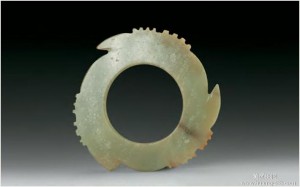
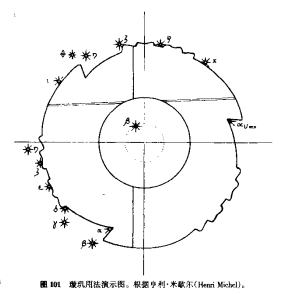 Needham’s conjecture, cited, about the use of the xuanji yuheng
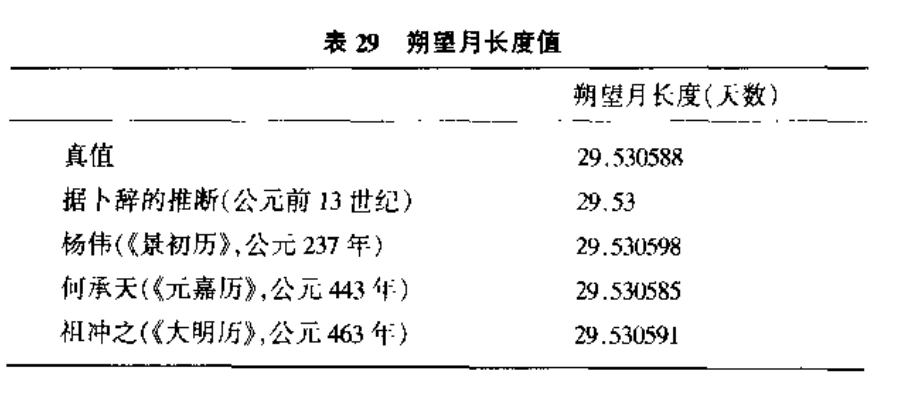
Of course, ancient Chinese astronomy was not only good at observation; its computational side was no less impressive. In calendar-making, the main problem was calculating the relations among year, month, and day. The ancient Chinese very early on had extremely precise data, and they also had an accurate understanding of the cycle of lunar eclipses. As for the motions of the sun, moon, and the five major planets, including their irregularities, the ancient Chinese did not establish geometric models to explain them, but they were still able, through empirical records and algebraic methods, to obtain relatively accurate estimates.
The oracle bone inscriptions of the Shang dynasty already record detailed observations of celestial phenomena. For example, one may have recorded that after the winter solstice, 548 days later, the cycle returned to the summer solstice. This seems to have been an attempt to infer a precise value for the tropical year through records spanning a longer period. At least by the Han dynasty, the Chinese were already quite clear that a tropical year was roughly 365.25 days, and a synodic month about 29.53 days. As Chinese astronomy developed, these values were continually refined.
 The History of Chinese Scientific Civilization
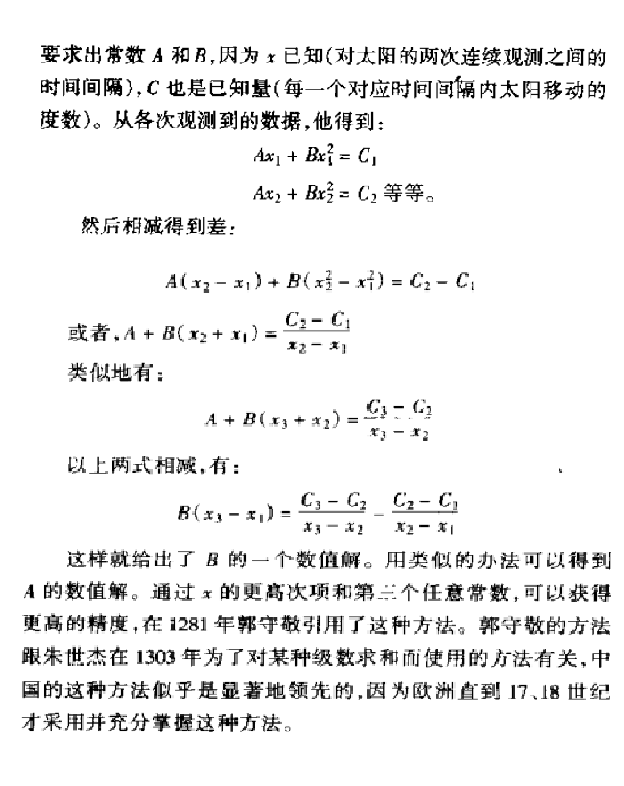
As for the irregular motions of the sun, moon, and the five major planets, ancient China estimated them by algebraic methods. For example, in the works of Li Chunfeng in the early Tang, quadratic equations and the method of finite differences were introduced to handle the irregularity of the sun’s motion. Translated into modern symbols, it is roughly like this (as shown in the figure):
 The History of Chinese Scientific Civilization
From the Yuan dynasty on, China established a separate Muslim Astronomical Bureau to support Muslim astronomers and introduce Arabic astronomy. The Ming dynasty’s Imperial Astronomical Bureau still followed Yuan institutions, handling the Chinese calendar and the Muslim calendar separately, and also introducing Arabic mathematical methods. Ming-dynasty Beilin, drawing on Arabic astronomy, compiled Seven Political Bodies Calculational Methods, which computed the motions of the sun, moon, and the five major planets; but in China the geometric models of the Ptolemaic system were also replaced by algebraic methods.
Chinese achievements in mathematics were also rich, though one must note that ancient China did not have mathematics as a discipline or field of research in the modern sense. We know that the Greeks’ “mathematics” included arithmetic, geometry, astronomy, and music, and was a pure study devoted to the elevation of the soul, but China clearly had no such conception. In China, some of the so-called mathematicians were also astronomers, since astronomical calculation required many mathematical techniques. Another group of mathematicians emerged from the folk tradition of arts of calculation and divination, each with its own lineage of transmission, and on the whole there was neither unity nor continuity. For example, the three most famous mathematicians of the Song dynasty—Qin Jiushao, Li Ye, and Yang Hui—lived in roughly the same period, but their approaches were completely different, and they had no exchanges with one another.
Like astronomy, mathematics in ancient China was also closely linked to “inquiring into the relation between Heaven and humanity,” that is, studying human “fortune.” In the first bibliographic catalogue compiled in the Han dynasty by Liu Xiang and Liu Xin, the Seven Abstracts, “numerical arts” was one of the seven categories, and it included six types: astronomy, calendar and chronology, the five elements, milfoil and turtle-shell divination, miscellaneous divination, and physiognomic methods. Here astronomy included astronomy in the modern sense as well as astrology; calendar and chronology included calendrical systems, pitch standards, genealogies, and so on; the five elements studied the interactive resonances among metal, wood, water, fire, and earth, and also included knowledge such as the selection of auspicious days; milfoil and turtle-shell divination meant divination using yarrow stalks and tortoise shells; miscellaneous divination included other methods of augury and ritual, such as dream omens; physiognomic methods included the study of forms such as terrain and facial features. In the Qing dynasty’s Complete Library of the Four Treasuries, works such as The Nine Chapters on Mathematical Procedures were classified under the “astronomy and mathematical calculation” subcategory of the Masters section, but under the “numerical arts” subcategory of the Masters section were works on calendrical calculation such as The Canon of Great Mystery and The Canon of the Imperial Age, as well as writings with astronomical significance such as The Comprehensive Manual of the Kaiyuan Era on Astrology.
From the modern point of view, arithmetic and fortune-telling are obviously two different things, but in the eyes of ancient Chinese people there was no strict distinction. Calculation is the calculation of fortune; numerals are the numerals of fate. The Canon of the Imperial Age was also regarded as a serious theoretical work, speaking of “observing things,” speaking of “extending principles, exhausting nature, and thereby reaching fate,” by observing things, probing into principles, digging out their nature, and ultimately grasping human destiny. Zhu Xi classified it in the category of “books of predictive calculation,” on the same level as works like The Zhou Bi Suan Jing; if one were to point to a difference, perhaps it is that the former leans more toward theory, while the latter places greater emphasis on technique.
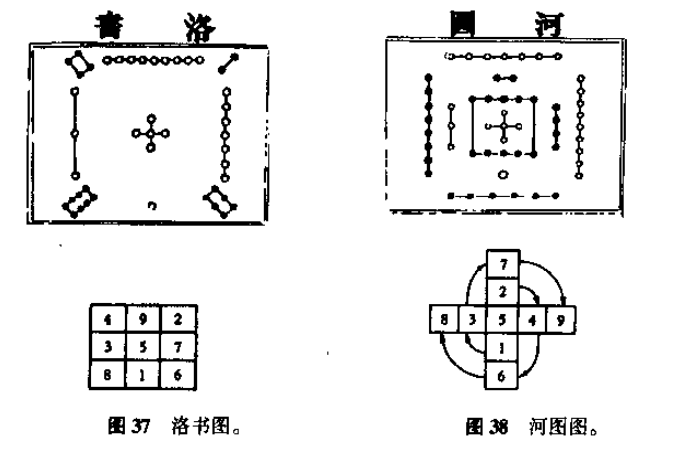
The legendary “He Map–Luo Script,” said to have been presented to Yu the Great by the divine tortoise of the Luo River and the dragon horse of the Yellow River, is something lying between mathematics and arts of divination. Its original versions appeared at least by the Han dynasty, but they developed in the Song dynasty, when they were called “vertical and horizontal diagrams,” or what Westerners call “magic squares,” developing into more complex forms such as higher-order magic squares and even three-dimensional magic squares. But the He Map and Luo Script also became the source of numerical arts; all manner of theories—divination, feng shui, meridian theory, alchemy, and so on—would cite them.
 The History of Chinese Scientific Civilization
Before the abacus became widespread, the main means of calculation for Chinese people was counting rods. The counting rods were originally little round bamboo sticks, perhaps related to the long and short sticks of the Eight Trigrams; the phrase “maneuvering within one’s tent” (运筹帷幄之中) refers to moving these little bamboo rods. Laozi once said, “He who is good at counting does not use counting rods” (善数者不用筹策), which shows that rod calculus had already become popular at least by the Spring and Autumn period. In rod numeration, a horizontally placed counting rod represented 1, and a vertically placed rod represented 5; several groups of rods were arranged horizontally to represent numbers in decimal notation. Rod calculus had a set of methods for the four operations; for example, the figure below demonstrates the algorithm for 81 multiplied by 32.
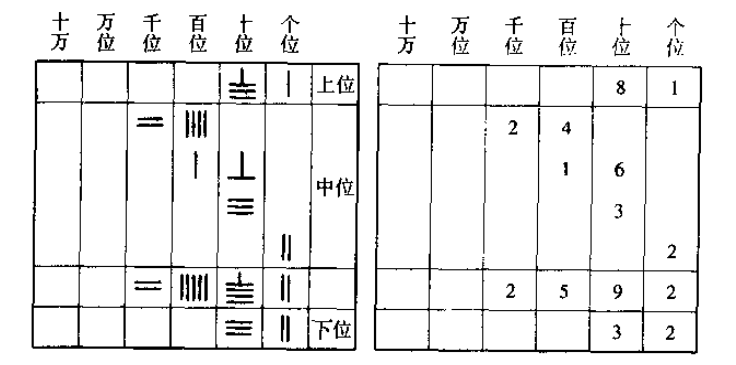
In later times, the abacus replaced counting rods and became the main arithmetic tool. Whether with counting rods or with the abacus, compared with written calculation, their advantage—and their disadvantage—is that they erase the intermediate process. Chinese mathematics has always emphasized results and practicality, and has not attached importance to process and proof.
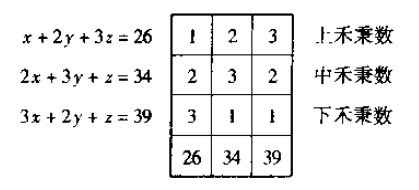
Chinese algebraic methods were originally expressed with counting rods as well. In both ancient China and ancient Greek mathematics, there were no concise equations written with symbols such as x, y, z, a, b, c in the modern manner; the Greeks approached algebraic problems geometrically, while the Chinese also, in a certain sense, spatialized algebraic problems. For example, in the Han-dynasty *The Nine Chapters on the Mathematical Art*, systems of linear equations in several variables were represented by placing counting rods in different squares, as in the figure below:
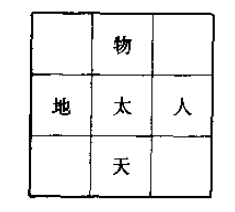
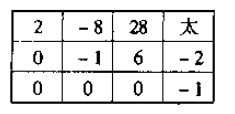
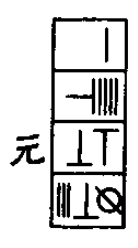
In the Song dynasty, a very sophisticated system of algebraic expression and calculation was developed, namely “the method of tian yuan” (天元术). Beginning from “tai,” which represents a constant, it could extend in up to four directions: heaven, earth, man, and things. The first cell in a given direction represents the first power, the second cell the second power, and so on; counting rods are placed in the corresponding cells, and for negative numbers one simply adds another diagonal stroke. The figure below is the notation for xy3-8y2-xy2+28y+6yx-2x-x2. If it is a single-variable polynomial equation, it can be written more compactly as a single vertical column, with a “tai” or “yuan” character marked beside it. For example, the figure below shows the notation for x3+15x2+66x-360=0.
The method of tian yuan had already gradually fallen into oblivion by the Ming dynasty, and only in the Qing dynasty, under the stimulus of the introduction of Western learning into the East, was its value rediscovered by Chinese mathematicians. Compared with modern Western symbolic algebra, the method of tian yuan looks very beautiful, but it ultimately still lacks flexibility and universality.
In geometry, although the Chinese were not good at proof, they were quite strong in measurement and calculation. During the Three Kingdoms period, Liu Hui’s commentary on *The Nine Chapters on the Mathematical Art* established the method of cutting the circle, using the area of a regular 192-gon inscribed in a circle to obtain π≈3.14. By the Northern and Southern Dynasties, Zu Chongzhi (429–500) and his son went further, calculating the areas of regular 6,144-gons and 12,288-gons inscribed in a circle, obtaining π=3.1415926~3.1415927, nearly a thousand years ahead of Westerners.
Of course, the Chinese were not completely incapable of proof. For example, the figure below is a proof of the Pythagorean theorem given by Zhao Shuang in the Three Kingdoms period; in essence, it shows that four right triangles (ab/2) plus a small square (b-a)2 add up to c2. Compared with Pythagoras’ “mousetrap” proof, the Chinese proof seems more elegant, though it also seems to lean more toward algebraic thinking.
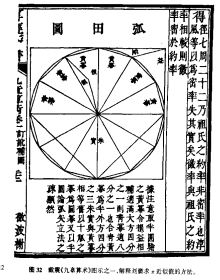 Circle-cutting method
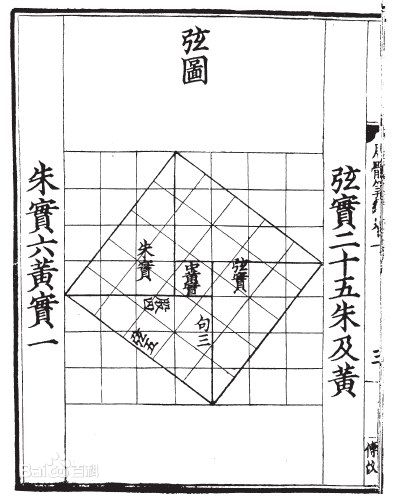 Zhao Shuang’s proof of the Pythagorean theorem
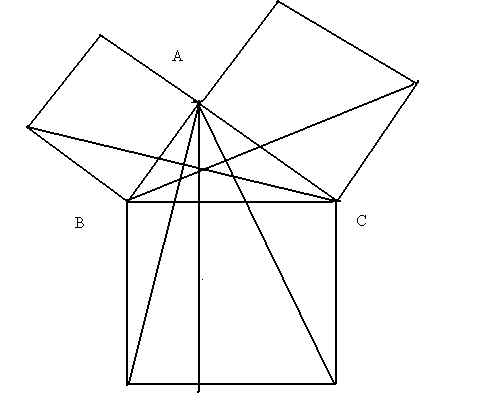 Pythagoras’ proof (described by Schopenhauer as a mousetrap)
In ancient China, practical and empirical disciplines such as agriculture and medicine were highly developed.
The *Essential Techniques for the Welfare of the People* (*Qimin Yaoshu*) from the Northern Wei period is the earliest and most complete surviving comprehensive agricultural treatise in China, consisting of 10 juan and 92 articles, reflecting the state of agricultural production in the middle and lower reaches of the Yellow River. *The Complete Book on Agriculture* (*Nongzheng Quanshu*), written by Xu Guangqi (1562–1633) at the end of the Ming dynasty, is the culmination of ancient Chinese agronomy. It totals 60 juan and more than 500,000 characters, and includes 12 sections: agricultural fundamentals, land systems, farming affairs, water conservancy, farm implements, arboriculture, sericulture, expanded sericulture categories, cultivation, animal husbandry, manufacture, and famine relief administration. Among these, famine relief administration occupies about one-third of the whole book, emphasizing preparations against famine and disaster relief.
In medicine, *The Yellow Emperor’s Inner Canon*, compiled during the Warring States or Qin-Han period, used the theories of yin-yang and the Five Phases to establish the basic theoretical framework of traditional Chinese medicine.
At the end of the Eastern Han, Zhang Zhongjing’s *Treatise on Cold Damage and Miscellaneous Diseases* proposed the “six-channel pattern differentiation” in Chinese medical diagnosis (taiyang, yangming, shaoming, taiyin, shaoyin, jueyin) and the “eight-principle theory” (yin, yang, exterior, interior, deficiency, excess, cold, heat), establishing the model for clinical medicine and prescription formulation in traditional Chinese medicine. Sun Simiao, the “King of Medicine” of the Sui and Tang periods (c. 581–682), wrote *Essential Prescriptions Worth a Thousand Gold Pieces*, emphasizing that the art of medicine is an art of benevolence, arguing that “human life is of the utmost importance, worth more than a thousand gold pieces,” and treating patients of all kinds alike, whether “Chinese or barbarian, foolish or wise.”
Of course, there is also Li Shizhen’s late-Ming *Compendium of Materia Medica*, the culmination of ancient Chinese pharmacology, which includes 16 divisions, 52 juan, and 1.9 million characters. It was introduced to Europe very early and translated into German, French, English, Latin, Russian, and other languages; Darwin’s *On the Origin of Species* also cited it.
Aside from written knowledge, traditional Chinese medicine is still fundamentally a practical art. In theoretical terms, traditional Chinese medicine had long remained within the conceptual framework established by the *Yellow Emperor’s Inner Canon*. Later theories of traditional Chinese medicine were mainly commentaries and annotations on classics such as the *Yellow Emperor’s Inner Canon* and *Treatise on Cold Damage*. The theory of traditional Chinese medicine may be the last remaining thread of traditional Chinese science to preserve its own distinctiveness under the impact of modern science, but today it is also under heavy criticism. In any case, what traditional Chinese medicine leaves us most importantly may not lie in abstract theory or empirical knowledge, but in the attitude and manner with which illness and patients are treated in practice. After all, medicine, in China and abroad, ancient or modern, is first of all not a science, but a practical activity, and beyond science there are many more layers of meaning. In my previous survey course I deliberately avoided the history of medicine, precisely because the history of medicine is difficult to handle simply as one link within the history of science.
Ancient Chinese geography was also highly flourishing, and this too belongs within the historiographical tradition. The tradition of local gazetteers in ancient China was devoted to recording the scenery, customs, hydrology, and geography of the various regions of the Nine Provinces. By the Song dynasty, all kinds of local gazetteers already numbered at least several hundred; by the Ming and Qing dynasties, almost every city and every town had its own gazetteer, and some famous mountains and great rivers also had special records devoted to them.
Chinese cartography adopted a rectangular grid method very early on. Pei Xiu (224–271) of the Three Kingdoms period is regarded as the father of Chinese cartography, though unfortunately the *Map of the Yu Gong Region* that he drew has not survived.
The map that has survived to this day as representing the highest achievement of Chinese cartography is a stone inscription from the Song dynasty (c. 1137), the *Yuji Tu* in the Xi’an Forest of Steles. This map uses grid cartography and depicts rivers and coastlines with remarkable accuracy. This obviously required a comprehensive and meticulous survey of the geography of the whole country. Its cartographic achievement is utterly incomparable with medieval European maps of the same period.
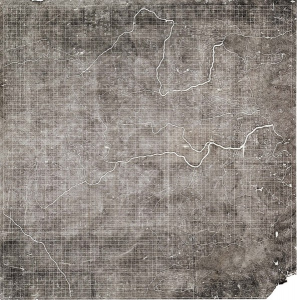 The *Yuji Tu* of 1137
 The Western world map of 1050
Finally, I gave a brief overview of Chinese technological achievements and the Four Great Inventions, basically using Professor Wu’s slides directly, so I will omit that here.
Further Reading
Joseph Needham (adapted by Colin Ronan): “Science and Civilisation in China”
Jiang Xiaoyuan: “The True Origins of Chinese Astronomy ”
Lloyd: “Adventures of a Curious Mind”
Translated from the Chinese original with AI assistance. The original text is authoritative.