
This was a talk I gave at the Fourth “Future Scenarios” International Forum on Technology and Art Education held at the Sichuan Fine Arts Institute. The written version is a bit more complete than the actual speech. The whole article is hand-typed by me; AI participated in the outline design, and the images and a few individual cases were also generated by AI.
The theme of this stage of the conference was “Cross-Cultural Dialogue and Educational Collaboration.” Teacher Hai Chao arranged for me to speak first, at the opening. At first I worried that my topic might be a bit off-theme, but Teacher Hai Chao said it was fine, that it fit the theme. I thought about it some more and realized that it really was on point: my talk starts from the educational crisis in the AI era, and then finds inspiration in cross-cultural exchange—only my “crossing” goes a bit far, all the way back to the roots of Western culture, to ancient Greek culture. Ancient Greek culture is the root of Western culture, and also the source of modern technology. I believe this source of living water can still offer us guidance in our confusion today.
Opening
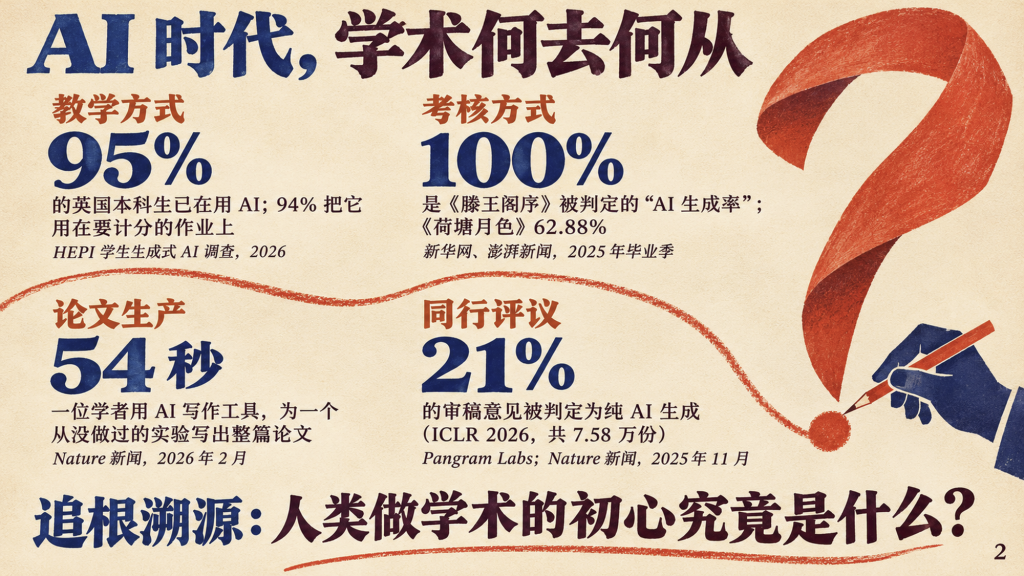
Just last night, humanity used AI to prove the Riemann hypothesis—250,000 pages of complete proof (called a “book” by Claude), and 17 million lines of formalized code. The Riemann hypothesis is absolutely the holy grail of mathematics, the brightest jewel in the crown; this is clearly an epoch-making event. Even if people later discover loopholes in the proof or the like, this event is already enough to show that the old academic paradigm is being overturned. For example, how is a mathematics student supposed to plan their academic career from here on out? How should one assess the academic level of a student or a paper?
My comment is this: the paradigm of research is going to change. In the future, the academic world’s key question will become how to help human beings understand AI’s output. In the past, scientists’ task was to understand the “book of nature”; in the future, AI will be the one cracking the book of nature, forming a book of AI, and then human beings will have to struggle to understand the “book of AI.” But human understanding may never catch up with AI’s production. Just as with understanding the book of nature, a person may never fully exhaust an AI book; it is fine if, over the course of a lifetime, one can at least grasp a little of its surface.
A deeper confusion is this: do human beings still need to do scholarship at all? What is the meaning of academia? To answer this question, I want to return to the source of science, ancient Greece, and take a look at what the “original intention” of academic research was.
Aristotle on the Conditions of Scholarship
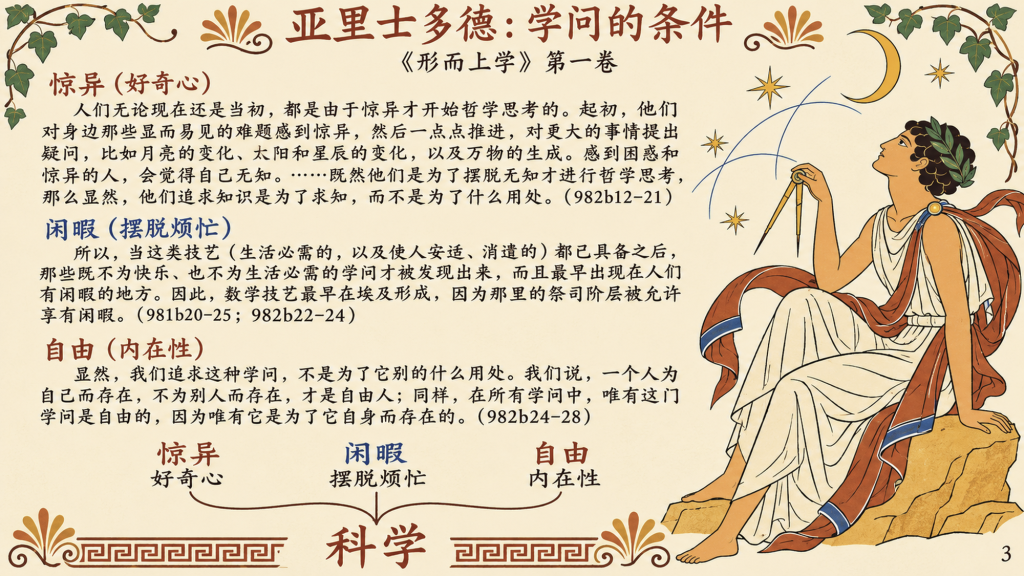
Aristotle spoke specifically about the conditions for scholarship, and roughly divided them into three items: wonder, leisure, and freedom. Of course, in essence these three points are all saying the same thing; they are different aspects of freedom.
First, from the bodily or emotional angle, wonder—or curiosity—is the starting point of science. Aristotle says:
For it is owing to their wonder that men both now begin and at first began to philosophize; they wondered originally at the obvious difficulties, then advanced little by little and stated difficulties about greater matters, such as the changes of the moon and the sun and stars, and about the generation of the universe. He who is puzzled and wonders thinks himself ignorant. … Since then they philosophized in order to escape from ignorance, obviously they were pursuing knowledge in order to know, and not for any utilitarian end. (982b12–21)
Second, from the social or institutional angle, leisure, or rather release from busy affairs, is a necessary condition:
Hence when all such inventions had been already established, those sciences which do not aim at pleasure or at the necessities of life were discovered, and first in the places where men first began to have leisure. This is why the mathematical arts were founded first in Egypt, for there the priestly caste was allowed to enjoy leisure. (981b20–25; 982b22–24)
Finally, from the standpoint of purpose, scholarship should seek knowledge for the sake of knowledge, with no external end—neither to make money nor to increase productivity, but for knowledge itself. That is freedom. If the purpose of scholarship were some other thing, then, just as the meaning of a slave is to help others work, it would not be free:
Clearly then we do not seek it for the sake of any other utility. For as a man, we say, is free if he exists for his own sake and not for another’s, so among the sciences this alone is free, for it exists for its own sake. (982b24–28)
Leisure Is Learning
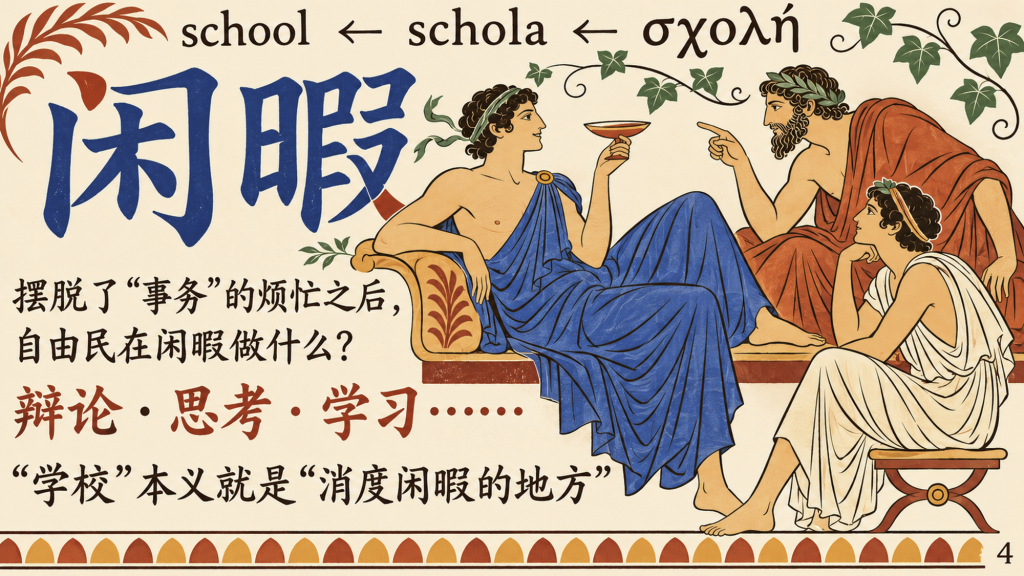
The word leisure is worth discussing, because the Greek word for leisure is the etymological source of what later became school. The place we today call a school comes from ancient Greek leisure. That is to say: where would a free person go to amuse himself in his leisure time? The Greeks liked to debate, think, and study, so the place for spending leisure came to be called “school.” In other words, the original intention of scholarship was the pursuit of wonder, the satisfaction of curiosity, a free activity for spending one’s leisure.
Three Pursuits of Beauty
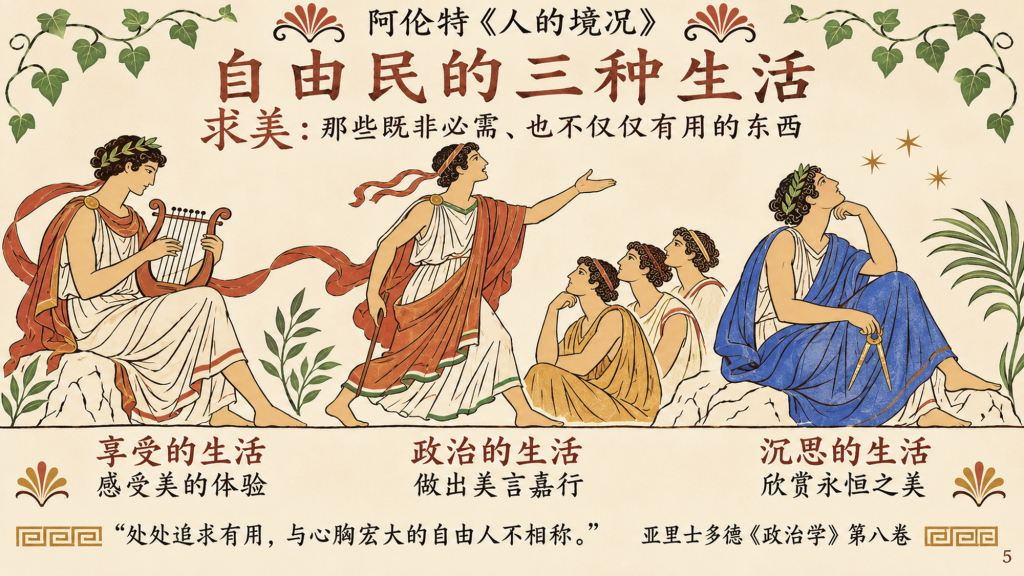
Of course, free persons do not go only to school. Arendt, drawing on Aristotle, summed up three ways of life for the Greek free citizen: “enjoyment,” “politics,” and “contemplation,” and pointed out that all three are pursuits of “beauty.”
The life of enjoyment—such as hosting banquets, listening to music, watching drama—is a kind of receiving beauty, an experience of feeling beauty.
The political life, by contrast, is about producing beautiful words and noble deeds, letting oneself shine in excellence.
The contemplative life, in turn, is about appreciating eternal beauty through the pursuit of knowledge, such as mathematics, astronomy, and philosophy.
What, in the final analysis, is “beauty”? Today many uses of the word emphasize feeling and experience; in fact, that is just the first kind of life. In Greek, however, beauty has a broader meaning. In short, beauty is what is neither necessary nor merely useful. Of course, some beautiful things are also useful, but the place where they go beyond usefulness—the place where you continue to pursue them beyond utilitarian ends—is beauty.
The Greeks looked down on the attitude of “pursuing usefulness.” Aristotle said: “To pursue utility everywhere is not fitting for a magnanimous and free person.”
The Necessity of Slaves and Their True Liberation
Of course, neither Arendt nor I mean to advocate a return to ancient Greece. Aside from the difference in historical circumstances, the so-called freedom of ancient Greece was built on slavery; it was the existence of slaves that made the leisure of free citizens possible.
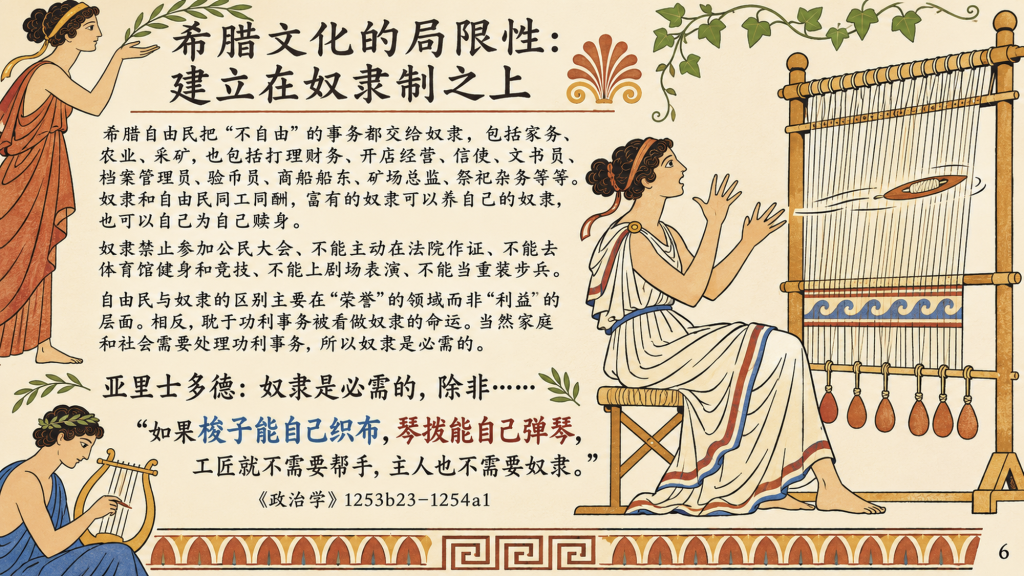
Still, it should be noted that the “slaves” of ancient Greece actually lived under fairly decent conditions. The Greeks handed over “unfree” tasks to slaves, including household work, agriculture, mining, and so on, as well as many utilitarian tasks—for example, helping their masters manage finances, run shops, serve as messengers, scribes, archive keepers, assayers, shipowners, mine superintendents, temple functionaries, and the like. Some jobs could be done by both free citizens and slaves, and were often paid equally for equal work. Certain personal-protection rules also applied to slaves. Wealthy slaves could own their own slaves, and could also buy their own freedom. One of Athens’ biggest bankers was born a slave and eventually purchased his own freedom.
In other words, what many slaves did was actually very much like what most blue-collar and white-collar workers do today. Apart from not being able to resign freely and change bosses, their lives were actually not that bad.
In what respects, then, were slaves’ rights really relatively low? For example, slaves were forbidden to participate in the citizen assembly, could not testify in court on their own initiative (they could only be questioned), could not go to the gymnasium to exercise and compete (even if accompanied by their master, they still could not enter), could not perform in the theater (though they could accompany their master to watch), and could not serve as heavy infantry—because war was an extremely high honor. In emergencies, slaves might be conscripted to serve in the army, but afterward they were often rewarded with citizenship. In addition, the rowers on warships may have been slaves, perhaps because that position was not highly honored.
In sum, the difference between free men and slaves lay mainly in the sphere of “honor,” not at the level of “interest.” By contrast, being absorbed in utilitarian affairs was regarded as the fate of slaves.
Of course, the ancient Greeks were also well aware that utilitarian matters were “necessary,” but precisely because they were “necessary,” they were unfree.
This is exactly how Aristotle argued for the necessity of slaves—these affairs always have to be handled by someone, which means that free people always need slaves. When, then, can one do without slaves? Aristotle says: “If shuttles could weave by themselves and plectra could play the lyre by themselves, craftsmen would not need helpers, and masters would not need slaves.” (Politics 1253b23–1254a1)
That is to say, it is in the age of automation, the age of AI, that human beings may finally obtain true liberation, namely liberation from necessity.
From the Pursuit of Beauty to the Pursuit of Power
But between Aristotle and artificial intelligence, the idea of freedom and the meaning of learning had already been thoroughly transformed. Rome and its slavery was one layer of change; the Christian notion of free will was another; but the greatest transformation was still the one between antiquity and modernity, that is, the modernizing process from the Scientific Revolution to the Industrial Revolution.
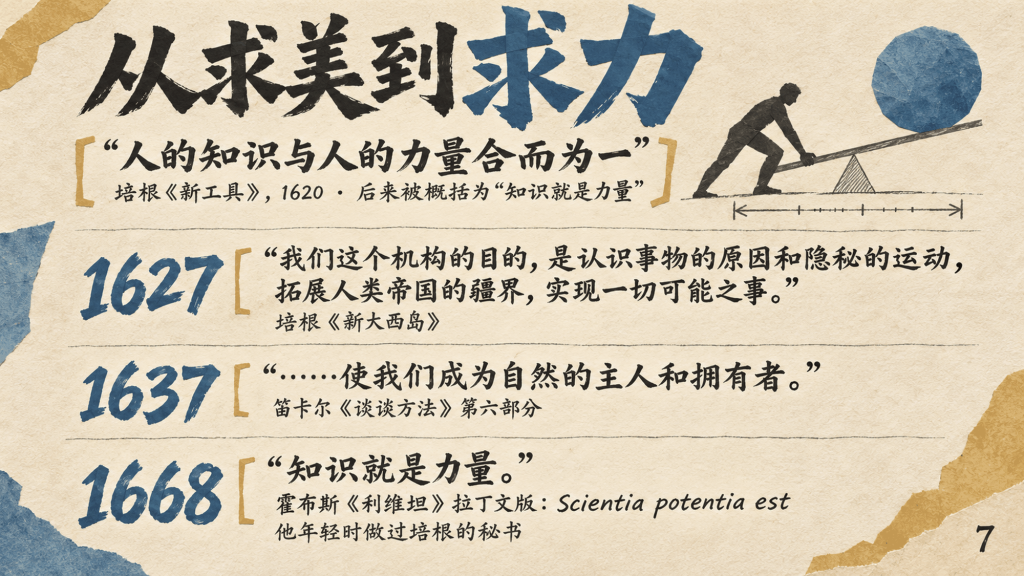
First, the meaning of knowing changed: it was no longer for the pursuit of beauty or wonder, but became a “pursuit of power,” the pursuit of force and authority. Bacon said that “human knowledge and human power meet in one,” later summarized by Hobbes as “knowledge is power”; Descartes likewise advocated becoming the master and possessor of nature. The meaning of science became conquering nature and transforming nature, and its ultimate meaning was to raise productivity.
Science Becomes an Assembly Line
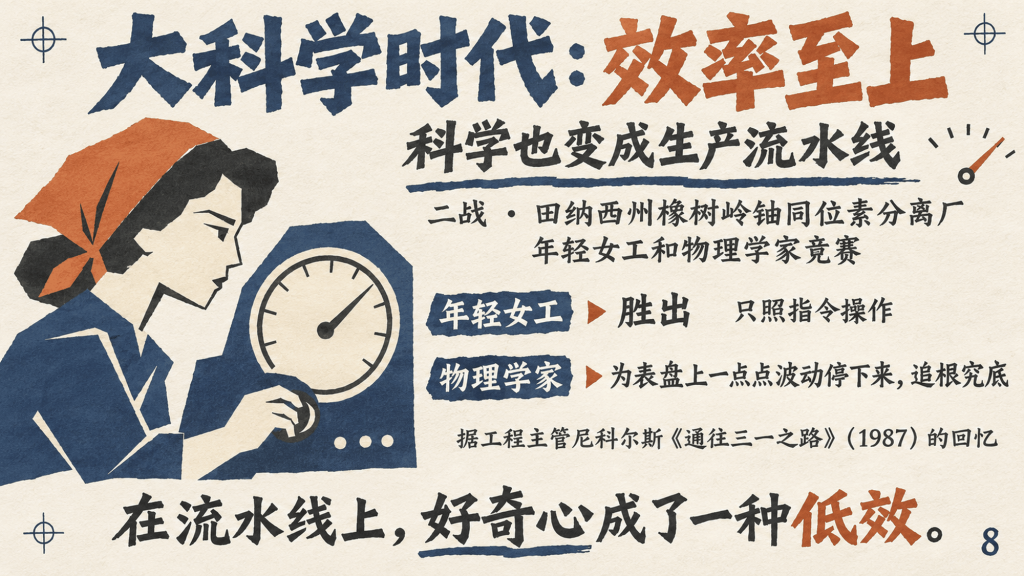
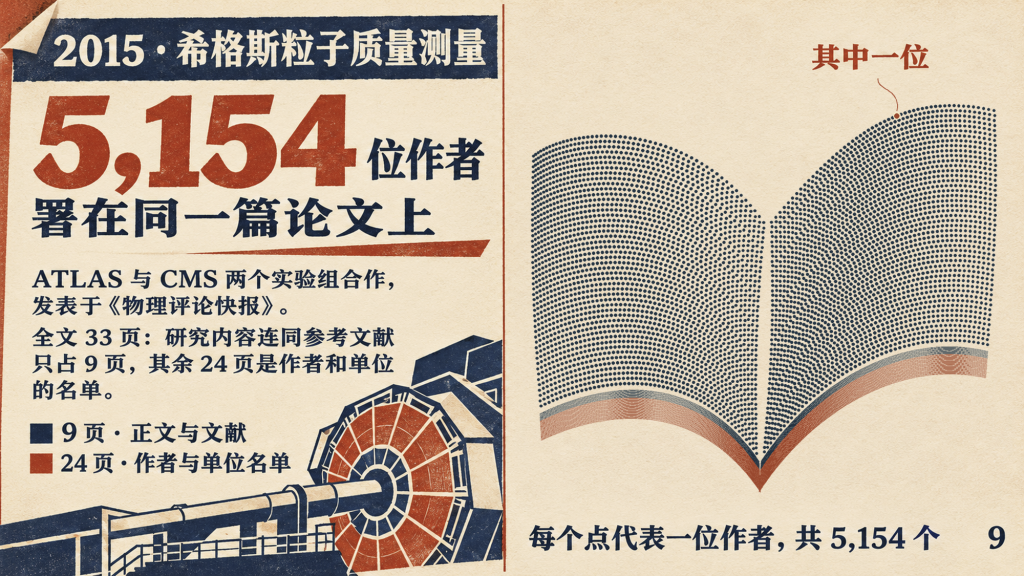
After the Industrial Revolution, education and research were gradually governed by the logic of the production line. “Love of wisdom” became “specialized learning”; scientific research, like an engineering project, was broken down into minute links, with the work under each link made as simple and tedious as possible, and each participant, like a worker on an assembly line, needing only to master the small patch of business right in front of them.
During the Second World War, Lawrence oversaw a uranium refining project, in which there was a classic competition: one group consisted of physics students, and another recruited a batch of women textile workers. The result showed that the textile workers were even more capable than the physics students, because they were “obedient and productive,” and did not ask why. The curiosity of the physics students, by contrast, became a kind of inefficiency.
In Big Science, individual honor also began to fade. Although there are still prizes like the Nobel Prize recognizing outstanding individual scientists, many concrete projects are in fact collective work; in them, each person may simply be a so-called “research coolie,” an utterly insignificant screw in the machine.
From “Seeking Knowledge” to “Demanding Knowledge”
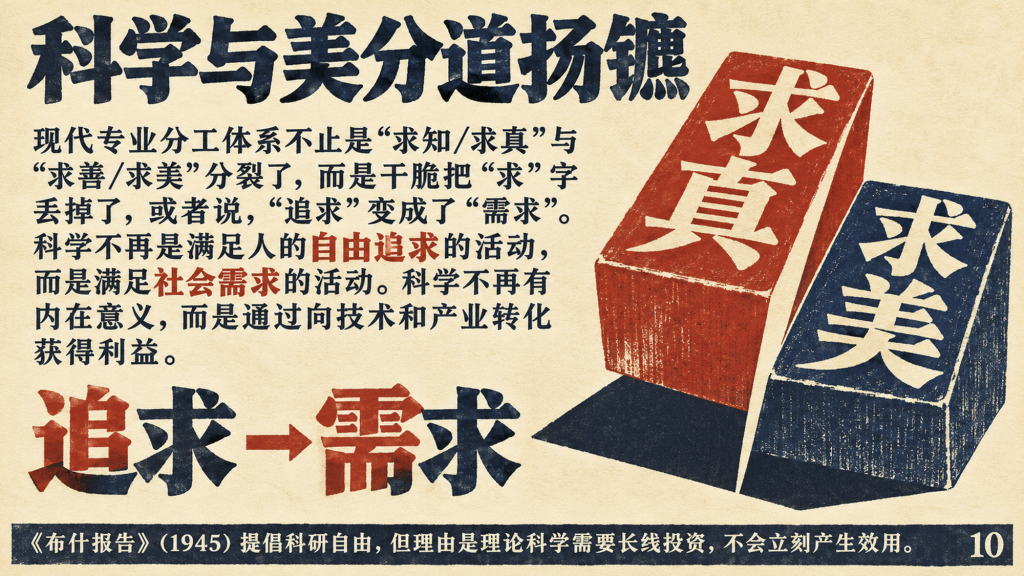
Under the modern system of specialized division of labor, it is not only that “seeking knowledge/seeking truth” and “seeking the good/seeking beauty” have split apart; rather, the word “seeking” has simply been dropped, or, one might say, “pursuit” has turned into “demand.” Science is no longer an activity that satisfies human free striving; it is an activity that satisfies social demand. Science no longer has intrinsic meaning; instead, it obtains benefits by being converted into technology and industry.
The 1945 Bush Report advocated freedom in research, but its reason was that theoretical science requires long-term investment and does not produce immediate utility. In essence, what the Bush Report emphasizes is not the dichotomy of “freedom/utilitarianism,” but rather that of “long-term benefit/short-term benefit.” The core of the “freedom” emphasized by the Bush Report lies in letting scientists themselves “manage the money,” rather than in stressing that science has a value that transcends utility.

A Society of Workers without Labor Is a Disaster
Thus, in this new age, when the automation Aristotle spoke of truly arrives, human beings’ total liberation will not happen automatically; on the contrary, it may become a disaster.
Arendt said: “A society of workers without labor—nothing could be worse.”
That is to say: modern society, in terms of ideas, social institutions, economic conditions, and so on, has already become a “society of workers,” in which human value is assessed by the labor capacity of “human resources,” resources are “distributed according to labor,” the merits of political systems are judged by the criterion of “productivity,” the educational system aims to produce labor power, and even the entertainment and leisure industries develop according to the measure of balancing work and rest… everything revolves around “labor.” At such a moment, to suddenly tell us that human labor will be replaced by machines, that human beings will no longer need to labor, is absolutely not good news, because people have long since forgotten the intrinsic meaning of leisure. Social order will fall into chaos, and individuals will also fall into nihilism and confusion. AI replacement will not automatically become a great cause of liberation; first and foremost, it will manifest as an unemployment crisis, a governance crisis, and a crisis of meaning.
So the crisis of the AI age was in fact already visible in Arendt’s time (the early stage of automation), and even in Marx’s time (the early stage of industrialization): human beings forgot the capacity to embrace leisure.
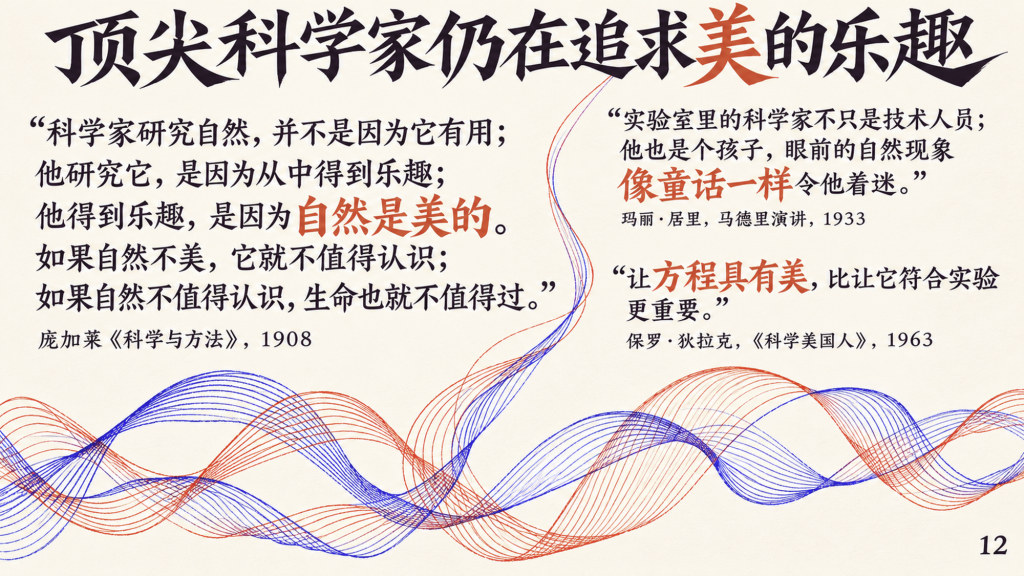
Of course, not everyone has forgotten the Greek conception of freedom; top scientists and artists still retain this stance. Poincaré said:
The scientist studies nature, not because it is useful; he studies it because he takes pleasure in it; he takes pleasure in it because nature is beautiful. If nature were not beautiful, it would not be worth knowing; if nature were not worth knowing, life would not be worth living. (Poincaré, Science and Method, 1908)
Dirac said: “It is more important that equations have beauty than that they fit experiment.”
We still often hear such remarks from a handful of mathematicians and theoretical physicists, but viewed across the academic world as a whole, this sentiment is long no longer mainstream. A graduate student will not smoothly earn their degree just because they derived pleasure from the work; nor will a submitted paper be smoothly published simply because its equations are more beautiful.
Zhang Zhitao’s Belated Anxiety
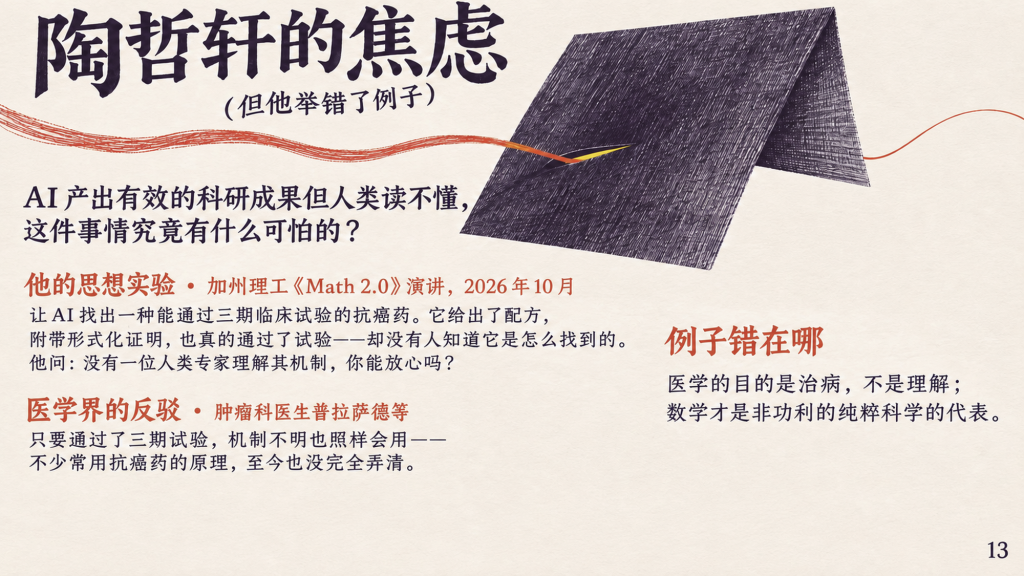
Recently, in the face of AI’s furious bombardment in the field of mathematics, Tao Zhang, one of contemporary mathematics’ leading figures, expressed obvious anxiety, but he clearly chose the wrong example.
This October, at Caltech, Tao Zhang gave a public lecture titled “Math 2.0,” in which he presented a thought experiment: let AI find a cancer drug that can pass a three-phase clinical trial. AI produces a formula, along with a formal proof, and it really does pass the trial, but no one knows how it found it. He asks: if no human expert understands its mechanism, can you feel assured?
This example immediately drew rebuttals from the medical community. Because medicine has always worked this way: with many drugs on the market, medical scientists in fact have not figured out their mechanisms; phase III clinical trials themselves are the standard, and there are far too many drugs that have successfully reached the market without anyone understanding the underlying principles.
In my view, what Terence Tao really wants to say may be this: the original purpose of science is to understand the mysteries of the world, not to produce a lot of papers that nobody can make head or tail of. But using medicine as an example is mistaken, because the aim of medicine is not understanding but curing disease. From ancient Greece onward, it has been different from the liberal sciences; medicine is not an inwardly free discipline. The purpose of medicine is to cure disease, so it has always been utilitarian. Mathematics, by contrast, has always been the representative of non-utilitarian pure science, the last stronghold of the Greek liberal arts tradition, and top mathematicians are still driven by curiosity rather than utilitarian goals.
So Tao Zhexuan’s anxiety has come too late. It was only when this last pure land of mathematics was eroded by industrialized mass production and a utilitarian attitude that he began to resist, but he did not notice that the replacement of curiosity by utility had already taken place in other fields of science long ago.
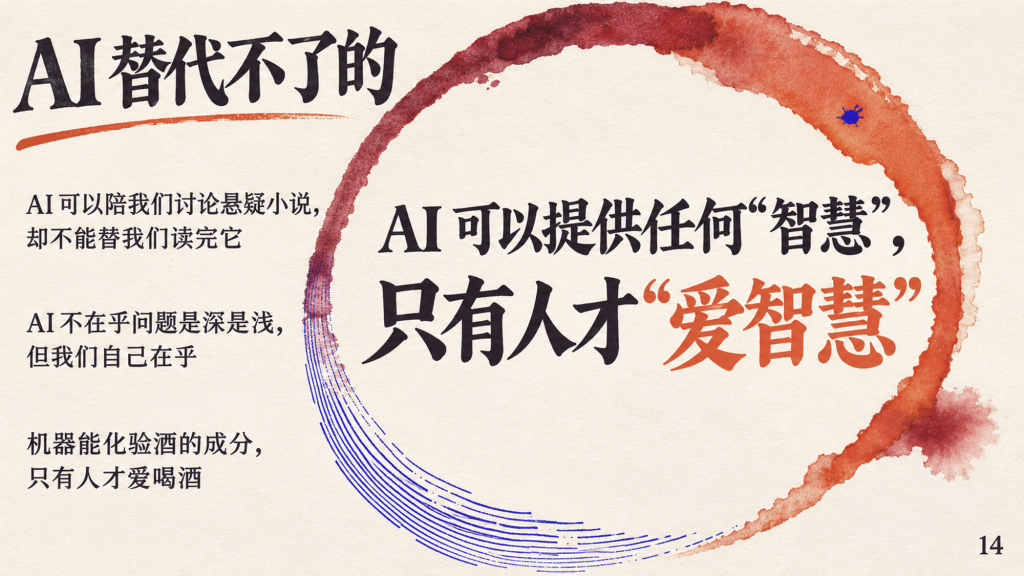
AI can replace human beings in producing wisdom, but it cannot replace human beings in loving wisdom
The development of AI has brought modernity’s step-by-step pressure on the “tradition of free science” to its peak. In a situation where human beings have nowhere left to retreat, we must once again question the meaning of science and reflect on our own pursuits.
What, after all, is the one thing human beings cannot yield? We will discover that once we measure everything by utility or efficiency, human advantages may be lost in any field, and AGI, as a general-purpose tool, will replace almost all “jobs.”
But while AI can mass-produce “wisdom,” it cannot replace human beings in “loving”—pursuing beauty, pursuing astonishment, pursuing the satisfaction of curiosity: these demands cannot possibly be replaced. External utility can be replaced, but internal delight can only be enjoyed by each person in person.
AI can accompany us in discussing a plot point from a mystery novel that we did not understand, but it cannot read it to the end for us, because the process of understanding and reasoning itself is the pleasure. AI also does not care whether the questions we ask are profound or superficial, but we care ourselves. Scholars in the AI era are more like wine tasters: machine testing may perhaps analyze the components of wine more precisely, but only human beings love to drink wine. AI can provide any kind of “wisdom,” but only human beings “love wisdom.” Astonishment is an emotion that must be experienced personally; no one can astonish on our behalf.
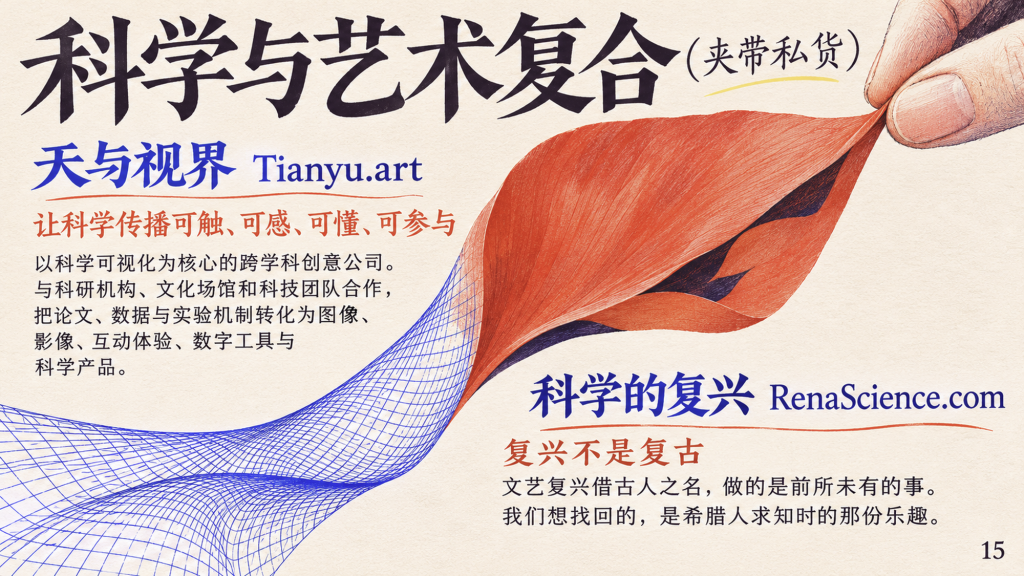
The fusion of science and art
Reviving the original purpose of science and returning to the “astonishment of beauty” is the mission of our generation. The entrepreneurial direction my students and I have chosen is exactly this: Tianyu.art aims “to make science communication tangible, perceptible, understandable, and participatory,” but we do not regard science communication merely as an additional task附属 to science. Rather, we believe that science communication is precisely the most central part of the new paradigm of science in the AI era, because activating wonder and satisfying curiosity will once again become the main pursuit of human scientific activity.
Thank you all
Translated from the Chinese original with AI assistance. The original text is authoritative.