
Commissioned piece for China Science Daily China Science Daily (2025-03-23, p. 4, General) — I am posting the original draft here
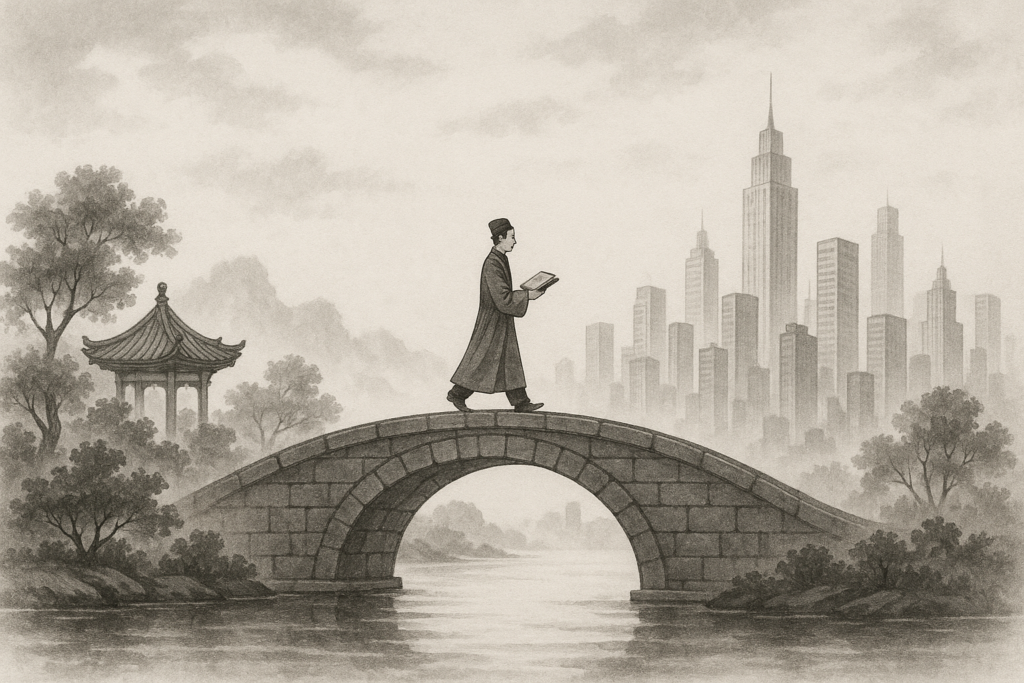
The theme of World Book Day 2025 is “Reading: A Bridge to the Future” (Reading: A Bridge to the Future).
Come to think of it, this formulation seems a bit strange, because the future will always arrive; no matter what we do, time will always pass, and we will always move toward the future. Reading, by contrast, is always touching “the past,” and what becomes a book always originates in the past and settles there.
Perhaps the point of the metaphor is the “bridge” — we will always enter the future, but whether we stride toward it with our heads held high and an easy gait, or are swept into it in a daze by the giant waves of the age, or, after rising and falling in the river of time, finally swim toward it exhausted, these are different endings.
In this era, more and more people feel lost and at a loss before the arrival of the future; we sense that the times are accelerating and changing constantly, yet it is becoming harder and harder for us to grasp our own destiny, and we can only drift with the tide.
The development of AI has intensified this sense of helplessness, and some extremists have even begun to doubt that humanity “has a future.” OpenAI, a leading force in artificial intelligence, once posted a paper on its homepage, playing up the crisis facing humanity: “The immense power of superintelligence could also become highly dangerous, leading to a loss of human control and even extinction.” The article even said that the crisis of human extinction could arrive within ten years. Of course, OpenAI claims that the risk of human extinction can be avoided through alignment work, but ironically, they cannot even “align” their own board of directors, instead staging all sorts of “palace intrigue” dramas.
Optimistic accelerationists believe the future is beautiful, but they likewise think that human beings can do nothing and need only let technological development run its course. Optimists and pessimists are in agreement about human helplessness: both believe humans can do nothing and can only drift with the tide. The difference is only that one side thinks the place where humanity is ultimately thrown by the waves is paradise, while the other thinks the destination is hell.
The “bridge” has been washed away, and we are directly thrown into the torrent of the age, losing our sense of connection to both past and future, losing the ease of strolling and pausing along the way, losing the solidity of taking one step at a time.
In this sense, reading — especially reading history and the classics of the past — is not necessarily to help us speed toward the future; rather, it is to allow us to wander at an easy pace, even to pause for a moment, to confirm where we stand and retarget the direction we are heading toward.
Reading the past is not only the pastime of literati and men of letters; even for scientists and engineers who are opening up new paths at the cutting edge of the times, it is meaningful to pause occasionally and read those documents that seem outdated. Ordinary research workers in fact do not need to read; they only need to quickly search the latest literature. But great scientific breakthroughs are often built on a deep reading of history.
Many contemporary scientific advances are the result of reexamining history. For example, mathematicians reexamined Euclid’s axiomatic system and developed non-Euclidean geometry; mathematicians revisited Plato’s theory of forms and Aristotle’s logic, launching the dispute over the foundations of mathematics; physicists reexamined Newton’s absolute space, returned to Galileo’s principle of relativity, and then Einstein, by reading Faraday’s field theory, reinterpreted matter and force, using the principle of the constancy of the speed of light to bring Maxwell’s equations to new fruition.
For an ordinary scientific worker, Maxwell’s work is an upgraded version of Faraday’s, and one need not even read Maxwell’s papers, only memorize Maxwell’s equations. But for Einstein, he found greater resonance in Faraday, and he also offered a new interpretation of the meaning of Maxwell’s equations. Not to mention that before Einstein, scientists such as Mach and Poincaré had already built bridges in the intellectual history of physics.
The history of artificial intelligence is also, in a sense, a return to the classics — AI once lost its way on the path of symbolism, logic, and semantics, falling into bottlenecks and becoming hard to advance. So people began to return to the cybernetic thinking of the 1950s. In Norbert Wiener we can already see the concept of “machine learning,” the idea of combining evolution with machine training, and the analogy of the “neural network.” Thus, when the direction of propositional logic ran into an impasse, the evolutionary model, like Wiener’s, which embraced uncertainty, achieved a breakthrough.
Wiener himself also benefited from extensive reading. By the age of seven he had thoroughly read Darwin and Plato, and later he read a great deal of philosophy and social science, with research interests spanning philosophy of science, biology, and physiology. Wiener not only proposed the cybernetic ideas that led the development of artificial intelligence, but also foresaw the impact automatic machines might have on human society. As early as 1950, he anticipated the unemployment crisis brought about by automation and offered profound insights, which are even more worth our reading today.
The famous quantum physicist Schrödinger wrote a book called Nature and the Greeks, in which he called on scientists to read the ideas of two thousand years ago. He believed that his reading of ancient Greek philosophy was not due to chance or personal interest, but to the demands of this age.
Schrödinger said: “If you live rather comfortably and securely, and regard this as the normal pattern of human life, and if you believe that, by a necessary progress, it will spread and become universal, then you seem able to live quite well without having any philosophical views at all… But now the situation has sadly changed.” Schrödinger believed that the uncertainty of this age compels us to read the ancients: “continuous progress of mankind is no longer taken for granted.”
When humanity begins to doubt the future, the best course is to read the past. Schrödinger believed that the significance of reading the past is not merely to seek wisdom from the ancients; in many cases, we can also discover “prejudices” among them — “a prejudice which, if exhibited in the naive and primitive form in which it originally emerged, is easier to detect than the complex and rigid dogma into which it may later degenerate.”
Facing the tides of the age, we may feel small and powerless, but if we return to the source of this surging river, we will more easily see the true face of these currents; we will more easily discover the role of the age’s “inertia” upon us, and thus have a better chance of breaking free from that inertia, or else of riding with the current. Of course, for most ordinary people, we may not be able to achieve epoch-making accomplishments through reading, as Einstein, Wiener, and Schrödinger did. But for each of us ordinary people, reading at least helps every tiny individual establish some kind of connection with human civilization as a whole, helps us find our own anchor points, confirm our own situation, and thus find the proper posture for meeting the future.
Translated from the Chinese original with AI assistance. The original text is authoritative.