
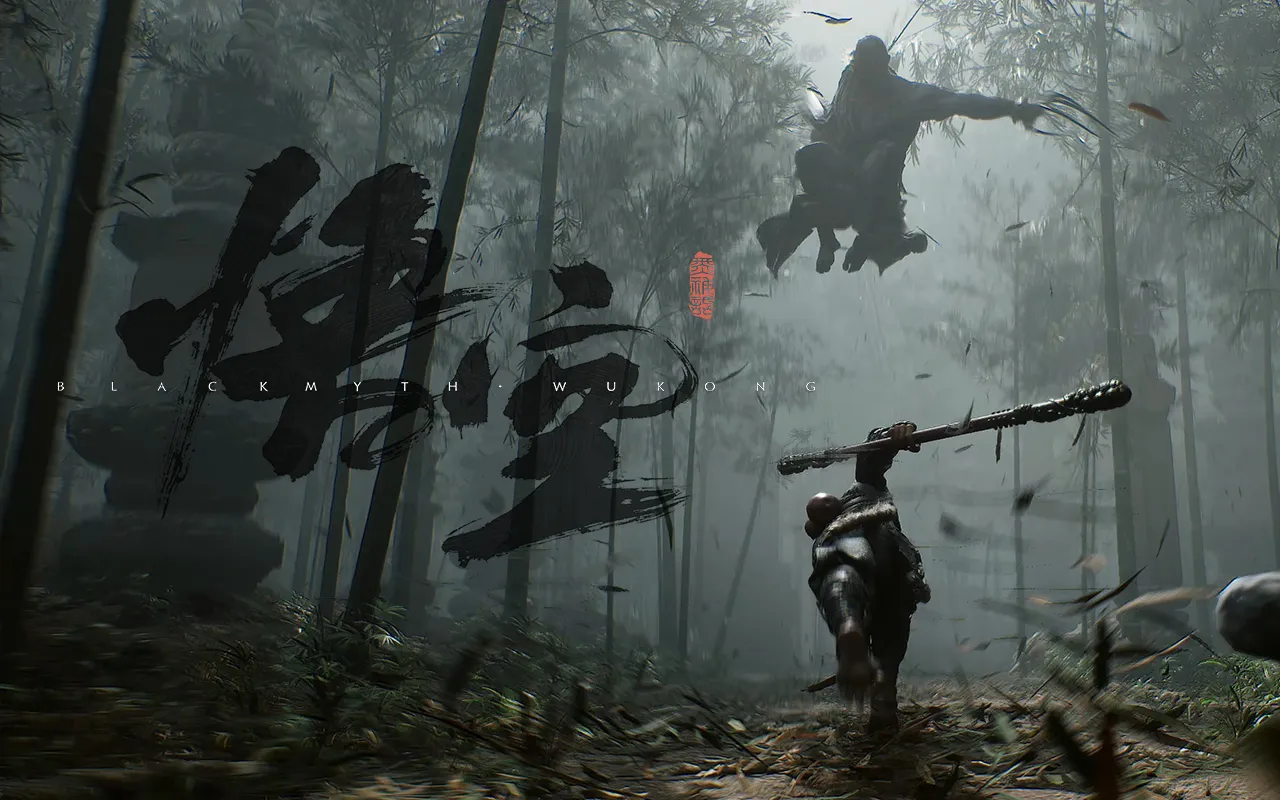
I bought Black Myth and still haven’t had time to play it, so I first wrote a commissioned essay, published in China Science Daily (2024-09-20, p. 4, Culture). At publication, its title was changed to “Black Myth” as a Vehicle for “Cultural Export” — Does It Measure Up?
On August 20, 2024, the action role-playing AAA game Black Myth: Wukong, produced by the Chinese company Game Science, was officially released. Both Black Myth’s preorder revenue and its peak concurrent online player count set records in Chinese game history, and reached world-leading levels, coming in second only to the record of PlayerUnknown’s Battlegrounds on Steam.
The so-called AAA game is a common concept in the game industry and among players, but its meaning is somewhat vague. Broadly speaking, it refers to high-cost, high-quality, and high-scale premium console games, including PC games. In recent years, many mobile games have also been high-cost, large-scale productions. Chinese mobile games such as Genshin Impact and Honor of Kings are also widely popular around the world, but they are usually not regarded as AAA games. That is because they are more like “consumer goods” than “works of art”: mobile games pursue ever-renewing “traffic,” rather than producing a complete work that can “stand the test of time” and become “a classic known throughout the world.”
So in a certain sense, Black Myth is the first AAA game produced by a mainland Chinese team since the concept of AAA games became popular. What is especially worth noting is that both the narrative and the art style of this game are steeped in Chinese characteristics, so it can indeed be called a kind of “cultural export.”
When it comes to games as “cultural export,” some people are proud, but others are offended—they say: isn’t it just a game? At most it’s something that makes people addicted and wastes time. How can it possibly deserve to be a vehicle for cultural export?
If games are unworthy of serving as vehicles of culture, then what exactly should bear culture? Are bound books with sewn spines a better medium? When faced with Japanese anime and games, Korean pop music, and American Hollywood blockbusters, if we pull out bound books with sewn spines to spread culture, do we really have any competitiveness?
Many people not only harbor prejudice against games, but also cannot understand the essence of “culture.”
First of all, what we call “culture” is precisely those ways of “wasting time.” Everyone toils like an ox or a horse, running about all day like an animal just to feed themselves; there is no “culture” here. Only when at least some people, for at least some of the time, are able to obtain leisure and have room to care about things beyond mere animal survival does “culture” emerge.
In the Paleolithic Age, when hunters were not busy hunting but instead spent time carefully painting images of cattle and sheep on cave walls, “culture” happened; when someone did not actually mate, but instead devoted their mind to carving a completely impractical stone sculpture of a plump woman, “culture” advanced. When a group of nomads with no fixed abode gathered in the Göbekli area to build a giant megalithic complex, “culture” made a leap.
In ancient times, those scholars who did not cultivate the five grains and did not engage in production spent all day composing poems and writing couplets, creating those poems, songs, and prose while roaming mountains and rivers, and these became our “cultural tradition.” Take Journey to the West, the typical vernacular novel, for instance: it too first took shape repeatedly in the mouths of storytellers in teahouses, and in the end became popular in the world as recreational reading. It contributed neither to industry nor to the imperial examinations, yet it has survived to this day and become one of the Four Great Classical Novels, carrying the Chinese cultural tradition.
In summing up his celebrated book Sapiens, Yuval Harari said: “The best way to describe the Sapiens is as a storytelling animal. We create stories about gods, nations and corporations, and these stories form the basis of our society and the source of the meaning of our lives.” Though these stories were initially far removed from utility, it is precisely they that constitute the backdrop of human culture, making possible increasingly complex and diverse social organization.
The Four Great Classical Novels were also, in the Ming and Qing dynasties, a kind of frivolous pastime. Scholars had so many “classics, histories, masters, and collected works” to read—how could they possibly have time to waste on these vernacular novels? But those classics, histories, masters, and collected works that were regarded as the “proper business” were, in many cases, themselves products of idle theorizing and empty talk.
This is also the second characteristic of “culture”: it is always “renewing itself daily,” something that is constantly changing and forever alive and growing, rather than “the things of the past.” The relationship between culture and the “past” is like the relationship between the present me and the me of ten years ago: the present me inherits the me of ten years ago, yet no longer remains stuck in the past. When I “express” myself and “communicate,” my past settles into my thoughts and habits, but I always have to express my present content in the present context, rather than repeatedly reenacting my behavior from decades ago. The blocks I stacked at age three may have shown creativity and scale far beyond my peers, but if at age thirty I were still carrying around the blocks I completed at age three and showing them off everywhere, that would be rather laughable.
Memory of past achievements is certainly precious, but even more important is continuously bringing forth the new and discarding the old, creating novel things while maintaining one’s individuality. Constantly bringing forth the new and discarding the old, and integrating fashion, is precisely what has made Chinese culture worthy of pride throughout history. Journey to the West is a typical example: it integrates cultural elements from multiple sources and eras—Indian legends, Buddhism, Daoism, folk legends, and so on—finally converging in the medium of vernacular prose and printed books.
From folk legend and religious myth, to the elaboration by storytellers, to the organization of the text by Ming-dynasty booksellers, and finally to a fixed edition in modern print, followed by re-creations in television dramas, the content and medium of Journey to the West have always been constantly iterating and changing. Just as the Chinese absorbed elements of Indian mythology to create Journey to the West, the Japanese also absorbed elements of Journey to the West to create new works such as Dragon Ball.
Every new cultural work is not a repetition of the past, but a reassembly of countless cultural elements from ancient and modern times, China and abroad, shaping new “myths” in a new medium.
The papermaking and printing techniques—Chinese culture has always been especially adept at developing and making use of new media. Papermaking promoted the flourishing of the metaphysical thought of the Wei and Jin periods and the poetry of the Tang and Song dynasties, while printing spread Buddhist culture and promoted the flourishing of Song-Ming Neo-Confucianism and popular novels.
Entering the digital age, video games can of course also become a new cultural medium, carrying forward and giving full play to the ancient yet vigorous culture of China.
Of course, I am not saying that video games are all necessarily good things, just as we also see works of varying quality in printed books. Novels of the Ming and Qing dynasties also had all kinds of obscene and tasteless material, but their existence did not prevent the Four Great Classical Novels from standing out. In any diverse and vibrant cultural environment, excellence and inferiority will coexist; that is a byproduct of vitality—in a certain sense, the stronger the capacity for metabolism, the faster the production of filth.
Today, of course, there are also more shoddy video games; and even in the long run, Black Myth may perhaps only count as a middling work, a stepping stone for future masterpieces. But we should acknowledge that new culture can emerge here.

Translated from the Chinese original with AI assistance. The original text is authoritative.