
This is a commissioned piece for SeeDAO’s 卧虎藏龙 project, https://chinese3.substack.com/p/chinese3-newsletter2dao-2f0?r=3lmuif&utm_campaign=post&utm_medium=web&triedRedirect=true
In fact, my understanding of the current state of Chinese-language DAO is not all that comprehensive. Among the several DAOs I hang around in, I’m mostly a lurker. But this year at the Hong Kong Web3 Carnival, I happened to give a talk titled “The Possibility of the Revival of Traditional Chinese Culture in Web3,” and since the content was somewhat related, I took on this topic as an excerpt and expansion of that talk. The talk was too long, so in this article I’ll try to make things as concise as possible.
This topic can be divided into three levels. First, we need to clarify what “DAO” is, and what role DAO plays in the Web3 movement and indeed in the entire information age; second, we need to discuss what distinctive features Chinese-language DAOs have—whether they are the same kind of organization as English-language DAOs, or somehow more low-end, or whether each has its own strengths; finally, we will focus on the influence of “Chinese culture,” that is, beyond simply speaking Chinese, whether our Chinese-language DAOs may also, on the basis of traditional culture’s distinctive traits, carve out a style all their own.
In short, my conclusion is this: first, DAO is a new organizational form that floats free of the boundaries of traditional states, companies, and social organizations, and it will ultimately replace the nation-state as the new paradigm of the “imagined community” in the network age. Second, Chinese-speaking users have already been widely participating in DAO practice; it may be more scattered and disorderly, but this wildness is also revolutionary. Finally, the distinctive traits of Chinese culture are an emphasis on history and an emphasis on family; these traits happen to complement modern Western culture, and they also fit very well with the cultural tendencies embedded in blockchain.
1. Why We Need DAO
The literal meaning of DAO is “decentralized autonomous organization,” but it is generally also assumed to be built on blockchain—either using NFTs as identity markers, or using some kind of token to establish an economic system, or using smart contracts to implement governance mechanisms, or all of the above.
But the reason it needs to be based on blockchain is still “decentralization.” If an organization introduces blockchain merely to add a fundraising gimmick rather than for the sake of decentralization, then it can only be called a fake DAO, a traditional organization dressed up in DAO clothing.
A DAO in the true sense is unlike any traditional organization. Club, affinity group, nonprofit organization, company, consortium, political party, state… a DAO may combine the features of all of the above, yet it is different from any one of them. It is a new kind of “city-state” that transcends the nation-state.
Because if we really want to use blockchain, and not merely use blockchain for the sake of a gimmick, then it must be because our organization needs some foundation that stands above any nation, any multinational corporation, and any international institution. For if I am perfectly willing to make things happen on the rules or platforms already provided by the existing state or company, then in principle I do not need blockchain. Only when I need to do things beyond the ready-made boundaries of these traditional institutions do I need to rely on this new technology, blockchain.
The distinctive feature of blockchain is that it opens up a piece of “ownerless land” in the digital world. I can establish a digital identity without relying on any “registration” or “permission,” and then use that digital identity to work in a DAO, complete digital work or create digital works, earn digital currency, then consume digital resources, play digital games, collect digital artworks, sponsor other digital city-states, and, after achieving success and fame, leave my mark in the digital world… All of these activities—whether technological creation or artistic appreciation, whether chasing fame and profit or indulging in entertainment and leisure—may take place entirely in the digital world, that is to say, these activities leave no trace anywhere in the old world. As long as I never exchange anything for fiat money or real-world resources, my entire digital life is completely independent.
That is what true “autonomy” means. It means that in the digital world we can break free of all conventions and old customs and establish new rules and consensus for ourselves. Every DAO is such a community unit that independently governs itself in the digital world, and this autonomy, insofar as digital life is concerned, may be even more complete than the sovereignty of a traditional nation-state.
Of course, not all DAOs need such a thorough autonomy. Many DAOs are willing to attach themselves to a larger ecosystem, and need not necessarily break free of all dependence on the old world. But in principle, the ideal direction of DAO is the “network state,” a new political form that transcends the old nation-state paradigm.
Why does the nation-state paradigm need to be transcended? Clearly, because this paradigm no longer fits the new environment of the information age. The nation-state paradigm is not something that has existed since antiquity; it is a product of modernity, arising alongside the whole wave of modernization from the Renaissance to the Industrial Revolution. Before that, imagined communities were sustained by myth or divine authority, and the boundaries of states were not clear either.
Many rules that seem self-evident in fact depend on the nation-state paradigm, such as the fiat currency system. Right now many people find it odd why every blockchain project has to come up with its own tokenomics; I didn’t really understand it either at first, because indeed many tokens are issued just to fleece the sheep. But once I map crypto communities onto nation-states, it all makes sense, because the fiat currency system is actually even stranger—why does every country or region with some degree of independence need its own fiat currency system? Even a tiny place like Singapore issues the Singapore dollar, and Macau issues the pataca; why not just use currencies like the US dollar or the renminbi directly? Obviously, they want to use an independent monetary system to draw a boundary between themselves and the global market, so that within that boundary they can carry out independent governance in a more flexible and autonomous way. So by the same logic, if a network state wants to draw its own boundary and implement its own charter more independently, setting up a tokenomics system of its own design is a perfectly natural thing to do.
2. DAO as Public Space
Since DAO replaces the new paradigm of the traditional state, and its ultimate ideal is to build an independent and autonomous network state, DAO should provide a pluralistic, multi-layered public space, rather than being content with the vertical relationships of a traditional company.
Public space is the place where each person’s actions generate an echo. This space cannot be too large, or else everyone’s actions will seem too insignificant within it, and no echo will be heard; nor can it be too small, or else it becomes a “cocoon” or an “echo chamber,” filled only with homogeneous voices and lacking richness.
As Arendt said, a person’s “sense of reality” depends on the existence of the public realm; too much echo or too little will both plunge people into nihilism. Human beings need to receive feedback from the world frequently. Literary works often depict this: when a person suspects that they are trapped in a dream, they pinch themselves, and if they feel pain, it means they are in the real world. Pinching oneself is the output of my will, while feeling pain is receiving the corresponding feedback. If I want my whole life to possess more reality, I need to receive feedback from the world at large in response to the will I put out. If all my actions are like passing clouds, like stones sinking into the sea, failing to stir even a ripple in the world, then I will feel that my life is equally void.
From the electronic age (or the mass-media age) to the mobile internet age (or the Web2 age), the overall trend has been the disintegration of public space, and this disintegration has been achieved through the acceleration and expansion of public space. McLuhan’s prophecy of the “global village” actually hints at the terrifying situation in which public space ultimately “bursts apart” under its own expansion—billions of people across the world packed together as if inside a single village. This is by no means a lovely scene; on the contrary, in this world that has lost the concept of distance, public space disappears entirely. Everyone seems to have the right to speak, but very quickly they are swallowed up by the noisy environment and forgotten. Electronic media (in McLuhan’s time, telegraph and telephone; today, represented by the mobile phone) provide ever more immediate and rapid feedback to satisfy people’s demand for feedback, but at the same time make it harder for people to produce lasting echoes in public space. Political action in Arendt’s sense—action that stirs up endless ripples in public space—has become the privilege of a tiny minority, and those who seem able to produce significant echoes are in fact all typecast, from politicians to KOLs, serving “traffic” and presenting a certain “persona” to the outside world rather than their true self.
The key lies in two trends: on the one hand, the atomization of the individual—more and more people don’t even form small families anymore, let alone live in dependence on clans or specific communities; on the other hand, the flattening of social platforms—we no longer go to squares, marketplaces, streets and alleys, or city halls and other concrete and limited spaces to engage in social and political action, but do so on social platforms like Twitter or WeChat, whose spaces are homogenized and globalized, and within them all sense of boundaries is completely lost. In other words, the public spaces we can participate in are either too small, so that even neighbors cannot hear, or too large, so that nothing stirs at all.
If DAO’s mission is to rebuild public space, then one of its major tasks is to reconstruct diverse “terrain” in the flat, ever-shifting digital world (this was the topic of my talk the last time I went to Singapore for a conference; I’ll organize it again if I get the chance), and to establish suitable boundaries while remaining broadly open and interconnected. In this way, within a proper boundary, everyone’s actions will receive just the right kind of feedback, and the ripples each person stirs up will be able to resonate into a harmonious melody.
In fact, even in the internet age, there have still been small-circle cultures with boundaries that are neither too large nor too small, such as hacker communities, open-source communities, BBS and forums, subtitle groups, fan clubs, and so on. The flourishing of the tipping economy satisfies people’s need to “receive feedback in public space.” The top tipper who throws down millions does so in order to hear those few shouts of “Boss, you’re generous!” from the host in public, as well as to enjoy the honor of leading the tipping rankings. Perhaps it is precisely because the whole world is so short of such public spaces that influencer economics has become so feverishly hot.
The key point is that the “tokenomics” of influencer economics is deformed: the entire public space is not constituted by influencers and their fans; rather, it survives entirely by relying on the livestream platform. Whether it is fish balls or rockets, these “tokens” are monopolized by the platform, cannot be fairly minted, and cannot circulate freely. The platform strictly restricts the use of tokens and takes the largest share out of circulation.
The platform’s hefty cut is not just a matter of monopoly and exploitation; more importantly, it is a matter of who sets the rules of the game. The crucial point is that the corporations and capital operating the platform are not themselves participants in the public space. They still belong under the paradigm of traffic economics. In the eyes of capital, everyone participating in public action on the platform is not a unique individual but a wave of “traffic” that brings profit.
So the mission of blockchain and DAO is also called Web3: to overturn the Web2 paradigm, resist the trend of big companies and big capital monopolizing public space, break out of traffic economics, and return the right of association to every individual.
3. The Distinctive Features of Chinese-Language DAO: the Positive Meaning of “Spiral, Relocate, Lie Flat, and Get Rekt”
Having discussed the significance of DAO, let us turn back to the distinctive features of Chinese-language DAO.
As the name suggests, the most basic feature is, of course, that Chinese is the main language of social interaction. Clearly, this feature presents a certain barrier: making Chinese the main language first of all raises the threshold for English and other language users to participate, limiting the range of participants—mainly Chinese users, and especially attracting more domestic users who are not good at communicating in English.
But according to my earlier analysis, this language barrier may not necessarily be a bad thing; it may instead provide the conditions for increasing a public space’s sense of boundary and diversity. In the information age, traditional spatial boundaries have collapsed; what remains to determine a community’s boundary are, first, interest or attention, and second, language and cultural background.
People in the English-speaking cultural sphere are actually aware of the importance of cultural diversity too—although the diversity issues they have in fact pushed for have mostly focused on gender, sexuality, and skin color, compared with these animal features, diversity in language and culture is even more something human beings ought to cherish.
Of course, the Chinese community also has some characteristics that are often criticized. People say that Chinese scammers are especially numerous; I already discussed this in the previous piece, “The Possibility of the Revival of Traditional Chinese Culture in Web3.” This is the inevitable atmosphere of the early age of great voyages and great frontier expansion, and East and West were basically the same. Here I’ll additionally discuss some features of behavior in Chinese communities.
There is a meme image called “Analysis of China’s Current Social Mentality” that is quite interesting. It uses the horizontal axis “resistance—cooperation” and the vertical axis “negative—positive” to divide things into four quadrants: “juǎn, rùn, tǎng, jiǔ.” In fact, these four characters also neatly summarize the many kinds of life found in Chinese Web3 communities.
- Juǎn: Chinese communities are often more caught in internal competition, for example, they are more fond of PVP (players exploiting one another);
- Rùn: Some Chinese players do everything they can to run into Western communities, or else worship Western projects more; projects with endorsement from foreigners are more popular;
- Tǎng: Many Chinese players like to lie flat and obtain something for nothing, content to reap benefits without wanting to build anything;
- Jiǔ: Chinese players are often willing to be harvested, like playing a hot-potato game, with a very strong gambling mentality, and in the end all become leeks.
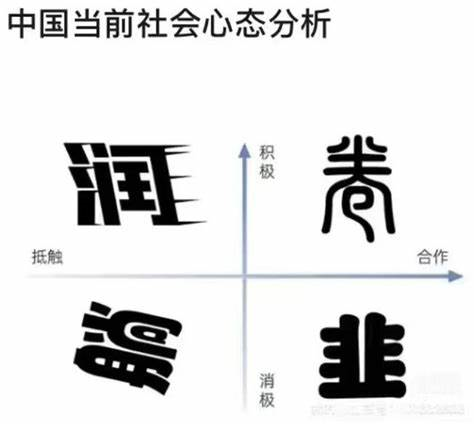
First, the same old point: many phenomena are actually found regardless of East or West, especially when it comes to DAOs; in the Western community, there are in fact not many that are running very well. Second, some phenomena may indeed be more pronounced in Chinese communities, but this is not only a bad thing. For a blockchain revolution that aims to create a new order, it may instead be an advantage.
The 19th-century proletariat was also mixed in quality. It, too, was intensely caught in internal competition, with cheating, swindling, and fraud running rampant. But Marx believed that the hope of social revolution lay in the proletariat, because they had nothing much to lose, they cherished the old world less than anyone else, and they desired the new world more than anyone else. As long as they could keep pace with the great trend of technological evolution, they would ultimately be able to erupt with a force capable of transforming heaven and earth. Although the later development of the labor movement in many respects exceeded Marx’s expectations, and there were also many ugly aspects, on the judgment that it was “more revolutionary,” it was broadly accurate.
Returning to the present, the various disorders in Chinese Web3 communities have nothing to do with the supposed inferiority of Chinese culture. The main factor is actually the social environment of contemporary China, which has shaped them. None of “juǎn, rùn, tǎng, jiǔ” is an exception.
This matter of “the old order needs revolution” can only be widely recognized when the old system exposes major problems. In the West, especially in the United States, after the 2008 financial crisis, a wave of revolutionary thinking once erupted, and the Occupy Wall Street movement was blazing hot. However, on the one hand, the United States gradually (apparently) got through the crisis; on the other hand, the elites of the United States succeeded in shifting the contradictions toward “identity politics” through an open strategy, and the momentum of Occupy Wall Street faded once again.
Now, with the listing of the Bitcoin ETF, everyone is beginning to rejoice that Wall Street has accepted Bitcoin, and many coin speculators take pride in having become “Nasdaq traders,” completely forgetting that Wall Street is precisely the object of Bitcoin’s revolution, and that Bitcoin players’ status was originally higher than that of the vested interests of the old order.
Now the entire blockchain revolution has reached a crucial stage. Whether the Bitcoin ETF is the sign that revolutionaries have finally been “brought into line,” or the prelude to the old world’s gradual peaceful transformation, or perhaps the last “cooperation” before intense conflict, remains undecided.
The United States and China are the two major exceptions in the Web3 world, and many Web3 projects prohibit residents of both countries from participating. This is because they have to yield to so-called “compliance.” But the roles of these two countries are not the same: the United States is the leader of the old rules, so it is the most difficult to deal with in terms of compliance; China, by contrast, originally did not belong within the old rules of globalization.
So for many projects that exclude the United States, if they could easily pass official American approval, they would probably also be willing to accept approval. But for many projects that exclude China, they probably never even thought of going through official Chinese approval.
American blockchain players may feel that if the SEC were a little more open and a little more tolerant, that would be nice. But Chinese blockchain players would not even consider how the CSRC could be improved, because they had already gone their separate ways long ago.
A more direct comparison is this: many people feel that Bitcoin players becoming “Nasdaq traders” and “Wall Street analysts” is glorious, that they have finally entered the inner sanctum; but would anyone think that Bitcoin players becoming “BSE traders” and “A-share analysts” is a glorious thing?
But in fact, A-shares and Nasdaq, the China Securities Regulatory Commission and the U.S. SEC, are all obsolete and outdated financial systems; it’s just that the latter are relatively more glossy. Yet the global market’s eager anticipation of Yellen’s policy press conferences is fundamentally no less absurd and laughable than speculating on stocks by watching the evening news.
Beyond confronting the old financial system, Web3 must also confront the old social system (Web2), and Americans may still hope that everything will get better after Musk takes over Twitter, but Chinese people saw the ugliness of centralized control over social platforms much earlier.
Looking back at the four quadrants of “juǎn, rùn, tǎng, jiǔ,” first, none of them is satisfied with the old system; all contain the force of transformation. Second, their respective manifestations actually all have positive significance for the Web3 cause. Let us retell these four characteristics:
- Juǎn: Chinese communities often achieve internal competition more fully, which helps expose both the bugs and the potential of new technologies and new rules. The practice of DAOs is first and foremost a social experiment; since it is an experiment, it is all the more worth advancing in a high-pressure, high-intensity environment. Rather than waiting until the new order is mature before exposing all sorts of loopholes, it is better to let more people find more ways to exploit gaps under intense competition, so that contradictions erupt earlier.
- Rùn: Chinese communities are often more disdainful of the old centralized financial order and more longing for an ideal homeland, like the immigrants aboard the Mayflower who were dissatisfied with British policy. Compared with the well-dressed gentlemen of continental Europe, those who rùn out of Britain were the pioneers who opened up the New World; in the end, they in fact further carried forward English culture. Whether or not Chinese communities physically want to rùn, participating in Web3 basically requires “crossing the Great Wall and walking toward the world,” which just happens to revive the spirit of the Mayflower—or, one could say, to revive the Chinese spirit of “going down to the Nanyang.” In the end, this will further open up and develop Chinese culture.
- Tǎng: Since one is coming to participate in the Web3 cause, that does not count as complete lying flat. So-called lying flat simply means no longer submitting to the traditional company system, no longer selling one’s labor power according to the old rules, but being more willing to accept the new relations of production brought by Web3, such as the digital nomad model. In addition, the autonomous mode mentioned earlier, in which production and consumption both take place entirely in the digital world, is most likely to be realized first among those who lie flat, because they have lower material desires and thus a better chance of achieving spiritual freedom in the digital world.
- Jiǔ: At times of epochal change, bubble economies are always hard to avoid—for example, the tulip bubble, the South Sea Bubble, Ponzi schemes, and the internet bubble. All of them occurred in the golden ages of the Netherlands, Britain, and the United States. After the bubbles, the new economy continued to flourish, but there always had to be several waves of investors who became cannon fodder. The blockchain revolution, even more so, has risen through repeated bubble collapses. To put it harshly, “leeks” are the necessary fuel of economic transformation, and in this respect the Chinese-speaking world has plenty of resources. Of course, to put it more positively, there is the saying that repeated leek suffering can make one a doctor; the leeks will eventually have a day of awakening. When they discover that following authority and capital closely still ends up with them being harvested, they will more deeply identify with the slogans of the crypto movement such as “fair launch,” “full circulation,” “from the bottom up,” and “decentralization.” I believe that the reason this wave of prosperity in the Bitcoin ecosystem has centered on Chinese people is inseparable from Chinese leeks’ awakening to fairness.
IV. The Resonance Between Traditional Chinese Culture and the Blockchain Spirit
The final part here is the theme of my article “The Possibility of the Revival of Traditional Chinese Culture in Web3.” I won’t repeat it further here; I’ll only excerpt some key points. For further discussion, please refer to that article.
We are standing in the position of the “Mayflower,” opening up an ideal homeland in the ownerless land shaped by blockchain. What is called “ideal” must transcend mere material pursuit and instead include a repository of transcendent meaning.
Spiritual pursuit is common to all human beings, but Western culture often pursues things beyond this world, such as God and heaven. Traditional Chinese culture, by contrast, places more of its hopes in the real world: the annals of history, incense offerings, ancestral temples, and so on.
Unlike the long-standing Western tradition of emphasizing commerce, contracts, and universality, Chinese culture has always placed greater emphasis on history, kinship, and reality.
This realistic culture may not be conducive to the emergence of abstract thought, but it is more suitable for continuing to support, in the modern age of faith crises, a bottom-up and richer, more diverse mode of social connection.
The bottom-up, empathetic mode of construction in the Chinese tradition forms a chain of sympathy from “family—state—all under heaven,” and the resulting conception of “all under heaven” has a unique charm. This conception differs from the Western “global vision” (Western contemporary scholars such as Latour have also discovered the problems with this perspective). The notion of all under heaven can provide a “non-totalizing connectivity,” arousing mutual connection among individuals and communities without presupposing an overarching whole or a God’s-eye view, and inspiring cooperation and coexistence.
The Chinese ritual-and-music culture of “harmony in diversity” differs from the Western approach of invoking “identity” to formulate the social contract. Ideas such as a small state with few people and the Great Way running in parallel are closer to a polycentric aggregate of city-states thriving in diversity, rather than the traditional nation-state model. In the industrial age, such a community model did not have suitable conditions, but in Web3 practice, the Chinese notion of “harmony in diversity” can be more effectively embodied by DAOs.
In short, many features of Chinese culture can find corresponding forms in the Web3 world:
- Ancestor worship: first is first—the spirit of honoring what comes “first” has always remained among Greek-style athletes and scientists, while in Chinese culture it has solidified into the worship of ancestors and founding masters. But in the field of modern industrial technology, it is not actually very prominent. Great inventors such as Watt (the steam engine), Stephenson (the railway locomotive), Edison (the electric light), and Ford (the automobile) were in fact not the “first” of their respective inventions; they were merely the ones who commercialized them most successfully. In the fashion industries of the information age, stars have become fast-moving consumer goods, and there is even less basis for talking about who is “first.” But in the cryptocurrency field, Bitcoin powerfully revived the culture of “first is first,” precisely because blockchain brought history back.
- Shaman-historian tradition: blockchain inscription — from the NFT craze to the inscription craze, players are no longer content with blockchain merely carrying transaction history (the ledger); instead, they are inscribing more and more strange things onto the chain. The information that is inscribed does not possess computable value because it improves efficiency, but more because it shapes public memory and even unfolds various activities akin to mystical rituals.
- Attending to this world: long-termism — blockchain, especially Bitcoin, has strengthened long-termism
- Clan associations: GM fam~ —— small communities such as NFTs and DAOs, gathered around the token economy, have revived “family” culture. Although at present Web3 communities still mostly socialize on Web2 platforms, their relatively independent economic systems mean that these small circles are no longer flattened out; instead, they may well give rise to a pattern of diverse differentiation.
- All under Heaven for the public: open-source culture and public goods — the crypto movement is an extension of hacker culture and the free software movement, and emphasizes the public sphere.
- The feudal states of the Zhou order: autonomous worlds — network states supported by blockchain will inevitably transcend the industrial-age nation-state and become a new paradigm of the “imagined community.” In a sense, this is a revival of the ancient Greek polis and the pre-Qin Chinese “Zhou order”; the Zhou Son of Heaven is emptied out and suspended, becoming the underlying consensus of Bitcoin.
- Ritual-and-music society: plural identities politics — the ideal of the Web3 world is close to some kind of ritual-and-music society in which the Great Way travels together and harmony is maintained without uniformity.
Conclusion
Finally, let me also make a quick advertisement: in the name of reviving Chinese culture, I have personally launched a Web3 DAO organization, which currently uses Chinese-character NFTs as the community identity marker. For details, please follow my Twitter @epr510
Chinese characters are the common denominator of Chinese culture, and they also carry much of Chinese culture’s depth and distinctive character. Yet for more than a hundred years, Chinese characters have continuously faced the impact of the “information age,” and there has always been someone who felt that Chinese characters could not adapt to the information age — in fields such as printing, typing, telegraphy, input methods, and word processing, new technologies were originally tailored for alphabetic writing systems. In order to help Chinese characters keep pace with the information revolution, Chinese people have done a great deal of creative work (the vernacular language revolution, Chinese typewriters, Chinese telegraphy, Chinese indexing methods, Hanyu Pinyin, computer encoding, input methods, laser typesetting, Chinese office software…). So much so that even into the Web2 era, Chinese characters and the culture they bear have always participated as an active force in the tide of the information revolution, not only keeping up with the world but also displaying the distinctiveness of Chinese culture.
In the Web3 era, I believe Chinese culture will still be content to lag behind; we will continue building a “Chinese-character kingdom” in the Web3 world, forming an open yet independent cultural community and contributing to the diversity of the future world.
Translated from the Chinese original with AI assistance. The original text is authoritative.