
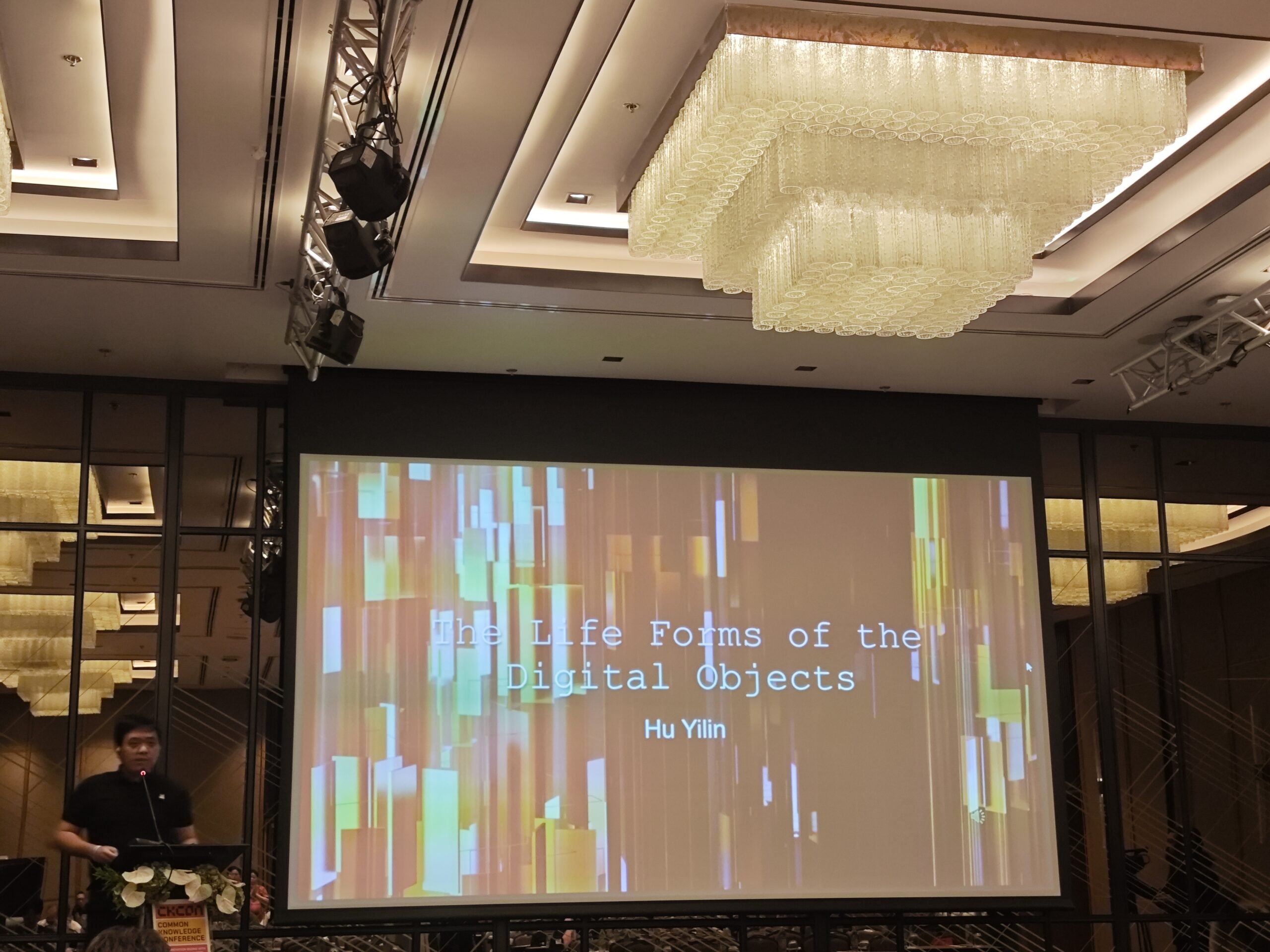
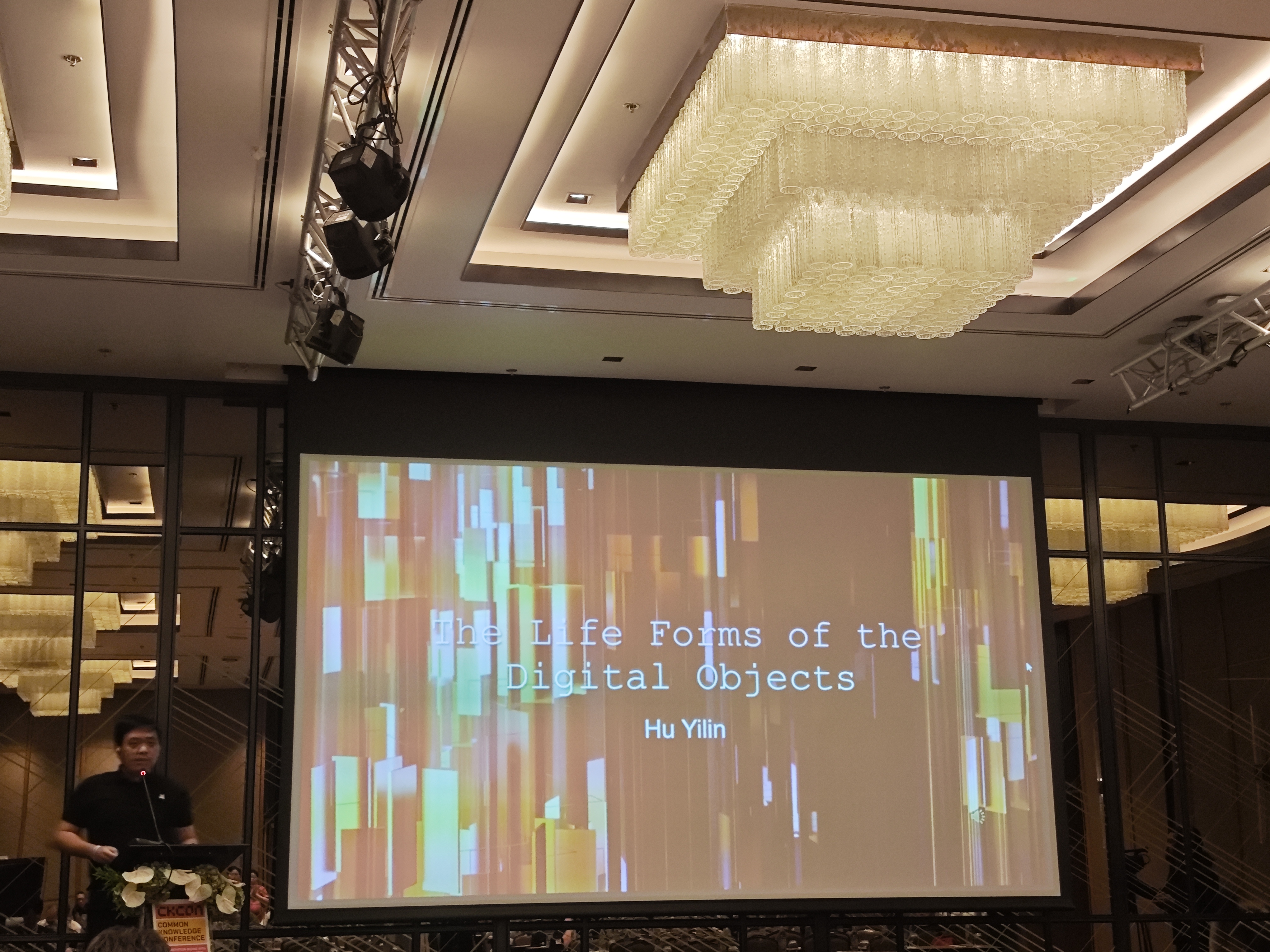
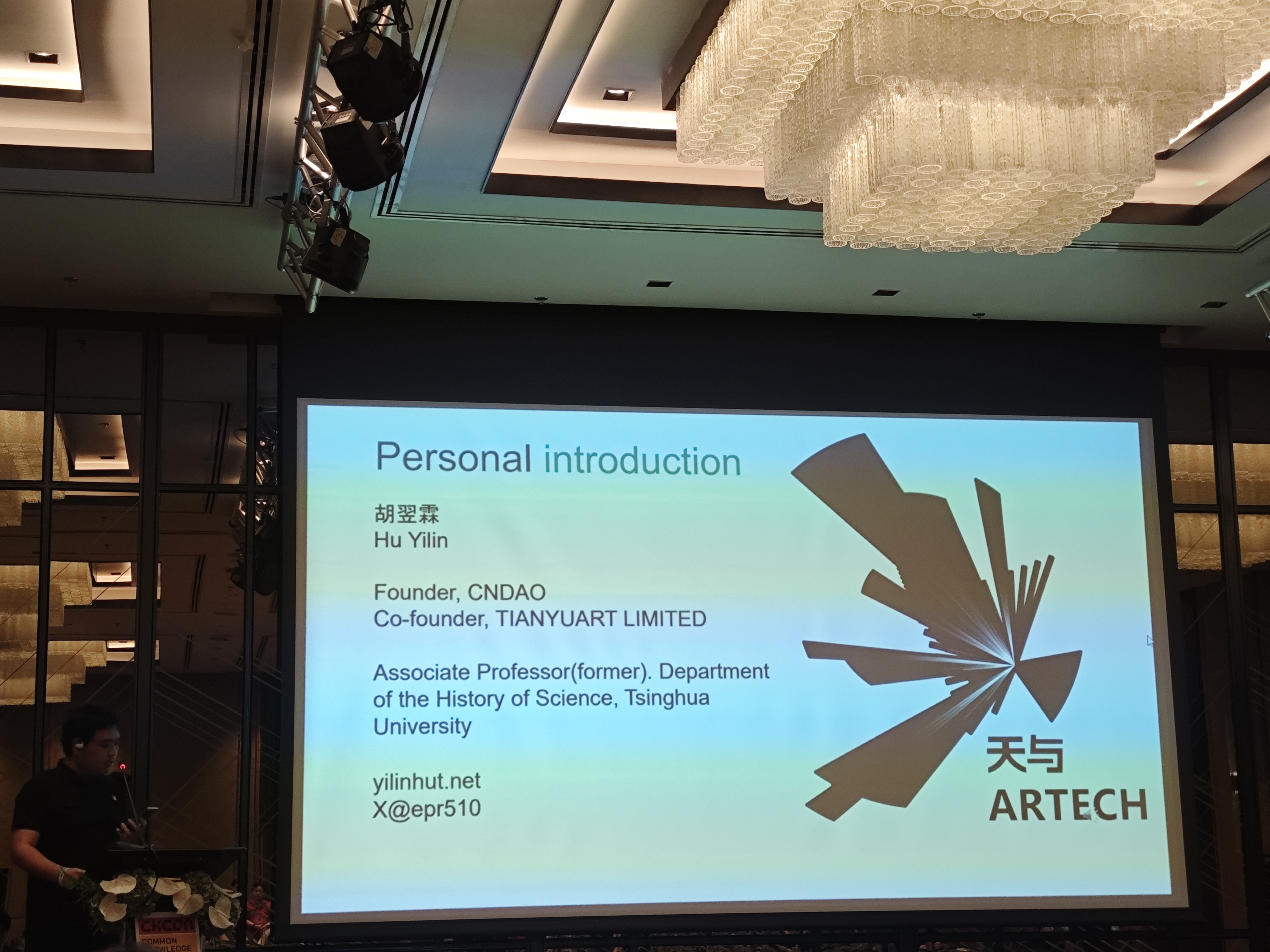
A while back I went to Chiang Mai to attend ckcon, where I read Simondon to the ckb community and also gave the somewhat endorsement-like talk below. Of course I have a personal relationship with ckb and also a stake in it, but what I said was indeed sincere. ckb’s distinctive design really does fit quite closely with my own entrepreneurial direction: digital artistic creation that fuses life, culture (history), and information (blockchain).
Both my ideas about “a new history of the blockchain” and “an AI life with individuality” can be done on ckb; moreover, the new “Common Sense” (from Common Sense to Common Knowledge) can serve as the foundation for a “new enlightenment” and a “new Declaration of Independence.” At the gathering I even said: the “decentralized public knowledge” formed by ckb replaces the position once occupied by Newtonian mechanics, becoming the basis on which a pluralist era can form a global consensus in a non-universalist way, and becoming the source of faith and methodological model for a pluralist world order.
I will write more of my thoughts later on. But on the one hand, this talk was only a tentative opening move to the ckb community; on the other hand, it was an English lecture and time was limited, so I couldn’t expand on my more specific ideas. Below I’m posting my Chinese draft, in case it can be completed in the future.
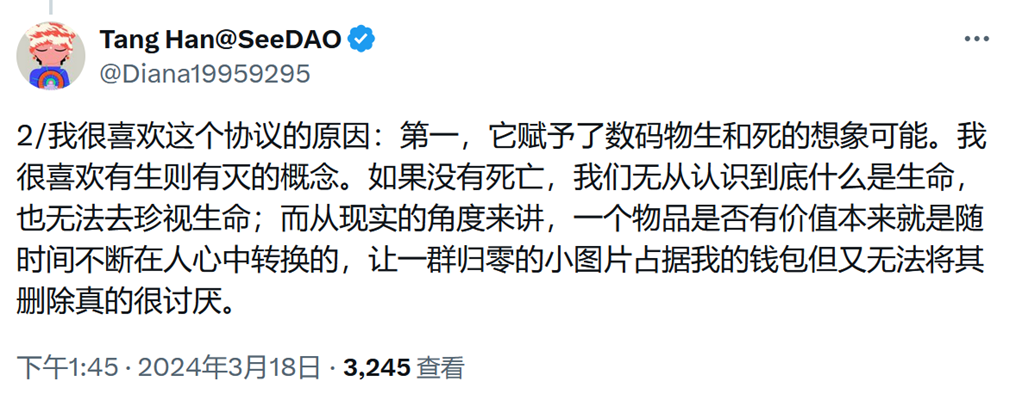
I am also very optimistic about CKB. One thing that attracts me to CKB is its imagery of life. We see that CKB has “Cell,” while DOB has “Spore.” As Tang Han said, CKB gives information birth and death at the protocol level. Below I will use my own understanding to offer some interpretation of this life metaphor.
Aside from death, as life, they should also follow the laws of evolution and ecology. I will compare common knowledge to species, as the unit of evolution in the world of ideas.
The things I want to talk about today are divided into three levels: first, Common Knowledge is alive; second, how Common Knowledge survives in the new environment of the internet; third, what kind of better ecological environment blockchain, especially CKB, can create in the network world.
For example, ordinary language itself is a kind of Common Knowledge; different languages have different life forms, and different words within a language also have different vitality.
For instance, we know that Vitalik’s recent Twitter signature was this sentence: “mi pinxe lo crino tcati.” The entrepreneurs “to V” should already have looked into this; it is an artificial language called Lojban, whose characteristics are a clear logical structure and precise expression.

If you know Lojban, then these words are Common Knowledge between you and others who know the language, and you will know that this plan means “I drink the green tea.” “tcati” means tea.
According to the designer’s original intention, “Lojban is proposed as a speakable language for communication between people of different language backgrounds.” The Chinese “茶” and the English tea can understand each other through this intermediary, tcati. Because of the precision of this language, many ambiguities can be avoided.
Indeed, ordinary language is always full of ambiguities. For example, in Chinese in recent years, when we say “茶” (tea), what is meant may not be a beverage, but a certain kind of woman. “绿茶” (green tea) refers to a bad woman who puts on an innocent front to lure men, and “茶艺师” (tea artist) and “卖茶” (selling tea) sometimes imply the provision of prostitution services.

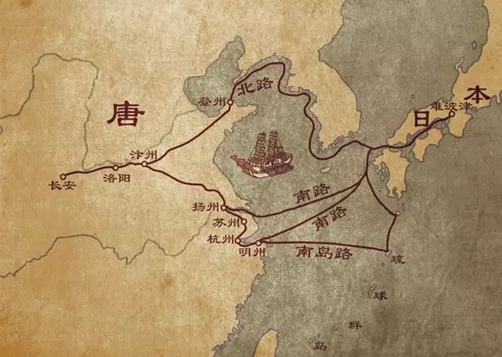
Of course, this is a relatively crude use case; more often than not, certain words branch out new meanings for more positive reasons. Advances in technology and cultural diversity will both expand the denotation of certain words. For example, tea before and after the invention of stir-frying tea leaves in ancient China had completely different forms; the old tea-making method declined in China proper, but when it was spread to Japan by envoys to Tang China, “matcha” developed. So does matcha count as green tea? It seems that it should, but in fact, if you say “I drink the green tea.” in a Chinese-style teahouse, you will not be served a cup of matcha.
Also, if you drink green tea in a fast-food restaurant rather than a teahouse, what you get will very likely be something entirely different, such as “Kangshifu green tea” — a consumer product from the modern beverage industry.

So ordinary language is always full of ambiguities. This is not a flaw of language, but because language must leave room for the expansion of the lifeworld. As technology and culture become richer, the meanings and uses of various words will change accordingly. A more ambiguous concept can be compatible with a wider range of living environments; only when the living environment remains fixed and unchanged can all words possibly achieve a high degree of precision.
Logical language and ordinary language are like two forms of life. The former is highly dependent on a specific environment and adapts best in a stable environment, but once the environment changes rapidly or abruptly, it may be on the verge of extinction; the latter has more redundancy in its capacities, but adapts more easily to environmental change. For example, giant pandas are especially good at eating bamboo, so they live very well in an environment full of bamboo forests; but once the ecological environment changes abruptly, they are on the verge of extinction. If the only plant in the environment were bamboo, then humans might not survive as well as pandas; on the grassland, humans are no match for tigers; in the desert, humans are no match for camels… but humans can live in bamboo forests, grasslands, and deserts all at the same time.
We all know that, in Darwinian evolution, evolution has no direction, and there is no absolute superiority or inferiority between different species. But if we regard organisms and their environment as a whole, then we can still make some subjective evaluations: some forms of life are developing together with their environment, becoming more and more rich and colorful, and this kind of ecology is better. And if the environment remains unchanged and life also stops changing, achieving a precise fit with the environment down to the last detail, then this ecology is actually bad.
In order to make Common Knowledge evolve toward a richer and smarter direction, the principle is the same as with biological evolution — we need to maintain the diversity of the ecological environment. This world needs both grasslands and forests, both deserts and oases. Different environments need to be connected, but not too seamlessly.
Take Japan and China, for example: they are close enough that Chinese tea culture was able to spread to Japan; but they are also far enough apart that Japan was able to preserve and develop its own distinctive form of matcha. Today, we have West Lake Longjing, Huangshan Maofeng, Yunnan Pu’er, English black tea, Japanese matcha, Taiwanese milk tea, Southeast Asian teh tarik… No matter what kind of tea you like to drink, I believe you would be happy to see so many different varieties in the world.
The Common Knowledge in the world of ideas is the same. We like the image of Wukong; this image is obviously Common Knowledge for us, but its boundaries are also constantly expanding. We know that the chaos in Heaven and the journey to the West may be a mélange of folk tales from different sources, and the whole story of Journey to the West was adapted by generation after generation of storytellers and publishers. In modern times, Wukong has been continually adapted across different media and cultures.
I like Liu Xiaolingtong’s Wukong, but I also like Zhou Xingchi’s and Toriyama’s Wukong, and I even more warmly welcome Black Myth: Wukong. Life can continuously evolve and mutate. Of course, many times the result of mutation is pathological, even monstrous. If the replication of a species were always absolutely precise, then it would also lose its vitality.
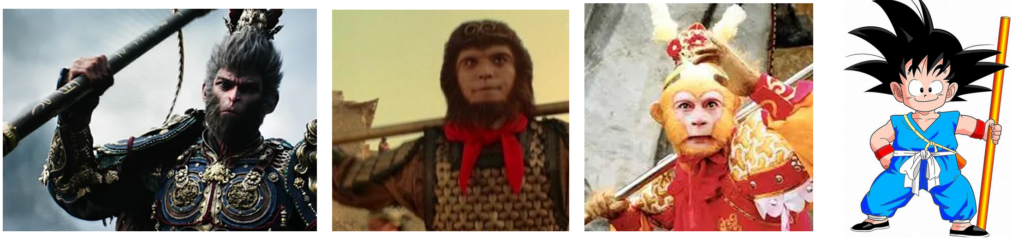
We can see that the flourishing of life requires a certain ambiguity; life needs to flow, but not to flow too smoothly; it needs replication, but not replication that is too exact.
Then we can see what form Common Knowledge takes after entering network space, this new continent.
The internet connects the world; McLuhan called it a “global village,” which is actually a frightening concept — all barriers disappear, and the whole world squeezes into one small village. Just think: if we all lived in the same village, could we still develop black tea, matcha, and milk tea all at the same time?
In the global village, “the world is flat,” and all life competes in the same territory; often, there can only be one winner in the same ecological niche.
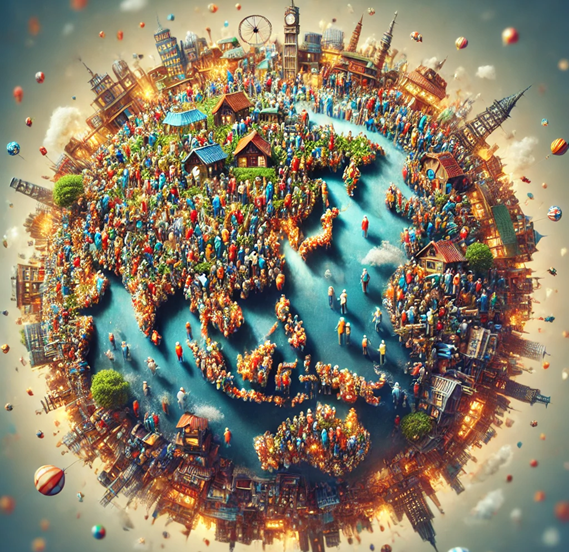
Of course, in the early days of the information age, we still felt the world becoming richer, because the species that had evolved in the old pluralistic environment could not possibly go extinct that quickly; the internet brought all kinds of cultures and ideas into collision, and naturally countless sparks were generated.
But the problem is that sparks are brief. After the dazzling collision, what remains in cyberspace? What kind of Common Knowledge survives in cyberspace, and continues to flourish and evolve?
By the era of web2, we gradually discovered that the internet always seems to favor those fleeting “sparks” and is not suited to long-term sedimentation. Netizens seem to like only “new information”; everything they do online is “refreshing,” scrolling, click next page…… When those old collisions gradually settled and the dust cleared, businesses deliberately set up antagonisms and designed sparks; in the entertainment industry, countless new boundaries seemed to take shape, partitioning culture once again into little circles. But the value of these circles lies in producing sparks and generating traffic, so they too are still destined to decay quickly.
Fundamentally speaking, in cyberspace, communication is too smooth and copying too exact. Because digital objects are too “light,” they have no weight at all, and thus can spread without obstruction, yet always fail to take root and settle down.
So, one way to govern the ecology of cyberspace is precisely to shackle ourselves, and instead increase the “weight” of digital objects.
The blockchain invented by Satoshi Nakamoto was from the very beginning a kind of “self-shackling”: originally a ledger could be generated and refreshed in less than half a watt-hour of electricity and in under a second, but now, through PoW, it has to consume vast amounts of computing power and takes about 10 minutes before it can finally be generated. But this kind of “weight gain” is important: it endows certain data with publicness and eternity, establishing in the misty and unstable digital world a solid continent on which something can take root.
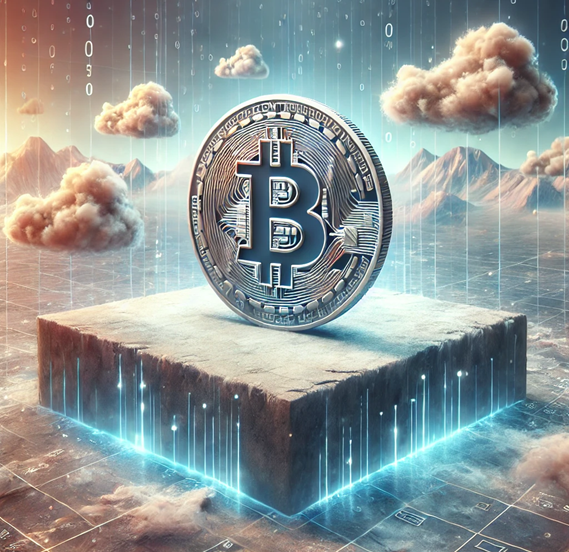
But Bitcoin only provides the simplest of ledgers, far from enough to bear the richness of Common Knowledge. So I am very glad to see the exploration of CKB—it has not given up the weight of PoW, while at the same time adding a new weight to knowledge. CKB itself is almost a unit of weight; the design of CKB means that if you want to “update” a new piece of information here, you have to pay a relatively high cost. You cannot, as in web2 spaces, casually churn out one self-media article after another, or mass-produce all kinds of influencer personas on an assembly line. Writing an article on CKB requires investment; generating an image costs even more; making a short video would probably be prohibitively expensive. But this cost is beneficial—the most precious knowledge will survive, and the producers of knowledge will reap greater returns.
In addition, I hope that smart contracts can provide the possibility of symbiosis and mutation for life. For example, the Common Knowledge protocol should be able to combine with the Creative Commons license, so that creators can share their works without reservation while also effectively obtaining benefits.
Of course, the above is still far from enough; the digital world also needs richer terrain and environments, and on this point I place my hopes on DAO.
Finally, I want to say that we should also treat different forms of life with respect. There are swans and there are toads in this world; there are butterflies and there are bedbugs. From the standpoint of a particular species, I may dislike or even oppose another species, but from the perspective of the ecosystem as a whole, we can carry out certain targeted cleanups, but there is no need to make the environment too clean. Some people think the flood of shallow MEMEs is terribly annoying, while others believe that people who do blockchain projects writing poetry or talking philosophy is meaningless. But from the perspective of building an ecological environment, we should be as inclusive as possible of more forms.
Translated from the Chinese original with AI assistance. The original text is authoritative.