
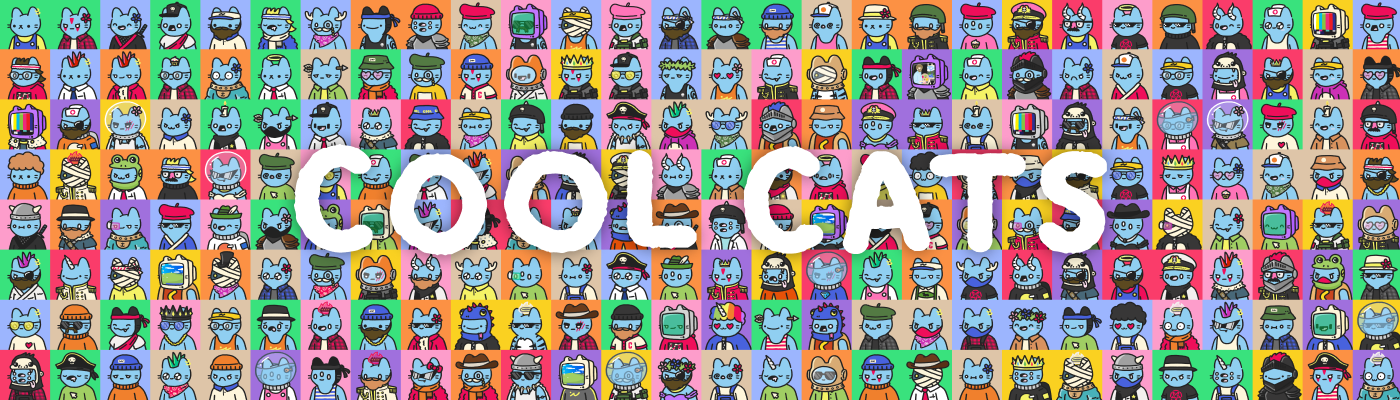
Yesterday, the floor price of the Bored Ape NFT broke through 100 Ether (ETH), and now it is 106.9 (one Ether is currently worth more than 2,500 U.S. dollars), which means a single Bored Ape is worth roughly one to two million yuan.
“Floor price” refers to the cheapest ape you can buy right now if you rush in and make the purchase immediately. Because every ape looks different, and the rarity of their various attributes also differs, many people choose to buy at a higher price point; for example, Justin Bieber today spent 500 ETH to buy one.
The full name of Bored Ape is “Bored Ape Yacht Club” (Bored Ape Yacht Club, abbreviated BAYC). I also mentioned this in my first article discussing NFTs; it is one of the two projects you cannot avoid when trying to understand NFTs. One is CryptoPunks, which first established the basic pattern, and the other is Bored Ape, which carried this pattern forward and explicitly developed it into a “club” model.
Aside from some one-off NFTs released by artists, the most influential NFT series today all follow this path: first, the total supply is generally 10,000; then various attributes such as eyes, mouths, hats, clothes, backgrounds, and so on are drawn separately; then an algorithm arranges and combines them to generate these 10,000 images. Each image is different, but the various attributes are not evenly distributed: some are scarce, some are common. This algorithmic pattern was inherited from CryptoPunks.
As for how they are used, these NFTs are usually suitable as avatars displayed on Twitter. In addition, NFT holders often set up channels in Discord or establish similar “club” structures in other ways. Once the first batch of NFTs has gained a foothold, secondary NFTs may be issued to expand the community. For example, Bored Ape released 20,000 Mutant Apes (MAYC): the release method was to “airdrop” a vial of mutant serum to all Bored Ape holders; by using that serum directly, one could obtain a Mutant Ape, while the remaining 10,000 Mutant Apes were sold through public auctions and other means. CryptoPunks did something similar even earlier, issuing 20,000 Meebits (3D block people), which could be claimed for free by CryptoPunks holders, with the rest put on the market.
These kinds of NFTs are sometimes called “avatar NFTs,” but as I said in my first article on NFTs, their essence is actually power, “identity,” and “club membership.”
The aesthetics of the avatar are of course important, but even more important is using the avatar to display identity and gain recognition from a specific community. Only this can explain why these avatars are so sought after. Some avatars are drawn quite well, but because they are obviously knockoffs of some more popular project, they are destined to be unpopular. Displaying a knockoff avatar on a social network is like wearing counterfeit branded clothing on the social stage; even if it is more durable or even looks better, those who know will still look down on it.
Usually, luxury goods are very particular about both materials and appearance, but if you specifically analyze luxury goods from the angles of materials, appearance, cost, function, and so on, then you certainly cannot understand them.
In cyberspace, NFTs can realize the main functions of luxury goods—taste, flaunting wealth, gift-giving, displaying status, and so on. More importantly, they can provide a strict and definite threshold for entry. In a social dance, a person wearing knockoff goods may get snubbed, but at least he may still find a way to slip through the door. But in a well-designed Web3.0 service, it is easy to establish an effective access mechanism stipulating that only people holding a specific NFT may enter, while others find it hard to fake. An NFT is roughly a combination of luxury good and membership card, providing both outward identity decoration and rigorous identity verification.
Here we come to the so-called Web3.0. What is Web3.0? This is a concept that has become popular recently, though of course there has also been a great deal of controversy and mockery. We know that Web1.0 refers to the era when the World Wide Web had just begun, when information was published in a top-down form, static webpages were the main format, and Yahoo was representative; Web2.0 refers to the era of social media, characterized by “user-generated content,” with dynamic webpages as the main format, and Twitter and Facebook as representatives. What is Web3.0? At present, opinions are still divided, but there is a consensus among its supporters that blockchain technology must be added. For now, Web3.0 is represented by the NFT ecosystem; when logging into websites, one usually needs to use wallet plugins such as MetaMask to provide identity verification.
So what is the significance of Web3.0? Some time ago, I saw a critic’s view, and @木遥 provided a translation excerpt on Weibo. The general idea is that the so-called Web3.0 can never escape elitism from beginning to end and cannot attract the masses. The redundant computation and high fees necessarily required by blockchain technology mean that these current playstyles will never be suitable for popularization, and the masses also have no need for technical functions such as decentralized identity verification. He concluded: “If web3 cannot find a way to break through the membrane that stands between nerds and ordinary people, then in the end it will very likely become a self-congratulatory land grab.”
After reading that, my feeling was: “There’s still such a good thing?” In my previous articles as well, I have argued that NFTs should be elitist; this is both unavoidable and, at the same time, a good thing.
First, we need to make clear that neither Web2 nor Web3 is a matter of one replacing the other from below. Although social media has risen, the traditional top-down information-publishing platforms centered on static webpages have not disappeared, and these platforms will interact with social media. The fact that Web3 is elitist does not mean that there is nowhere for the masses to go. Existing social media and mass playstyles will not be replaced; rather, a new layer is being erected on top of the existing hierarchy.
As we have experienced, Web2 is not always a beautiful thing. Especially in recent years, the social environment of online platforms has become increasingly bad. Whether at home or abroad, the overall trend is the same: anti-intellectualization, extremization; every small circle that netizens build in social space is either frenzied adoration or frantic attack, with fighting and mutual abuse everywhere, demanding only that people pick sides and never asking for logic… All netizens who have lived through Web1 and the early days of Web2 will miss the online environment of that time, and this is not merely an illusion caused by beautified memories. Why has this happened?
One direct and simple reason is that the threshold for getting online has fallen. In the early days, having a computer, or at least being able to have regular access to one, was already a very high threshold. Generally speaking, people who went online frequently could have a relatively substantial educational background and a relatively decent living environment, and they also had to set aside time to sit in front of a computer and type. But now, going online has become both widespread and easy, and fragmented as well; there is no need at all for the “leisured class” to set aside leisure time to type, because anyone can connect to the network at any time.
Charts like the one below are very popular: from 2000 to 2020, the proportion of netizens with junior high school education or below rose from 6.4% to 59.6%, while those with a bachelor’s degree or above fell from 41.1% to 9.3%.
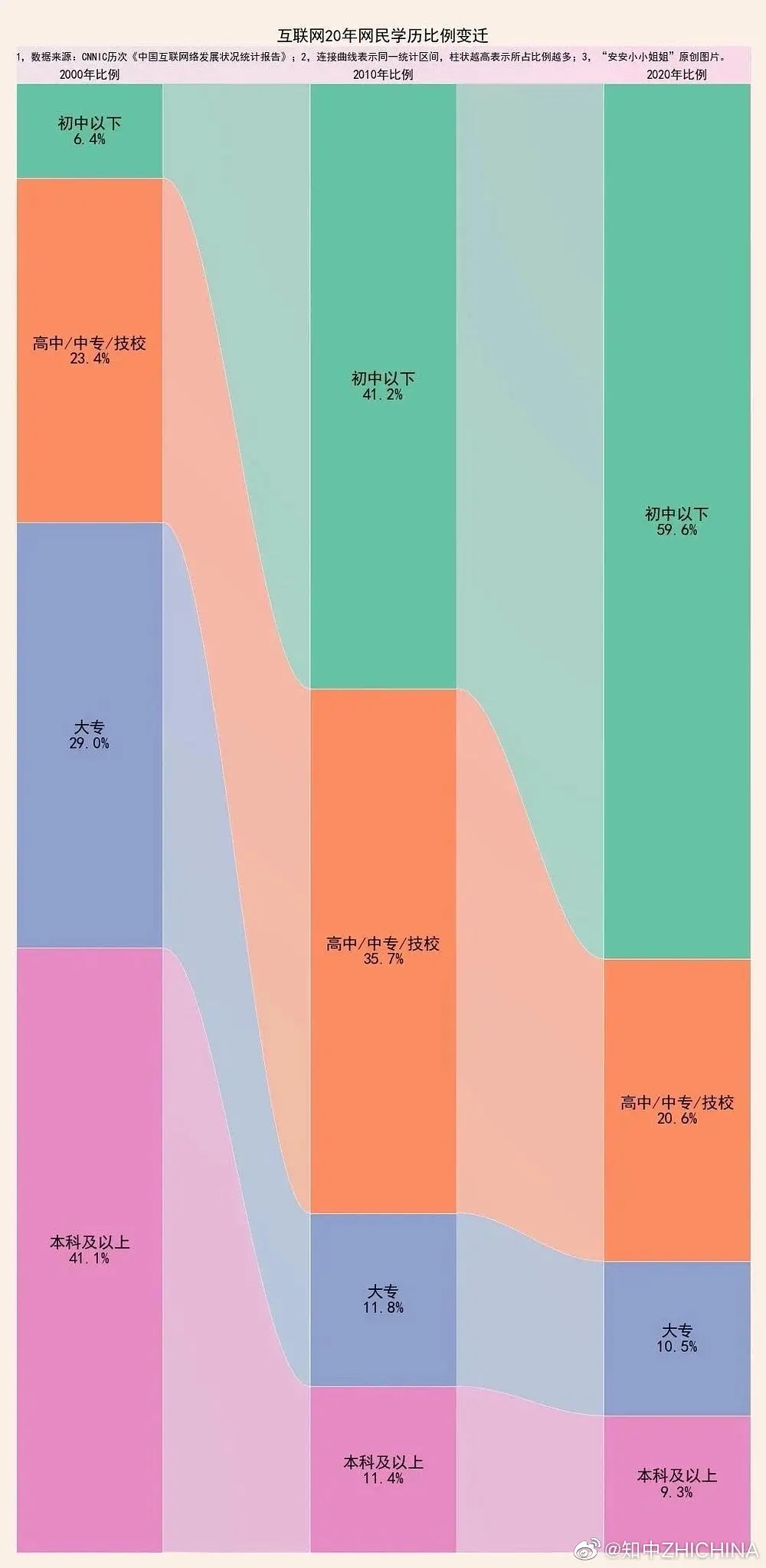
Of course, this is not a bad thing. It is the inevitable result of the spread of Internet technology. In fact, compared with the educational distribution of the entire population, people with lower educational attainment among netizens are still relatively fewer.
The Internet gives everyone a chance to join in, and that is a good thing. I even think that those clashes, factional alignments, tearing apart, and abusive outbursts are actually not too bad either; after all, a dull and empty life needs some seasoning and an outlet. But the problem is that while the Internet creates new spaces, the old spaces of communication are being shaken and dismantled. Because in the face of the flattening force of social media, small-circle communities find it very difficult to establish an effective threshold and carry out so-called “land-grab self-high.”
Of course, a few friends setting up a private chat group or private forum and amusing themselves inside it is basically still doable. But the problem is that, many times, we do not want the circle to be too closed off; rather, we want relatively open interaction. On the one hand, we need to output information to the outside of the circle, and on the other hand, we need to attract newcomers from outside the circle to join.
Establishing an identity threshold in such a relatively open social field was, in fact, the model of the early Weibo “Big V.” Weibo officially vetted certain celebrity figures and gave them a visible identity marker. This identity marker was indeed useful, and this model also helped Sina Weibo stand out among the various Weibo platforms of that time and have the last laugh.
But this kind of identity verification also has fatal flaws. First of all, it is of course centralized: a single order from Sina or some higher authority can determine life and death, and almost all of Sina’s first generation of Big Vs had their accounts canceled. Second, this kind of marker leaves little room for free control; the owner has great difficulty choosing, switching, and transferring it. Finally, such a marker can function neither as a luxury good nor as a membership card.
Now, Twitter has added NFT avatar functionality to Blue members. In my view, this kind of identity-verification marker is much stronger than things like Gold V verification. Twitter does not need to scrutinize someone’s identity in real life; Twitter scrutinizes whether someone holds a certain NFT. If I want to use a certain NFT as my avatar and I do indeed own that NFT, then Twitter will add a special verification mark to display the fact that I own that NFT.
NFT identity is of course not limited to the Twitter platform. I might also use the same identity marker to move around Discord, Telegram, and other small-circle social platforms, or any blockchain social platform that may appear in the future. Or I might act within NFT-specific platforms like the Bored Ape bathroom, or within the metaverse games developed by the corresponding NFT projects.
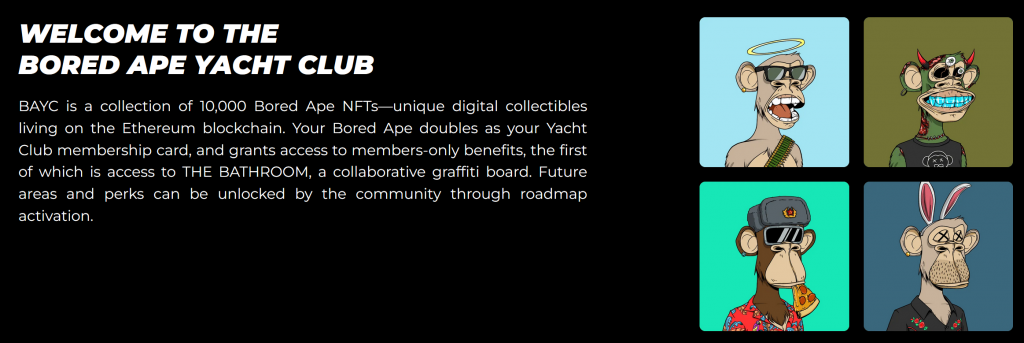
Of course, as identity authentication, NFT avatars also have a “downside,” namely that they can be sold for money. For example, I was certified by Sina as a Doctor of Philosophy; this identity marker obviously cannot be freely transferred, because the person who takes away this marker may well not be a Doctor of Philosophy. So the identity that an NFT marker can authenticate is mainly still “financial capacity” — at the very least, you can afford such an expensive NFT, or else you can afford to keep such an expensive thing from being cashed out.
Of course, in the future this situation may not be impossible to change; communities can, through secondary authentication, gift or rent NFTs to certain specific people.
But in any case, financial-capacity authentication is the basic function of NFT avatars, so we will see a Matthew effect in which the expensive become ever more expensive. The pricier an NFT is, the more attractive it becomes, because the stronger the “power of proof” it can provide. At the same time, the stronger the attraction, the greater the power of the community, and then the stronger the attraction becomes. Of course, because of the finiteness of the total supply, the NFT market will not produce a situation in which one player dominates everything; instead, up-and-coming challengers will have more opportunities to occupy more niche segments.
For example, suppose you hear of a club whose membership card has a floor price of 100 yuan; then you might guess it’s just the supermarket next door to your house. But if this mysterious club has a floor price of 2 million yuan for its membership card, and you have already heard that a number of very famous celebrities have joined it, then you may start to think the club is somewhat interesting. And what if the threshold for joining is hundreds of millions? You might feel you have discovered the legendary Freemasons. Regardless of the club’s specific activities, merely by looking at the threshold for joining, one can tell which club is more valuable.
Of course, you may fear that this is a scam: you say that Jay Chou, Justin Bieber, Curry, James, and a big crowd of other celebrities have all bought Bored Apes — are you not fooling me? But the authentication mechanism of Web3.0 can make this public information easier to verify. For example, their social media accounts will post the corresponding NFT images, or even simply use them as avatars; the purchase and transfer records of these NFTs are also publicly searchable. We can see that the apes they hold are all different, and we can also see that, including the apes held by celebrities, the total number is forever only 10,000.
What this club does is actually not important, because the club’s activities are themselves discussed and decided by all the members. The project’s founders are usually more proactive in planning and have more of a voice, but the community does not necessarily listen to the founders; the founders have no right to take back or increase the initial NFTs — they can only, like anyone else, develop derivative NFTs. Other members can also launch derivative projects or do secondary development according to their own ideas. So the club’s activities have infinite possibilities, and what plays the decisive role is the strength of all participants. This too will form a Matthew effect — the stronger the participants are, the more they can attract participants who are even stronger.
Top-tier universities often offer so-called “boss classes,” with exorbitant tuition. Many bosses come but do not study seriously; they are just there for the networking. The point of a “boss class” is, on the one hand, to establish a social threshold and, on the other, to advertise one’s intellectual taste; the biggest gain for the bosses is their “classmates.” Similarly, the purpose of buying a Bored Ape is not to doodle in the bathroom, but to obtain a channel for entering a certain social circle, or for raising one’s status within an existing social circle.
The “intangible” has never been a defect of a club. The reasons for being suspicious of or resistant to “virtual currency” no longer apply here, so many celebrities may not be able to accept cryptocurrencies, but they have all quickly accepted NFTs. Only those who think that if they join a club it must be because they are there for the free oil and rice, because they fundamentally cannot understand the meaning of social thresholds, are also unable to see the potential of NFTs.
Decentralization is not flattening; on the contrary, it is often centralization that leads to flattening. The advantage of decentralization is precisely that it allows organizational layers formed from the bottom up to become richer.
From life to humanity, all have constantly used various “thresholds” to block disorderlyization. For example, animals whose every epidermal cell can breathe are often less complex than animals that use only a specialized organ for breathing. If the flow of information were to diffuse wantonly and move without obstruction, the result would be the disordering of the system. Of course, a wall that is completely sealed off and isolated is also catastrophic. So we need city walls, and we also need gates, and the gates need thresholds. Openness and blockage complement each other. In this sense, from Web1 to Web2 to Web3, it is like a process of “thesis–antithesis–synthesis”; Web3 is not a progression of Web2, but rather a kind of seemingly retrograde “synthesis.”
Translated from the Chinese original with AI assistance. The original text is authoritative.