
This article was commissioned by China Business Journal; see http://www.cb.com.cn/index/show/zl/cv/cv13457191859 or https://weibo.com/ttarticle/p/show?id=2309404735824251191808. It was published with slight revisions here, and I am posting the original text. Because of space constraints and because some things cannot be said too directly, it is still better to read it together with my earlier On VR IV, The Metaverse Is Hyperreality, and related essays.
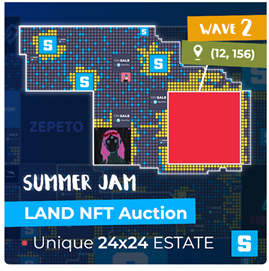
For some reason, a couple of days ago the domestic media once again recycled the news about metaverse property speculation, reporting that “in December 2021, a virtual plot of land on the metaverse platform Sandbox was sold for about 32 million yuan.” I looked up the news from last December and found that at the time there was a report saying “a virtual plot of land on Sandbox was sold for 4.3 million US dollars (about 27.4 million yuan).” I did not carefully verify whether the two reports were talking about the same plot of land—because in fact land on Sandbox is traded in cryptocurrencies (SAND or ETH), and these cryptocurrencies fluctuate considerably, so converting them into US dollars or yuan at different times may yield different figures.
In any case, the metaverse “real estate” represented by the Sandbox, and by similar projects, has indeed remained active over the past few months, with traditional brands such as Nike, Adidas, PwC, and Gucci all buying land and entering the field.
Why Does Virtual Real Estate Have Value?
Quantitatively, it is hard to assess whether today’s metaverse real estate is a bubble or has boundless potential, but qualitatively speaking, metaverse real estate does indeed have value—on this point, I suspect there is no longer much room for debate. Even so, let me say a few words about it.
In fact, the metaphor of “land” appeared already in the early days of internet development. We use “address” and “domain name” to locate a website, and many online social platforms are named with the word “space.” For example, there was MSN Space in the early days, and in China there was QQ Space (Qzone).
QQ Space, which came out in 2006, already foreshadowed the logic of today’s metaverse real estate and NFT trading. Every QQ user could have a personal “space” for self-presentation, including posting all kinds of articles and images, as well as using all sorts of free or paid decorative items. QQ users who liked dressing up or were keen on showing off often willingly spent money to buy exquisite and rare decorations to beautify their space and QQ Show. Later, some people also used QQ Space for marketing and selling goods, and they too were happy to spend money decorating their own space.
What is called metaverse real estate today mainly serves the same purpose: it provides a display space, used by some for socializing and showing off, by others for advertising and selling goods. The difference between the Sandbox and QQ Space is basically only two things. The first is openness: with blockchain technology, the ownership of space and the trading of various decorations become much more open, and users can freely trade with one another at any time, not limited to within a single company or country, but open to internet users and institutions all over the world (that use cryptocurrency). The second is richness: with VR technology, the display space provided in the Sandbox is no longer a flat webpage, but a three-dimensional virtual reality.
Whether such spaces are used for personal showing off or for commercial advertising, these kinds of demand all have a certain tendency toward “self-realization.” That is to say, when no one is paying attention, the space is worth nothing; but the more it is hyped up and the more attention it receives, the more its value may rise accordingly.
How Big Is Metaverse Land?
On the internet, “space” is a metaphor—or rather, it restores a certain ancient meaning of space (such as the Greek topos), referring to a place occupied by things. The “emptiness” of space implies “degrees of freedom”; the owner of space has room for autonomous activity within it.
From URLs and domain names to Qzone, MSN Space, and then to the Sandbox and Decentraland, “cyberspace” seems to have undergone a change from one dimension to two and then to three. But in any case, cyberspace has no direct relationship with physical space. Three dimensions are the three degrees of freedom in physical space, whereas in cyberspace, “degrees of freedom” cannot be understood as three-dimensional coordinates, and cyberspace is not measured in meters.
So the question arises: what, exactly, is metaverse real estate measured by? How big, really, is that plot of land sold for tens of millions in the report?
In the Sandbox, the smallest unit of land is a Land; one Land is a 1×1 plot, identified by coordinates, with (0,0) at the center, such as (-10,123) or (55,-149). Sometimes adjacent plots are sold as a package, such as 1×2, 3×3, 24×24, and so on.
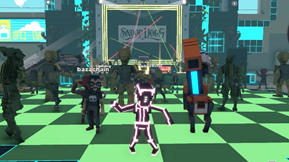
So how big is a 1×1 plot exactly? Still taking the Sandbox as an example, the answer is “288 voxels by 288 voxels,” a space only 288 cubic pixels long and wide. Of course, this is not the final display resolution; avatars, materials, and textures are a bit more refined, but on the whole it is a pixelated, jagged world. From the standpoint of visual resolution, rather than comparing a 1×1 plot to an actual apartment, it is better to say that it is a place smaller than a soapbox. The current development of metaverse real estate is like conducting a ritual in the shell of a snail: it is, in fact, interior decoration carried out in a relatively cramped environment.
Why Move to the Metaverse?
At least for now, what attracts people to settle in metaverse real estate is not the exquisitely detailed effects of virtual reality; on the contrary, this place looks cramped and crude. So why are people from all over the world flocking here?
Come to think of it, why do people gather in cities in the first place? Nature is rich and colorful, with countless species and wide-open vistas. Why did human beings build cities and shut themselves inside walls? Why are so many people willing to give up rural homesteads with their own gates and courtyards and vast expanses of farmland, just to squeeze into the concrete forest of the city?
Simplification of visual experience, or rather “squaring,” has also been a trend since antiquity. There are almost no “squares” in nature; squares are usually man-made. Farmers divide land into squares in order to parcel it out to one another, and city dwellers build houses into squares in order to make use of space. The more civilized and modern a place is, the more squares there are. The reason is simple: squares are easier to measure, divide, and manage.
Of course, we can expect that the current jagged, grid-like visual appearance of the metaverse is only temporary, and that with the development of VR technology we will soon be able to enter virtual reality worlds that are difficult to distinguish from the real world. But I feel that if one merely stops at “simulation,” then the metaverse actually has little revolutionary significance.
Just as people flock to cities not because urban living conditions are hard to distinguish from those in the countryside, but because cities bring more possibilities, more “degrees of freedom,” the essence of the city is sociality: by bringing people together, it accelerates interaction and cooperation among them. Struggling in the city makes it easier to encounter more friends and ideas, and creates more opportunities and room for choice. In order to gain autonomy in social and work life, from thousands of years ago until today, this has been the main meaning of urban life. Those who move to the city are willing to sacrifice the openness of their physical field of vision for the broadened horizons of thought, and willing to endure the cramped feeling of living space in exchange for the openness of social space.
Seen this way, the pixel aesthetic of the metaverse may not disappear quickly as technology advances. In fact, if it is just one person playing a single-player game, then today’s VR technology can already deliver an 8K field of view, which is basically very realistic. But the problem is that the metaverse is not a single-player game; it is a new space of gathering. Technology and bandwidth will keep improving, but the number of metaverse participants will also keep increasing, and the amount of interactive activity in the metaverse will keep increasing as well. The growth of bandwidth may not necessarily outpace the growth in demand. If so, then in order to save bandwidth and communicate more efficiently, the “image quality” of the metaverse may not improve easily.
Even if the image quality of the metaverse does continue to improve, its direction may not be toward becoming ever more like physical space, just as the improvement of urban space is not a movement toward pastoral scenery. For example, why should the metaverse have “houses” at all? Houses in the real world are for shelter from wind and rain, but there is no wind or rain in the metaverse, so what use are houses? The effect of concealing privacy can be achieved in any number of ways. Why should the metaverse have streets? Since anyone can teleport in virtual space, streets and roads are utterly meaningless…
At present, mainstream metaverse real estate platforms such as the Sandbox and Decentraland are still laid out in many places according to traditional spatial concepts. I suspect that in the not-too-distant future, the space of the metaverse will form its own logic—no longer taking the city, the countryside, or nature itself as its standard.
Translated from the Chinese original with AI assistance. The original text is authoritative.