
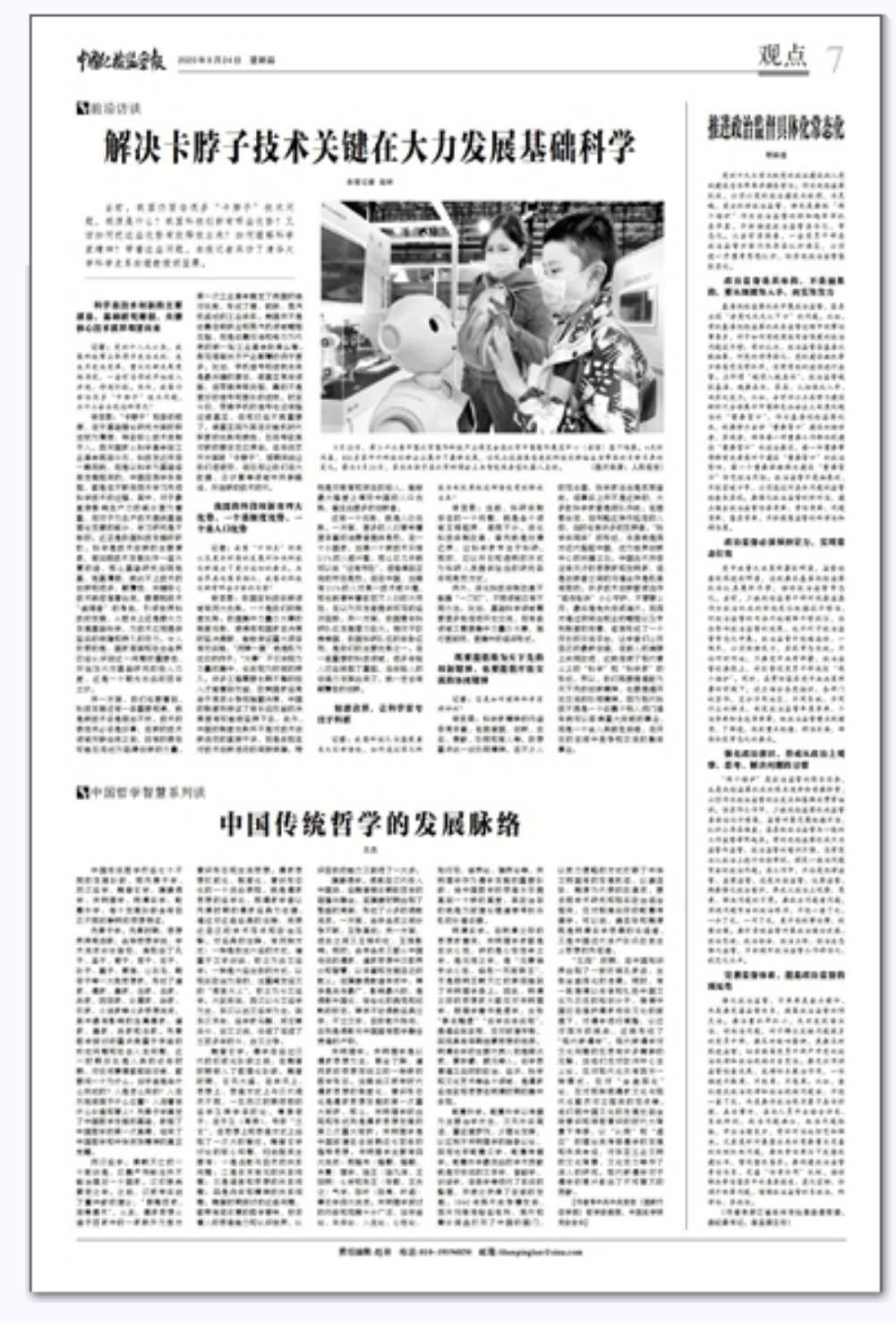
The published version can be found here: http://www.jjjcb.cn/content/2020-09/24/content_95300.htm
There are quite a lot of changes in the published version of my wording, but these changes were also reviewed and approved by me, so I suppose this counts as a necessary compromise. Of course I have my own more independent thoughts, but when dealing with official media, I am also willing to seek common ground while reserving differences, and take the opportunity to pass along a couple of things I want to say.
It is quite obvious that the interviewer wanted to locate the cause of the “chokepoint” problem in the weakness of “basic science.” I agree with this point, but I think basic science cannot be “grasped” directly; it can only be slowly nurtured and gradually accumulated. Although basic science is the source of technology, that source is too distant. Distant water cannot put out a nearby fire; if one tries to promote it by force, the result may well be the opposite of what was intended.
Since modern times, China’s learning from Western science and technology has been overshadowed by the urgent mindset of “saving the nation and preserving survival,” which is why we have placed greater emphasis on the West’s “superior skills” and not enough on basic science and the scientific spirit. From Professor Wu to myself, we have always emphasized tracing things back to their source, developing basic science, and establishing the scientific spirit. But what we are emphasizing is precisely this long-term accumulation that resists quick success and instant benefits. This problem of accumulation cannot be made up for by yet another urgent campaign under the pressure of “survival.”
So when I answered the questions, I was extremely careful, trying by every means to stress that the promotion of basic science is a “century-long plan.” When it was printed in the newspaper, it was heavily edited, but I still insisted on keeping the four characters “century-long plan.”
Below is my original written interview draft:
Question 1: Since the Eighteenth National Congress of the Communist Party of China, we have attached great importance to scientific and technological innovation, and insisted on taking innovation as the primary driving force leading development. Through the joint efforts of society as a whole, China’s science and technology事业 have achieved historic accomplishments and undergone historic transformations. Major innovative achievements have emerged in abundance; some frontier fields have begun to enter the phase of running alongside others or leading the way; and our scientific and technological strength is moving from quantitative accumulation to qualitative leap, from breakthroughs at isolated points to enhanced systemic capability. However, China still faces many “chokepoint” technological problems. Why has this situation arisen? Where does the root lie?
Answer: On the one hand, as the General Secretary has said, our accumulation in basic theoretical research is relatively weak, which has resulted in core technologies being controlled by others; this is the root cause of the “chokepoint” phenomenon. From the Scientific Revolution to the Industrial Revolution and on to today, Western technology did not develop overnight, but grew gradually on the basis of science. From the introduction of Western learning into China to reform and opening up, Chinese people have continuously learned advanced science and technology from the West. But because our learning of science and technology was first and foremost for the purpose of saving the nation and preserving survival, it was inevitably a bit more “utilitarian.” We placed greater emphasis on those parts that most directly affect productive forces, while our learning and research in those areas that provide foundational theoretical support for production technology were still relatively lagging. Therefore, if we are to shed the role of “follower” and lead the development of world science and technology, we still need to vigorously develop basic science, providing a solid guarantee and lasting impetus for technological application.
Of course, as the saying goes, it takes a hundred years to nurture a person of talent; progress in basic science must begin with education, and cannot be rushed. Therefore, our current push to advance basic science research and education is not meant to solve the immediate predicament. The development of basic science cannot be achieved overnight; it requires a long-term perspective. One could say that the chokepoint phenomenon has stirred our reflection, leading us to think of patching the fold after the sheep have been lost, and thus to make plans for the century-long grand strategy of the great rejuvenation of the Chinese nation.
While deficiencies in basic science have not yet been made up, we need not be pessimistic. We can also strive to turn “chokepoints” into the impetus for our “finding another route,” thereby promoting technological innovation.
The “chokepoint” phenomenon is also a law of technological development itself. Technology does not develop out of thin air; it always has its continuity. However much one explains the principles of an airplane to a primitive person, he still will not be able to build one. This is especially true in manufacturing processes, where there are many things that are hard to put into words and require continuous accumulation rather than an overnight leap. So in the development of a particular technology, there is only a “first-mover advantage,” no “latecomer advantage.” If latecomers want to develop technology along the same route as those who came first, they are often one step behind and then behind at every step, because the first movers can not only continue the intrinsic inertia of technological development, but also gain external benefits by seizing the market, using market incentives to promote further research and development in an ongoing virtuous cycle. Latecomers, on the one hand, lack sufficient accumulated inertia in the technology itself; on the other hand, their external impetus is also insufficient because the market has already been seized. So of course it is difficult for them to keep up.
So the point is that, no matter how hard we try, in most technological fields where Western countries have already established a leading edge, it is still difficult for us to shake their dominant position. We need to face this issue squarely. Precisely because the intrinsic inertia of technology and market incentives will inevitably produce a Matthew effect in technological development, making the strong ever stronger, we need all the more to actively promote technological innovation.
We need to work hard to catch up in lagging areas, but we need even more to “find another route.” This is because technology has another important law of development: new technologies are always emerging in endless succession. The inertia of technology is not necessarily a good thing; once new technological fields have been opened up, old inertia may instead become a force that hinders innovation.
The rise of American technology and its overtaking of Britain was itself the result of finding another route. The First Industrial Revolution laid the foundation for Britain’s absolute advantage, forming an industrial system built on coal, steel, and the steam engine. But the United States did not rise and overtake by relying on steel and steam engines; rather, it took the lead in the new round of industrial revolution represented by oil and electricity. In addition, the United States initially lacked historical accumulation, and thus lacked skilled workers; it had abundant labor, but in fine manufacturing it was far behind Europe. Then the United States developed the model of assembly-line production in a big way, no longer relying on skilled workers, and instead making workers more foolproof, opening up a new mode of production represented by Ford automobiles.
There are even more examples at the micro level. For instance, signal strength and battery life on mobile phones were originally the most crucial requirements; Nokia dominated the field for years, while Apple suddenly emerged. What Apple relied on was not better signal or longer battery life; on the contrary, it was initially mocked for its terrible antenna and extremely short battery life. Even today, the signal on Apple phones has still not surpassed Nokia’s, but by now that is no longer important. Nokia, on the other hand, because of the advantages and inertia it had accumulated in the feature-phone era, reacted too slowly to the new demands.
We can see that the fact that first movers “choke” latecomers is caused by the inherent laws of technological development. We should face this phenomenon squarely, but we must not become too entangled in it. If, back then, the United States had resolved to cultivate as many highly capable skilled workers as Britain had, then the assembly-line production model would in fact have been harder to promote. If Jobs had gone to every length to catch up with Nokia in antenna performance, the epoch-making iPhone would never have come into being.
Being choked in the field of traditional chips is certainly very passive for us in the short term, but perhaps it will instead reduce our burden in the future development of cloud computing, quantum computing, and other fields, allowing us ultimately to find another route and open a new technological era.
Question 2: The world today is undergoing changes unseen in a century. The domestic and international environment facing China’s development has undergone profound and complex changes, and China’s development during the Fourteenth Five-Year Plan period and beyond has placed even more urgent requirements on accelerating scientific and technological innovation. Compared with other countries in the world, what advantages does China have in scientific and technological innovation?
China’s advantages in scientific and technological innovation are, first of all, its population advantage. On the one hand, if high-quality education is made universal, then a larger population means more innovative talent. On the other hand, in an open market environment, a larger population means a richer pool of consumers providing incentives.
In a small country, if only 0.1 percent of people are interested in a new technology, then it can almost be said to have “no market” and it will be difficult to obtain positive market incentives. But in China, if 0.1 percent of people are interested in a certain technology, that still means a market of several million people, enough to provide developers with considerable economic returns and create incentives. China’s niche market is equivalent to the mass market of many countries.
And as we know, when emerging technologies are first introduced, they usually cannot immediately become mass-market products. Electric motors at first were like toys; automobiles at first were used only for racing games. In the process of moving from niche to mass adoption, there must be a process of exploration and trial and error. In the Chinese market, new products can leave the laboratory and enter the market at a relatively immature stage, receiving diverse user feedback earlier and thereby encouraging further research and development.
In addition, as we mentioned in the previous question, the so-called “latecomer advantage” in technological development is fundamentally reflected in “having no burden.” For example, to develop mobile payments overseas, the first environment encountered is the enormous popularity of credit cards. The prevalence of credit cards was originally a Western advantage, but this very prevalence slowed down, and even suppressed, the spread of mobile payments. Even if mobile payments embody many new advantages, they may be intentionally or unintentionally overlooked. The banking industry, which has already invested heavily in the credit-card system and card-swipe infrastructure, also has little incentive to develop mobile payments. So, those who lagged behind in the credit-card field have instead become leaders in mobile payments in China.
In addition, China of course has its institutional advantages. These institutional advantages are not reflected in direct interference with technological innovation activities—which would be futile—but should instead be reflected in indirect safeguards for technological innovation. In particular, they are reflected in support for education and people’s livelihood. Only universal and equal education can maximize China’s population advantage and give rise to more innovators. And only by ensuring that the broad masses of people have enough to eat and wear can they actively consume and promote the commercialization of new technologies. In the past, we mostly directed the so-called demographic dividend toward the sphere of manual laborers, and the demographic dividend in this sense will gradually be exhausted. But when we no longer regard the population only as producers, but at the same time as innovators and consumers, then this will still remain China’s advantage.
In recent years, universities and graduate programs have continued to expand enrollment, and China’s doctoral students have already surpassed those of the United States to become number one in the world. More and more young people can receive specialized training and ultimately obtain doctoral degrees. On the one hand, this certainly carries the danger of doctoral overproduction, with doctoral degrees becoming ever more watered down; on the other hand, it also ensures a huge base of innovative talent. The growing number of university students and doctoral students may not all enter specialized research institutions; even if they are distributed across all walks of life, they may still spread a research attitude and innovative spirit. For young scholars personally, the increase in graduate students means greater pressure, but for the nation’s scientific and technological development, intensified competition will also help promote innovation.
Now, many of these newly trained doctoral students are still in their young and middle-aged years, the period richest in possibility. So we need to work hard to better unleash the immense innovative potential contained in our young and steadily growing scientific and technological workforce. This is the theme of the next question.
Question 3: China’s scientific and technological workforce contains enormous innovative potential. How can this potential be effectively released by deepening reform of the science and technology system?
Answer: Institutional reform first of all means clear division of labor. In innovative activity, including theoretical research, applied research, and commercial development, and so on, it is difficult for one person to take charge of everything. Every innovator plays a role in their own field.
In terms of fields, academia, business, and government each perform their proper functions; in terms of identity, scientists, engineers, managers, and entrepreneurs also each perform their proper functions. A sound system should ensure both the independence and the coordination of every link.
At present, many problems in the research system arise from different fields overstepping one another and being mixed together without distinction. For example, a scientist may have to spend a great deal of energy filling out forms and cultivating connections, but these activities are not intrinsic requirements of scientific research. Much repetitive labor could be handled entirely by full-time administrative staff. And sometimes an administrator will directly interfere in scientific and technological research, setting or revising research directions, which also disrupts the order of research. Of course, some scientists too fail to devote themselves to their proper work, thinking all day about getting promoted or making money, and lacking focus on the cause of research. So the first task of institutional reform is to draw clear boundaries and let scientists focus on research.
But on the other hand, modern scientific and technological research and development are different from research in ancient times, and they often involve far more resources and interests. Scientists often require massive financial investment, and successful research results may also generate substantial financial returns. In this situation, it would also be irresponsible to demand that scientists devote themselves entirely to research while not concerning themselves in the slightest with questions of interest. In order to advance the research enterprise itself, scientists also need to secure the corresponding fame and material benefits for themselves. In this sense, the second task of institutional reform is to distribute fame and material benefits in an appropriate and balanced way. We should enable innovators to enjoy the proper incentives of reputation and interest, but without allowing them to become excessively caught up in the pursuit of profit.
For these purposes, openness and transparency are both directions in which institutional reform should strive. Neither reputation nor interest is in itself a bad thing; neither should be treated as something too taboo to mention. To obscure the links of fame and profit will only lead to more gray-area operations. The science and technology system should provide innovators with appropriate research conditions and incentive mechanisms in an open and transparent way.
In addition, beyond clear division of labor, institutional reform also requires different approaches for different fields. There is no one-size-fits-all system that works once and for all. For example, in some basic science fields, we need to promote open exchange more actively, and research institutions may be better the freer and more dispersed they are; while in some fields that must strengthen secrecy, such as military technology, we again need to concentrate our forces to accomplish major tasks, and to promote more closed and more centralized organizational forms.
The socialist system with Chinese characteristics is neither like the former Soviet Union, which understood only centralization and not openness, nor like many capitalist countries, which are completely scattered and loose. Rather, it has the potential to bring the system’s inclusiveness and diversity into fuller play, and to promote the comprehensive blossoming of scientific and technological innovation.
Question Four: Please talk about your understanding of the spirit of scientists.
Regarding the spirit of scientists, the Party Central Committee and the State Council have long given an authoritative formulation, including such spiritual dimensions as patriotism, innovation, realism, dedication, collaboration, and education of others.
I would like to focus on the spirit of “collaboration.” Under some older models of propaganda, scientists were often portrayed as especially solitary people, people whom the whole world did not understand, fighting against the whole world all by themselves. But in fact it is not like that. Most scientists work as teams; they have partners and friends. Even pioneering figures such as Copernicus and Galileo had many supporters in their own time. Copernicus had long been quite well known in small circles of astronomers, and he even maintained friendly relations with the Roman Curia. Galileo also received patronage from aristocrats and kept up correspondence with many scholars, including artists.
The formation of a “scientific community” itself was a key reason why the modern West surpassed China and became the world’s center of innovation. Ancient China was not without brilliant thinkers and inventors, but the channels of communication among innovators were extremely limited. Many technological innovations were carefully guarded as “ancestral secret formulas,” unwilling to be made public, and in the end they inevitably fell into oblivion or were eliminated. By contrast, the rise of the private publishing industry in the West, together with the improvement of the patent system, gradually created an open platform for exchange. It allowed scholars to make their latest creations public, to find like-minded people to discuss them together, and to stand on the shoulders of their predecessors to improve things collectively. This in turn promoted the formation of “science” and “scientists” in the modern sense as a whole. The greatest backwardness of ancient philosophers and alchemists lay not in the content of their thought, but in the way they communicated.
So we should advocate the innovative spirit of daring to be first under heaven, and advocate the spirit of sitting on the cold bench and working hard in obscurity; but at the same time, we should even more advocate the collaborative spirit of open exchange. Modern science and technology are no longer an undertaking in which major breakthroughs can be achieved by a few individuals working behind closed doors; rather, it is a collective enterprise of all humanity moving forward one after another, competing and exchanging in an open space.
Now, the United States and a few other countries are in danger of slipping into isolationism, but that does not mean that science itself should also retreat to a premodern closed model. On the contrary, this is precisely the opportunity for us Chinese to take up the mission. If Americans no longer advocate cooperation, then we must even more vigorously advocate open cooperation. As stated in the “Opinions on Further Promoting the Spirit of Scientists and Strengthening Work Style and Academic Style Building” issued by the General Office of the CPC Central Committee and the General Office of the State Council, we must “uphold a global vision, strengthen international cooperation, adhere to the concept of mutual benefit and win-win, and contribute Chinese wisdom to advancing scientific and technological progress and building a community with a shared future for humanity.”
Translated from the Chinese original with AI assistance. The original text is authoritative.