
Published in China Science Daily (2020-09-24, page 7, book review). This book is actually not all that great; at first glance I thought it would be about Bitcoin, but it turns out the real topic is digital payments. Bitcoin is only mentioned in passing, and even then in a conspiratorial way. To be frank, if you can talk conspiracy theories about such a completely transparent open-source project, that only shows there is definitely something off with your intelligence.
I would still write the review, on the one hand because it was commissioned, and on the other because, even with conspiracy theories mixed in, the problems this book wants to address are not fake. In the last class of my introduction to philosophy of technology, I also said this (while introducing Winner): whether or not the promoters of a technology have a conspiracy, a technology may still carry certain political biases. Setting aside the conspiracies of particular individuals, if we focus on financial digitization technology itself, there are still issues worth reflecting on.
At least on one fundamental point I support the author of this book: if we are to resist the utopian system of total surveillance, the anonymity of money is worth protecting. Of course, on this point, cryptographic currencies are the ally and the way out, and should not be brushed aside as lightly as this author does.
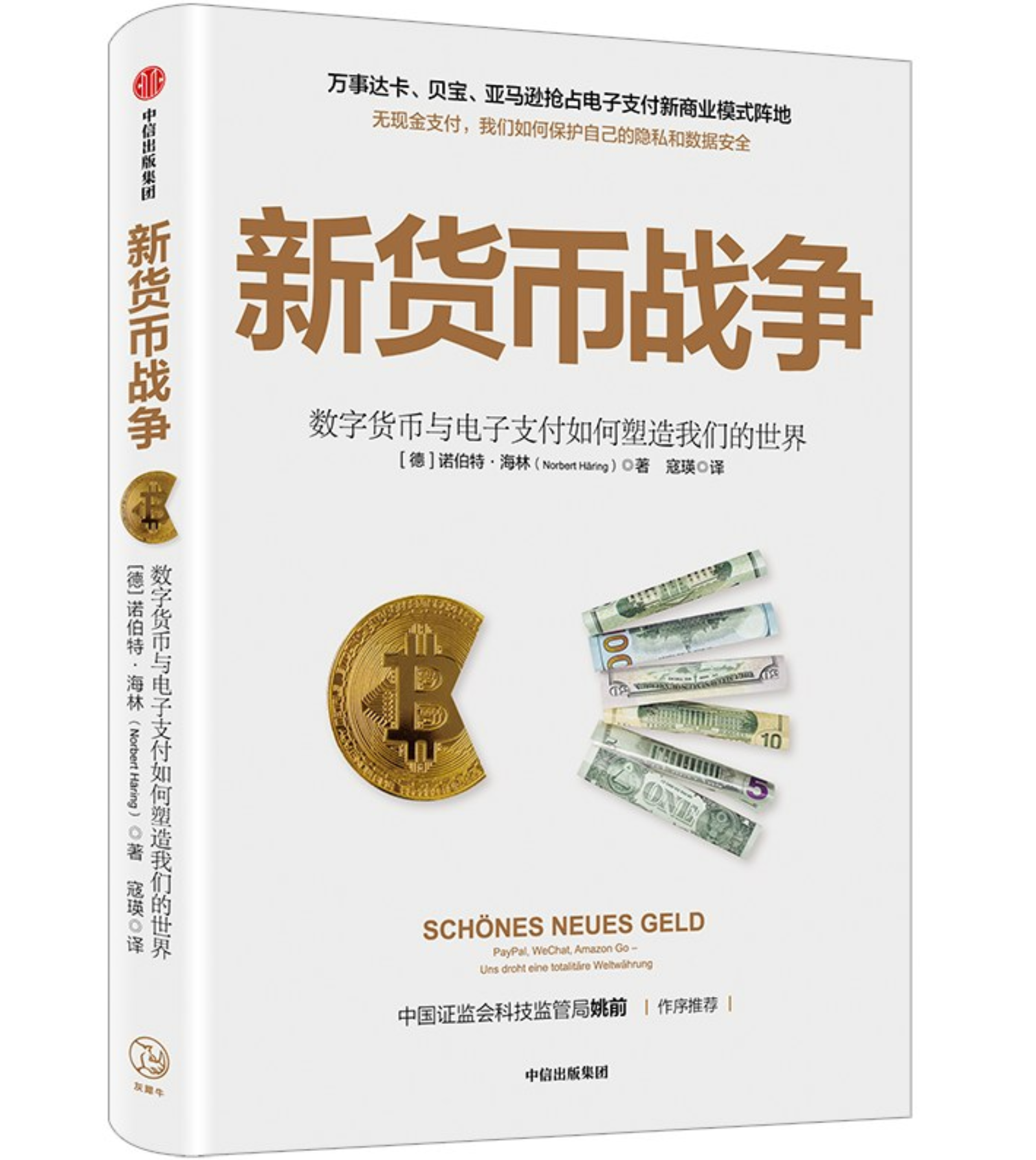
Seeing Zhongxin Publishing Group’s newly translated New Money War, it is easy to think of Currency War, which was once popular in China.
Currency War has long been controversial; critics believe that it uses specious theories to promote unfounded conspiracy theories. This new work by the German economist also reads with a bit of a “conspiracy theory” flavor. Norbert Häring argues that the “cashless” movement jointly promoted by MasterCard, Visa, Paypal, eBay, Facebook, the Gates Foundation, and other institutions, while ostensibly flying the banner of inclusive finance, is in fact hiding a conspiracy, and will ultimately harm the interests of the poor by widely collecting personal information.
Of course, Norbert Häring actually has nothing to do with Song Hongbing. The original title of this book is Schönes neues Geld, clearly corresponding to Huxley’s dystopian classic Brave New World (Schöne neue Welt). If translated literally, the more precise title would be Beautiful New Money.
At the beginning, Häring quotes a scene from Brave New World, which depicts a seemingly beautiful future world: “Crime has been eradicated because supervision is complete, everyone pays taxes, social fraud is impossible, and irrational self-harm by people is also effectively prevented. For example, people with high blood pressure no longer buy pork shanks; if they do so, they will lose their health insurance.” (p. 24)
Is this really a wonderful world? Most readers who have read Brave New World probably would not agree, because although this world strengthens order and security, what it sacrifices is creativity and fluidity. Everyone’s life is arranged in advance; no one can make mistakes, and no one can achieve breakthroughs or innovation—because innovation and crime are both breaks with the existing order.
A world without order is of course terrifying, but when order becomes too rigid, the world may turn despairing, because people can no longer see the possibility of change.
Häring believes that technological developments in recent decades have made Huxley’s utopia increasingly within reach. The uniform order and universal surveillance demanded by “Brave New World” are being turned into reality through digital technology, and in this process, the digitization of money is the spearhead.
Thus the once terrifying “Brave New World” has become “an attractive future prospect” in “a payment world controlled by Silicon Valley bosses.” (p. 191)
The Silicon Valley bosses claim that they want to eliminate poverty, and the way to do so is “to bring people into the system” (p. 13)—that is what PayPal CEO Dan Schulman said. And Gates suggested that if transactions are not brought into the American system, it will mean that people cannot know “which are known normal transactions that need to be monitored, and which are transactions we want to prevent and therefore need to stop.” (p. 13)
This “system,” and the “system” that delivery riders in China have recently found themselves trapped in, are essentially the same. It presents itself as neutral and scientific, uses the total collection of big data to monitor every move of each user, and plans an “optimal action route” for every user. The difference is that the delivery system is limited to monitoring riders’ activities, whereas a digital payment system can monitor all economic activity.
Delivery platforms believe that their systems will play a role in overall coordination and optimization, promptly punishing the petty opportunism of individual riders and ultimately ensuring that every rider gets the best possible return. The promoters of digital payment systems likewise believe that this cashless digital payment system will punish all tax evasion and fraud, and ultimately allow every lower-tier user to enjoy the protection of “inclusive finance.”
But Häring is deeply wary of this vision, because once everyone is swept into the system, whatever the outcome, there is at least one basic trend: it is easy to fall into the system, but hard to get out of it. With the help of ever-changing digital technology, this “system” does indeed possess the characteristics of coordination and high efficiency, and thus can easily establish a dominant position. Once this system has been effectively built, those who resist will be rapidly marginalized. In the end, consumers, riders, and merchants are left choosing only between this system (Meituan) and that system (Ele.me), and it becomes increasingly difficult to step outside the framework. The future of digital payments may at most be a choice between Amazon and Facebook, but however you choose, you still cannot escape the total coverage of the “system.”
“Inclusive finance” claims it can benefit honest poor people, enabling them to save and borrow in more convenient and efficient ways. This is true, just as delivery platforms really can allow riders to receive more orders, faster and in greater numbers. But what is the price? The price is that, in order to enjoy this convenience, poor people must accept and join the entire system, becoming yet another screw in the machine that keeps the system running. The result is that an already established financial order is continually reinforced, and the poor at the bottom of the pyramid become even less willing than the rich at the top to break this entrenched order—because once the order is broken, the livelihood on which they depend will be threatened.
The maintenance of an entrenched order is of course beneficial to the vested interests at the top of the pyramid. Even if poor people are given investment opportunities exactly the same as those of the rich, in this financial world where money makes money and interest compounds on interest, the assets of the rich are always easier to multiply or preserve.
Of course, the poor originally had hardly any opportunity at all to invest or borrow. Now the rich, through so-called inclusive finance, charitably grant the poor more financial opportunities. But these financial instruments that make the rich ever richer cannot turn the poor into rich people themselves. On the contrary, they become a kind of hypnotic potion for the poor, making them willingly join this vast system that sustains the existing order, and willingly allow the system to extract their labor in the most scientific and efficient way.
Häring believes those “philanthropists” have gotten the causality of poverty wrong. In fact, the poor are obviously poor first, and therefore seldom use financial tools such as savings or loans; it is not, conversely, that they are poor because they do not understand borrowing. In fact, we have already seen that when various digital microloan and small-loan products centered on P2P lending rose to prominence, they did indeed allow many poor people to enjoy the pleasure of “consuming in advance.” But so what? Apart from plunging more people into the predicament of consumerism, they have not produced all that many new rich people.
The digitization of money really does make borrowing and spending easier; there is no need to wet your fingers to count out stacks of banknotes, but instead you can just click the mouse and instantly complete the “buy, buy, buy” act of consumption. But who is truly the greatest beneficiary of this “convenience”? Clearly it is the super-rich such as Jack Ma and Bezos, who have made a killing by relying on the convenience of digital payments. But have ordinary consumers really benefited? Even if we have benefited too, are the gains of the poor proportionate to the gains of the rich?
Of course, Häring’s argument may be somewhat alarmist, but he does in fact point to certain issues that deserve vigilance. In the era of big data, or rather in an era governed by “systems,” we need to be constantly alert: even if our lives inevitably fall into systems, our minds should at least not be trapped by them. The most basic attitude is this: do not easily believe the honeyed words of the people standing at the top of the system; and, going one step further, no matter how beautiful the coming world looks, if it cuts off our room to get away from it, then we should not be in too much of a hurry to welcome it.
Finally, Häring points to some solutions, and I also remain reserved about his conclusions, but at least on one basic standpoint I agree with his line of thinking—we cannot expect to use technology to solve technological problems, just as we cannot expect Meituan to rescue Ele.me’s riders. To step out of the predicament, we need to transcend the technical rationality that takes efficiency and data as its standards of measurement, no longer focusing on objective and cold data, but on living, breathing people who know how to reflect, but who may also make mistakes or act impulsively. To eliminate poverty and build the future, in the end we still have to call for human action and solidarity; we cannot simply hand everything over, once and for all, to the “technical system.”
Translated from the Chinese original with AI assistance. The original text is authoritative.